
AI for Amazon Sellers: What Actually Works in 2026 (And What Doesn't)
Artificial intelligence is the most-hyped and most-misapplied technology in the Amazon seller ecosystem right now. Every tool claims to use AI. Most tools use it in ways that produce marginal improvement at best and false confidence at worst. The sellers who are actually extracting competitive advantage from AI in 2026 understand one thing that separates useful AI from hype: Amazon business decisions require Amazon data, and most AI tools have none of it. This guide covers where AI genuinely creates leverage for Amazon sellers and where it falls short.
The Core Problem With Generic AI for Amazon
ChatGPT, Claude, Gemini, and other general-purpose AI tools are trained on vast amounts of text — including a lot of Amazon-adjacent content. They can discuss Amazon strategy competently because they've processed thousands of blog posts, courses, and seller forums. But they have a fundamental limitation for actual business decisions: they have no access to your data.
When you ask ChatGPT "should I reorder my top ASIN now?", it doesn't know your current inventory level, your average daily sales velocity, your supplier lead time, or your Q4 seasonality history. It gives you a framework for thinking about reorder decisions — which is useful once, educational, and quickly becomes worthless for running your actual business. Every session starts from zero, requires you to manually brief the AI on your context, and produces recommendations that are generic by construction.
The gap compounds across every Amazon decision: bid optimization requires campaign-level data, account health requires knowing your current ODR and open violations, listing optimization requires knowing your current conversion rate and keyword ranking position. Generic AI can explain concepts. It cannot make specific decisions. That distinction is where most sellers waste hours and generate false confidence.
Where AI Creates Real Leverage: Listing Optimization
AI is genuinely powerful for listing copy generation and optimization — with the right inputs. Provide an AI tool with your product's features, top competitor reviews (what buyers love and complain about), your target buyer persona, and your primary keywords, and it can generate title and bullet point variations faster than any human copywriter and at comparable quality.
The limitation is that AI-generated copy needs human judgment about Amazon-specific constraints: character limits per field, mobile truncation behavior, Amazon's restricted claims policies (no "cure," "treat," or "prevent" for most products), and category-specific formatting requirements. AI writes the copy faster; a human who knows Amazon's policies and has read the category reviews reviews it.
AI can also accelerate the audit side — feed an AI tool your current listing content and ask it to evaluate keyword density, benefit vs. feature ratio in bullets, and emotional appeal in the title. The output isn't a substitute for A/B testing with real buyer data, but it's a fast first pass that identifies the most obvious gaps.
AI for Account Health and POA Writing
Plan of Action writing is one of the highest-value AI applications in the Amazon seller workflow — if the AI tool is built for it. A generic AI tool can produce a structurally correct POA, but it will be vague in the ways that matter most: the root cause section will be generic, the corrective actions will be forward-looking promises rather than past-tense completions, and the preventive measures will be boilerplate.
Purpose-built POA tools that gather your case-specific information before writing — the specific violation cited, the ASINs affected, your supplier documentation, the timeline of events — produce materially different documents. They can identify whether your situation calls for a performance-based response or a supply chain documentation response, structure the language to match patterns Amazon's reviewers respond to, and flag missing documentation before you submit.
The practical test for any AI POA tool: does it ask you detailed questions about your specific situation, or does it ask you to fill in a few blanks in a template? Templates produce template rejections. Context-aware generation produces reinstatements.
AI for Advertising: Bid Optimization and Campaign Management
Amazon advertising AI tools are the most technically complex category. Real bid optimization requires access to your campaign performance data (impressions, clicks, spend, orders, ACoS by keyword and placement), your target ACoS or TACoS, your inventory position, and your business calendar. Any tool that offers "AI bid optimization" without those inputs is applying static rules, not AI.
The highest-value AI advertising applications are anomaly detection (catching ACoS spikes before they materially impact P&L), search term harvesting (identifying high-converting terms in broad and auto campaigns and migrating them to exact), and dayparting optimization (identifying the hours when your conversion rate is lowest relative to spend and reducing bids in those windows).
Sellers managing $50K+/month in ad spend can typically save 15–25% of that spend through disciplined AI-assisted bid management compared to manual optimization. The savings are primarily from eliminating high-spend/low-conversion placements and keywords that accumulate over time in manually managed campaigns. The AI doesn't replace strategy — it executes it at scale and catches the things human attention misses.
What to Demand From Any Amazon AI Tool
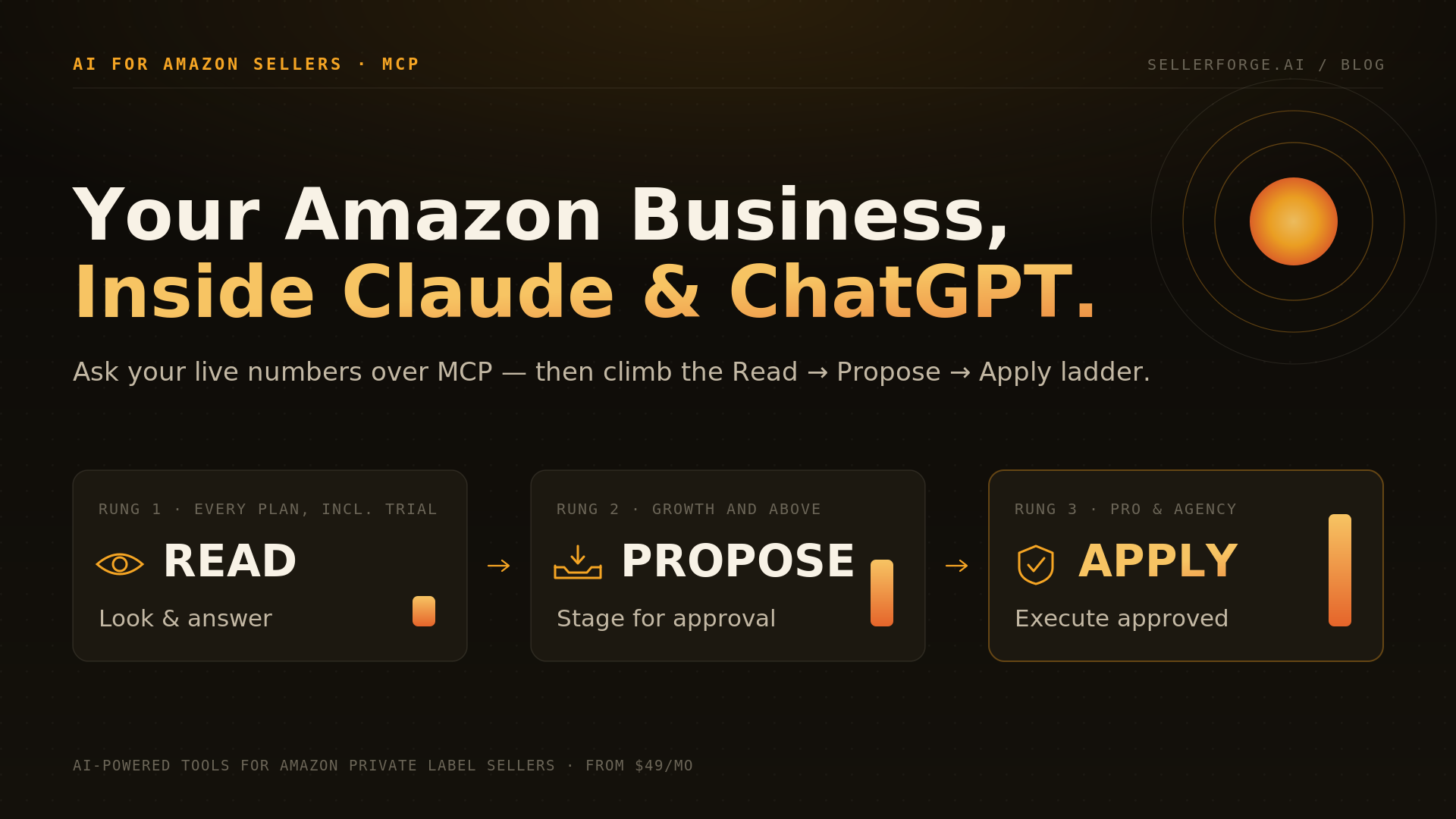
Before paying for an Amazon AI tool, evaluate it against three questions. First: does it connect to your actual Amazon account data via SP-API? If the answer is no — if you have to copy and paste your metrics into the tool — you're using generic AI with extra steps, not purpose-built intelligence.
Second: does it maintain context between sessions, or does every conversation start from zero? A tool that remembers your ASINs, your typical ACoS targets, your account health history, and your seasonal patterns produces compounding value. A tool that resets every session requires you to re-brief it every time.
Third: can it produce specific, actionable outputs — not frameworks, not advice, but actual decisions? "Your ACoS on ASIN B0XXXXXXX in the 'tactical headlamp' campaign has been above your 30% target for 7 days — here are the 3 keywords driving the overage and recommended bid changes" is an AI output. "You should regularly review your campaign performance and adjust bids based on your target ACoS" is a blog post. Know which one you're paying for.
Frequently Asked Questions
6 articles in AI for Amazon Sellers



Stop reading. Start shipping.
SellerForge turns these playbooks into one-click AI workflows — from $49/month.
No credit card required