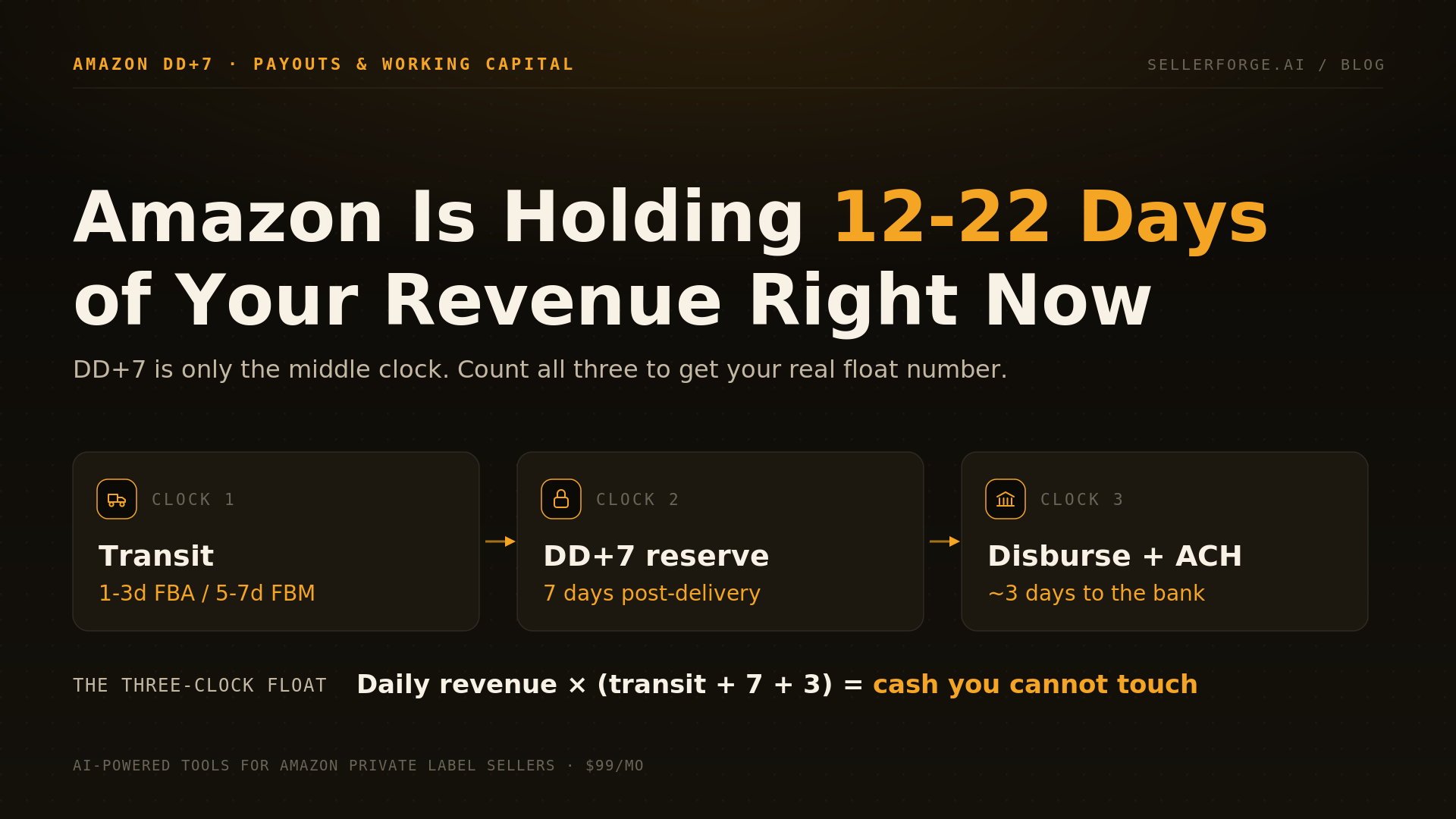
Amazon's DD+7 policy releases order funds seven calendar days after confirmed delivery, but the reserve is only one of three clocks. Add transit time and the disbursement plus ACH lag and a typical FBA seller finances about 12 days of revenue at all times; FBM on standard ground finances 17 to 22. Multiply your daily revenue by that number to get the capital DD+7 permanently removes.
Amazon's DD+7 policy holds the money from every order for seven calendar days after the carrier confirms delivery. But seven is not the number that matters to your bank account. The number that matters is your float: transit time, plus the seven-day reserve, plus the disbursement and ACH lag. For a typical FBA seller that is about 12 days of revenue standing in Amazon's hands at all times. For FBM on standard ground it is 17 to 22. Multiply your daily revenue by that figure and you have the capital DD+7 permanently removes from your business.
The policy — officially Delivery Date Based Reserve, or DDBR — took effect for US and Canadian sellers on March 12, 2026. What almost every write-up gets wrong is who it actually hit. Most accounts worldwide had been on DD+7 terms for years. The March 2026 wave migrated a specific cohort of long-tenured North American sellers off legacy arrangements, and for that group it was not an adjustment, it was a wall.
This guide gives you the arithmetic. You will get a fulfillment-specific float multiplier instead of a one-size-fits-all rule of thumb, a table showing whether your account type was affected at all, the extended reserve Amazon has never documented, and a financing ladder that starts well below the cash-advance rates most sellers reach for first.
What DD+7 Actually Is (And What "DD" Does Not Mean)
DD+7 stands for Delivery Date plus seven days, not Disbursement Date. The official policy name is Delivery Date Based Reserve. When an order ships, Amazon collects the buyer's payment into a deferred transactions pool; the seven-day clock starts only once the carrier confirms delivery, and only then do the funds become eligible for your next disbursement.
Amazon's own example in the migration notice makes the mechanic concrete: sell a product on January 1, have it delivered January 6, and the funds become available for disbursement on January 14. Note what that example quietly includes — five days of transit that Amazon does not count as part of "the seven days," and does not mention in the headline.
For FBA orders Amazon controls the whole chain, so delivery confirmation is reliable and the clock starts predictably 1 to 3 days after the order. For FBM, the clock starts on a third-party carrier scan you do not control. For low-cost items that ship untracked — typically under about $10 — there is no scan at all, so Amazon falls back to the estimated delivery date and runs the same seven days from there.
Did March 12, 2026 Actually Change Anything for You?
Probably not, unless your account is old. DD+7 has been the global standard for most sellers since roughly 2016, and European accounts finished migrating in September 2025. The March 2026 North American wave targeted the last holdouts: legacy zero-reserve, shipment-date-reserve, and daily-payout accounts, generally established before about 2011. If you opened your account in the last decade, this was a headline, not an event.
| Account type | Before March 2026 | After DD+7 | Actual impact |
|---|---|---|---|
| Zero-reserve legacy (pre-~2011) | No reserve; funds available at shipment, transfer on demand | Full DD+7 reserve applies | Severe — 0 to 12+ days added, no opt-out |
| Shipment-date reserve (legacy FBM) | Released on ship date; transit not counted | Delivery confirmation + 7 days | Severe — full transit now stacked on top |
| Daily disburse-on-demand (legacy) | All recently cleared funds available daily | Button remains, but only DD+7-cleared funds qualify | Severe — feature intact, pool gutted |
| Standard bi-weekly (newer FBA/FBM) | Already on DD+7 | Already on DD+7 | None |
| Individual (non-professional) | 7 days from estimated delivery date | 7 days from confirmed delivery | Minor — shifts only untracked orders |
The disburse-on-demand story is the one to understand, because it is where sellers lost the most and Amazon technically changed nothing. The button still exists. But it now draws only from funds that have cleared the seven-day reserve, so legacy sellers who hit it on migration day found single-digit dollar amounts available on accounts turning thousands a day. Nothing was removed; the pool behind it simply emptied.
It is worth knowing that Europe got a pause and North America did not. The EU rollout was halted in 2023 after UK seller backlash and pressure from government ministers, then resumed in September 2025. The US migration ran straight through, framed by Amazon as standardization in line with worldwide settings.
The Three-Clock Float: The Number Amazon Does Not Quote
Your float is not seven days. It is three clocks running in sequence: transit until delivery is confirmed, then the seven-day reserve, then the disbursement cycle plus ACH settlement into your bank. Amazon publicizes the middle clock only. Add all three and multiply by daily revenue and you have the standing balance you are financing on Amazon's behalf, permanently, at every moment your business operates.
The Three-Clock Float: Standing capital = average daily revenue × (transit days + 7 reserve days + ~3 ACH days). Count all three clocks. The one Amazon names is the only one that is the same for everybody.
This is where most published guidance goes wrong in both directions. The lender blogs quote a bare ×7 multiplier, which understates the real hold by nearly half. Earlier versions of this guide used a flat ×14 for everyone, which overstated it for FBA sellers and understated it badly for FBM. The multiplier is not universal — it depends on how you fulfill.
| Fulfillment method | Typical transit | Float multiplier | What drives the variance |
|---|---|---|---|
| FBA (Prime) | 1–3 days | ≈12 days | Amazon controls the scan; most predictable |
| FBM standard ground | 5–7 days | ≈17 days | Carrier scan timing you do not control |
| FBM economy / slower carriers | 8–10 days | 20–22 days | Every transit day is a financed day |
| FBM untracked (under ~$10) | EDD assumed | ≈14 days | Predictable, but A-to-Z clawback risk after release |
Run those multipliers against real revenue and the standing requirement stops being abstract. The FBA and FBM columns below are DD+7 float alone — before your Account Level Reserve, and before a dollar of inventory capital.
| Annual revenue | Daily revenue | FBA float (×12) | FBM float (×17) |
|---|---|---|---|
| $250,000 | $685 | ~$8,200 | ~$11,600 |
| $500,000 | $1,370 | ~$16,400 | ~$23,300 |
| $1,000,000 | $2,740 | ~$32,900 | ~$46,600 |
| $2,500,000 | $6,850 | ~$82,200 | ~$116,400 |
| $5,000,000 | $13,700 | ~$164,400 | ~$232,900 |
| $10,000,000 | $27,400 | ~$328,800 | ~$465,700 |
And the requirement is seasonal, not flat, which is the trap in every static table including this one. ChannelX documented one retailer modeling DD+7 against their 2025 trading figures: the policy required permanently financing an extra £20,000 in March, rising to roughly £50,000 during December peak. Your float grows with your revenue curve, so it peaks precisely when your inventory commitments peak.
In twelve years of running Amazon accounts — 57 of them at Worldfront, across more than $350M in sales — the businesses that broke on payout changes were never the ones with thin margins. They were the ones carrying a float number they had never actually calculated, discovering it during Q4 when the gap was at its widest and inventory deposits were already committed.
- 1Pull your last 90 days of ordered product sales from Seller Central and divide by 90 to get true average daily revenue — do not use a good month.
- 2Pick your float multiplier from the table above based on how you actually fulfill; if you run both FBA and FBM, weight it by revenue share.
- 3Multiply the two. That is your DD+7 standing float — capital you will never see again while you sell at this volume.
- 4Open Payments → Summary and read your current Account Level Reserve, then add it. That total is your real locked balance.
- 5Compare that total against your bank balance today. If the float exceeds your cash, you are already financing Amazon with supplier terms or a credit line, whether or not you meant to.
- 6Rebuild your 13-week cash forecast so every projected disbursement derives from sales 12 to 22 days earlier, not 7 — treat the lag as a fixed offset, never a variable.
This calculation matters most heading into the holidays, when purchase orders are largest and the payout lag is longest. The Q4 2026 inventory and cash-flow plan runs the same working-capital math against Amazon's Holiday 2026 deadlines.
DD+7 and the Account Level Reserve Are Additive, Not the Same Thing
These are two separate holds that run simultaneously and stack. DD+7 is an order-level timing rule applied uniformly. The Account Level Reserve is a dynamic account-wide hold covering Amazon's estimate of future returns, refunds, and A-to-Z claims — typically 7 to 14 days of recent sales, varying with your return rate and account health. A seller carrying a 10-day reserve alongside DD+7 has roughly 17 to 20 days of rolling sales held at once.
They also appear in different places in Seller Central, which is why sellers keep double-counting or missing one entirely. Deferred transactions — your DD+7 holds — live under Payments → Transaction View with the filter set to "Deferred," showing each order and its expected clear date. The Account Level Reserve sits under Payments → Summary. The combined figure shows as Unavailable Balance.
The Extended Reserve Amazon Never Documented
If funds are still held after the seven days have clearly elapsed, you may be in an undisclosed extended reserve. Sellers who escalated through three levels of Seller Support in 2026 were told Amazon operates a "Delivery Date Based Reserve Policy that goes beyond DD+7" — with no published documentation, no stated criteria, no duration, and no appeals process. One documented order was scheduled for release at DD+24.
That case involved an account with no health issues, no chargebacks, and no open disputes, which is what makes it worth planning around rather than dismissing. There is no way to check whether you are subject to it in advance. You find out when money that should have cleared does not.
Practical rule: audit your deferred transactions weekly, not monthly. Any order showing an expected release date more than 7 days past confirmed delivery is your signal — open a Seller Support case immediately and reference the extended reserve by name, because first-level support will otherwise quote the standard DD+7 policy back at you.
The same weekly audit catches the other silent FBM drain: orders that never received a delivery scan at all. Amazon's fallback to the estimated delivery date is supposed to be automatic, and often is not. Any FBM order more than 10 days old without delivery confirmation deserves a case opened rather than patience.
Financing the Float Without Paying 24% for It
The default seller reaction to DD+7 is a cash advance, and it is usually the most expensive option on the board. Services like Payability and Storfund advance about 80% of pending Amazon revenue for 1 to 2% of gross — roughly a 12 to 24% APR equivalent. Amazon Lending, in the same Seller Central account, frequently prices dramatically lower. Work the ladder from cheapest to most expensive.
| Option | What it does | Typical cost | When it is the right call |
|---|---|---|---|
| Supplier terms (Net 30–60) | Moves your payables to match Amazon’s receivables | Free, or 3–5% forfeited early-pay discount | First move, always. Longest-tenured suppliers first. |
| Faster inventory turns | Shrinks the total cash cycle the float sits inside | Liquidation losses on slow SKUs | Any SKU over 90 days of supply that is not seasonal |
| Amazon Lending (Slope) | Revolving line drawn in Seller Central, lines up to $5M | APRs from 8.99%, soft credit pull, no personal guaranty required | Structural float financing at growth stage |
| Express Payout | Compresses the ACH leg only, 3–5 days to ~24 hours | Eligibility-gated; US bank account | Worth enabling, but it removes the last clock, not the middle one |
| Cash advance (Payability, Storfund) | Advances ~80% of pending revenue | 1–2% of gross ≈ 12–24% APR equivalent | Bridge only, after everything above is exhausted |
The other half of this is pricing the float in rather than financing it. Money locked in reserve has an opportunity cost, and at a $1M run rate that is roughly $33,000 of FBA float carrying whatever your capital would otherwise earn. If your alternative use returns 15%, the implicit cost is about $4,900 a year — real money, and in most categories a 2 to 3% price adjustment absorbs it without measurable conversion loss.
Four Mistakes That Turn a Cash Problem Into an Account Problem
The most expensive DD+7 outcomes are not the cash gaps themselves — they are the account health damage that follows a panicked response to one. Riverbend Consulting documented the cascade directly during the migration: cash shortage leads to skipped restocks and late shipments, late shipments and cancellations spike refunds and A-to-Z claims, and Amazon's automated systems read that pattern as operational neglect, not liquidity. A financial problem becomes an integrity review.
- Cutting ad spend reactively. Slashing campaigns collapses sales velocity, which shrinks the funds clearing DD+7 two weeks later — the squeeze tightens exactly when you were trying to loosen it. Shift budget toward profitable campaigns instead of cutting.
- Trying to speed up payouts through workarounds. Switching bank accounts mid-cycle, manipulating disbursement requests, or processing refunds to shift cash all trip compliance systems and can trigger the review you were trying to avoid.
- Opening a second account to escape the hold. This violates the multiple-accounts policy in its clearest form and is the fastest route from a cash flow problem to a deactivation.
- Treating DD+7 as temporary. Amazon’s "one-time cash flow impact" language described the migration window, not the steady state. The float is now a permanent line item.
One quiet discipline prevents most of this: buy inventory against your bank balance, never against your Seller Central dashboard balance. Those two numbers diverged permanently in March 2026, and every seller I have watched get into trouble since was still mentally reading the dashboard.
The Bottom Line
DD+7 is not being reversed. Amazon framed it as standardization with worldwide policy, the legacy arrangements are gone, and no opt-out was ever offered. What is left is arithmetic: know your multiplier, know your float, know your reserve, and treat all three as fixed operating inputs rather than a policy to be angry about.
About the author
David Gallo is the founder of SellerForge.AI. Before building it, he managed 57 Amazon seller accounts representing more than $350M in sales at Worldfront, where he modeled payout timing for sellers who could not afford to guess. He writes the SellerForge blog for operators, not affiliates.