
Amazon Seller Industry News: Fee Changes, Tariffs, and What's Shaping the Market in 2026
The external environment for Amazon sellers has shifted more dramatically in the past 24 months than in the previous five years combined. FBA fee restructuring, new tariff regimes on Chinese imports, supply chain disruption from geopolitical events, and Amazon's own policy evolution are all changing the economics of private label selling in real time. Sellers who understand these forces — and adapt proactively — protect their margins. Those who react late absorb the full cost. This guide covers the major industry forces shaping the Amazon seller landscape in 2026.
Amazon FBA Fee Changes: What's Changed and What It Costs You
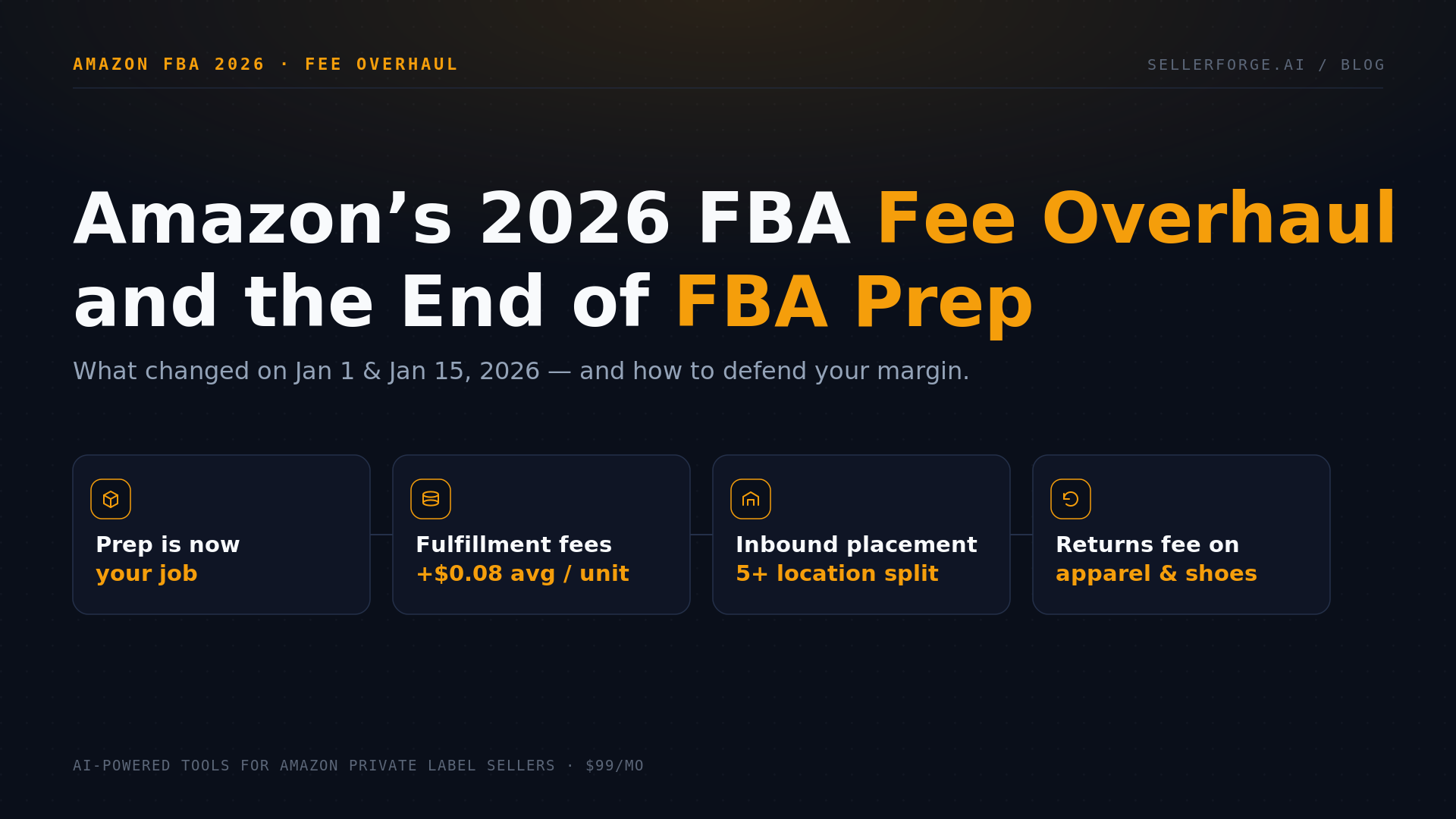
Amazon has restructured its FBA fee model significantly since 2023. The most material changes: the introduction of inbound placement fees (replacing free inbound distribution with a per-unit charge for certain placement options), fee adjustments tied to product size tiers, and the introduction of the low-inventory-level fee, which charges per unit shipped when both a product's 30-day and 90-day historical days of supply fall below 28 days.
For a typical private label seller the increases arrive in layers rather than one jump: the January 15, 2026 fulfillment update averaged about +$0.08 per unit, the 3.5% fuel and logistics surcharge since April 17, 2026 adds 3.5% of every fulfillment fee (about $0.15 on a $4.20 fee), and placement and low-inventory fees depend on how each SKU is shipped and stocked. On thin-margin products those layers still add up to real margin erosion before accounting for increased PPC costs. Sellers who didn't reprice or renegotiate COGS in response have seen real margin compression.
The practical response to fee increases is a four-step analysis: model the fee impact on your unit economics (not just at current prices, but at elasticity-adjusted price points), identify which ASINs have pricing power to absorb fees vs. which need COGS renegotiation, review your product dimensions to identify items that could move down a size tier with minor packaging changes, and model whether MCF (Multi-Channel Fulfillment) or self-fulfillment is now competitive for your slowest-moving SKUs.
Tariffs on Chinese Imports: The 2026 Landscape
US tariffs on Chinese goods have remained elevated since 2018 and have been restructured multiple times since. As of 2026, private label sellers sourcing from China are generally facing effective tariff rates of 25–145% depending on the product category and HTS code, on top of the Section 301 tariffs that have been in place since the initial trade war.
The Section 321 de minimis exemption — which allowed shipments under $800 to enter the US without tariff — was significantly restricted for Chinese-origin goods starting in 2025. This closed the direct-to-consumer shipping loophole that allowed some sellers to avoid tariff liability on FBM inventory. Sellers still relying on de minimis for cost modeling need to update their landed cost calculations.
Sellers in categories with the highest effective tariff rates — electronics accessories, tools, certain textiles — are facing the most acute margin pressure. The most effective responses observed in 2026: first-sale valuation for imports (using factory price rather than FOB price as the dutiable value, where eligible), HTS code re-classification with a licensed customs broker, shifting production to Vietnam, Mexico, or India for applicable product types, and applying for Section 301 exclusions where available.
Supply Chain Diversification: Where Sellers Are Moving Production
The combination of tariffs, China+1 risk mitigation, and rising Chinese manufacturing costs has accelerated supply chain diversification for private label sellers with sufficient volume. Vietnam and India are the most common alternatives for sellers who have successfully moved manufacturing out of China — Vietnam for electronics, hardware, and textiles; India for apparel, home goods, and certain personal care categories.
The practical barriers to supply chain migration are higher than most sellers expect. Finding a manufacturer with equivalent quality and production capacity requires significant lead time (6–18 months for a full transition), tooling costs need to be rebuilt, and QC processes need to be re-established. Many sellers who attempted rapid transitions in 2023–2024 returned to Chinese manufacturing because alternative suppliers couldn't meet quality specifications at scale.
The sellers who have successfully diversified tend to be those who started with pilot orders from alternative manufacturers while maintaining Chinese supply, validated quality over 2–3 production runs, and only shifted primary volume after quality was proven. For sellers doing under $1M in annual revenue, full supply chain migration often doesn't pencil out against the transition cost — the tariff savings don't exceed the migration investment over a reasonable payback period. For sellers above $3–5M, the math typically shifts in favor of diversification.
Amazon Policy Changes Every Seller Needs to Watch in 2026
Amazon's seller policy landscape continues to evolve in ways that create both compliance burden and competitive opportunity. The major policy vectors to monitor: FBA product restriction expansions (more categories requiring safety documentation, certifications, or regulatory approvals), Brand Registry enforcement escalation (Amazon is increasingly aggressive about MAP enforcement and listing hijacking removal for Brand Registry members), and the evolution of Amazon's AI-generated content policies.
Amazon has begun using AI detection to flag listings with AI-generated content that violates its content policies — specifically, AI-generated claims about product efficacy, safety, or comparative superiority that wouldn't pass a human content review. Sellers who used AI tools to bulk-generate listing content in 2023–2024 may find their listings flagged under updated enforcement in 2026. Audit your AI-generated content against Amazon's current content policies.
The competitive opportunity in policy evolution: sellers who invest in Brand Registry, comply early with documentation requirements, and maintain clean account health records build a structural advantage over competitors who operate in the gray zones. Amazon increasingly rewards verified, compliant sellers with better placement, faster appeal processing, and access to programs (Premium A+, Vine, etc.) that are unavailable to sellers with policy violations.
The DD7 Payment Change and Cash Flow Management
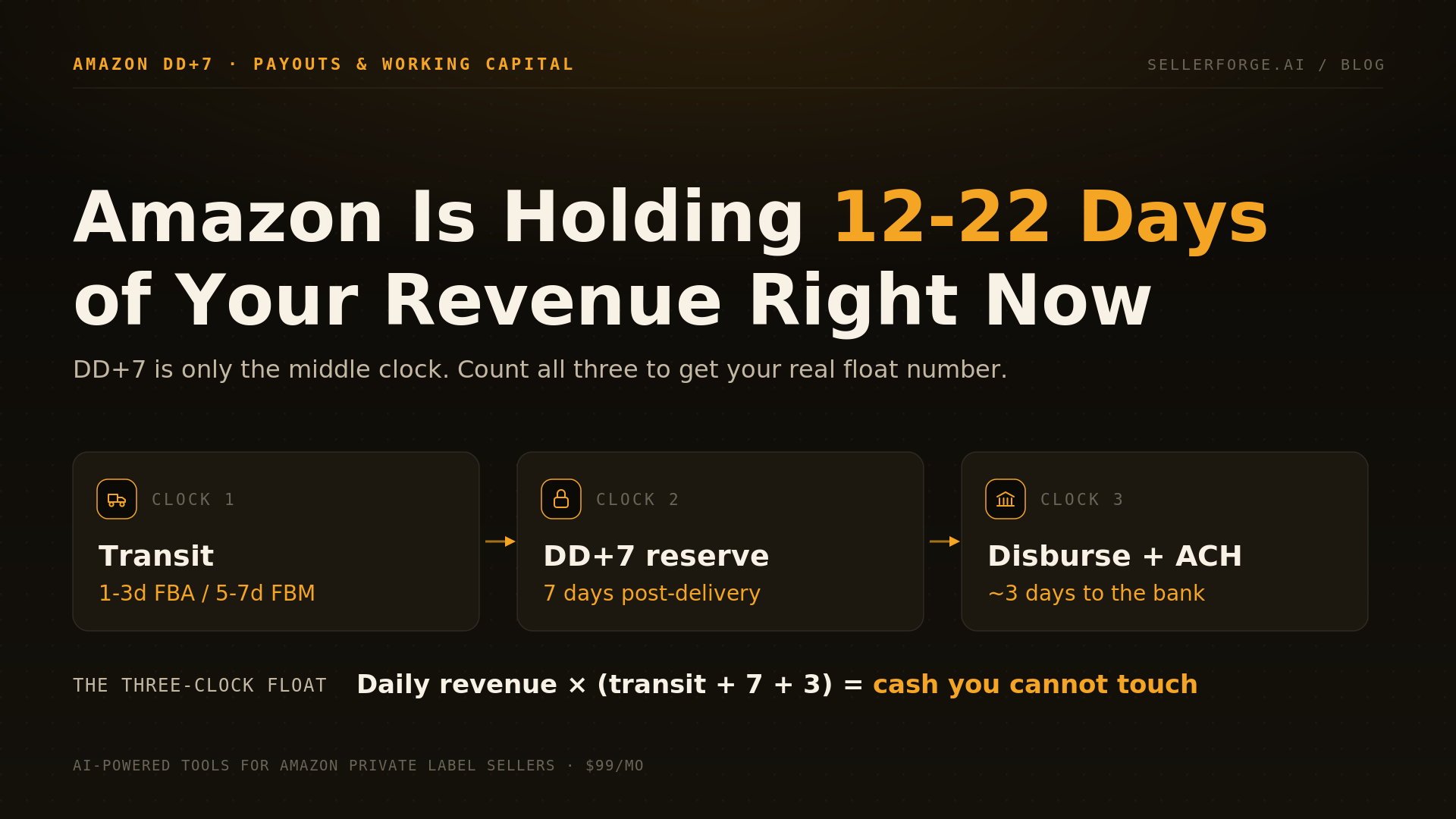
Amazon's shift to a 7-day disbursement cycle (DD7) for established sellers was intended to improve cash flow predictability — and it has, for sellers who previously waited 14 days. But the more significant cash flow issue for most private label sellers isn't the disbursement cycle, it's the gap between inventory investment and revenue realization: manufacturing lead time (45–120 days), ocean freight (25–45 days), Amazon receiving and processing (3–14 days), and sales velocity. The total cycle from COGS outlay to cash receipt can easily be 120–180 days.
Sellers who don't model this cash flow cycle explicitly often discover their working capital is insufficient to support their growth rate. The most common mistake: using a profitable month's cash flow to fund the next inventory order without accounting for the cash tied up in transit and at Amazon. A business doing $1M in annual revenue with a 90-day cash conversion cycle needs approximately $250K in working capital just to sustain current operations, let alone grow.
The practical tools for cash flow management in 2026: inventory financing from Amazon Lending or third-party sellers (Clearco, 8fig, Wayflyer), conservative growth planning that accounts for full cash conversion cycle, and SKU rationalization that eliminates slow-moving inventory that ties up capital without generating adequate returns.
Frequently Asked Questions
18 articles in Industry



Stop reading. Start shipping.
SellerForge turns these playbooks into one-click AI workflows — from $49/month.
No credit card required