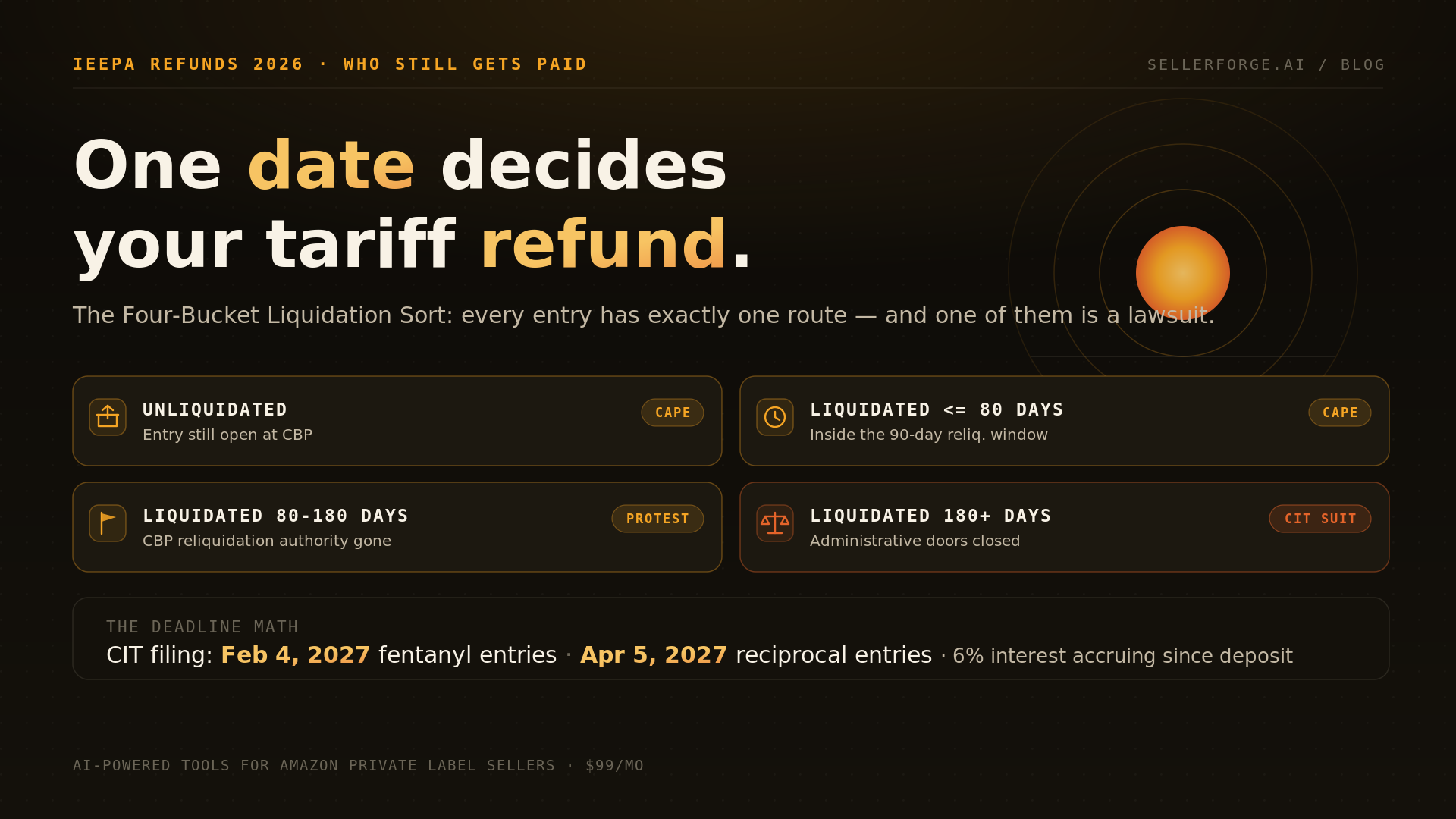
IEEPA tariff refunds are available to the Importer of Record on duties paid from February 4, 2025 (fentanyl tariffs) or April 5, 2025 (reciprocal tariffs) through February 24, 2026, claimed by filing a CAPE declaration in CBP's ACE Portal. The route depends entirely on liquidation status: open entries and those liquidated within 80 days go through CAPE, entries liquidated 80–180 days ago need a protest, and entries past 180 days currently require a suit at the Court of International Trade.
IEEPA tariff refunds are real, they are being paid, and the deciding factor is not how much you imported — it is the liquidation date on each of your customs entries. Entries still open, or liquidated within the last 80 days, are refunded by filing a CAPE declaration in CBP's ACE Portal. Entries liquidated 80 to 180 days ago need a protest. Entries past 180 days currently require a lawsuit at the Court of International Trade. Same duties, same seller, three completely different outcomes.
The April version of this guide told you to call your customs broker and file. That advice is now only half right. On July 15, 2026, CIT Judge Richard Eaton ordered CBP to refund IEEPA duties on a plaintiff's finally liquidated entries, and the court has begun entering the same relief across roughly 3,700 pending cases — while the government's position is that CBP has no authority to reliquidate those entries for anyone who did not sue. Per Holland & Knight's July 27, 2026 alert, non-filers currently have no equivalent confirmed path.
Across the 57 Amazon accounts I managed at Worldfront, duty was the line item sellers understood last and felt first. The ones who will actually collect this money are not those with the biggest import volume — they are the ones who pulled an entry list early, sorted it by liquidation date, and did the one thing each bucket required. This guide is that sort.
What Are the IEEPA Tariff Refunds?
They are refunds of duties collected under tariffs the Supreme Court invalidated. On February 20, 2026 the Court ruled 6–3 in Learning Resources, Inc. v. United States that the International Emergency Economic Powers Act does not authorise the President to impose tariffs of indefinite scope. The orders were revoked, and CBP built a refund system for the money already collected.
The mechanics came in two steps sellers routinely conflate. The Supreme Court decided the tariffs were unlawful; it did not order anyone paid. It was the Court of International Trade, on March 4, 2026, that directed CBP to liquidate and where applicable reliquidate entries without the IEEPA duties — and CBP that built CAPE, the Consolidated Administration and Processing of Entries module inside ACE, to process claims at scale.
The scale is not theoretical. In a status declaration filed August 4, 2026, CBP reported that as of July 31 more than 75,000 CAPE declarations had been submitted, 25.1 million entries had passed validation and been accepted for refund processing, 17.69 million had already been reliquidated without IEEPA duties, and approximately $128.68 billion in potential and certified refunds had been accepted into CAPE. Also in that filing: 5.02 million entries failed validation — roughly one in six — which is the number nobody quotes and every seller should. Figures via BDO's August 11, 2026 importer FAQ.
Update, August 2026: per CBP's August 4 status report, roughly $128.7 billion has entered CAPE for processing and about $100 billion (including statutory interest) has been certified to Treasury for disbursement. The money is flowing — but only to importers who filed. You still have to claim yours.
Where the program stands now: Phase 1 (unliquidated + recently liquidated entries) has been paying since spring. Phase 2 launched June 29, 2026 to reconcile corrected entries. Phase 3 covers finally liquidated entries — and on July 17, 2026 the Court of International Trade ordered CBP to reliquidate entries liquidated more than 80 days for importers who filed CIT lawsuits. The government's position is that Phase 3 refunds process only for importers who sued, and its Federal Circuit appeal is still pending — so if you hold older liquidated entries, talk to trade counsel about filing at the CIT before the deadlines: February 4, 2027 for the "fentanyl" IEEPA tariffs (China/Mexico/Canada) and April 5, 2027 for the reciprocal tariffs. See Thompson Hine's summary of the CIT order.
One in six submitted entries failed CBP validation. A declaration is not a refund. Budget a second pass for the entries that bounce, and do not spend the money until the ACH lands.
Which Tariffs Are Refundable — and Which Are Not
Only duties imposed under IEEPA authority are refundable: the fentanyl and trafficking tariffs from February 4, 2025, the reciprocal tariffs from April 5, 2025, and the Venezuela, Brazil, and Russia/India actions — all through February 24, 2026. Everything else on your entry summary, including Section 301 and Section 232, stays exactly where it is.
The April version of this post got one thing importantly wrong and it is worth correcting plainly: the reciprocal program was never a flat 35% blanket rate. It was a 10% baseline under Executive Order 14257 effective April 5, 2025, with country-specific rates stacked on top running as high as 50% for 57 trading partners. The 35% figure belongs to the Canada fentanyl tariff from August 1, 2025 — a separate program that is also refundable, and which the original guide left out entirely.
| Program | Refundable? | What it covers | Status now |
|---|---|---|---|
| IEEPA "fentanyl" / trafficking (Feb 4, 2025+) | Yes | Canada and Mexico 25%, China 10% then 20%, Canada 35% from Aug 1, 2025 | Refundable through Feb 24, 2026 |
| IEEPA reciprocal (EO 14257, Apr 5, 2025+) | Yes | 10% baseline plus country rates up to 50% on 57 partners | Refundable through Feb 24, 2026 |
| IEEPA Venezuela / Brazil / Russia-India | Yes | EO 14245, EO 14323 (+40%), EO 14329 (+25%) | Refundable |
| Section 301 (China) | No | Original trade-war rates on Chinese goods | In force; forced-labor tariffs added Jul 24, 2026 |
| Section 232 | No | Steel, aluminum, copper at 50% / 25% / 15%; autos; pharmaceuticals | In force and expanding |
| Section 122 global 10% surcharge | No | Replaced the IEEPA tariffs from Feb 24, 2026 | Expired Jul 24, 2026 at its 150-day limit |
| MFN duty, AD/CVD, Section 201 | No | Ordinary rates, trade-remedy duties, safeguards | Unaffected |
One CAPE mechanic follows from that table and catches people out. When a claim processes, ACE recalculates the ordinary duty and every other trade remedy on the entry. You are refunded the IEEPA slice, not the duty line: a Chinese shipment carrying Section 301 plus a 20% IEEPA fentanyl duty gets back the 20 points and keeps the rest.
The Four-Bucket Liquidation Sort
Sort every 2025–2026 entry into one of four buckets by liquidation status, because each bucket has exactly one route and mixing them wastes the only thing that is actually scarce here — time. Unliquidated and recently liquidated entries go through CAPE. Older liquidated entries go through a protest. Finally liquidated entries currently go through court, or nowhere.
| Bucket | Definition | Your route | What kills it |
|---|---|---|---|
| 1. Unliquidated | CBP has not finalized the entry | CAPE declaration (Phase 1, live since Apr 20, 2026) | Nothing yet — but liquidation starts the clock |
| 2. Liquidated ≤ 80 days | Inside the 90-day reliquidation window under 19 U.S.C. § 1501, less CBP's 10-day buffer | CAPE declaration | Day 81 — the window closes quietly |
| 3. Liquidated 80–180 days | Past CBP's reliquidation authority, inside the protest window | Protest under 19 U.S.C. § 1514, via your broker | Day 181 — permanent bar, no exceptions |
| 4. Liquidated 180+ days ("finally liquidated") | Both administrative doors shut | A suit at the Court of International Trade | Feb 4, 2027 (fentanyl) or Apr 5, 2027 (reciprocal) |
Deadlines: Why This Is Urgent
- Entries liquidated more than 180 days ago: no longer an automatic dead end — the July 17, 2026 CIT order opened a Phase 3 reliquidation path, but (per the government) only for importers who filed CIT lawsuits. Deadlines: Feb 4, 2027 (fentanyl tariffs) / Apr 5, 2027 (reciprocal tariffs).
Bucket 4 is where the story stopped being administrative and became legal. CAPE Phase 1 opened April 20, 2026 for buckets 1 and 2. Phase 2 opened June 29, 2026 for entries flagged for reconciliation. Phase 3, which would cover finally liquidated entries, is the contested one: DOJ has told the CIT that CBP has no statutory authority to reliquidate outside the 90-day window and that Phase 3 programming will be available only to importers who filed an action at the court.
Two proceedings could still change that for everyone else, and neither has resolved: the government appealed the CIT's universal refund order to the Federal Circuit on June 3, 2026, and class certification motions in Freestyle World and V.O.S. Selections were argued at the CIT in August 2026. If a class is certified and survives appeal, non-filers may eventually claim by form rather than lawsuit. Final resolution is not expected before the end of 2026 — which is the whole argument for sorting your entries now.
The Four-Bucket rule: an entry only ever moves in one direction — toward the bucket with fewer options. Every week you wait, some of your bucket-2 entries become bucket-3 entries, and some bucket-3 entries become bucket-4 entries. Nothing ever moves back.
Were You Even the Importer of Record?
Only the Importer of Record who paid the duties, or the customs broker who filed the entries, can claim through CAPE. Not the buyer, not the brand owner, not whoever actually absorbed the cost. The IOR is the entity named on CBP Form 7501, and for Amazon sellers that answer is less obvious than it should be.
| How you imported | Likely IOR | What to do |
|---|---|---|
| Your LLC on the entry, broker filed for you | You | Have your broker file CAPE declarations on your behalf |
| Forwarder or consolidator arranged it "door to door" | Often the forwarder | Ask in writing who was IOR; if it was them, negotiate pass-through or a Form 4811 designation now |
| Amazon's own import or logistics program | Amazon | You are not the claimant; ask Seller Support what they are doing on those entries |
| Supplier shipped DDP with duties "included" | Usually the supplier or their agent | The refund follows the IOR, not the invoice — a contract conversation, not a CBP one |
If someone else was the IOR, there is exactly one CBP-sanctioned mechanism to redirect the money: designate a notify party on CBP Form 4811 in the ACE Portal and include that party's IOR number on each applicable entry summary. The trap is timing — the designation must be in place before the CAPE declaration is submitted, because once an entry goes into CAPE, corrections are no longer accepted and the refund defaults to the IOR. If you are negotiating pass-through with a forwarder, you are also negotiating against their filing calendar.
How Do You Actually File a CAPE Declaration?
You file through CBP's ACE Portal, either directly or through your licensed customs broker, after identifying which of your entries carry IEEPA duty lines. The work is 80% identification and 20% filing. Budget several weeks if you do not already have ACE access, because account registration is the step that quietly blows the schedule.
- 1Confirm ACE Portal access with an Importer sub-account. If you are starting from zero, register now — practitioners report six to eight weeks for a new ACE account, which is longer than most sellers assume.
- 2Enrol in ACH refund. CBP stopped issuing paper checks in February 2026; without ACH on file an approved claim has nowhere to land.
- 3Pull the Entry Summary Detail Report (ES-003) in ACE for every entry from February 2025 forward.
- 4Filter for Chapter 99 tariff lines — HTSUS codes beginning 9903.01 or 9903.02 — refining by country at the eight-digit level. Those lines are the IEEPA duties; anything else on the entry is not refundable here.
- 5Sort the resulting entries into the four buckets by liquidation date. This is the step that determines everything downstream.
- 6File a CAPE declaration for buckets 1 and 2. One declaration can carry up to 9,999 entries; split larger lists across multiple filings. Do not file a Post Summary Correction — CBP rejects PSCs as a route to IEEPA refunds.
- 7File protests for bucket 3 through your broker, and get counsel's read on bucket 4 before the February and April 2027 CIT deadlines.
- 8Track every confirmation number and reconcile refunds against your claim list, because roughly one in six submitted entries fails validation on the first pass.
CBP publishes its program page and phase notices at cbp.gov/trade — IEEPA Duty Refunds, and the U.S. Chamber of Commerce small-business FAQ is the plainest-English walkthrough available. The Chamber has also warned about refund-recovery scams: legitimate brokers charge by the filing or by the hour, so anyone cold-calling to "process your tariff refund" for a percentage is not one. For duty drawback and the forwarder class actions this post does not cover, see our broader Amazon seller tariff refund guide.
What Is the Refund Actually Worth?
The duties themselves plus statutory interest under 19 U.S.C. § 1505(c), which accrues from the day you deposited the estimated duties until the entry liquidates or reliquidates. The rate is the IRS overpayment rate, published quarterly — 6% for corporate overpayments in early 2026 — and across the whole pool roughly $650 million of interest is accruing every month.
That interest clause is why late filers should still file. On duties deposited in mid-2025 and refunded in late 2026, interest alone can add several percent to the recovery. It is also why the refund is not free money: the duty portion reverses a deduction you already took, and the interest is separately taxable. Both land as ordinary income in the year received.
The practical version for an Amazon P&L: a refund that arrives net of tax, months after the inventory it paid for has already sold through, is a cash-flow event and not a margin event. Model it that way. If you do not currently know your landed cost per unit by ASIN, that is the actual gap this episode exposed — our FBA profit margin benchmarks give you the yardstick, and the DD+7 payout and cash-flow guide covers where a lump-sum recovery should land in your working-capital cycle.
Processing runs 60 to 90 days from acceptance absent compliance issues, though clean entries have come back in weeks. Entries carrying AD/CVD, an open protest, an active drawback claim, or incomplete ACE records take longer. Payment is by ACH to the IOR, or to a properly designated notify party.
What Are You Paying Now Instead?
Less than in 2025, but the relief is narrower than headlines suggest. The Section 122 global 10% surcharge that replaced the IEEPA tariffs on February 24, 2026 expired on July 24, 2026 at the 150-day limit in the Trade Act of 1974. What did not go away: Section 301 on Chinese goods, and Section 232, expanding all year.
- Section 232 now reaches steel, aluminium and copper at 50%, 25% or 15% depending on the article, per the April 2, 2026 proclamation, plus autos, parts, and patented pharmaceuticals
- Section 301 forced-labor tariffs became effective July 24, 2026 — the same day Section 122 lapsed, which is not a coincidence
- Section 338 duties on certain Canadian products at an additional 50% take effect August 19, 2026
The strategic read for a private-label seller: the authority changed, the direction of travel did not. Sourcing decisions made on 2024 duty math are stale, and the sellers who handled 2025 best could re-run landed cost per unit inside a day rather than a quarter. That is a validation-and-forecasting muscle, not a customs one — see product validation in 2026 and the FBA capacity, IPI and AWD playbook for the reorder model that absorbs a shock like this, plus our supply-chain disruption guide for the freight half of the same equation.
What to Do This Week
Three tasks, in order, and none of them requires a decision about litigation yet. Get the entry list, sort it by liquidation date, and find out who the IOR was. Everything else — CAPE, protest, counsel — follows mechanically from what that sort tells you.
- 1Email your customs broker today for every entry from February 2025 forward, with the liquidation date and Chapter 99 duty lines shown. One email — the highest-value hour in this whole process.
- 2Sort the list into the four buckets and count the dollars in each. If bucket 4 holds real money, that is your trigger to ask a trade attorney about a protective CIT filing before February 4, 2027.
- 3Confirm in writing, per shipment lane, who was named Importer of Record — and if it was a forwarder, open the pass-through conversation before their CAPE declarations go in, not after.
- 4File a protective protest on any bucket-3 entry approaching day 180. Many importers are doing this purely to preserve rights while the Phase 3 fight resolves.
- 5Keep the entry list, every CAPE confirmation number, and all broker correspondence in one place, and diarise the 60–90 day follow-up per declaration.
That last step is unglamorous and it is where recoveries get lost. If your customs paperwork lives across a broker's inbox, a forwarder's portal and a laptop folder, SellerForge's Document Vault is where our users keep entry summaries and CAPE confirmations alongside the ASINs they belong to, while Custom Breakdowns and Forecasting carry landed cost per unit into the reorder model — so the next duty change shows up in your numbers the same week, not the next quarter. All 14 modules run on your live account data.
The Bottom Line
The IEEPA refund is a one-time recovery on a permanent lesson. Roughly $128.68 billion has been accepted into CAPE and the money is moving — to importers who could produce an entry list and a liquidation date on demand. The question is no longer "did I pay these tariffs" but "which bucket is each entry in, and did I act before it moved."
If you take one thing from this guide, take the sort. Four buckets, one email to your broker, an afternoon of work. The sellers who did that in April are being paid now. The ones still meaning to get to it are watching bucket 2 turn into bucket 3, and bucket 3 turn into a lawsuit.
If you want landed cost, duty exposure, and reorder timing living in one place — so the next policy shock is a number you can see rather than a surprise on a P&L — start a SellerForge trial and connect your account this week.
About the author
David Gallo is the founder of SellerForge.ai. Before building SellerForge, he managed 57 Amazon seller accounts representing over $350M in sales at Worldfront, where duty and landed cost were the line items that decided which SKUs survived a tariff year.