Sellers leave Amazon agencies in 2026 because the retainer — typically $2,500–$5,000/month — now buys work that software does for about $99/month, and because the analytics that justified the fee went free when Amazon opened Marketing Cloud to every sponsored-ads advertiser. Use the Three-Door Test: sort the five jobs an agency does behind Door 1 (agency), Door 2 (software), or Door 3 (you). If fewer than two land behind Door 1, you are renting a report.
Amazon sellers are leaving their agencies in 2026 for one blunt reason: the retainer — typically $2,500–$5,000 a month — now buys work that software does for around $99, and the analytics that justified the fee went free this year when Amazon opened Marketing Cloud to every sponsored-ads advertiser. The decision is not really about AI. It is about which jobs still need a human, and how many of them are left.
That is the part the internet is bad at answering. Search “Amazon agency cost” and every page on the first screen was written by an agency, and every one of them presents the same two options: hire us, or build an expensive in-house team. It is a real choice. It is also not the choice most private label sellers are actually making.
One disclosure up front: SellerForge is our software, and this post ends up recommending a door we happen to sell. So I have tried to make the case against us as carefully as the case for us — there is a full section below on when keeping your agency is the correct call, and I mean it.
What Does an Amazon Agency Actually Cost in 2026?
A full-service Amazon agency costs $2,500–$5,000 per month for brands doing $1M–$20M annually. The full market runs from roughly $1,500/month for basic offshore management to $25,000+/month for enterprise teams. For a $1M–$3M brand, $2,500–$3,000/month is the honest market rate — and four different pricing models can produce that same number.
| Model | Typical 2026 range | Where it bites |
|---|---|---|
| Flat monthly retainer | $1,500 (offshore) → $25,000+ (enterprise); $2,500–$5,000 typical | Your fee is fixed whether they do forty hours or four |
| % of ad spend | 10–20%, usually with a $1,000–$2,500 floor | The agency gets paid more to spend more of your money |
| % of revenue | 3–10% of Amazon sales | Charges you for revenue you would have earned anyway |
| Hybrid (base + performance) | Base $8,000–$15,000 + 5–8% over a threshold | Best alignment on paper; usually only offered above $10M |
Run it against your own P&L rather than against a range. At $3,000/month you are spending $36,000 a year. On $500K of Amazon revenue that is 7.2% of your top line — before COGS, before FBA fees, before ad spend. Set that against a realistic 15–20% net margin and the retainer is not a line item; it is roughly a third of the profit the business generates.
The 5% check: if your agency retainer exceeds roughly 5% of Amazon net revenue and you cannot name three specific decisions they made last month, you are not buying management. You are renting a report.
Then there is the out-of-scope tax. Suspensions, IP complaints, and listing suppressions are usually billed separately — reinstatement services run $300–$700 for a simple case and $1,500–$3,000 for anything complex, with My Amazon Guy publishing tiers at $1,000 and $2,000. That bill arrives on your worst week of the year, on top of the retainer you were already paying for account health monitoring.
For the full tier-by-tier numbers — including hidden fees, contract red flags, and a method for converting any retainer into an implied hourly rate — see our 2026 Amazon agency pricing guide.
Why Are Sellers Leaving in 2026 Specifically?
Because three of the agency model’s four moats collapsed inside eighteen months. Data access, analysis, and reporting are now free or cheap and self-service. What remains is judgment — genuinely valuable, but far harder to sell at $4,000 a month when it is the only thing left in the box.
Moat 1: privileged data access — gone
Moat 2: analysis and reporting — automated
Assembling a client report used to take an account manager two or three hours of exports and slide formatting. Software now drafts it from live data in minutes. That is why the reporting deliverable no longer justifies the fee — and, ironically, why the better agencies are re-pricing around strategy instead. When the artifact you receive each month can be generated for free, the artifact stops being the product.
Moat 3: platform expertise — commoditized
Amazon policy, listing mechanics, and campaign structure are documented, discussed, and now well-modeled by AI. That does not make every seller an expert. It does mean the median agency account manager — often junior, often carrying 30+ accounts — no longer knows meaningfully more than a competent operator with good tooling. An account manager on 30+ accounts is a widely cited industry red flag precisely because the math does not allow for expertise to be applied.
Moat 4: judgment and accountability — still real
A human who has personally lost and recovered accounts, who can read an ambiguous enforcement email and tell you whether it is a template or a warning, who will be on a call at 9pm when a hijacker takes your Buy Box — that is not commoditized and will not be soon. This is the only moat left. It is a good one. It is also, honestly, one job out of five.
The Three-Door Test: Should You Leave Your Agency?
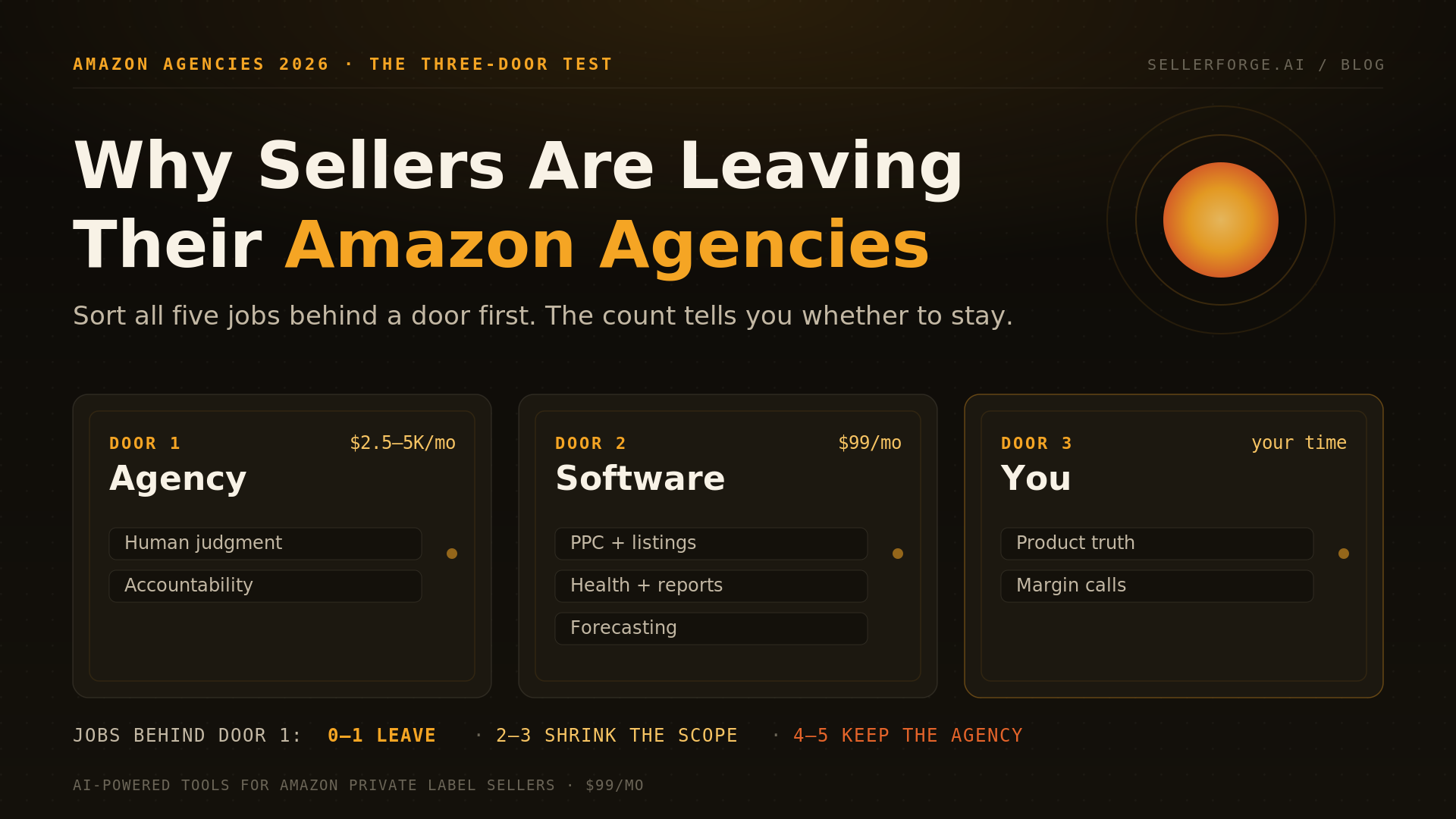
The Three-Door Test replaces the agency-versus-in-house binary with a sorting exercise. Take the five jobs your agency is paid to do and put each one behind exactly one door: Door 1 (needs an agency), Door 2 (software does it), Door 3 (only you can do it). Then count Door 1. The count is the decision — not the retainer, not your feelings about last month.
| The job | Door 1 — agency | Door 2 — software | Door 3 — you |
|---|---|---|---|
| Listing optimization | Only for full brand repositioning | Audits, rewrites, keyword coverage, A+ gap checks | Product truth: what it does, who buys it, why |
| PPC management | Aggressive multi-ASIN scaling with real budget risk | Bid analysis, waste flags, TACoS by SKU, search-term mining | Margin floor: what you will pay for a sale |
| Account health | Ambiguous enforcement, repeat violations, Section 3 | Monitoring, POA drafting, escalation paths | The facts of what actually happened |
| Reporting | Almost never — this is the report you already pay for | Assembly, charts, trends, the weekly pulse | Deciding what the numbers mean for your business |
| Strategy | New marketplace entry, genuine org complexity | Options, benchmarks, scenario math | The bets — pricing, catalog, where the brand goes |
Be strict about Door 1. The question is not “could an agency do this?” — an agency can do all five. The question is “does this job fail without a human who is accountable to me?” Most sellers who run this honestly land on one job behind Door 1: account health. A few land on two. Almost nobody lands on four.
- 0–1 jobs behind Door 1 → leave. You are paying a retainer for software and your own product knowledge.
- 2–3 jobs → shrink the scope. Fire the full-service retainer, hire a specialist for the two jobs that need one, usually per project rather than per month.
- 4–5 jobs → keep the agency. It is doing real work and you should probably pay it more, not less.
The test is deliberately uncomfortable, because the honest failure mode of a full-service retainer is not bad work. It is unexamined scope — five jobs bundled at a price set by the one job that was hard, renewing quietly every year after that job stopped being hard.
When You Should Keep Your Agency
Keep the agency when Door 1 is genuinely crowded: complex or repeated enforcement history, a new marketplace where local expertise is not optional, aggressive scaling across dozens of ASINs with real capital at risk, or an organization where the bottleneck is internal coordination rather than Amazon. In those cases the retainer is cheap. So is a hybrid.
And a fact the AI-replaces-everything crowd skips: the ANA/4As tenure research finds average client–agency relationships running near seven years. Long relationships are not evidence of inertia — they are usually evidence that somebody is doing something hard, well. If your agency has three or four jobs genuinely behind Door 1, this whole post is not about you.
The one thing I would not do is stay out of momentum. Churn data suggests the window between the first warning sign and the termination conversation runs 60–120 days — meaning most sellers spend a full quarter knowing, paying, and not deciding. That quarter costs $7,500–$15,000. Run the test in an afternoon instead.
The agencies worth keeping are usually the ones restructuring around AI rather than billing hours for report assembly; our breakdown of how Amazon agencies scale with AI shows exactly what that restructuring looks like from the inside.
What Sellers Are Actually Doing Instead
They are not going it alone with a spreadsheet. The pattern is a lean stack: software for the analytical and drafting work, their own time for the decisions, and a specialist hired per incident rather than per month. Roughly $99/month plus a few hours a week, against $36,000 a year and a monthly deck.
The switching cost people underrate is rhythm. An agency imposes a cadence — someone looks at the account every week because you are paying them to. Software does not impose anything. Sellers who leave and then drift are not proving the agency was necessary; they are proving that the cadence was the product.
How to Leave Without Wrecking the Account
Leave in this order: build the replacement first, get your data out second, give notice third, revoke access last. The common failure is doing it backwards — sending an angry email on the 1st and then discovering your campaign history lives in an agency spreadsheet you never had access to.
- 1Run the Three-Door Test in writing. If Door 1 has two or more jobs, negotiate scope instead of leaving — you will get a better price for less work.
- 2Stand up the replacement stack and run it in parallel for 30 days while the retainer is still paid. Overlap is cheap; a gap is not.
- 3Request four exports before giving notice: every listing copy version with revision history, the full PPC campaign structure with historical performance, ASIN-level performance for the whole relationship, and every Seller Support case ID they opened for you.
- 4Read the auto-renew and notice clauses before the fee clause. Thirty days is standard; 60–90 is common in enterprise retainers; a demand for 12+ months is a red flag worth arguing about.
- 5Give notice in writing, dated, with the effective end date and the export list attached. Keep it boring — you may want a specialist from this firm on a case later.
- 6On the last day, revoke their Seller Central and Ads console user permissions yourself. Do not assume they did it. Then change any shared credentials.
- 7Take over one workflow at a time in the first month — start wherever the money is, usually PPC waste or a suppressed listing — rather than trying to be a full account manager on day one.
Give it 30 days before judging the switch. Most sellers find they are spending less time on the account than they did managing the agency — the status calls, the report they had to interpret anyway, the chasing. That surprised me the first time I saw it from the seller side, and I had been on the agency side.
The Test That Predicts Everything
Here is the shortcut, from the other side of the desk. At Worldfront I was accountable to the owners of 57 Amazon accounts, and I can tell you which relationships were durable: the ones where the owner could name three specific decisions we had made that month. Not deliverables. Decisions — a bid strategy we changed and why, a listing bet we took, a case we escalated.
If you cannot name three for last month, the problem is not that your agency is bad. It is that you are paying agency prices for software output. That gap closed in 2026, and it is not opening back up.
Running the Three-Door Test? SellerForge covers the Door 2 column — listing audits, ad waste analysis, POAs and escalation plans, and the weekly report — for $99/mo, roughly 3% of a typical retainer. Start a free trial and run it in parallel for 30 days before you give notice. Run an agency instead? The Agency plan ($499/mo) does the same across ten client accounts — see Amazon agency software.
About the author
David Gallo is the founder of SellerForge.ai. Before SellerForge, he ran Worldfront — an Amazon account management firm with 57 active seller accounts and $350M+ in sales managed — which means he has been on both sides of the email this post is about. SellerForge is the software that made most of that retainer unnecessary.