The Amazon M&A market of 2026 looks almost nothing like the market of 2021. Three years ago, more than seventy aggregators were collectively bidding up FBA brands with $16 billion in raised capital and check sizes that often cleared 7x EBITDA. Today, the deal flow is steadier, the buyers are pickier, and the bar for a premium exit is higher — but the quality of exits available to disciplined sellers is arguably the best it has been since the boom began.
This guide covers what you actually need to know: current multiples, who's buying, how to optimize your growth rate, when to list, and the 12-month preparation roadmap that routinely lifts closing prices by $280K–$600K on a $400K SDE business.
The 2026 Amazon Exit Landscape: What Changed
What changed is not demand. Strategic CPG acquirers, private equity rollups, family offices, and a smaller cohort of restructured aggregators are all still actively writing checks. What changed is how rigorously they underwrite. The 2021 thesis — "buy at 5x, scale to 8x, exit to the next aggregator" — collapsed when interest rates rose, consumer behavior normalized, and aggregators discovered that running 200 brands inside a single P&L is operationally brutal. Thrasio's February 2024 Chapter 11 filing, which shed $495 million of debt off a peak $10 billion valuation, was the punctuation mark on that era.
Three structural shifts now define 2026:
- Capital discipline. Aggregators that survived raised debt covenants and shifted to profitable-growth mandates. They will still pay attractive multiples, but only for brands that match a narrow buy-box: diversified SKU mix, defensible IP, predictable earnings, and minimal owner dependency.
- Strategic buyers in the driver's seat. Consumer brands, retailers, and PE-backed platforms have stepped into the gap. Because they buy for strategic fit rather than financial arbitrage, they often pay 5x–6x and occasionally 7x–8x in competitive auctions.
- A premium for "operational maturity." Buyers no longer reward raw growth. They reward growth that survives owner removal. A $1M SDE business with messy ops sells for $2.5M. The same business with documented SOPs, automation, and a non-owner operator can clear $4M–$5M.
Current Multiples: What Amazon Businesses Actually Sell For
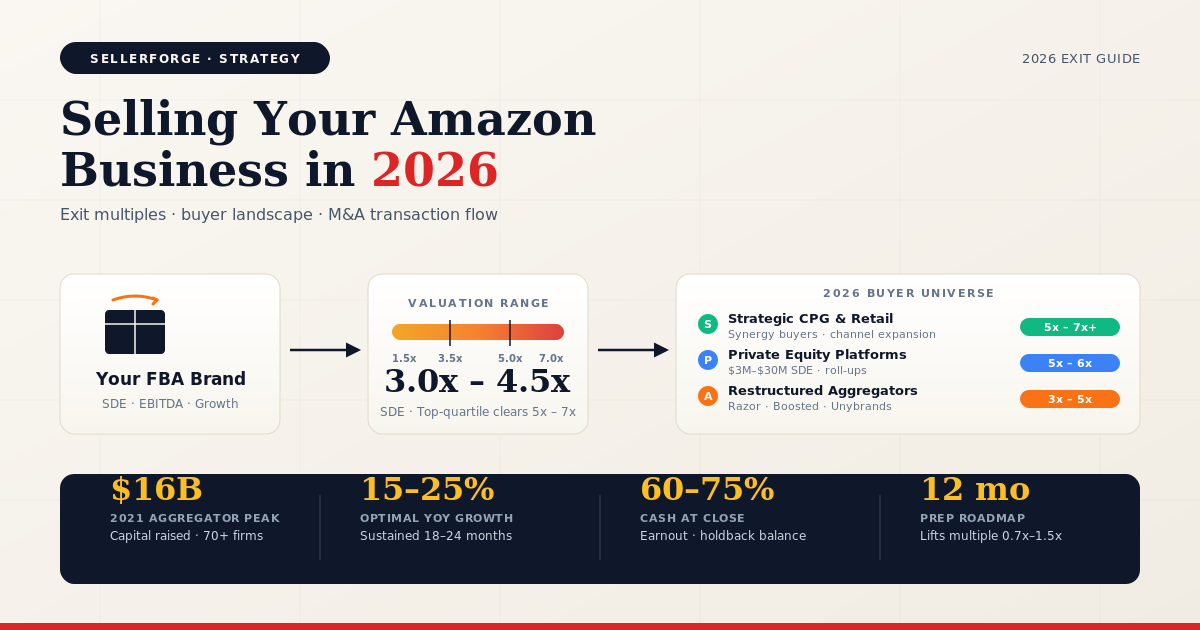
For Amazon FBA businesses in 2026, expect a valuation range of 2.5x to 4.5x annual Seller's Discretionary Earnings (SDE) for the typical owner-operated brand, with top-quartile exits clearing 5x–7x in competitive processes. For larger businesses generating $1M+ in earnings, buyers shift to EBITDA multiples in the 3x–6x range, with strategic buyers reaching 7x–8x for trophy assets.
Empire Flippers reported an average closing multiple of 3.1x across FBA businesses sold on its marketplace in 2024, while Quiet Light Brokerage — which concentrates on the $500K–$30M range — averages 3.5x–4.0x for "clean, evergreen brands." The table below maps the realistic range to the underlying business profile. The honest truth is that the multiple is set by your business's profile before it hits the market, not by negotiation skill on the day of the LOI.
| Multiple Range | Business Profile | Example: $300K SDE | Example: $1.5M EBITDA |
|---|---|---|---|
| 1.5x–2.5x SDE | Heavy owner dependency, declining revenue, single-SKU concentration, no brand registry, commingled finances, recent suspension history | $450K–$750K | n/a |
| 2.5x–3.0x SDE | Some documentation, partial automation, 50%+ revenue in top SKU, stable but unspectacular growth | $750K–$900K | n/a |
| 3.0x–3.5x SDE / 3.0x–3.5x EBITDA | Documented SOPs, automated PPC and inventory, top SKU under 35%, clean P&L, single-digit growth | $900K–$1.05M | $4.5M–$5.25M |
| 3.5x–4.5x SDE / 3.5x–5.0x EBITDA | Fully systemized, diversified across 5+ revenue-meaningful SKUs, registered IP, 15%+ consistent YoY growth, operates without owner | $1.05M–$1.35M | $5.25M–$7.5M |
| 5.0x–7.0x SDE / 5.0x–8.0x EBITDA | Strategic-fit asset: defensible niche, brand recognition off-Amazon, omni-channel revenue, proprietary product features, patent moat, multi-bidder process with PE or strategic acquirer | $1.5M–$2.1M | $7.5M–$12M |
The difference between the bottom and top of this range on the same $300K SDE business is roughly $1.65 million. That gap is not negotiation — it is the financial reward for 12 months of operational preparation.
Who's Buying in 2026: Aggregators, Strategics & PE
The single most important shift for sellers to internalize is that the buyer universe is wider, not narrower, than it was at the aggregator peak. There are now four distinct buyer profiles, each with a different valuation logic and a different ideal target.
Marketplace consolidators (the restructured aggregators). Razor Group, Boosted Commerce, Unybrands, and a smaller cohort of survivors still acquire actively, but with tighter underwriting. Razor acquired Perch in March 2024 and merged with Infinite Commerce in August 2025 to operate over 10,000 SKUs across Amazon, Walmart, Target, and Chewy. Expect aggregator offers in the 3x–5x SDE/EBITDA range with 60–70% cash upfront.
Strategic CPG and consumer brand acquirers. These buyers don't think in financial multiples — they think in synergies. They will pay 5x–7x SDE/EBITDA, sometimes higher, because they can monetize the acquisition through retail expansion, cross-sell to existing customers, and channel leverage that financial buyers cannot.
Private equity platforms. PE-backed e-commerce roll-ups are increasingly active in the $3M–$30M SDE range. They use leverage, so they need cash flow stability and clean financials, but will pay 5x–6x EBITDA, sometimes 7x, for category leaders with 20%+ EBITDA margins.
Individual operators and search funds. For businesses under $1M SDE, the dominant buyer is now a single operator — often a former executive deploying personal capital plus an SBA loan. Multiples land in the 2.5x–3.5x SDE range, but cash-at-close ratios are often higher than what aggregators offer.
The Aggregator Reckoning: From Thrasio to Razor
The aggregator gold rush peaked in 2021, when more than seventy firms collectively raised over $16 billion. Thrasio alone reached a $10 billion valuation after raising $3.4 billion from Silver Lake, Oaktree, and Goldman Sachs Asset Management — and was acquiring approximately one Amazon brand per week.
The model assumed two things that turned out to be false: that the aggregator could centralize operations and capture margin expansion across 200 disparate brands, and that the next round of capital would be available at progressively higher valuations. Neither held. Thrasio entered 2023 with approximately $425 million in excess inventory and more than 200 warehouse leases. On February 28, 2024, the company filed for Chapter 11 protection, emerging in June 2024 having shed $495 million in debt.
Thrasio was not alone. Benitago filed for bankruptcy in August 2023 — just two years after raising $325 million. Funding into the category cratered from over $10 billion in 2021 to under $100 million by 2023.
The lesson sellers should take: aggregator economics no longer support inflated multiples. Where 2021 aggregators paid 5x–7x routinely for ordinary brands, today's surviving aggregators are disciplined to 3x–5x and demand operational quality that lets them integrate efficiently. The 2021 FOMO thesis is permanently retired.
The Optimal Growth Rate for Maximizing Exit Value
The most common question Amazon sellers ask when planning an exit: what's the right growth rate to target? Push too hard and margins compress, hurting the multiple. Coast too gently and buyers see a flat business and discount. The answer is more specific than most sellers realize.
The empirical sweet spot is 15% to 25% trailing twelve-month revenue growth, sustained for at least the most recent 12 months and ideally 18–24 months. Growth in this band signals three things buyers care deeply about: the brand is still in demand, the operator is competent, and the trajectory is repeatable rather than spiky.
| Trailing 12-Month Growth | Buyer Perception | Multiple Impact (vs. flat baseline) |
|---|---|---|
| Negative (declining) | High risk, often deal-pause | −0.5x to −1.5x |
| 0–5% (flat) | Mature, low risk, but no upside story | Baseline |
| 5–15% (moderate) | Healthy, well-run, predictable | +0.1x to +0.3x |
| 15–25% (sweet spot) | Premium: real demand + sustainability | +0.3x to +0.6x |
| 25–40% (hypergrowth) | Exciting but flagged for sustainability + working capital | +0.1x to +0.4x (often discounted) |
| 40%+ (explosive) | Treated as one-time event or paid growth | Heavy underwriting scrutiny; often discounted |
A more nuanced point: consistency beats magnitude. A business growing 18% YoY for three consecutive years will receive a higher multiple than a business that grew 8%, then 35%, then 14%. Buyers underwrite predictability, and predictability is a stochastic property — the variance of your growth rate matters as much as its level. Smooth your earnings before you list: don't run a Q4 ad blitz that will make Q1 look like a cliff, and don't time inventory purchases to dump expense into a single month.
When Is the Right Time to Sell?
Timing an Amazon business exit comes down to three overlapping questions: where is the business in its growth curve, where is the market in its M&A cycle, and where is the seller personally? The best exits align all three.
The classic answer: sell before the peak. Conventional wisdom says to sell on the way up, not at the top — because buyers underwrite forward, and a flat trailing-twelve-month always projects worse than an upward trend. The right time to sell, for most owner-operators, is after 18–24 months of consistent 15–25% growth, with the trajectory clearly intact for the next 6–12 months.
The "large and stagnant" case is more nuanced. If your business has plateaued at significant size — say $5M+ revenue with $1M+ EBITDA — flatness is not automatically a problem. Strategic buyers will pay premium multiples for mature, profitable, defensible brands because they can grow them through channel expansion (retail, international Amazon marketplaces, DTC) that you don't have time or expertise to execute. The key is having a clear, credible "next chapter" thesis the buyer can underwrite.
Sell when you're emotionally ready to stop running the business. Due diligence and earnouts typically extend the seller's involvement 6–24 months past the LOI. If you've already mentally checked out, that period will torpedo the deal. Sellers in true peak performance, fully engaged in the business, get the best outcomes.
The brutal rule of thumb: if you've thought "I should probably sell this" for more than two consecutive quarters and have not started preparing, you've already cost yourself money. Exit prep takes 6–12 months. Sellers who decide to exit and list within 60 days almost always leave 25%+ of value on the table.
The Eight Valuation Drivers Buyers Actually Pay For
Every buyer — aggregator, strategic, PE, individual — underwrites the same eight factors. The relative weighting varies, but the list is remarkably consistent. The further you can move each factor before listing, the higher the closing multiple.
1. Owner independence. The single biggest determinant of the multiple. Buyers will pay 0.5x–1.0x more for a business that can operate profitably for 30 days without the founder. Document SOPs, automate operational tasks, hire a VA or operations manager, and demonstrate at least 90 days of operation under the new model before listing.
2. Revenue concentration. No single SKU should represent more than 25–30% of revenue. Sellers who built on a single ASIN face the steepest discounts. Diversifying takes 6–12 months; start before you decide to list, not after.
3. Margin profile. Gross margins of 35%+ and net margins of 20–30% are the buyer-friendly range. Below 15% net, buyers worry about Amazon fee increases and tariff exposure. Above 40%, buyers worry the price points are unsustainable and competitors will arrive.
4. Brand and IP defensibility. Registered trademarks across all selling marketplaces, Brand Registry enrollment, design or utility patents on differentiated SKUs. Patents in particular can lift the multiple materially — they're the closest thing to a structural moat an Amazon brand can build.
5. Account health and history. A clean Seller Central account with no suspension history, ODR below 1%, IPI of 500+, and no policy violation flags. Any suspension within the last 24 months — even fully resolved — depresses the multiple and may eliminate aggregator buyers entirely.
6. PPC efficiency and TACoS. A TACoS in the 5–15% range is the buyer-friendly band. TACoS above 15% raises concerns that the business is paid-growth dependent. TACoS above 25–30% is a red flag that organic rankings are weak.
7. Off-Amazon presence. A DTC website, email list, social following, retail relationships, or international marketplace presence. These don't need to be revenue-meaningful — they signal that the brand has a life beyond a single marketplace, which de-risks platform concentration.
8. Financial cleanliness. Twenty-four months of clean P&L, COGS calculated per unit including all landed costs, separate business accounts, properly documented add-backs. Sellers commingle personal and business expenses far more than they realize; if you've been doing it, fix it now.
Deal Structure: Upfront Cash, Earnouts & Holdbacks
The headline number — "I sold for $4 million" — almost never equals the cash that lands in the seller's account at close. Understanding deal structure is how you avoid signing an attractive LOI that turns into a disappointing closing.
Cash at close. In 2026, expect 60–75% of the headline price as cash at close for typical Amazon FBA transactions, with the remainder structured as some combination of earnout, holdback, seller note, or equity rollover. Cash-at-close ratios have improved meaningfully from the 2022–2023 trough, when buyer caution pushed the typical upfront component as low as 50%.
Earnouts. A typical earnout structure pays the remaining 20–30% of the price over 12–24 months, contingent on the business hitting specified revenue or profit thresholds. Negotiate the milestones carefully — buyers will design earnouts that look reasonable but are subtly out-of-reach (e.g., "growth net of new ad spend" when the new owner controls the ad budget).
Holdbacks. Typically 10–15% of the purchase price held in escrow for 90–180 days post-close to cover undisclosed liabilities and account transfer risk. Holdbacks are largely unavoidable in Amazon transactions because Seller Central accounts cannot be directly transferred.
Equity rollover. In larger PE transactions, the seller may be asked to roll over 10–25% of proceeds into equity in the acquiring entity. Done well, this can deliver meaningful upside at a future PE exit. Done badly, it traps capital in an illiquid position for 5–7 years.
Choosing a Broker: Empire Flippers vs. Quiet Light vs. FE International
For Amazon businesses valued above $500K, working with a specialized broker rather than selling direct typically increases proceeds by more than the broker's commission. The right broker brings three things you can't replicate alone: a vetted buyer network, transaction process expertise, and negotiation leverage created by competitive bidding.
Empire Flippers is the highest-volume marketplace for online businesses, closing more than $500 million in transactions in 2024. Strongest in the $100K–$5M range with commission typically 8–15% depending on deal size. Best for sellers who want a transparent, well-structured process with predictable timeline.
Quiet Light Brokerage concentrates on the $500K–$30M range with a more advisor-led model. Quiet Light's average closing multiple of 3.5x–4.0x for evergreen FBA brands trends higher than Empire Flippers' 3.1x average. Best for sellers in the $1M–$10M range who want strategic counsel.
FE International focuses on the $500K+ range with strong representation in both Amazon FBA and SaaS. Often a strong fit for sellers whose business straddles e-commerce and tech (subscription-driven Amazon brands, software-enabled brands).
Above $5–10M, expect to work with a boutique M&A advisor or investment banker rather than a brokerage, with fees structured as 1–3% Lehman-style success fees plus a retainer.
Interview at least three brokers before signing an exclusive. Ask about their last five FBA transactions, average days from listing to close, and buyer composition (how many strategic vs. aggregator vs. individual). A broker whose pipeline is 80% individual buyers will run a meaningfully different process from one with active strategic buyer relationships.
The 12-Month Exit Preparation Roadmap
The math on preparation is unambiguous: 12 months of disciplined work routinely lifts the closing multiple by 0.7x–1.5x, which on a $400K SDE business translates to $280K–$600K of additional proceeds. Below is the month-by-month sequence the best-prepared sellers follow.
Months 1–2 — Audit and Diagnose. Run an honest exit-readiness assessment across the eight valuation drivers. Identify the three or four areas with the biggest gap between current state and the 3.5x–4.5x tier. Engage an e-commerce-specialized CPA to begin financial cleanup. Separate any remaining commingled accounts immediately — the 12-month look-back starts now.
Months 3–4 — Systemize and Document. Build SOPs for every recurring operational task: PPC management, inventory forecasting and ordering, listing maintenance, customer service, review monitoring, supplier communication, and financial reporting. Loom videos work better than written documents for complex processes. The objective is not perfect documentation — it is transferable documentation.
Months 5–7 — Diversify and Strengthen. If revenue concentration exceeds 30% in any single SKU, launch new products to bring the top SKU under 25%. File any pending trademark or patent applications now (these take 6–18 months to grant). Refresh A+ Content and Brand Store assets. Build or accelerate any off-Amazon presence — DTC site, email list, social, retail.
Months 8–10 — Operate the New Model. This is the most important phase and the one most sellers skip. Run the business for at least 90 days under the new systemized model, with the owner in a strategic-only role. The objective is to generate 3+ months of P&L data that proves to buyers the operational improvements are real and not cosmetic.
Months 11–12 — List and Negotiate. Engage a broker, create the prospectus, and enter market. With 10 months of preparation behind you, the listing-to-LOI window typically runs 30–90 days, and the LOI-to-close window another 60–120 days. Plan to be highly available during this stretch: due diligence questions will arrive daily and slow responses can derail momentum.
The seductive mistake is to compress this timeline. Sellers who try to "tidy up" in 30–60 days before listing get the work of preparation without the proof of preparation — buyers can see that the systemization happened recently and discount accordingly. Twelve months is the minimum to make the improvements credible.
Due Diligence: What Buyers Will Tear Apart
Once you have a signed LOI, the deal is not done — it has merely entered the phase where most deals die. Due diligence on Amazon businesses is rigorous and unforgiving. Anticipating what buyers will examine, and having the documentation ready, is the difference between a smooth 60-day close and a 4-month grinder that ends in a re-traded price.
Expect buyers and their advisors to request:
- A complete data room: 24 months of bank statements, monthly P&L with COGS broken out per SKU, all Amazon settlement reports, inventory records (current stock, in-transit, seasonal forecasts), and supplier contracts with MOQs and pricing terms.
- Full Seller Central access with complete analytics history. Buyers will pull ASIN-level revenue and PPC reports, examine BSR trends, review velocity and rating curves, suspension and policy-violation history, and inventory health.
- Operational documentation: complete SOP library, VA contracts, automation tool stack, decision frameworks for non-routine decisions.
- IP and legal documentation: trademark registrations and pending applications in every marketplace, patent filings, brand registry status, supplier agreements with IP and exclusivity terms.
- Customer and review history: review volume and rating curves over time, return rates by SKU, customer service ticket history, common complaint patterns.
The two most common reasons deals collapse in due diligence are financial misrepresentation (revenue or COGS that don't reconcile to source documents) and discovered account risk (suspension history or policy violations that weren't disclosed). Disclosed risks get priced into the LOI; undisclosed risks discovered in DD typically destroy the deal or trigger 20%+ price re-trades.
How SellerForge.AI Lifts Your Multiple
The valuation drivers buyers reward most — owner independence, operational consistency, PPC efficiency, financial visibility — are precisely the areas where AI-driven operations infrastructure moves the needle most. A SellerForge.AI–powered business is, by buyer underwriting standards, structurally more valuable than the same business run on manual workflows.
Automated PPC management removes the single biggest source of owner dependency: the daily bid and budget decisions that, when left to a new operator, often degrade ACoS by 20–40% in the first 60 days post-close. A business running on AI-managed PPC presents to buyers as a system, not a person.
Automated inventory forecasting, restock recommendations, and reorder workflows eliminate the second-largest source of post-close risk: stockouts during ownership transition. A buyer who can see 90 days of forward-looking inventory health and automated reorder triggers has dramatically less to fear about the handoff period.
Real-time competitor monitoring, automated Buy Box surveillance, and reimbursement scanning are the kind of "invisible operations" that protect margin and trigger buyer skepticism when handled manually. Automating them tells buyers the operator has built a system that will keep working after they hand over the keys.
The math is the same as the multiple math: on a $400K SDE business, moving the multiple from 2.8x to 3.8x through demonstrated operational maturity adds $400K to the exit. That is the entire reason exit-focused sellers invest in operational automation 12 months before listing rather than 12 months after.
SellerForge gives you AI-managed PPC, automated inventory forecasting, real-time competitor monitoring, reimbursement recovery, and account health surveillance — all running on your Seller Central data, all designed to make your business pass the 30-day test. Start your free trial →
Frequently Asked Questions
What multiple can I realistically expect for my Amazon business in 2026?
Most Amazon FBA businesses sell for 2.5x to 4.5x annual SDE in 2026. Top-quartile exits with diversified SKUs, registered IP, automated operations, and 15–25% YoY growth can reach 5x–7x in competitive processes with strategic buyers or private equity. Businesses above $1M EBITDA shift to EBITDA-based multiples, typically 3x–6x, with strategic buyers occasionally paying 7x–8x for trophy assets.
Is now (2026) a good time to sell an Amazon FBA business?
For well-prepared businesses, yes. Aggregator capital has stabilized after the 2022–2024 reset, strategic buyers and PE platforms are actively acquiring, interest rates have begun easing, and platform fees and tariff structures are more predictable than they have been in three years. The buyer pool is the most active it has been since the post-bubble correction, but the bar for premium multiples is higher than during the 2021 boom.
What is the optimal revenue growth rate to target before exit?
15% to 25% YoY revenue growth, sustained for the trailing 12–24 months, is the empirical sweet spot. This range adds roughly 0.3x–0.6x to the closing multiple compared to flat businesses. Growth above 30–40% can actually hurt the multiple because buyers worry about sustainability and working capital risk. Consistency matters more than magnitude — three years at 18% beats years at 8%, 35%, and 14%.
When should I sell — at peak revenue or on the way up?
Sell on the way up, after 18–24 months of consistent growth, with a clearly intact 6–12 month forward trajectory. Buyers underwrite forward earnings; a flat or declining trailing-twelve-month always projects worse than an upward trend. The exception is large, mature businesses ($5M+ revenue, $1M+ EBITDA) where flatness can be acceptable if you can present a credible "next chapter" thesis a strategic buyer can execute against.
Can I sell a stagnant but large Amazon business?
Yes, but only to the right buyer. Strategic acquirers and PE platforms will pay premium multiples for stable, profitable, defensible brands because they can grow them through retail expansion, international marketplaces, or category extension. The key is a clear, credible growth thesis the buyer can act on — without that, stagnant reads as declining.
Are Amazon aggregators still buying in 2026?
Yes, but with tighter discipline. Razor Group (which acquired Perch in 2024 and merged with Infinite Commerce in August 2025) is the most active global consolidator. Boosted Commerce, Unybrands, and Essor are also active. Expect aggregator offers in the 3x–5x SDE/EBITDA range with 60–70% cash upfront. The boom-era 6x–7x multiples for ordinary brands are not coming back.
What killed the original Amazon aggregator model?
A combination of zero-interest-rate capital, indiscriminate acquisitions, operational complexity from running hundreds of brands inside one P&L, and inventory overhang. Thrasio peaked at a $10B valuation, accumulated $425M of excess inventory, and filed Chapter 11 in February 2024, emerging in June with $495M less debt. Funding into the aggregator category fell from $10B+ in 2021 to under $100M by 2023.
How long does it take to prepare an Amazon business for sale?
Plan for 12 months minimum. You need time to clean financials, document SOPs, reduce owner dependency, diversify revenue, and demonstrate at least 90 days of consistent performance under the new systemized model. Sellers who compress preparation into 30–60 days routinely leave 25% or more of value on the table because last-minute improvements don't pass buyer scrutiny.
Should I use a broker or sell direct?
For businesses valued above $500K, work with a specialized broker. The right broker brings vetted buyer relationships, process expertise, and competitive bidding leverage that typically more than offsets the 8–15% commission. Empire Flippers leads the $100K–$5M segment, Quiet Light specializes in $500K–$30M, and FE International is strong at $500K+. Above $5–10M, consider a boutique M&A advisor.
What's the typical deal structure for an Amazon business sale?
Expect 60–75% cash at close, with the balance structured as some combination of earnout (12–24 months, tied to revenue or profit milestones), holdback (10–15% in escrow for 90–180 days), seller note, or equity rollover. Cash-at-close ratios have improved from the 2022–2023 lows, but pure all-cash deals remain uncommon outside the largest strategic acquisitions.
What single factor most determines my exit multiple?
Owner independence. The ability of the business to operate profitably for 30+ days without the founder is the single biggest determinant of the multiple. A business that passes the 30-day test sells for 0.5x–1.0x higher than the same business that doesn't. Automation and SOP documentation are the highest-ROI investments an exit-focused seller can make.
Do I need clean financials to sell?
Yes. Commingled personal and business expenses, inaccurate COGS, and undocumented revenue streams are the most common deal-killers in due diligence. Buyers want 24 months of clean P&L statements with COGS calculated per unit including all landed costs, ideally accountant-prepared. Discrepancies above 5–10% between bank deposits and Amazon settlement reports almost always trigger a price re-trade or deal collapse.
What's a deal-breaking red flag for buyers?
Recent suspension history (within 24 months, even if reinstated), financial misrepresentation discovered in due diligence, single-SKU concentration above 50% of revenue, TACoS above 25–30%, ODR above 1%, or review manipulation. Any of these can eliminate aggregator and PE buyers entirely and force you toward individual operator buyers at meaningfully lower multiples.
Amazon seller with 12+ years managing private label brands across 57 accounts and $60M+ in annual sales.


Get Amazon seller insights in your inbox
Practical strategies, SP-API updates, and AI tooling tips — no fluff.
No spam, ever. Unsubscribe anytime.