Amazon retired Rufus on May 13, 2026 and folded it into Alexa for Shopping — an AI assistant now inside the default Amazon search bar. The brain didn't change (same recommendation signals, same listing optimization principles), but the interface did. New capabilities include on-demand comparison tables, 12 months of visible price history, Auto-Buy, and cross-retailer purchasing. Sellers should audit attribute completeness against competitors this week, build A+ Content on top ASINs if missing, and test conversational queries to see how their products surface in the new interface.
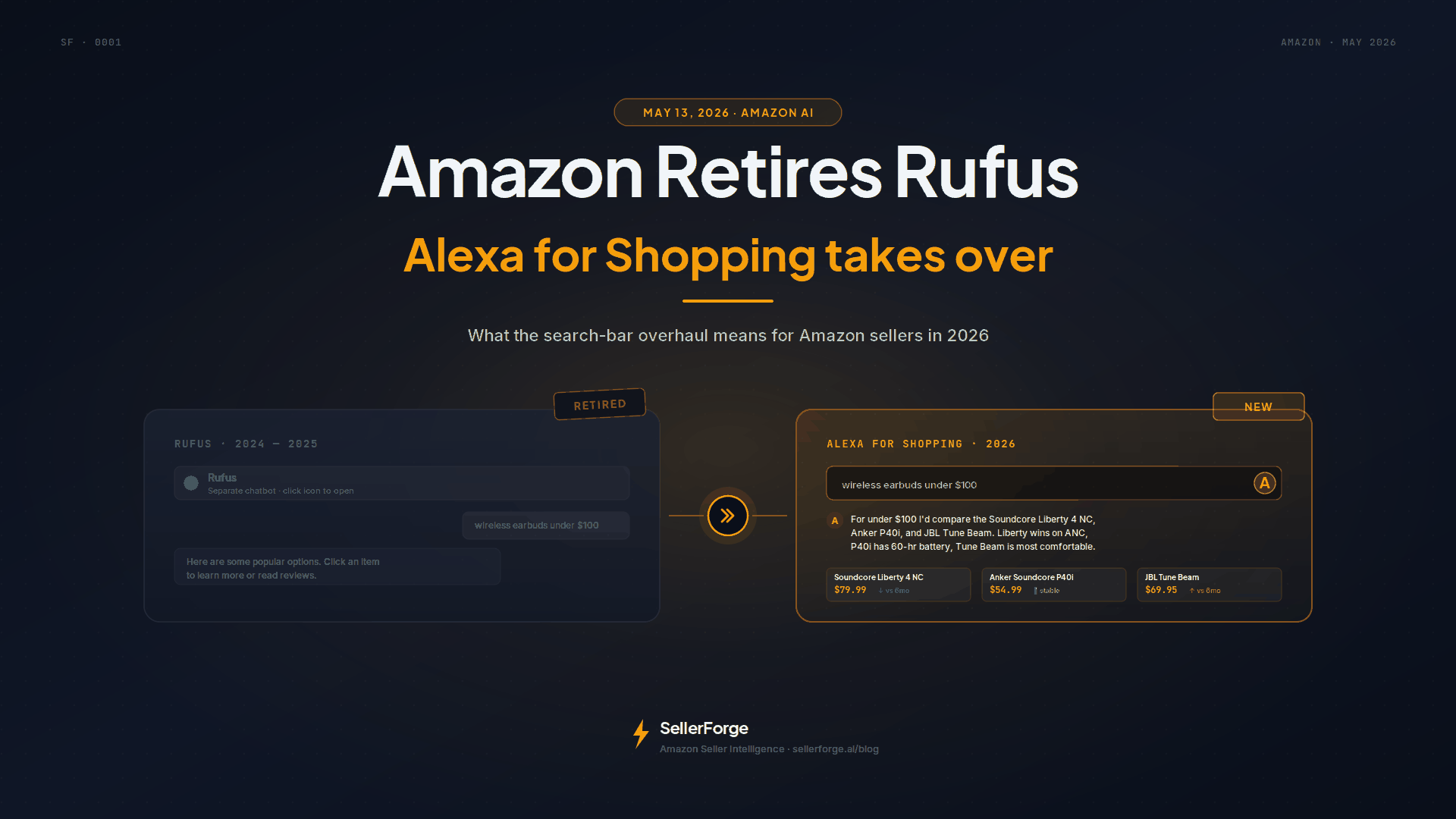
On May 13, 2026, Amazon retired Rufus. The standalone chatbot that 300 million customers used in 2025 is gone — folded into a new unified assistant called Alexa for Shopping that now sits directly inside Amazon's search bar.
This is not a rebrand. It's a structural change to how customers discover products on Amazon, and it affects every seller on the platform whether you sold through Rufus surfaces or not.
If you spent the last 18 months optimizing your listings for Rufus, the good news is that most of that work still pays off. The bad news is that the surfaces, behaviors, and competitive dynamics have shifted enough that you need a fresh playbook — and the sellers who adapt in the next 30 days will pull ahead of competitors still treating the Amazon search bar like a keyword-matching engine.
This guide gives you the full breakdown: what changed, why Amazon made the move, what it means for your listings and ad strategy, and a 90-day action plan.
What Actually Changed on May 13
Amazon announced Alexa for Shopping on Wednesday morning. The launch is US-only initially, with international expansion tied to the broader Alexa+ rollout through the rest of 2026.
Three things changed simultaneously:
1. The Search Bar Is Now an AI Assistant
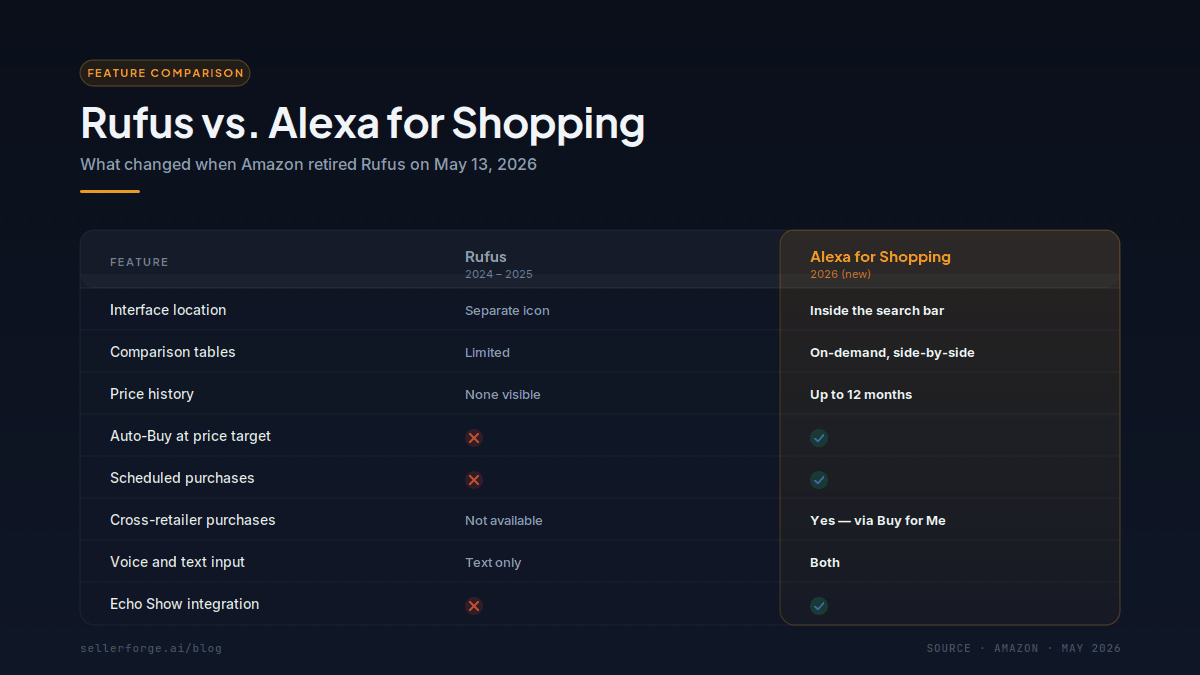
This is the biggest structural change. Before, Rufus was accessible but optional — a separate icon you tapped if you wanted conversational answers. After May 13, the search bar itself is the conversational interface.
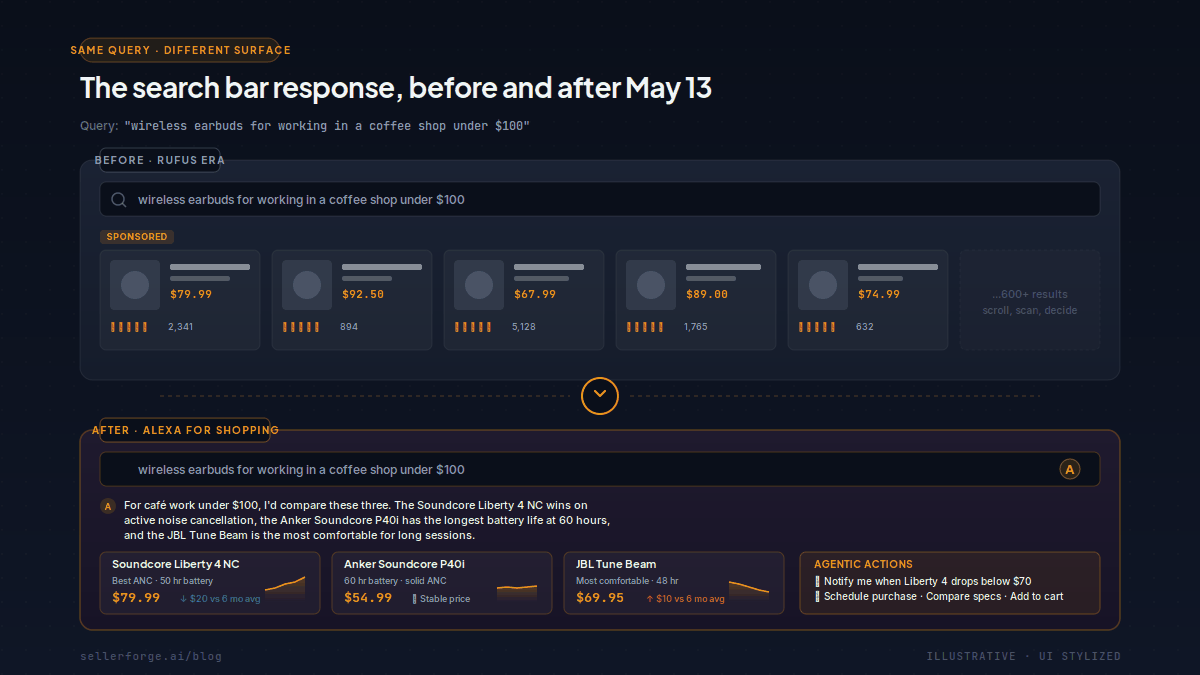
When a US customer types into the search field on amazon.com or in the Amazon app, they're now routed through Alexa for Shopping. The output isn't a flat list of products with sponsored placements at top — it's a hybrid response: conversational answer, product comparison cards, up to a year of price history, personalized recommendations, and the traditional product listings.
The closest analog is what Google did to its results page with AI Overviews. The query box still works the same way, but what happens after you hit enter is fundamentally different.
2. Rufus and Alexa+ Are Merged
The Rufus name is retired from the shopping interface. Its recommendation graph, shopping history features, and product knowledge are now folded into Alexa for Shopping alongside the Alexa+ home assistant capabilities. The merger is also Amazon's tacit admission that running two AI assistants — one for the home and one for the cart — was confusing for customers and expensive to maintain.
Practical effect for sellers: the same recommendation signals that drove Rufus surfacing (review quality, listing completeness, fulfillment performance, price competitiveness) still drive Alexa for Shopping surfacing. The brain didn't change. The interface did.
3. New Agentic Capabilities
Alexa for Shopping adds capabilities Rufus never had:
- Auto-Buy: customers can authorize Alexa to purchase items when they hit a target price
- Scheduled Actions: customers can queue purchases for future dates (subscription-adjacent but more flexible)
- Side-by-side comparison: Alexa builds comparison tables across competing ASINs on demand
- Cross-retailer Buy for Me: Alexa can purchase products from external retailers' websites on the customer's behalf
- Price history surfacing: up to 12 months of price data is visible in the assistant's responses
The cross-retailer capability is the most strategically significant. Amazon now has an AI agent that can shop competitors. That has obvious implications for sellers whose products are listed on multiple marketplaces and for retailers who never opted into being scraped — some of whom have already pushed back publicly.
Why Amazon Made the Move
This change is not happening in a vacuum. The competitive backdrop is everything.
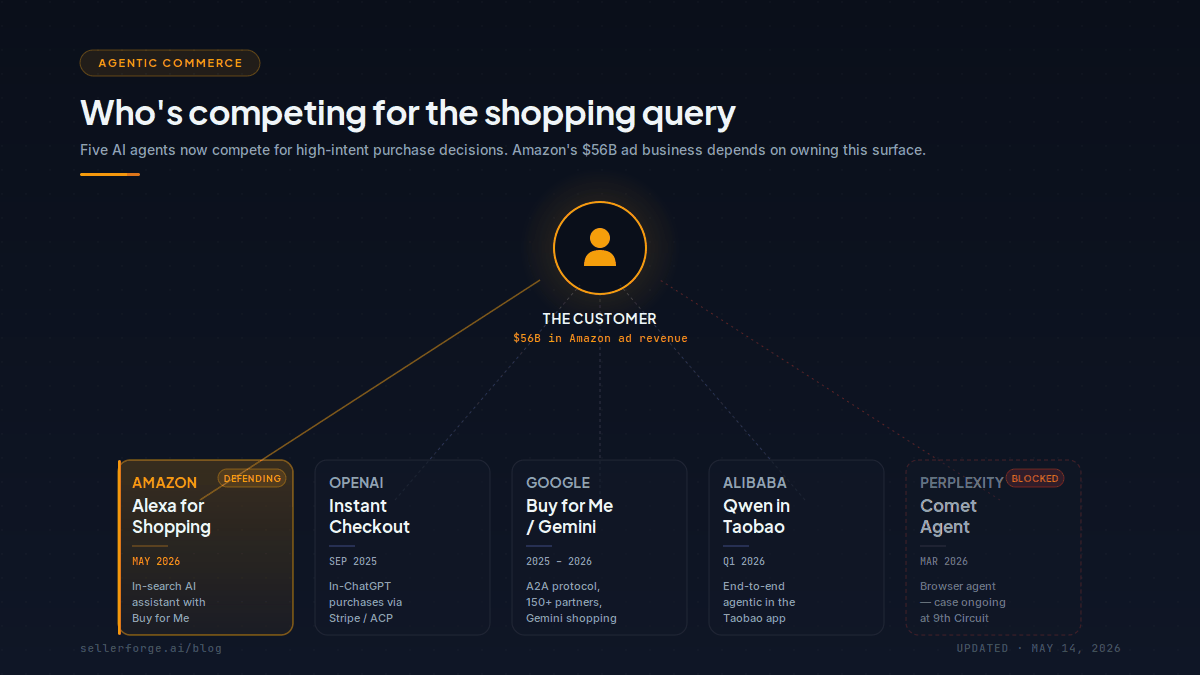
OpenAI launched Instant Checkout inside ChatGPT in September 2025, paired with an open-source Agentic Commerce Protocol that lets ChatGPT close purchases without ever sending users to a retailer's site. Google built Buy for Me into Gemini and now runs an agent-to-agent protocol with 150+ supporting organizations. Alibaba integrated Qwen directly into Taobao for end-to-end agentic shopping in Q1 2026. Perplexity's Comet shopping agent has been operating against Amazon's terms of service since 2025 — Amazon sued in November 2025 and won a preliminary injunction in March 2026; that case is now at the Ninth Circuit.
Every one of those competitors routes the high-intent shopping query through someone other than Amazon. That's the threat.
Amazon's $56 billion advertising business is built on owning the search query at the top of the funnel. Every sponsored placement, every search ad, every product display ad depends on Amazon being the first surface a buyer touches. If a customer asks ChatGPT "what's the best wireless earbud under $100" and ChatGPT closes the transaction without ever sending them to amazon.com, Amazon loses both the sale and the ad revenue.
Alexa for Shopping is the defensive move. By making Amazon's own AI the most fluent shopper on amazon.com — with access to the price history, recommendation graph, account-level purchase data, and product catalog that an external agent doesn't have — Amazon is betting that customers will prefer the assistant that already knows what they bought, what they returned, and what they liked.
Whether that bet works as a consumer product is a separate question. Voice shopping never reached the share Amazon projected when it first pushed Alexa as a commerce surface. The original Rufus, while widely used, was described in trade reporting as more useful for product research than for closing transactions. The merger with Alexa+ doesn't automatically solve those problems — but the placement change does. Putting the AI inside the default search flow rather than behind a separate icon dramatically increases the surface area.
What This Means for Your Listings
If you've been doing serious listing optimization since Rufus launched in 2024, the core principles still apply. But several things shift in priority.
What Still Matters (Maybe Even More)
- Review quantity and quality. Daniel Rausch, Amazon's top Alexa executive, specifically called out customer reviews as Amazon's competitive advantage over external AI agents. The assistant pulls heavily from review content to answer questions, compare products, and explain why one ASIN beats another. A product with 50 detailed reviews will get surfaced over a product with 50 one-line reviews, even at the same star rating.
- Listing completeness. Empty backend search terms, missing brand registry fields, blank manufacturer details — all of these were liabilities under Rufus. They're worse now because Alexa for Shopping is asked harder questions and has to compose answers from whatever attributes are populated. A listing with sparse attributes simply gets left out of comparison tables.
- Q&A on the listing. Customer Questions & Answers content has always been an input for AI shopping assistants. Alexa for Shopping leans on it more. If your listing has 3 questions answered while a competitor has 80, you're handing them the conversational query advantage.
- A+ Content and Brand Story. Structured A+ modules give the assistant cleaner data to extract than long body copy. If you're still relying on a 2,000-word HTML product description without proper A+ modules, your data is harder to parse and easier to skip.
What Shifts in Priority
- Side-by-side comparison readiness. Alexa for Shopping now builds comparison tables on demand. That means your listing's attribute completeness gets weighed against direct competitors' attribute completeness in a head-to-head visual layout. If you're missing dimensions, weight, materials, or certifications that competitors have, you're losing those comparisons before the customer even reads your bullets. Audit your listing against your top three competitors' listings — anywhere they have a populated attribute and you don't, fill it in this week.
- Price competitiveness and price history. Up to 12 months of price data is now visible in the assistant. Customers asking "what's a good time to buy this" will see your price history charted. Aggressive temporary discounting that you reverse later now creates a visible pattern. If you're using promotions strategically, the cadence becomes part of how the AI describes your product.
- Conversational query alignment. Customers no longer type "wireless earbuds noise canceling under 100" — they type "I need wireless earbuds for working in a coffee shop, under $100, that actually block out noise." Your listing needs to answer that question, not just match those keywords. The optimization playbook of aligning for use-case-led language still applies; the volume of queries that look conversational just went up.
- Image alt text and structured image data. Alexa for Shopping uses image attributes more aggressively than legacy search did. Descriptive alt text, properly tagged lifestyle images, and infographics that contain machine-readable structure all feed the assistant.
The deeper question is which listing surfaces the assistant actually reads — the answer is not the one most optimization guides give. Our Amazon Answer Engine Optimization guide sorts every surface on the detail page into what COSMO indexes, what its vision models interpret, and what only trains the graph through conversions.
What This Means for Your Advertising
Sponsored placements aren't going away. Rausch was explicit that ads will appear "where they enhance" the shopping experience rather than "narrow" results. The framing is friendly; the reality is more complicated.
Three things to watch:
1. Ad Inventory Inside Conversational Surfaces
The new comparison tables, Q&A responses, and shopping guides are all surfaces where Amazon can — and almost certainly will — sell sponsored placements. Expect the next 60-90 days to bring formal ad units inside conversational AI responses. If your campaigns are organized around legacy search-results-page placements, you'll need to extend your strategy to cover the new surfaces as they appear.
2. Bid Strategy in the Comparison Table Era
When Alexa builds a side-by-side comparison, the question of which ASINs get included is the new high-stakes placement decision. Sellers whose products consistently make it into AI-generated comparison tables will see disproportionate conversion lift. The signals that get you into the comparison set will likely include: organic rank, sales velocity, listing completeness, review density, and — almost certainly — sponsored bids. Watch the ad console for new "comparison placement" reporting in the coming weeks.
3. The TACoS Conversation Just Got More Important
What This Means for Prime Day 2026
For Prime Day specifically, prioritize:
- Lock listing changes by June 7. Alexa for Shopping's recommendation graph appears to index updates faster than legacy search, but the safe assumption is still 10-14 days for changes to stabilize. Anything you push closer to the event window risks not being fully reflected.
- Audit comparison readiness against your top 3 Prime Day competitors. Comparison tables are the new high-stakes surface. Missing attributes that your competitors have populated will cost you in head-to-head comparisons throughout the event.
- Plan for Auto-Buy. Customers who set Auto-Buy thresholds before Prime Day will purchase the moment your price drops. That's good news for sellers planning deal depth and bad news for sellers planning shallow "Prime Day" markups — the AI will surface the price history, and customers will see through it.
The 90-Day Action Plan
Here's the prioritized list of actions every Amazon seller should take in response to the Alexa for Shopping launch.
Days 1-7 (this week)
- 1Audit your top 5 ASINs' attribute completeness against your top 3 competitors per ASIN. Fill in every gap.
- 2Add 3-5 new customer Q&A entries to each top ASIN if you have under 20 questions answered.
- 3Review your image alt text on every primary listing image. Replace anything generic with descriptive, use-case-led language.
- 4Pull the last 12 months of pricing for your top ASINs. Flag any aggressive promotional dips that customers will now see surfaced.
Days 8-30
- 1Rewrite the top 3 bullet points on your highest-revenue ASINs to answer specific buyer questions rather than describe features.
- 2If you don't have A+ Content on a top-10 revenue ASIN, build it. Use the structured modules, not the generic text block.
- 3Re-audit your backend search terms and brand registry fields. Empty fields are liabilities now.
- 4Set up weekly monitoring of which conversational queries surface your products. Test 10-15 queries per ASIN by typing them into the new Alexa for Shopping interface as a customer would.
Days 31-90
- 1Watch for Amazon's announcement of formal ad units inside Alexa for Shopping responses. When they launch, test small budgets on the new placements early — early movers usually get below-market CPCs before competition arrives.
- 2Build a quarterly comparison-table audit into your standard listing review cadence. The competitive set for AI-generated comparisons may shift more dynamically than legacy search rank does.
- 3Reassess your Prime Day 2026 deal depth in light of price-history surfacing. Sellers who run honest promotions will win comparisons; sellers who manipulate cadence will be exposed.
The Bottom Line
Amazon retiring Rufus isn't really about Rufus. It's about Amazon defending the high-intent shopping query against OpenAI, Google, Alibaba, and Perplexity — all of whom have built or are building AI agents that route purchases away from amazon.com.
For Amazon sellers, the practical effect is straightforward: the search bar is now an AI assistant, customers will increasingly ask conversational questions, and the listings that win are the ones with complete attributes, strong reviews, honest pricing, and content structured for an AI to read and reason over.
The sellers who'll come out ahead in the Alexa for Shopping era are the ones who:
- Audited their listings against competitors' attribute completeness this month
- Built A+ Content on every top revenue ASIN with structured modules, not text blocks
- Maintained honest promotional cadences that won't be exposed by 12 months of visible price history
- Invested in Q&A and review velocity as core ranking inputs
- Tested the new conversational surfaces weekly to see how their ASINs perform in AI-generated responses
Rufus is retired. The optimization work continues — just in a new search bar.