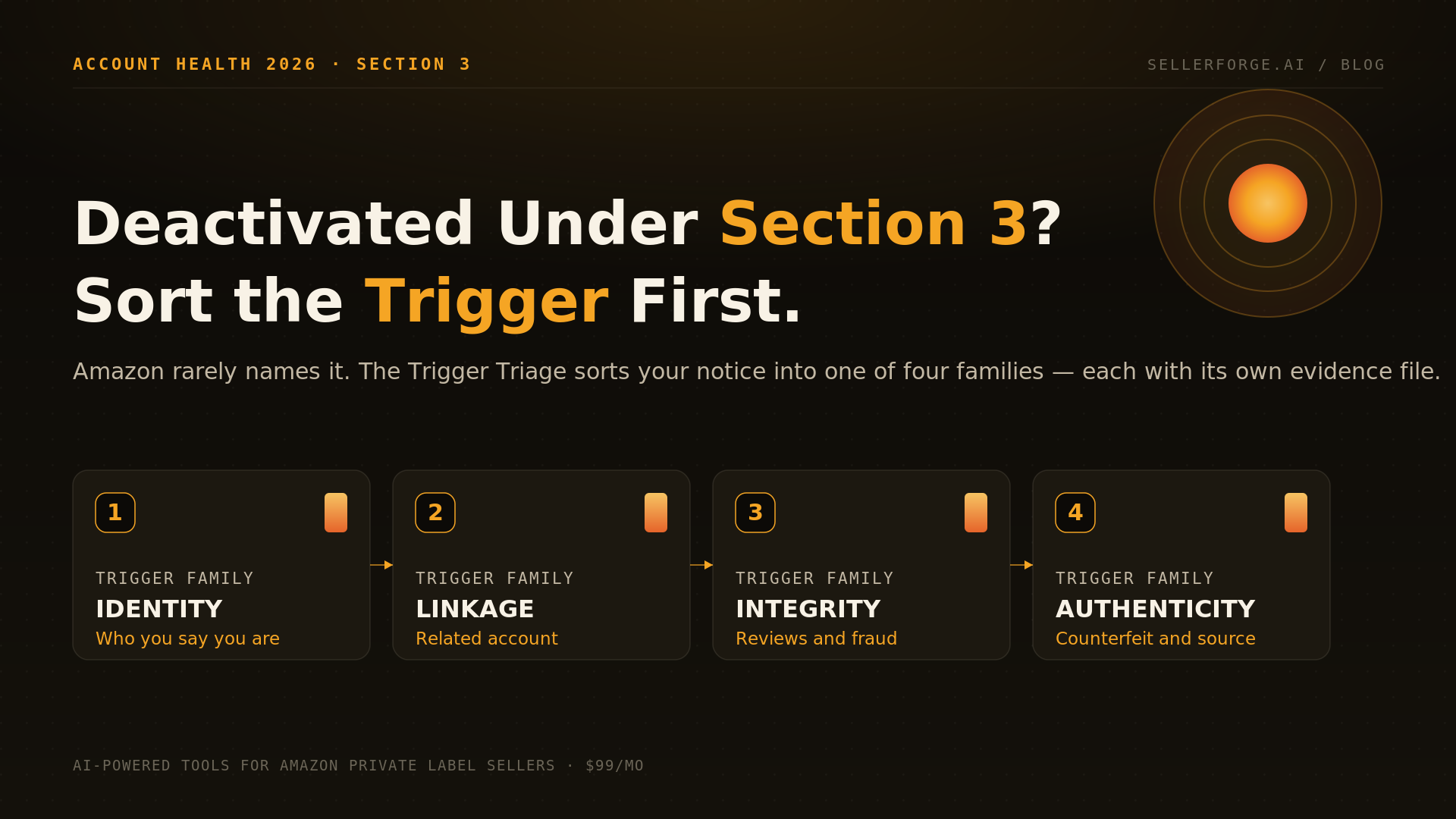
A Section 3 deactivation is account-level, not ASIN-level, and Amazon usually will not name the trigger. Sort it yourself into one of four families — identity, linkage, integrity, or authenticity — because each needs a different evidence file. Two 90-day clocks then run at once: 90 days to appeal, and a 90-day settlement period before you can even request your withheld funds.
A Section 3 deactivation means Amazon has stopped questioning a product and started questioning your account. It is account-level, it is the most serious enforcement category Amazon issues, and it almost never names its own trigger. That last part is the real problem: you cannot appeal a category. You can only appeal a trigger — so your first job is not writing, it is sorting.
The notice reads the same for everyone: "Your seller account has been deactivated in accordance with section 3 of Amazon's Business Solutions Agreement." No ASIN, no named policy. Your listings are gone, your balance is frozen, and two 90-day clocks just started running without telling you.
What Is a Section 3 Deactivation?
Section 3 of Amazon's Business Solutions Agreement sets out the foundational conditions of selling and the terms under which Amazon may suspend or terminate an account: accurate identity information, legitimate control of the account, no manipulation of reviews or metrics, no fraudulent or deceptive activity. A Section 3 deactivation says one of those foundations is in doubt.
The distinction from a normal suspension matters more than sellers realize. An ASIN-level suspension asks you to prove a product or process was fixed; a Section 3 deactivation asks you to prove your account should exist. Different arguments, different reviewers — and a well-written standard Plan of Action can fail here purely by answering the wrong question.
Roughly 35% of Amazon sellers face an enforcement action at some point, and around 2,000 accounts are suspended monthly. But Section 3 sits at the bottom of the recovery table: industry reinstatement estimates put it at 15–20% for sellers appealing without professional help — the lowest of any enforcement category. That is not a reason to panic. It is a reason not to improvise your first appeal.
One 2026 wrinkle worth naming: enforcement is now heavily algorithmic. Systems scan for patterns that resemble violations, so identity and linkage triggers increasingly fire on sellers who did nothing wrong — a shared office IP, a family member's old account, a card used once years ago.
The Section 3 Trigger Triage: Four Families, Four Evidence Files
The Trigger Triage is the sort that happens before you write anything: place your notice into one of four families — identity, linkage, integrity, or authenticity — and build only that family's evidence file. Sellers who skip the sort write one generic compliance appeal covering everything, which reads to a reviewer as someone who does not know what they did.
| Trigger family | What Amazon is actually asking | Evidence file | Typical resolution |
|---|---|---|---|
| Identity | Are you who your account says you are? | Government photo ID, proof of address dated within 90 days, business registration, matching bank and tax details | 1–3 weeks |
| Linkage | Do you control, or share control with, a deactivated account? | Signed declaration of sole control, affidavits, evidence of separate finances/inventory/operations, entity documents | 3–6 months |
| Integrity | Did you manipulate reviews, rank, or metrics? | Review-solicitation process documentation, communication templates, removal of any incentivized activity, clean invoice trail | 2–8 weeks |
| Authenticity | Is your inventory genuine and legitimately sourced? | Supplier invoices for every active ASIN, distributor authorization letters, supply-chain documentation | 1–4 weeks, longer if contested |
How to sort when Amazon gives you nothing: read the notice for verbs, not nouns. "Verify" and "confirm your information" point at identity. Any mention of a second or related account points at linkage. "Manipulate," "influence," and "abuse" point at integrity. "Authenticity," "condition," and "source" point at authenticity. If the language gives you nothing at all, sort by your own risk profile — the family where your documentation is weakest is almost always the one that fired.
Two families now have their own dedicated playbooks. For integrity triggers, the TOS-compliant review velocity guide covers exactly which solicitation practices survive scrutiny and which quietly build a manipulation profile. For authenticity triggers, the Brand Registry 3.0 hijacker guide covers the sourcing and enforcement documentation Amazon expects a brand owner to hold.
The single most common self-inflicted wound: appealing all four families at once. A Section 3 appeal that pre-emptively defends your identity, your account separation, your review practices, and your supply chain reads as a seller who cannot say what happened. Sort first. Defend one family properly. Hold the other three files in reserve for the reviewer who asks.
If the notices behind your case are product condition complaints — used sold as new, defective, or wrong item — the complaint-level playbook is covered in full in handling Amazon used sold as new complaints, including the Three-Origin Sort that decides which evidence file you actually need.
The First 48 Hours: What To Do, In Order
The first two days decide the shape of the case, and the most valuable thing you can do in them is not submit anything. Amazon gives you 90 days to appeal; the appeal you file first becomes the record every subsequent reviewer reads. A fast, thin submission is the most expensive mistake available to you.
- 1Read the notice completely — subject line, body, every linked policy — and save it with the exact timestamp. The trigger family is often implied in the verbs even when it is never named.
- 2Do not submit an appeal. Not a holding message, not a "we are investigating" note. Every submission is scored.
- 3Run the Trigger Triage. Sort your notice into identity, linkage, integrity, or authenticity, and write down which one and why.
- 4Build that family's evidence file completely before drafting a sentence. Missing attachments are the most common rejection cause, and a second submission never lands as cleanly as a first.
- 5Check your Account Health dashboard for a Submit Appeal button on the specific violation — in 2026 most enforcement routes through the dashboard rather than a generic appeal address, and some violations now use a guided template instead of free text.
- 6Start the funds clock consciously. Note the deactivation date; it is day zero for the 90-day settlement period described below.
The hour-by-hour version of this sequence — the 2-6-24-48 Rule — is in what to do in the first 48 hours of an Amazon suspension. It applies to every suspension type; the Trigger Triage is what you layer on top when the notice says Section 3.
The Two 90-Day Clocks: Your Appeal and Your Money
Two 90-day clocks start on the day of deactivation, they are answered by different teams, and confusing them costs sellers real money. Clock one: you have 90 days from notification to submit a valid appeal or decline to. Clock two: your funds enter a 90-day settlement period with disbursements disabled, so returns, refunds, A-to-Z claims, removal costs, and outstanding fees can settle.
Here is the part most guides get wrong, including an earlier version of this one. Amazon does not automatically release your balance when the second clock expires. After 90 days, if you have not been reinstated, you may separately request a disbursement review from Amazon's disbursement appeals team — and that request triggers its own investigation into your identity, financial instruments, and product sourcing. It is a second case, not a formality.
Blunt version: if your deactivation was tied to authenticity, counterfeit, dropshipping, or IP infringement, sellers routinely do not get the withheld balance back at all. Plan your cash position on that assumption rather than on the assumption the money arrives on day 91. Reinstatement is the reliable route to your funds — disbursement appeals are the fallback, not the plan.
The practical consequence: if you are choosing between funding a strong reinstatement effort and waiting out the funds clock, the reinstatement effort is where the money is. A reinstated account re-enables disbursements automatically; a closed account with a pending disbursement appeal is the far weaker position, and it is the one sellers back into by default.
How to Structure a Section 3 Appeal
A Section 3 appeal keeps the standard three-part shape — root cause, corrective actions, preventive measures — but each part changes because you are defending an account rather than a process. Target 300–500 words in the body. Length lives in the attachments; a long appeal signals arguing rather than documenting.
Root cause: name the family, factually
State what you believe triggered the action and why, without hedging or emotion. If you know the trigger, say it. If you are inferring it from the Trigger Triage, say that too — reviewers respond better to a clearly reasoned inference than to a seller who claims total ignorance.
Worked example, linkage family: "We believe this deactivation relates to a prior selling account operated by [NAME] under [ENTITY], deactivated in [YEAR]. That account was operated by [RELATIONSHIP] and was separate from ours in every operational respect — different tax ID, different bank account, different legal entity (documentation attached). We were not aware that our shared [residential address / office IP] created an apparent link in Amazon's systems."
Corrective actions: past tense, already done
For Section 3, corrective actions are usually structural rather than operational: updated verification documents submitted, shared infrastructure separated, business registration corrected, ASINs without clean supplier documentation removed. Every item must be something you have already completed. Planned actions read as promises, and promises do not reinstate accounts.
Preventive measures: systems, not intentions
Show the mechanism that makes recurrence structurally unlikely — dedicated devices and networks per account, a documented sourcing-verification step before any ASIN goes live, a monitoring cadence that catches policy drift early. "We will be more careful" is the single weakest sentence available to you.
The section-by-section mechanics, with language that survives review, are in how to write an Amazon Plan of Action. If your trigger involves a trademark, copyright, or patent complaint layered on top, the IP complaint POA guide covers the evidence standard those reviewers apply. SellerForge's Plan of Action Builder drafts the structure from your account data, and the Document Vault keeps the evidence file assembled before you need it — which is the part sellers are never ready for.
Related Accounts: The Hardest Family to Argue
Linkage is the hardest Section 3 family because Amazon matched data points you may not know exist, and it will not tell you which ones. IP address, device fingerprint, physical address, a shared card, a bank account, a browser signature — any of them can create a link, and the burden is entirely on you to explain the overlap.
What works is precision about the overlap rather than denial of it: state what the shared fact is, why it exists, and why it does not demonstrate common ownership or control. Amazon is not asking whether the accounts touched — it is asking who owns this one, who controls it, and who receives the money.
- A signed declaration that you have never accessed, controlled, or held an interest in any other selling account
- Government photo ID and entity documents for every principal on the account
- Affidavits or letters from an accountant, attorney, or other verifiable third party affirming sole ownership and control
- Evidence the accounts operated independently — separate bank accounts, separate tax IDs, separate inventory and premises, separate contracts
- A plain explanation of the innocent overlap: the shared address, the shared office network, the card used once
Before you resubmit, remove the ambiguity going forward: unique device, network, phone number, payment instrument, tax ID. And accept the timeline — related-account cases commonly run three to six months. Run escalation in parallel with standard appeals, and keep a dated log of every submission and response.
The 2026 Escalation Ladder After a Rejection
A first rejection is normal and not the end of the case; it usually means the appeal lacked documentation or specificity rather than merit. What changed in 2026 is the route: most enforcement now carries a Submit Appeal button inside the Account Health dashboard, some violations use guided templates, and Account Health Assurance sellers have a new second-review mechanism. Climb in order — skipping rungs burns them.
| Rung | Action | When to use it | What it needs |
|---|---|---|---|
| 1 | Revise and resubmit via the Account Health dashboard | After a first rejection | The specific gap fixed, plus attachments that were missing |
| 2 | Seller Challenge (Account Health Assurance sellers) | If enrolled and the decision is eligible | Three per 180 days; ~48-hour response; reviewed against your full appeal history |
| 3 | Escalation to Executive Seller Relations | After two substantive rejections | A strong POA plus a separate escalation letter naming what reviewers missed |
| 4 | Counsel, or BSA dispute resolution | Significant withheld funds or a demonstrably wrong linkage match | Documented evidence trail and a dated log of every submission |
On Seller Challenge, the honest caveat: it launched as a beta in October 2025 and is currently scoped to eligible listing-level decisions, with account-level expansion described as a possibility rather than a commitment — so it is not yet a direct Section 3 lever for most sellers. It is a strong argument for enrolling in Account Health Assurance before anything goes wrong, which also buys 72 hours' notice before a qualifying deactivation if you hold a Professional account, an Account Health Rating generally at or above 250, no recent severe violations, and roughly a year of selling history.
What does not work: resubmitting the same appeal with new adjectives. Escalation teams read your full history. Three near-identical submissions tell a reviewer you have nothing new, and sellers do get dropped from correspondence entirely. Escalate when you have added evidence, not when you have run out of patience.
Escalation is a sequencing problem, and sequencing is what most sellers lose track of at exactly the wrong moment. SellerForge's Escalation Plans lay out the rung-by-rung path with the evidence each one needs, and the Business Event Timeline keeps the dated submission log that rung 4 depends on.
What a Successful Section 3 Appeal Looks Like
Reinstated Section 3 appeals share a profile, and it has less to do with writing quality than sellers assume. The appeals that win look like case files. The ones that fail look like letters.
- One trigger family named and addressed directly — not a survey of everything Section 3 covers
- An attachment supporting every factual claim in the body; nothing asserted that is not evidenced
- Corrective actions in the past tense, already completed before submission
- Preventive measures that describe a mechanism, not a commitment
- Body of 300–500 words, professional and unemotional, with no argument about whether the decision was fair
- A dated log of every prior submission and response, so escalations can reference the record precisely
The pattern I saw repeatedly across the accounts I managed: sellers with clean documentation and a badly sorted appeal lost, and sellers with messier businesses but a correctly sorted, fully evidenced appeal won. Amazon is not evaluating whether you are a good operator. It is evaluating whether the file answers the question it asked.
How To Not Be Reading This Page
Nearly every Section 3 case I have seen was survivable in advance and brutal in the moment, because the evidence takes weeks to assemble and you get days of clear thinking. The prevention work is unglamorous and entirely front-loaded.
- 1Keep a live evidence file: current ID, proof of address, entity documents, and a supplier invoice for every active ASIN — refreshed quarterly, not requested in a crisis.
- 2Enrol in Account Health Assurance if you qualify. The 72-hour notice window is the difference between a managed response and a scramble.
- 3Audit your linkage surface once: who else has used your network, devices, cards, or address in any selling context, and document the innocent explanations while they are still easy to prove.
- 4Document your legitimate business need in writing for every additional selling account, even though Amazon no longer requires prior approval.
- 5Watch your Account Health Rating weekly rather than after a notice — algorithmic enforcement in 2026 rewards early drift correction and punishes surprise.
The weekly rhythm that catches account-health drift before it becomes enforcement is in the AI weekly operations cadence. If you manage accounts for other people, the client-communication side of an enforcement event — what to send, how fast, and what not to promise — is covered in the agency client reporting playbook.
The Bottom Line
Section 3 is the hardest enforcement category to beat, and the reason is structural rather than adversarial: Amazon asks a question it will not state, and most sellers answer a different one. Run the Trigger Triage, build one family's evidence file properly, respect both 90-day clocks, and escalate only when you have added something new. That method beats volume every time.
And plan your cash independently of the appeal. The sellers who came through intact were not the ones with the best appeals — they were the ones who assumed the withheld balance might never arrive, and kept operating on that basis while the case ran.
Want the evidence file assembled before you need it, and account-health drift flagged while it is still fixable? Start a free SellerForge trial — it connects to Seller Central and builds your document vault, event timeline, and health monitoring in about 15 minutes.
About the author
David Gallo is the founder of SellerForge.ai. Before building SellerForge, he managed 57 Amazon seller accounts representing more than $350M in sales at Worldfront, where the accounts that survived enforcement were always the ones whose documentation existed before the notice arrived.