
Amazon Account Health: The Complete Guide to Suspensions, POAs, and Reinstatement
Amazon account health is a zero-tolerance game. A single policy violation, a surge in buyer complaints, or an IP complaint from a brand owner can deactivate your listings — or your entire account — within hours. Understanding how Amazon measures account health, what triggers enforcement actions, and how to respond effectively is the difference between a two-week reinstatement and a six-month battle. This guide covers everything Amazon sellers need to know about protecting their accounts and winning appeals.
How Amazon Measures Account Health
Amazon's Account Health Rating (AHR) is a composite score visible in Seller Central under the Account Health dashboard. It combines your Order Defect Rate (ODR), Late Shipment Rate (LSR), Valid Tracking Rate, and a count of open policy violations. Scores above 200 are generally considered healthy; scores below 100 put you at elevated risk of deactivation.
But the AHR is only the surface level. Amazon also monitors product authenticity flags, intellectual property complaints, counterfeit reports, and buyer feedback patterns that never appear directly in the AHR. A seller with a 250 AHR can still receive a Section 3 suspension if Amazon suspects their supply chain is inauthentic — because the underlying enforcement system runs parallel to the visible metrics.
The practical implication: sellers who only monitor AHR are watching the wrong instrument. Account health management requires actively monitoring your policy warnings, watching for ASIN-level flags, and understanding the difference between a performance warning (which Amazon sends before acting) and an enforcement action (which often arrives simultaneously with the deactivation).
The 3 Most Common Causes of Amazon Suspensions
Performance-based suspensions occur when your ODR exceeds 1%, your LSR exceeds 4%, or your Valid Tracking Rate falls below 95% for FBM shipments. These are entirely preventable with proper operations, but they're the most common entry point for sellers who are scaling faster than their fulfillment infrastructure. FBA eliminates most of these risks, but FBM sellers who grow without building out their shipping operations often hit these thresholds without warning.
Policy violations cover a wide range: listing prohibited products, making unsubstantiated claims, violating Amazon's restricted product categories, or failing to comply with category-specific requirements (electronics safety certifications, hazmat documentation, pesticide registration). The most dangerous policy violations are the ones sellers don't know they've committed — Amazon's policies change constantly, and a listing that was compliant six months ago may be flagged today.
Inauthenticity and IP complaints are the most damaging suspension type. Amazon treats any allegation of inauthenticity — whether from a buyer complaint, a brand's rights owner portal submission, or Amazon's internal detection — as a supply chain integrity issue requiring documentation. Sellers who cannot produce invoices from verifiable wholesale distributors or directly from brands often cannot win these appeals regardless of their intent or actual product quality.
Writing a Plan of Action That Actually Works
Amazon's Plan of Action framework has three required components: root cause identification, corrective actions already taken, and preventive measures. Every element is a trap for sellers who haven't read thousands of reinstatements: root causes must be specific (not "I was unaware of the policy"), corrective actions must be past-tense and concrete (not "I will improve my processes"), and preventive measures must be documented systems (not promises).
The most common POA failure is vagueness. A statement like "I understand the importance of Amazon's policies" is meaningless to a reviewer who processes 50 appeals per day. What earns reinstatement is specificity: "I removed ASIN B0XXXXXXXX from inventory on April 14, 2026," "I have enrolled in an account health course," "I have implemented a 3-way matching process between purchase orders, invoices, and receiving documents." Dates, ASINs, supplier names, and documentation references are the currency of reinstatement.
For IP complaints, the POA must also include the rights owner's contact and, if possible, a retraction letter. Amazon strongly prefers to see that the seller has resolved the complaint directly with the brand rather than simply asserting innocence. If the IP complaint is wrong — your product is authentic, you have legitimate sourcing — your POA needs to prove it with invoices, not assert it.
Section 3 Suspensions: What They Are and How to Fight Them
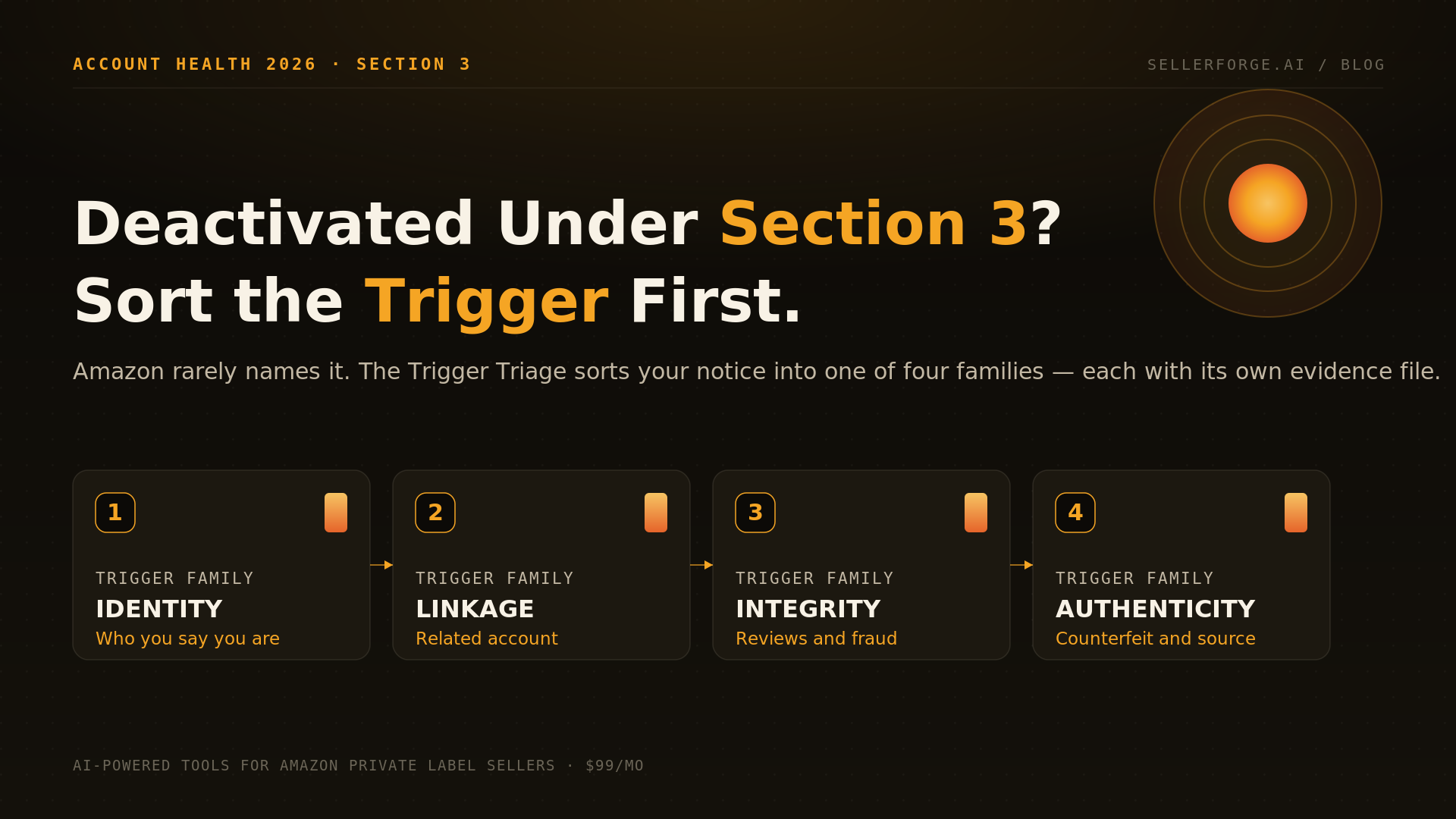
Section 3 of Amazon's Business Solutions Agreement covers the authenticity and integrity requirements Amazon imposes on all sellers. A Section 3 suspension typically means Amazon has determined — or suspects — that a seller's business identity, supply chain documentation, or product authenticity does not meet their standards. These suspensions are among the hardest to reverse because they require Amazon to change a structural assessment, not just clear a policy violation.
Section 3 appeals require a different approach than performance-based suspensions. The POA still uses the three-component structure, but the documentation burden is much higher: you'll typically need to provide government-issued business registration, invoices from verifiable suppliers (not drop-shippers or intermediaries), proof of product authenticity (brand authorization letters, lab reports, or manufacturer invoices with lot numbers), and sometimes a detailed supply chain narrative that traces the product from manufacturer to Amazon warehouse.
Section 3 cases are also more likely to require escalation beyond the standard POA pathway. If your initial appeal is rejected with a boilerplate response, the pathway is to request a call with the Account Health team, involve Amazon's Seller Support escalation path, or in extreme cases engage an attorney familiar with Amazon's arbitration process. Sellers who treat Section 3 as a standard POA situation and keep submitting the same document are making a mistake that costs months.
IP and Trademark Complaints: The Fastest-Moving Threat
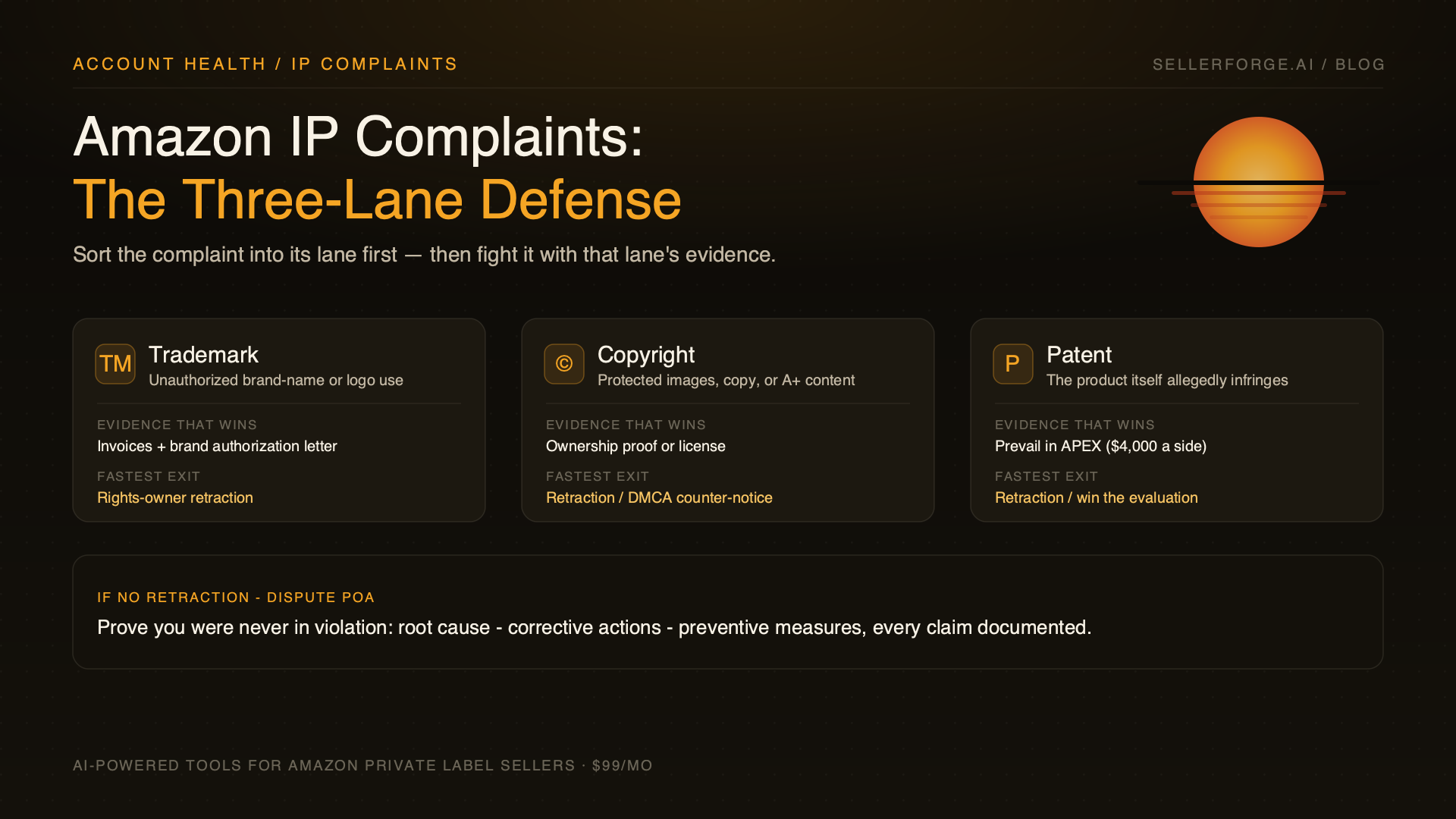
Intellectual property complaints through Amazon's Brand Registry are the fastest-moving suspension trigger available to rights owners — a complaint can deactivate an ASIN within hours of submission. Amazon's default posture is to protect the alleged rights owner while the complaint is investigated, which means sellers bear the burden of proving non-infringement or obtaining a retraction.
The fastest resolution for an IP complaint is a retraction from the complainant. Many IP complaints — particularly from aggressive brand enforcement programs — can be resolved by contacting the rights owner directly, providing proof of legitimate sourcing, and requesting they submit a retraction through Amazon's portal. This pathway is faster than any appeal process and is Amazon's preferred resolution method.
When a retraction isn't possible (the rights owner is unresponsive or the complaint is from a third party using Brand Registry aggressively), the appeal requires proving either non-infringement (your product does not use the protected mark or design) or legitimate authorization (you have a distribution agreement or authorization letter from the brand). Generic "we purchase through legitimate channels" responses are insufficient — the documentation must be specific to the product, the ASIN, and the alleged infringement.
Frequently Asked Questions
9 articles in Account Health

&category=Account%20Health&type=hero)


Stop reading. Start shipping.
SellerForge turns these playbooks into one-click AI workflows — from $49/month.
No credit card required