&category=Account%20Health&type=hero)
An Amazon Plan of Action must address three sections: root cause (the specific policy violation and how it happened), corrective actions (what you've already done — past tense), and preventive measures (systemic process changes, not personal commitments). Attach documentation for every claim. Amazon rejects vague root causes and future-tense corrective actions faster than any other failure mode.
Every Amazon seller who has faced a suspension knows the sinking feeling of reading a rejection: "We reviewed your Plan of Action, but we need more specific information." That response is Amazon's way of saying your POA was too generic — and it's the most common reason appeals fail. Not because sellers don't care. Because they don't know exactly what Amazon is looking for in each section.
This guide gives you the actual template structure Amazon expects, real-world examples for the three most common suspension types, and a line-by-line breakdown of what separates an approved POA from one that gets rejected again.
Amazon's Account Health team reads thousands of POAs per week. They can identify a template POA within the first sentence. The goal of this guide is to give you the structure — but you must fill it with the specific facts of your case.
The Anatomy of an Amazon Plan of Action
Amazon requires every POA to address three specific sections. Sellers who omit one or blur the boundary between them see immediate rejections. Here is what each section must accomplish:
Section 1: Root Cause
This section must identify — precisely — what caused the violation. Not what you think Amazon believes caused it. Not a diplomatic version of events. The actual root cause, stated plainly. Amazon is looking for evidence that you understand your own operational failure. Vague root causes ("we had some quality control issues") are the leading cause of first-round rejections.
- Name the specific policy that was violated (cite it by name, not paraphrase)
- Identify the process or decision that directly led to the violation
- Be specific to your ASIN — avoid generic language that could apply to any seller
- Keep it factual and past-tense — do not argue with Amazon's finding
- One to three sentences maximum — longer root causes signal that you're justifying, not explaining
One family plays by different rules: for trademark, copyright, and patent complaints the root-cause section often inverts into a merit dispute — see the IP complaint Plan of Action guide for the evidence each complaint type requires.
Section 2: Corrective Actions Taken
This section must demonstrate what you have already done — past tense, completed — to resolve the specific issue. It is not a list of things you intend to do. Amazon reviewers are specifically trained to flag future-tense corrective actions as insufficient. Every item should be something you can reference with a date, a document, or a verifiable change.
- Write every action in simple past tense: "We removed," "We contacted," "We updated"
- Include specific dates where possible — they signal that actions were real and deliberate
- Reference supporting documentation you are attaching (invoice #, supplier name, date)
- Connect each action directly to the root cause — show the causal logic
- Aim for 3–5 specific actions, not a general list of 10 vague steps
Section 3: Preventive Measures
The preventive measures section is where most sellers lose their appeal at the second attempt. Generic commitments ("We will monitor our account health weekly") are ignored. Amazon wants to see systemic process changes — changes to how your business operates, not just promises about personal vigilance.
- Describe process changes, not behavioral intentions
- Reference new systems, checklists, supplier agreements, or third-party services where applicable
- Show that the same failure cannot happen again without a process breakdown — not just a lapse in attention
- Where possible, include who is responsible for each measure (role or position, not personal name)
Template: Inauthentic Items Complaint
Inauthentic items complaints are one of the most common suspension types. They occur when a buyer or brand files a complaint claiming the product they received was counterfeit or did not match the authentic product. The POA must demonstrate a documented supply chain from a legitimate source.
Root Cause (example):
"The inauthentic complaint received on [DATE] for ASIN [ASIN] resulted from our purchase of [PRODUCT] from [SUPPLIER NAME], a distributor we had not previously verified against the brand's authorized reseller list. We did not confirm the supplier's authorization status before listing the product, and this failure created a supply chain gap that could not be verified in response to the buyer's complaint."
Corrective Actions Taken (example):
"On [DATE], we immediately removed the ASIN [ASIN] from our active inventory. We contacted [SUPPLIER NAME] and requested a Certificate of Authenticity and proof of brand authorization. Upon review, we were unable to obtain satisfactory documentation and have permanently terminated our relationship with this supplier (see attached correspondence dated [DATE]). We sourced the same product from [NEW SUPPLIER NAME], an authorized distributor verified directly with [BRAND NAME] (see attached authorization letter). We have attached supplier invoices, the brand's authorization confirmation, and a Certificate of Authenticity for the replacement inventory."
Preventive Measures (example):
"We have implemented a Supplier Verification Protocol that requires any new supplier to provide: (1) proof of direct manufacturer authorization or an authorized distributor agreement, (2) a current Certificate of Authenticity for the specific product, and (3) documentation reviewed by our compliance lead before any purchase order is issued. This protocol is documented in our internal SOP (copy attached) and applies to all new product sourcing regardless of category."
Attach everything you reference. Amazon reviewers cannot approve a POA based on claims alone. Every document mentioned in the appeal — invoices, authorization letters, supplier agreements, SOPs — must be attached as a separate, clearly labeled file.
Template: Used Item Sold as New
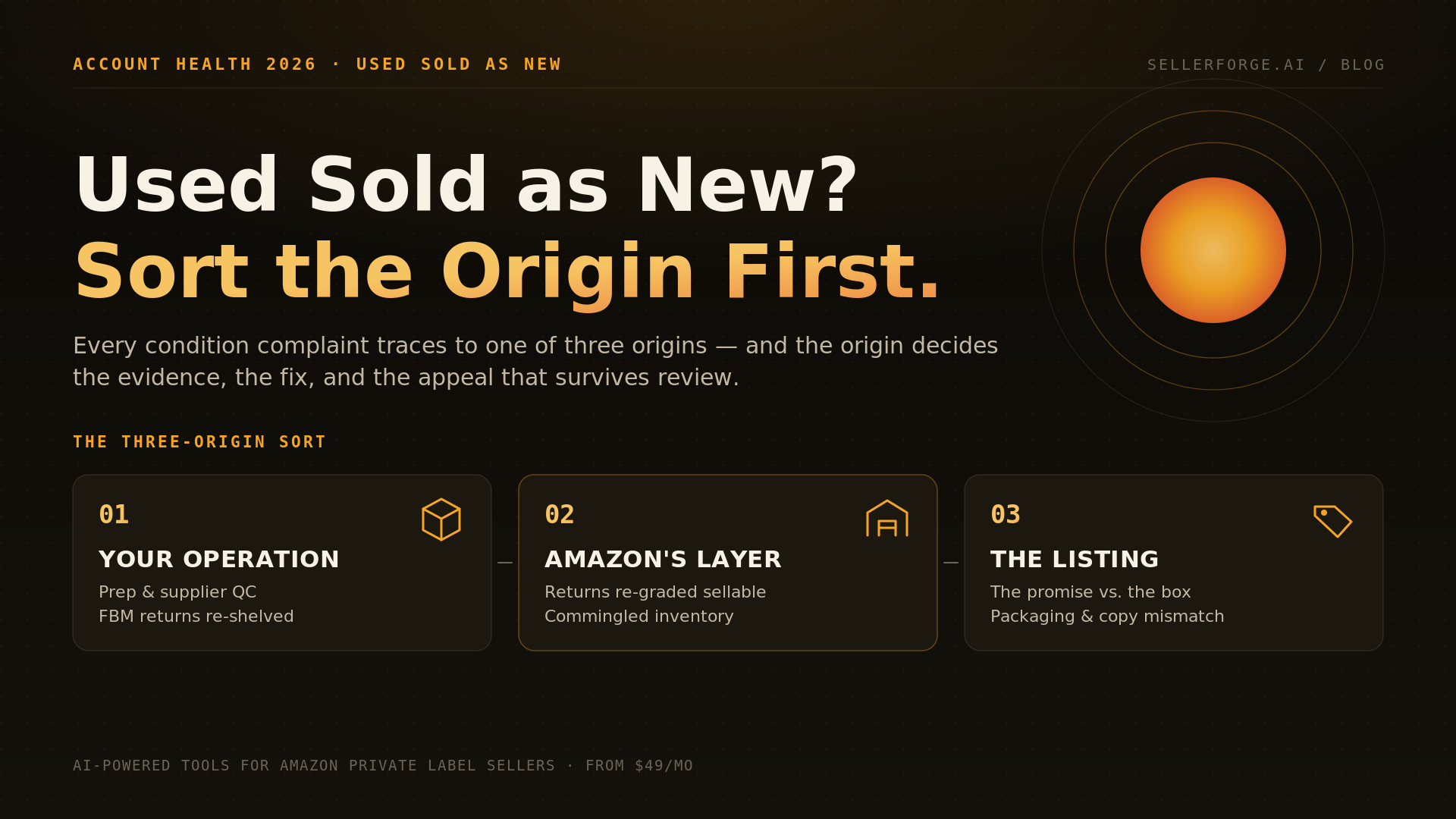
Used-sold-as-new complaints occur when a buyer receives a product that shows signs of prior use — opened packaging, wear, missing components, or evidence of prior returns. These can occur even when the seller genuinely believed the item was new, typically because of poor quality control on received inventory or a returns processing error.
Root Cause (example):
"The complaint received on [DATE] for ASIN [ASIN] was caused by the fulfillment of a unit from a batch of [PRODUCT] that included a customer return that had been incorrectly re-labeled as new inventory during our returns processing on [DATE]. Our returns processing at the time did not include a physical inspection step before units were returned to sellable inventory, which allowed a visibly opened and possibly used unit to be shipped to a subsequent buyer."
Corrective Actions Taken (example):
"On [DATE], we halted all sales of ASIN [ASIN] and audited our FBA inventory for returns-origin units. We identified [X] units that could not be confirmed as factory-new and submitted a removal order for all affected units on [DATE] (removal order ID attached). We have contacted the original buyer to arrange a replacement and full refund (correspondence attached)."
Preventive Measures (example):
"We have updated our returns processing SOP to require a physical inspection of every returned unit before it is reclassified as sellable. All returns must now be photographed, condition-graded using our updated grading rubric (attached), and approved by a designated quality control team member before any disposition decision is made. Units that cannot be confirmed as factory-new are automatically routed for liquidation or disposal, never back to FBA inventory."
Template: Order Defect Rate (ODR) Suspension
ODR suspensions occur when your Order Defect Rate exceeds Amazon's 1% threshold. They can be driven by negative feedback, A-to-Z claims, or credit card chargebacks. The POA must address the specific metric drivers — not ODR in the abstract.
Root Cause (example):
"Our Order Defect Rate for the period [DATE RANGE] reached [X]%, exceeding Amazon's 1% threshold. Analysis of the contributing orders identified two primary drivers: [X] A-to-Z Guarantee claims related to delayed FBM shipments during [EVENT — e.g., warehouse move/carrier disruption], and [X] negative feedback ratings citing [SPECIFIC ISSUE — e.g., incorrect item shipped]. The delayed shipments resulted from [SPECIFIC CAUSE], and the incorrect item complaints resulted from a mislabeled batch in our warehouse processed on [DATE]."
Corrective Actions Taken (example):
"We proactively reached out to all buyers with open A-to-Z claims and offered full refunds and replacements, resolving [X] of [X] claims as of [DATE] (case IDs attached). We identified and corrected the mislabeled inventory batch — all affected units were either corrected or removed (see removal order [ID]). We temporarily shifted [X] ASINs from FBM to FBA fulfillment to eliminate shipping delay risk while we resolved the carrier contract issue."
Preventive Measures (example):
"We have implemented a daily account health monitoring process with a dedicated team member reviewing ODR components each morning. Our FBM fulfillment SLA has been tightened from [X] to [X] business days with an automated alert if any order approaches the handling deadline. All inventory batches now undergo a barcode verification scan against purchase order records before entering storage — a step not previously included in our receiving process."
What to Do When Your POA Is Rejected
A first rejection is not a final answer. But how you respond to it determines whether reinstatement is likely or increasingly unlikely. Amazon's system tracks resubmission velocity — frequent rapid resubmissions without meaningful changes flag your case for lower-priority review.
- 1Read Amazon's rejection response carefully — even boilerplate responses contain signals about what was missing
- 2Do not resubmit for at least 24–48 hours — give yourself time to make substantive changes
- 3Identify the weakest section of your original POA and rebuild it from scratch, not from edits
- 4Add at least one new piece of supporting documentation that was not in the original submission
- 5After two thoughtful rejections, work the 2026 escalation ladder in order: re-appeal through the Account Health Dashboard's Submit Appeal flow, request a Seller Challenge review if you have Account Health Assurance (three per 180 days, for eligible listing-level decisions), and only then prepare an Executive Seller Relations escalation
Never resubmit the same POA with cosmetic changes. Amazon's reviewers see hundreds of appeals per day and recognize recycled language immediately. A new document that addresses the same case from a stronger angle is always better than a light edit of a rejected one.
2026 update: Amazon added a formal rung to the appeal ladder — Seller Challenge, launched in late 2025 for sellers with Account Health Assurance, lets you request a secondary review of eligible listing-level enforcement decisions up to three times every 180 days, typically answered within about 48 hours. Use it after a standard appeal fails but before escalating to Executive Seller Relations. The full 2026 ladder is mapped in our Section 3 deactivation guide.
Using AI to Build a Stronger POA from This Template
These templates give you the structural skeleton. The substance — the specific facts, dates, document references, and process changes — must come from your actual case. AI tools are most effective when you use them to fill in that substance accurately and professionally, not to generate filler.
The most effective approach: fill in the template with your raw notes (dates, what happened, what you did, what you changed), then use an AI tool to convert those notes into the professional, structured language Amazon expects. Treat the AI as your editor, not your researcher. It cannot know your case. You do.
Purpose-built Amazon POA tools — like the SellerForge POA Builder — are designed around this workflow. You provide the case facts, the tool provides the structure and professional language, and the result is a POA that is both specific to your situation and formatted correctly for Amazon's review process.