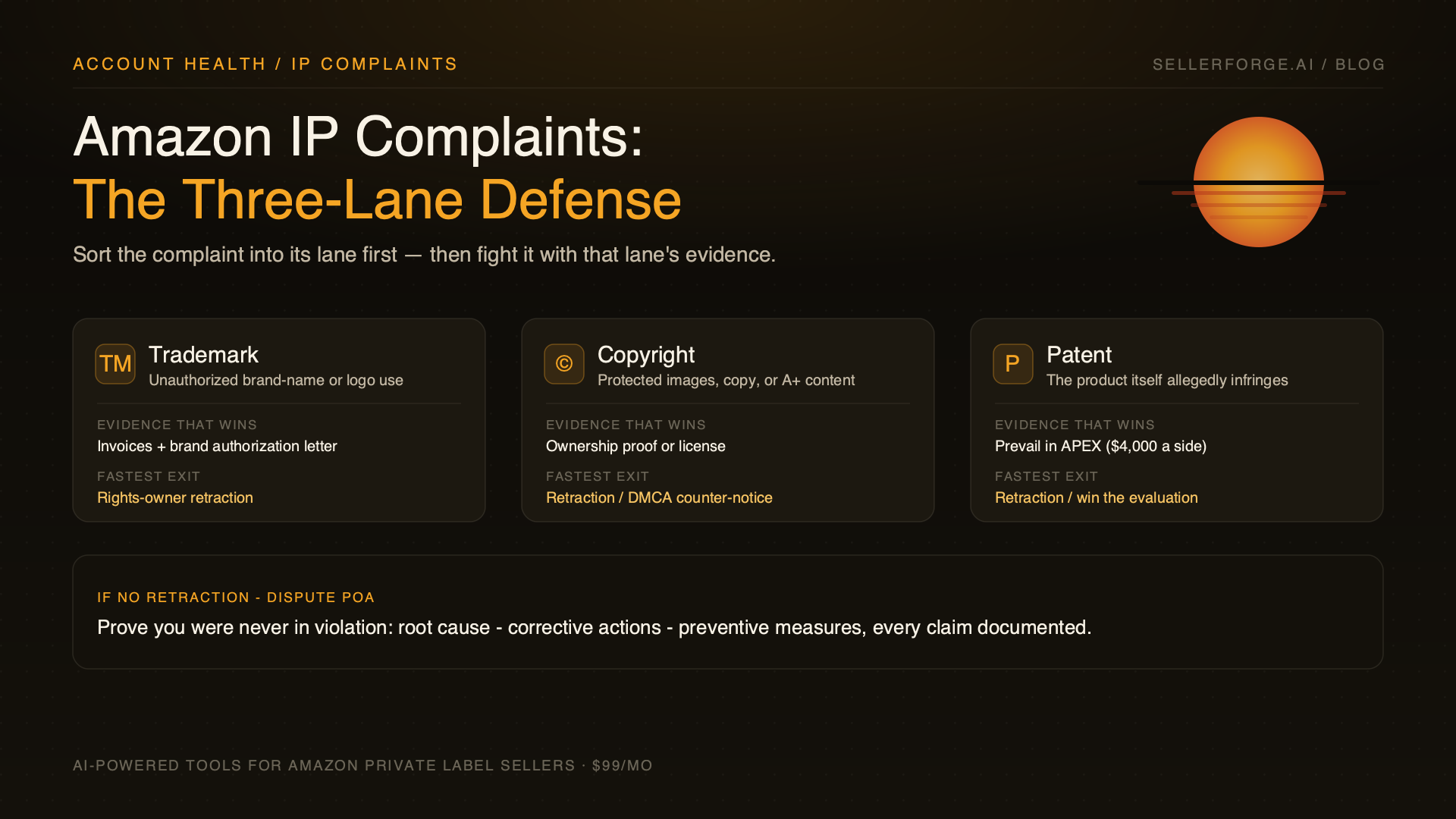
Sort an Amazon IP complaint into its lane before you respond: trademark needs authorized-sourcing evidence, copyright needs ownership or a license (and carries the only statutory counter-notice), and utility-patent disputes run through Amazon's APEX program at $4,000 a side. The fastest exit in every lane is a retraction from the rights owner. If you dispute instead, your Plan of Action must prove you were never in violation — a fundamentally different argument from a standard POA.
An Amazon IP complaint is not one problem — it is three different problems wearing the same performance notification. A trademark complaint, a copyright complaint, and a patent complaint each allege a different kind of violation, demand a different evidence file, and offer a different fastest exit. The single most expensive mistake sellers make is answering one lane's complaint with another lane's evidence: sending supplier invoices to a copyright complaint, or a heartfelt authorization story to a patent evaluator who only reads claim charts.
This guide is the 2026 version of the playbook: how to sort the complaint in the first hour, what wins in each lane, when a retraction beats an appeal, what the DMCA actually does and does not cover on Amazon, and how the Plan of Action changes when your argument is "I was never in violation" rather than "I fixed it."
The Three-Lane Defense: Sort the Complaint Before You Answer It
The Three-Lane Defense is the discipline of classifying an IP complaint by right type — trademark, copyright, or patent — before writing a single word of response, because the lane determines the evidence, the forum, and the fastest exit. Your performance notification names the right type and the complainant. Read it twice, sort it once, and build only that lane's file.
The stakes of sorting correctly went up, not down, as Amazon's enforcement got more automated. Amazon's 2025 Trustworthy Shopping Experience Report says its proactive controls now block more than 99.9% of suspected infringing listings before a brand ever reports them — which means the complaint that did reach your account had a human rights-owner behind it, and a human decision to target you. Treat it accordingly.
| Lane | What it alleges | Evidence that wins | Fastest exit | Statutory counter-notice? |
|---|---|---|---|---|
| Trademark | Unauthorized use of a brand name or logo | Supplier invoices to an authorized source + brand/distributor authorization letter | Rights-owner retraction | No — Amazon policy process only |
| Copyright | Your images, copy, or A+ use protected content | Proof you created it, a license, or grounds the content is not protectable | Retraction, or DMCA counter-notice | Yes — DMCA §512(g) |
| Patent | The product itself infringes a patent | Prevailing in APEX, a license, or attorney non-infringement analysis | Retraction, or winning the APEX evaluation | No — APEX or federal court |
One rule before anything else: never answer a lane with another lane's evidence. Invoices prove sourcing, not image ownership. An authorization letter says nothing about a patent claim. Mismatched evidence reads as evasion and hardens the reviewer's skepticism for every later attempt.
Lane 1: Trademark — Prove the Source, Not the Sentiment
A trademark complaint alleges your listing uses a brand's name or logo without authorization, and the only evidence that resolves it is a documented chain from your inventory back to an authorized source: supplier invoices, the distributor's authorization from the brand, and proof the goods are genuine. Everything else — tenure, feedback score, good intentions — is noise to the reviewer.
These are the most common IP complaints on Amazon, and they can hit sellers of perfectly genuine products. If you sell branded goods bought through gray-market channels — genuine, but imported outside the brand's official distribution — understand that Amazon's process structurally favors the brand's preferred distribution map. Winning a gray-market dispute is possible but slow; preventing it means verifying authorization before you list, not after the complaint.
- Invoices (not pro formas, not screenshots) from the distributor, matching quantities and dates to your inventory
- An authorization letter or distribution agreement naming the distributor — or you — as authorized for the brand
- Certificates of Authenticity where the brand issues them
- For your own brand: your registration number and Brand Registry enrollment, which flips the complaint into a bad-faith dispute (below)
Lane 2: Copyright — The Only Lane With a Statutory Counter-Notice
A copyright complaint alleges your listing content — images, bullets, A+ modules — belongs to someone else, and it is the one lane governed by an actual statute on Amazon: the DMCA. That gets misstated constantly, including by an earlier version of this article. The DMCA's notice-and-takedown framework covers copyright only; trademark and patent removals are Amazon policy choices with no statutory appeal.
The DMCA cuts both ways. It is why Amazon removes content fast on a compliant notice — but it also hands you the counter-notice, the only formal reinstatement mechanism in the whole IP complaint system. File one and, under §512(g), the content should be restored in 10–14 business days unless the complainant sues you in federal court within that window.
A counter-notice is a legal filing, not a support ticket. You swear under penalty of perjury that the takedown was mistaken, identify yourself, and consent to federal jurisdiction — and once submitted it cannot be withdrawn. If the complainant is litigious, you have just invited the lawsuit. Have a copyright attorney sanity-check it first; the fee is small against the downside.
If your evidence is ownership (you shot the images, wrote the copy), gather creation files with metadata and timestamps. If it is a license, produce the agreement and its scope. If your defense is that the content is not protectable — factual product specs, generic phrasing — say so explicitly in the POA. And if you actually did lift the images, concede the lane: remove the content, document the removal, and write the corrective-action POA rather than a dispute.
Lane 3: Patent — APEX Changed the Game
A utility patent complaint on Amazon now usually runs through APEX — Amazon Patent Evaluation Express — a neutral-evaluation program the old version of this guide predated entirely. The patent owner asserts one claim of a US utility patent against up to 20 ASINs; each side deposits $4,000; a licensed patent attorney evaluates written briefs and decides whether infringement is likely.
The mechanics matter because the defaults are brutal. Accused sellers get roughly three weeks to opt in. Decline, and the listings come down automatically — no evaluation, no appeal. Participate and prevail, and your $4,000 deposit comes back (the loser's deposit pays the evaluator), your listings stay live, and the same patent claim cannot be re-run against them through APEX. It is, as patent counsel routinely describe it, orders of magnitude cheaper and faster than district-court litigation.
- 1Calendar the opt-in deadline the day the APEX notice arrives — the three-week window is the whole game.
- 2Retain patent counsel to read the asserted claim against your product before you decide anything; APEX briefs are claim analysis, not narrative.
- 3Attempt a retraction in parallel: many patent complaints settle with a license or a design-around commitment before the evaluation runs.
- 4If your product plainly does not practice the claim, opt in — the economics favor a seller with a genuine non-infringement position.
- 5If it plainly does, negotiate or exit the ASIN; a lost evaluation plus a hostile rights owner is the worst position available.
Design patents and non-US patents fall outside APEX and follow the ordinary notice-dispute-POA path, where an attorney's non-infringement analysis is typically the evidence Amazon expects — a personal declaration that your product "doesn't infringe" carries no weight.
The Fastest Exit in Every Lane: The Retraction
Whatever the lane, a retraction from the rights owner beats any appeal you can write: Amazon reinstates on a confirmed retraction, usually within days, with no POA review cycle at all. It should be the first play in parallel with your evidence gathering, not the fallback after a failed appeal.
The notification names the complainant and a contact. Write professionally, without arguing merit, and ask one question: what specific resolution would lead you to retract? For legitimate brands the answer is usually concrete — remove the listing, produce authorization, commit not to relist. Give them the retraction language and the complaint ID to make it frictionless. Keep the entire thread; if the retraction falls through, the correspondence becomes exhibit one in your POA that you acted immediately and in good faith.
| Path | Best when | Typical timeline | The risk to weigh |
|---|---|---|---|
| Rights-owner retraction | Complaint has merit, or the complainant is reachable and reasonable | Days once confirmed | Careless wording can read as an admission — resolve terms before you concede anything in writing |
| Dispute POA (Account Health Dashboard) | You hold authorization, ownership, or license evidence | Days to weeks per review cycle | A weak first submission hardens skepticism for every resubmission |
| DMCA counter-notice (copyright only) | You are confident of ownership and prepared to be sued | 10–14 business days unless a lawsuit is filed | Irrevocable; identifies you and consents to federal jurisdiction |
| APEX (US utility patents) | You have a genuine non-infringement position | ~3 weeks to opt in, then briefing and decision | $4,000 deposit, refunded only if you prevail; declining removes the listings automatically |
Writing the POA When You Cannot Get a Retraction
An IP-complaint POA keeps the standard three-section skeleton — root cause, corrective actions, preventive measures — but when you dispute the complaint, the root-cause section inverts: it explains why the complaint lacks merit, not what you did wrong. That inversion is what makes IP appeals different from every other suspension type, and reviewers read hundreds of them; a dispute POA that drifts into apology reads as a confession.
Disputing: "The trademark complaint filed on [DATE] for ASIN [ASIN] concerns our use of [BRAND]. We are an authorized reseller, having purchased the product from [DISTRIBUTOR], authorized by [BRAND] (authorization letter and invoices attached). Our use of the brand name is accurate product identification." Conceding: name the real failure — an unverified supplier, images sourced without a license — then document what you already removed, replaced, or terminated, past tense, with dates.
The section-by-section mechanics — past-tense corrective actions, systemic preventive measures, the 300–500 word ceiling — are covered in our POA templates with worked examples and the broader guide to drafting a POA with AI. Preventive measures in the IP lane are sourcing controls: authorization verified before any branded ASIN goes live, image and copy provenance confirmed before any listing ships, and a periodic listing audit. SellerForge's POA Builder drafts the structure from your actual case data, and the Document Vault keeps invoices and authorization letters assembled before the day you need them.
Bad-Faith Complaints: Fight Them as Fraud, Not as Appeals
A bad-faith IP complaint — a competitor weaponizing a vague registration, or a fabricated claim aimed at knocking your listing down in Q4 — is contested by disputing its validity explicitly, evidencing your own rights, and reporting the complainant, not by writing a remorseful POA for a violation that never happened. Apologizing for fiction is the one unrecoverable move.
The environment shifted in your favor here. Amazon's Counterfeit Crimes Unit — which has pursued more than 32,000 bad actors through litigation and criminal referral since 2020 — now also sues fraudulent complainants: a 2024 action targeted actors who obtained invalid trademarks or filed fake complaints to strip rivals' listings, and Amazon has filed multiple suits against parties impersonating copyright owners. Your abuse report through Brand Registry's Report Abuse channel feeds that machinery, so file it every time with the complaint ID, your registrations, and the pattern (timing, repeat filer, competitor relationship).
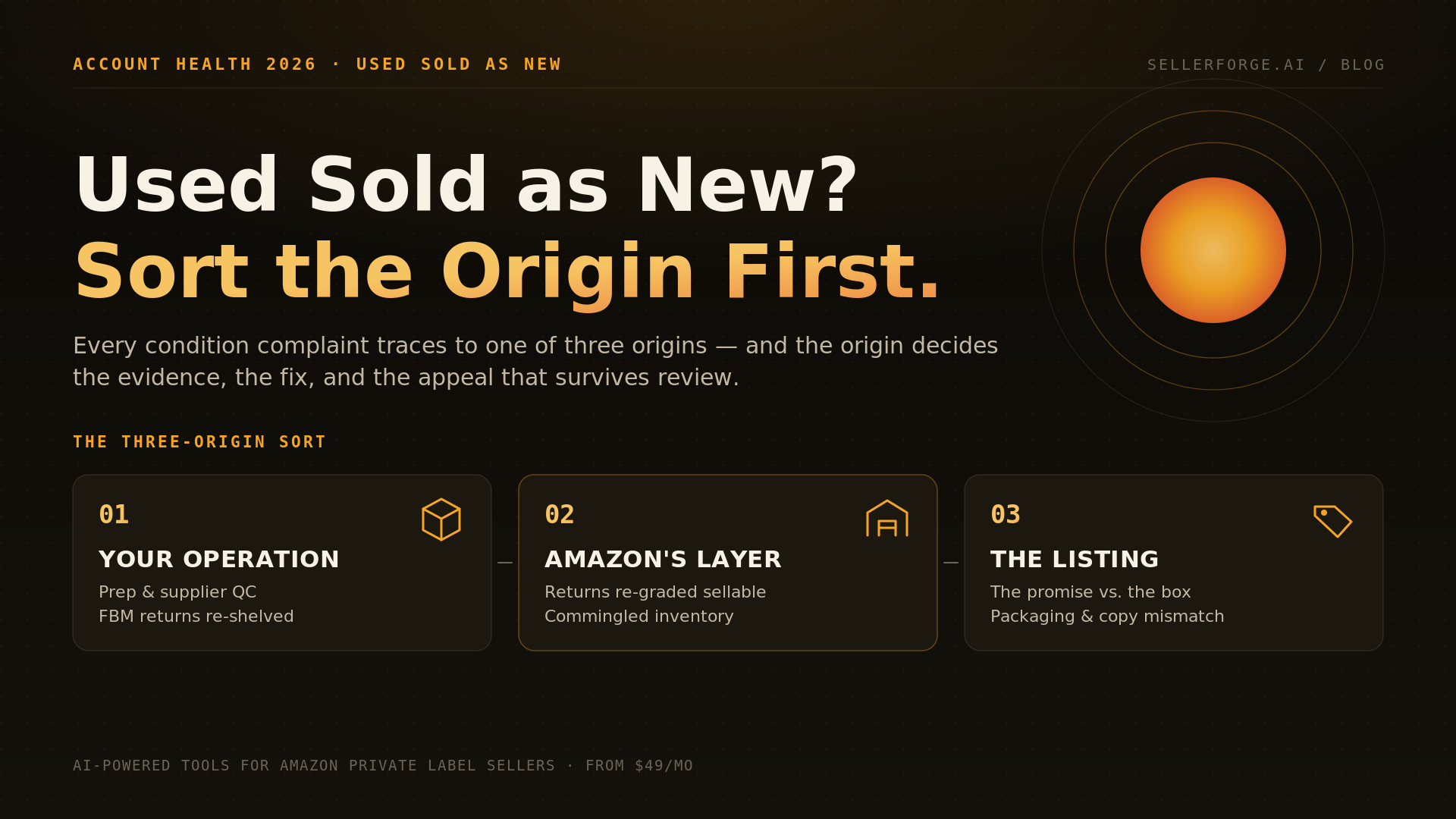
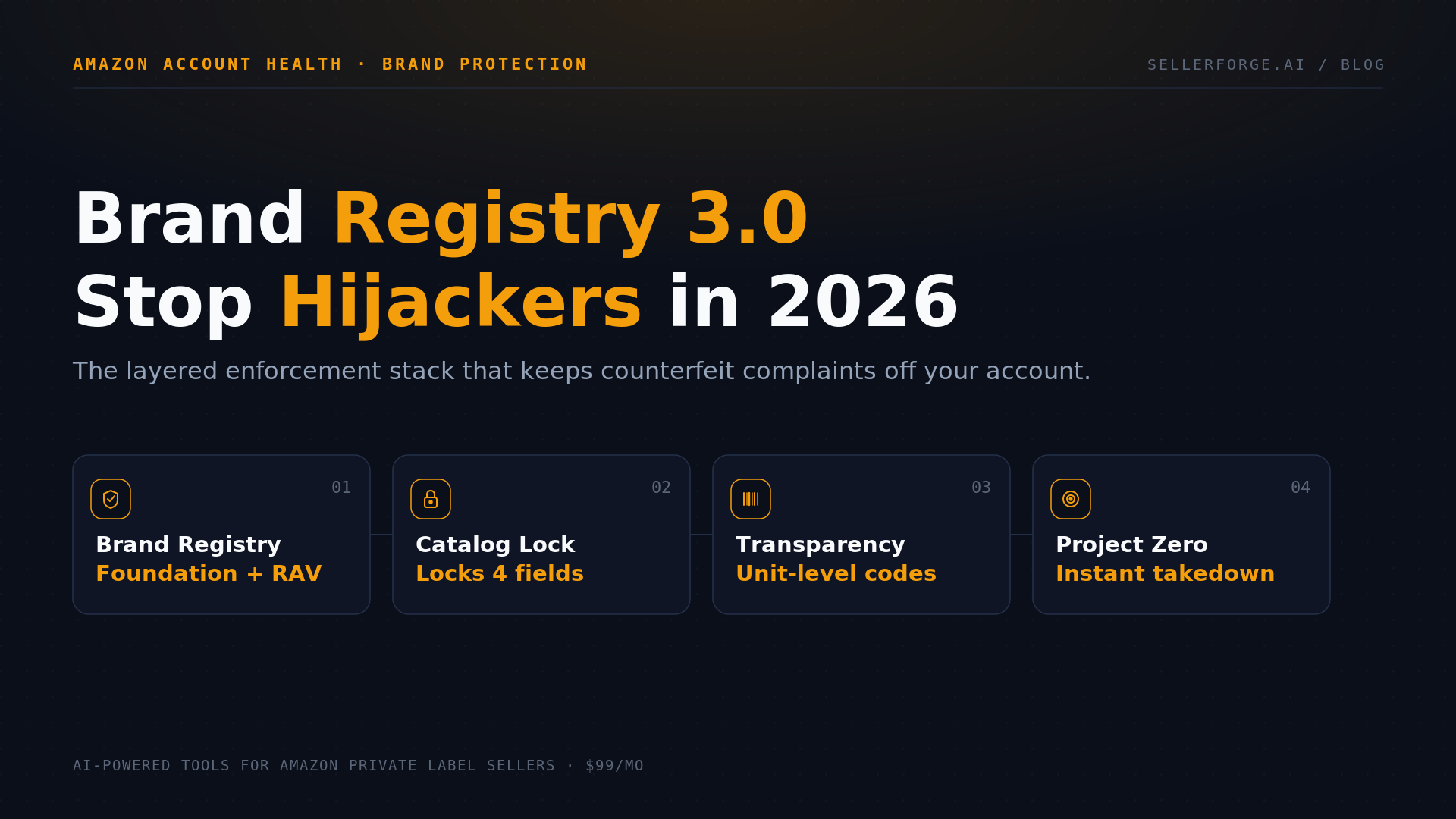
If your own brand is the one being hijacked or targeted, the offense-side toolkit — Brand Registry enforcement, Transparency (which has verified more than 2.7 billion genuine units), Project Zero — is covered in Brand Registry 3.0: stopping hijackers and counterfeiters in 2026.
What an IP Complaint Does to Your Account Health
Every IP complaint lands as a policy violation on your Account Health Rating — the 0–1,000 score where 200 and above reads healthy — typically deducting 2–8 points by severity, with repeat violations of the same policy able to double the hit. The listing-level takedown is the visible cost; the AHR erosion is the compounding one.
Left uncontested, complaints stack toward account-level review even while the headline number still shows green — which is how sellers with an 800 AHR receive deactivation notices. Resolve every complaint to closure (retraction, successful dispute, or documented concession), because a complaint you ignored reads to Amazon like a violation you accepted.
If the account has already been deactivated over IP triggers, you are in Section 3 territory — a different fight with its own evidence families and escalation ladder, covered in the Section 3 deactivation guide. And in the first two days after any takedown, sequence matters more than speed: the first-48-hours playbook covers what to do before you submit anything. SellerForge's Escalation Plans module maps that ladder to your specific case.
Prevention: The Cheapest IP Defense Is the One You Never File
Preventing IP complaints is a sourcing-and-provenance discipline, not a legal one: verify brand authorization before listing, own or license every pixel and sentence in your content, run a trademark search before naming a private-label product, and enroll your own brand in Brand Registry so you hold the enforcement tools instead of facing them.
- Verify supplier authorization against the brand's distributor list before any branded ASIN goes live — never after a complaint
- Create original images and copy, or hold written licenses with scope that covers Amazon use
- Run a USPTO search (and a basic design-patent scan for lookalike products) before launching any private-label SKU
- Enroll in Brand Registry with your registered trademark; use IP Accelerator if your application is still pending
- Audit your live listings quarterly for content you cannot prove you own — the complaint you find first is the one you never receive
That last item is automatable: SellerForge's Listing Audit module sweeps your catalog for listing-level risk so provenance gaps surface as a checklist instead of a performance notification.
The Bottom Line
IP complaints are the one suspension family where the right response is sometimes "you're wrong, and here is the proof" — but only when you have sorted the lane, built that lane's evidence file, and chased the retraction in parallel. Trademark is a sourcing-documentation fight, copyright is the only lane with a statutory reinstatement clock, and utility patents run through a $4,000-a-side evaluation most sellers still haven't heard of. The sellers who lose are almost never the ones without a defense; they are the ones who answered the wrong lane, or answered slowly.
If you'd rather have the evidence file assembled before the notification arrives, start a free SellerForge trial — the POA Builder, Document Vault, and Listing Audit modules exist for exactly this week of your seller life.
Sources
Proactive-blocking, counterfeit-seizure, and Transparency figures are from Amazon's 2025 Trustworthy Shopping Experience Report (published April 2026). Counterfeit Crimes Unit history and its litigation against fraudulent complainants: Amazon CCU. APEX mechanics ($4,000 deposits, one claim vs up to 20 ASINs, evaluator process): Harness IP's APEX explainer and Amazon Seller Central. DMCA notice, takedown, and counter-notice framework: 17 U.S.C. §512 (copyright.gov). Account Health Rating scale and deduction ranges reflect published 2026 seller guides; Amazon does not publish a per-violation point table, so treat those as planning figures.
About the author
David Gallo is the founder of SellerForge.ai. He previously managed 57 Amazon accounts representing over $350M in sales at Worldfront before building SellerForge to give sellers AI-powered tools at agency quality without the agency price.