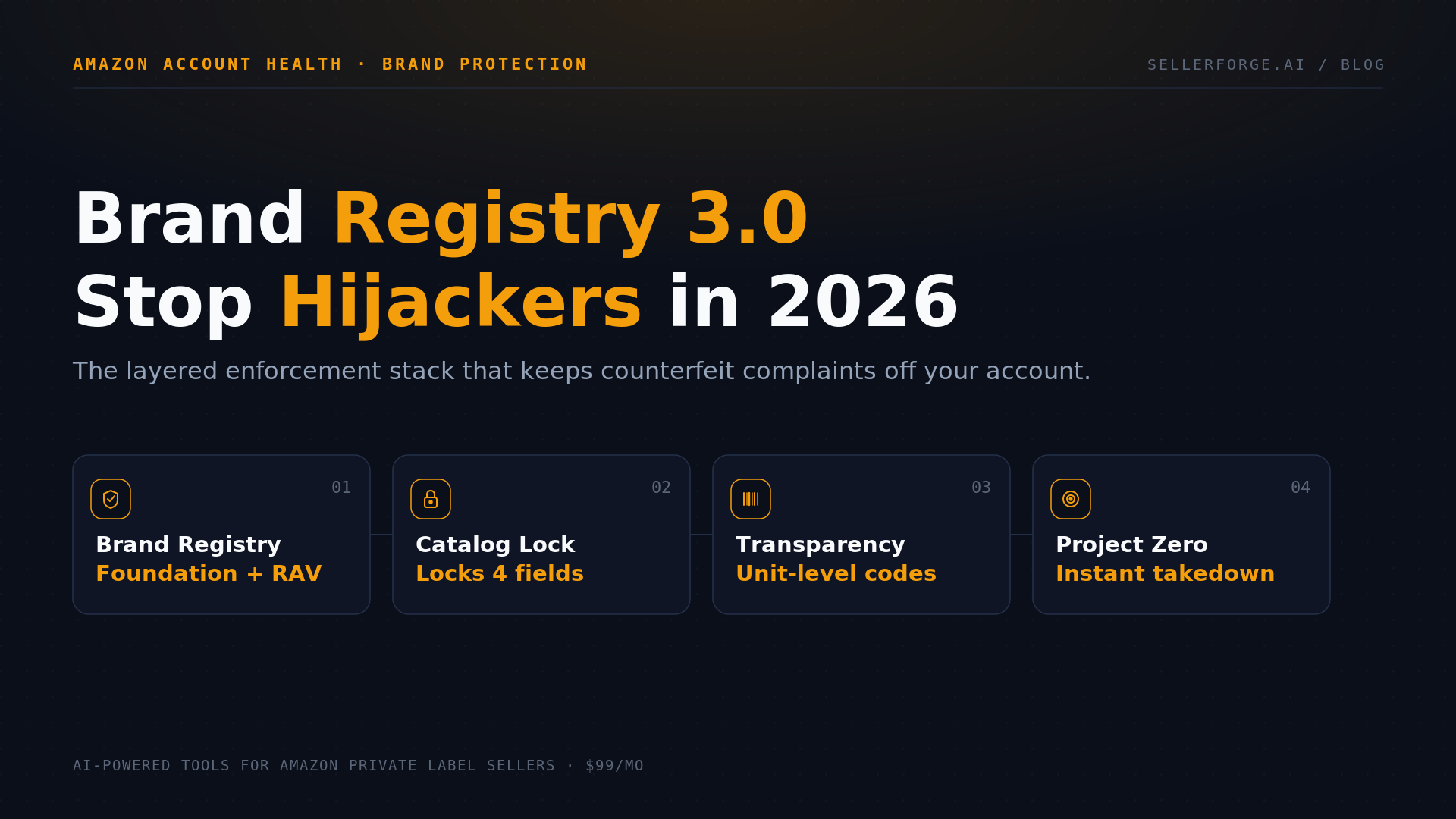
A hijacker's counterfeit offer on your ASIN can become a counterfeit complaint on your account — and one confirmed counterfeit drops your Account Health Rating to 0 with only a 3-day grace period. Brand Registry 3.0 is the layered defense: Brand Registry, Catalog Lock (locks your title, images, bullets, and description), Transparency (unit-level codes), and Project Zero (instant takedowns under a 99% accuracy rule). Turn on all four and keep an evidence package ready.
Most guides will tell you a hijacker is a competitor problem: someone piggybacks on your ASIN, undercuts your price, and steals your Buy Box. True, and painful. But in 2026 that's the small version of the problem.
The big version is what happens after. The hijacker isn't selling your product — they're selling counterfeit, used, or inferior stock under your brand name. A buyer receives it, is disappointed, and files a complaint. That complaint doesn't attach to the hijacker. It attaches to the listing, which means it can land on your account as an authenticity or counterfeit complaint. And under Amazon's policy-compliance rules, a single confirmed counterfeit can drop your Account Health Rating to zero with a three-day grace period to save your business.
That's the reframe this guide is built on: brand protection is not an IP side-quest. It's Account Health. A hijack you don't shut down fast enough becomes a complaint, and a complaint you don't beat becomes a suspension. The good news is that Amazon has quietly assembled a genuinely strong defensive toolkit — what operators now call Brand Registry 3.0 — and most brands are using maybe half of it.
The 2026 Threat Landscape (and Why Amazon's Numbers Cut Both Ways)
Amazon's own 2025 brand-protection reporting paints a picture of a platform winning the volume war. The company says it identified, seized, and disposed of more than 15 million counterfeit products globally in 2025; that its proactive controls blocked over 99% of suspected infringing listings before a brand ever had to find and report them; that it invested over $1 billion in brand protection in 2024; and that its Counterfeit Crimes Unit has pursued more than 32,000 bad actors through litigation and criminal referrals across 14 countries since 2020. More than 2.7 billion units have been verified as genuine through the Transparency program.
Those numbers are real and impressive. But read the most important one again: proactive controls block over 99% of suspected infringing listings automatically. That means the counterfeits that actually reach your listing are, by definition, the ones sophisticated enough to slip past Amazon's automated net. Amazon catches the obvious, mass-produced fakes at scale. What's left — the targeted hijack of your specific ASIN by someone who knows what they're doing — is exactly the threat that lands on you. The platform's success at the top of the funnel is precisely why the bottom of the funnel is your job.
The mental model for 2026: Amazon's machine learning is your first line of defense, not your only one. The fakes that get through the 99% filter are the targeted, persistent ones — and those are the ones that generate the complaints that hit your Account Health.
Why a Hijacker Is an Account Health Problem
Here's the chain most sellers don't connect until it's too late. A hijacker adds an offer to your ASIN. To win the Buy Box, they price below you, often with counterfeit or used stock. Customers buy what they think is your product. Some of them are unhappy. They leave authenticity complaints, file A-to-z claims, or report the item as "not as described" or "counterfeit." Those signals accumulate on the listing — and Amazon's enforcement systems don't always pause to figure out that it was the hijacker, not you, who shipped the bad unit.
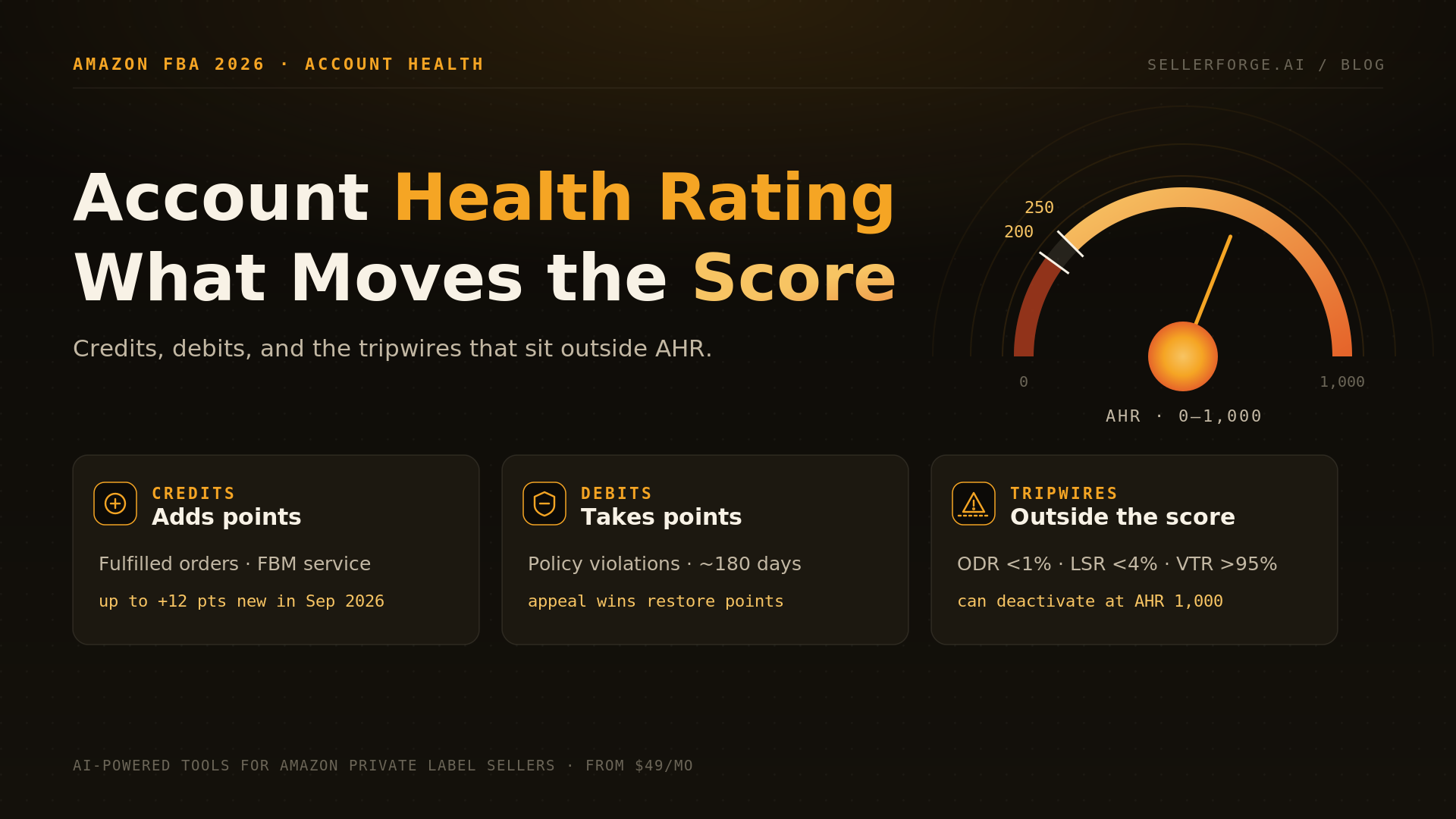
The reason this is dangerous is that Amazon's policy-compliance violations operate independently of your performance metrics. You can have a pristine Account Health Rating, a 0.2% Order Defect Rate, and perfect shipping — and still be one confirmed counterfeit away from deactivation. These are the kill-shots:
| Violation type | Limit (180-day window) | Consequence at the limit |
|---|---|---|
| IP infringement (trademark / copyright / patent) | ~5 violations | Automatic account deactivation |
| Restricted-product violation | 2 violations | Automatic account deactivation |
| Authenticity complaint | ~5 violations (varies) | Listing or account deactivation |
| Counterfeit confirmed via test buy | 1 violation | AHR → 0 instantly, 3-day grace period |
A seller with an AHR of 800 and four unresolved IP complaints is one complaint away from total deactivation — but their AHR alone still reads "healthy." That's the trap. And enforcement got stricter: in Q1 2026 Amazon tightened its account-health thresholds, with reports of a single unresolved restricted-product warning now carrying roughly the score impact of three late-shipment violations, and brands that had been coasting at green receiving suspension notices with 72-hour cure windows. The margin for letting a hijack fester shrank.
If a counterfeit complaint does land on your account, speed and structure are everything — you generally want to respond within about five business days with counter-evidence, and a clean Plan of Action if it escalates. We've covered that recovery path in depth in Writing an Amazon Plan of Action for IP, Trademark & Copyright Complaints and the broader triage in Amazon Account Suspended? The First 48 Hours. This guide is about the layer before that: not getting there in the first place.
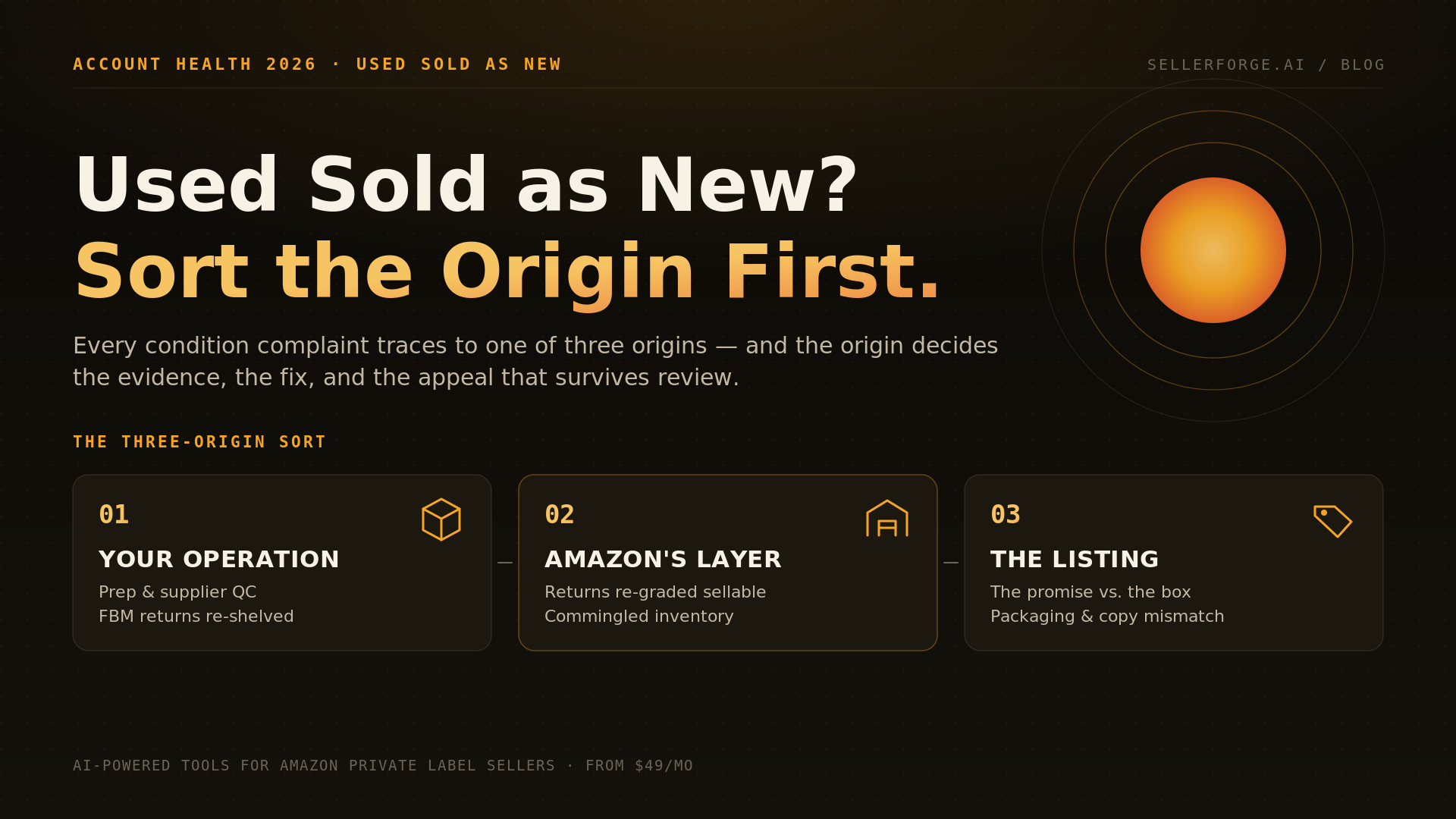
When an authenticity complaint escalates past the listing and hits the account, it usually arrives as a section 3 deactivation with no trigger named. The Section 3 guide covers the sourcing evidence file that family requires and the 2026 escalation ladder after a first rejection.
Brand Registry 3.0: The Four-Layer Enforcement Stack
"Brand Registry 3.0" isn't a product Amazon sells — it's how operators describe the current, layered state of brand protection. The shift from the old model is real: Brand Registry used to be a place you went to report a problem. Now it's the base of an enforcement architecture with four layers, each closing a different attack vector. Here's how they stack.
Layer 1 — Brand Registry (the foundation)
Everything else requires this. Enrollment needs an active registered trademark, or a pending application filed through Amazon's IP Accelerator (which grants Brand Registry access while your mark is still pending). Brand Registry gives you the Report a Violation tool, automated protections that scan for obvious infringement, and the authority to act on your listings. But understand its default posture: standard Brand Registry operates as "others can contribute, you dispute." It gives you the right to report — not, by itself, the power to prevent edits.
Layer 2 — Brand Catalog Lock (the one most brands leave off)
This is the highest-leverage, lowest-effort move in the entire stack, and it's the one most brands haven't turned on. Brand Catalog Lock lets you lock the four highest-impact detail-page fields — title, hero image, bullet points, and description — so unauthorized contributors simply cannot edit them. When a hijacker or rogue contributor tries to change a locked field, the edit is rejected and they get a "brand-restricted" error. It flips the default from "others can contribute, you dispute" to "only you can edit."
It launched quietly in 2025 — no press push, no Seller Central pop-up, no notification email to existing brand-registered accounts — which is exactly why adoption is so low. One agency that audited 200+ brand-registered accounts found only about 31% had Catalog Lock enabled. It's included with Brand Registry at no additional cost. If listing-edit hijacks are 80% of the damage, this is 80% of the defense, free, sitting in your dashboard unused.
Do this today: enable Brand Catalog Lock on your brand. It's free, it takes minutes, and it eliminates the single most common hijack vector — unauthorized edits to your title, images, bullets, and description.
Layer 3 — Transparency (unit-level authentication)
Transparency moves the fight from the listing to the individual unit. Every genuine unit gets a unique 2D code; Amazon scans that code before shipping, so a counterfeit unit without a valid code gets caught before it ever reaches a customer. With 2.7 billion+ units verified, it's a proven preventive layer for brands fighting physical counterfeits rather than just listing edits.
The historical objection was cost and operational drag — printing and applying Amazon-issued codes. In 2025 Amazon introduced Transparency Interoperability, which lets brands that already serialize their products connect their existing manufacturing serial codes to the Transparency system instead of applying new Amazon-issued ones. For brands already running serial numbers, that cut the enrollment cost and effort dramatically and removed the main reason to skip it.
Layer 4 — Project Zero (instant self-service takedowns)
Project Zero is the reactive power tool. It bundles three things: a self-service removal tool that lets you take down suspected counterfeit listings instantly, without waiting for Amazon to review your report; automated protections that use your logos and brand data to proactively scan and block suspected counterfeits; and product serialization. Crucially, every time you remove a listing through Project Zero, that action feeds back into Amazon's machine learning, which uses it to detect and block similar listings before they go live. You're training the 99% filter on your specific brand.
But Project Zero has a sharp edge you must respect. To keep access, Amazon requires you to maintain at least 99% accuracy on your self-service removals. Fall below 99% and Amazon can permanently revoke your access to the tool. That makes it powerful but unforgiving: it is not a tool for removing a competitor you merely suspect, or a reseller you dislike. Fire it only on confirmed counterfeits where the evidence is airtight — and keep that evidence, because a wrong removal isn't just reversed, it counts against the standing that keeps the tool in your hands.
Put the four layers side by side and the strategy becomes obvious — each one covers a gap the others leave open:
| Layer | What it stops | Cost | The catch |
|---|---|---|---|
| Brand Registry | Obvious infringement; gives you reporting authority | Free (needs a trademark) | Default is "report and dispute," not "prevent" |
| Brand Catalog Lock | Unauthorized edits to title / image / bullets / description | Free with Registry | Off by default — you must enable it |
| Transparency | Physical counterfeit units, before they ship | Per-unit code (cheaper with Interoperability) | Operational setup on every unit |
| Project Zero | Counterfeit listings — instant self-service removal | Free after eligibility | Must keep 99% removal accuracy or lose access |
Treat Your Enforcement Dashboard Like an IP Health Score
Sellers obsess over their Account Health Rating because Amazon put a number on it. Brand protection has no equivalent single score — so most brands treat it as a series of one-off fires instead of a metric to manage. That's a mistake. Your Brand Registry enforcement activity is a leading indicator of account risk, and you should read it the same way you read AHR: as a trend, weekly.
What to monitor on a recurring cadence:
- 1New unauthorized offers on your ASINs — the count and how fast you detect them. Detection latency is the variable you most control.
- 2Takedown latency — how long from detecting an infringer to a confirmed removal. This is the window in which complaints accumulate on your account.
- 3Repeat infringers — the same bad actors returning under new seller names signal you need to escalate beyond self-service.
- 4Your Project Zero removal accuracy — watch the 99% line like it's a suspension threshold, because for the tool, it is.
- 5Authenticity and IP complaint counts on your account — the downstream symptom. Rising counts mean an upstream hijack you haven't shut down.
The point of tracking these together is correlation. When you log enforcement actions over time, a Buy Box that dropped three weeks ago or a complaint that surfaced last week stops being a mystery — you can tie it back to a specific hijack and act on the pattern, not the symptom.
Win on Evidence and Speed: The Defensible Brand File
Whether you're firing a Project Zero takedown, submitting a Report a Violation, or rebutting a counterfeit complaint that landed on your account, you win the same way: with proof, fast. The brands that lose are the ones scrambling to find their trademark certificate while a 72-hour cure window ticks down. The brands that win have the package ready before they need it.
Keep these assembled and current, not scattered across inboxes and drives:
- Trademark registration certificate and registration number, plus any pending IP Accelerator filing details.
- Manufacturer invoices and supply-chain documentation proving your units are genuine and sourced legitimately.
- Test-buy documentation — order IDs, photos, and side-by-side comparisons showing how a hijacker's unit differs from your authentic product.
- UPC, GTIN, and serial/Transparency code records tying units back to you.
- Brand authorization letters for any legitimate resellers, so you can distinguish authorized from unauthorized offers instantly.
- A short, repeatable counter-evidence template for IP complaints, so a response goes out within days, not weeks.
Where SellerForge Fits
Brand Registry, Catalog Lock, Transparency, and Project Zero are Amazon's tools — turn them all on. What they don't give you is the operating layer around them: the evidence kept ready, the recovery handled when a complaint slips through, and the timeline that ties it all together. That's the gap SellerForge is built to close.
Keep the evidence package ready. The Document Vault holds your trademark certificate, supplier invoices, test-buy proof, and authorization letters in one place, so when you fire a takedown or answer a complaint, the proof is a click away — not a frantic search against a cure-window clock.
Handle the complaint that gets through. When an authenticity or counterfeit complaint rebounds onto your account, the Plan of Action Builder turns your evidence into a structured, root-cause-and-corrective-action POA in the format Amazon expects — the difference between a fast reinstatement and a second rejection.
Escalate when self-service stalls. Repeat hijackers and complaints Amazon won't resolve need a path beyond the report button. Escalation Plans give you the structured enforcement and escalation route so a persistent infringer doesn't quietly bleed your Account Health for weeks.
Make every takedown explainable later. Log each hijack, removal, and complaint on the Business Event Timeline, and when a Buy Box drop or a suspension notice shows up, you can correlate it to the exact event instead of guessing.
Ask in context. The built-in AI Assistant knows your catalog and your account, so "which of my ASINs has an unauthorized offer right now?" or "how many IP complaints am I carrying in the 180-day window?" is a question you can actually answer — not a generic best-practices lecture. The same hijacker threat shows up from the sales side in our Winning the Amazon Buy Box in 2026 playbook; this is its account-health counterpart.
The Bottom Line
Stop thinking of hijackers and counterfeiters as a competitor nuisance and start treating them as the single biggest unmanaged risk to your Account Health. The chain is short and unforgiving: a hijack becomes a complaint, and a complaint becomes a suspension. Amazon's automated systems stop the obvious 99% — your job is the targeted remainder that lands on your listing.
The defense is already built and mostly free. Enroll in Brand Registry, turn on Brand Catalog Lock today, add Transparency if you fight physical fakes, and use Project Zero with discipline against the 99% accuracy line. Then manage it like a metric — track detection and takedown latency, keep your evidence package ready, and shut hijacks down before they ever reach your Account Health dashboard.
Want the brand-protection and Account Health layers working together? Start a free SellerForge trial — keep your evidence in the Document Vault, your enforcement on the Business Event Timeline, and a POA ready the moment a complaint lands.
About the author
David Gallo is the founder of SellerForge.ai. He previously managed 57 Amazon accounts representing over $350M in sales at Worldfront before building SellerForge to give sellers AI-powered tools at agency quality without the agency price.