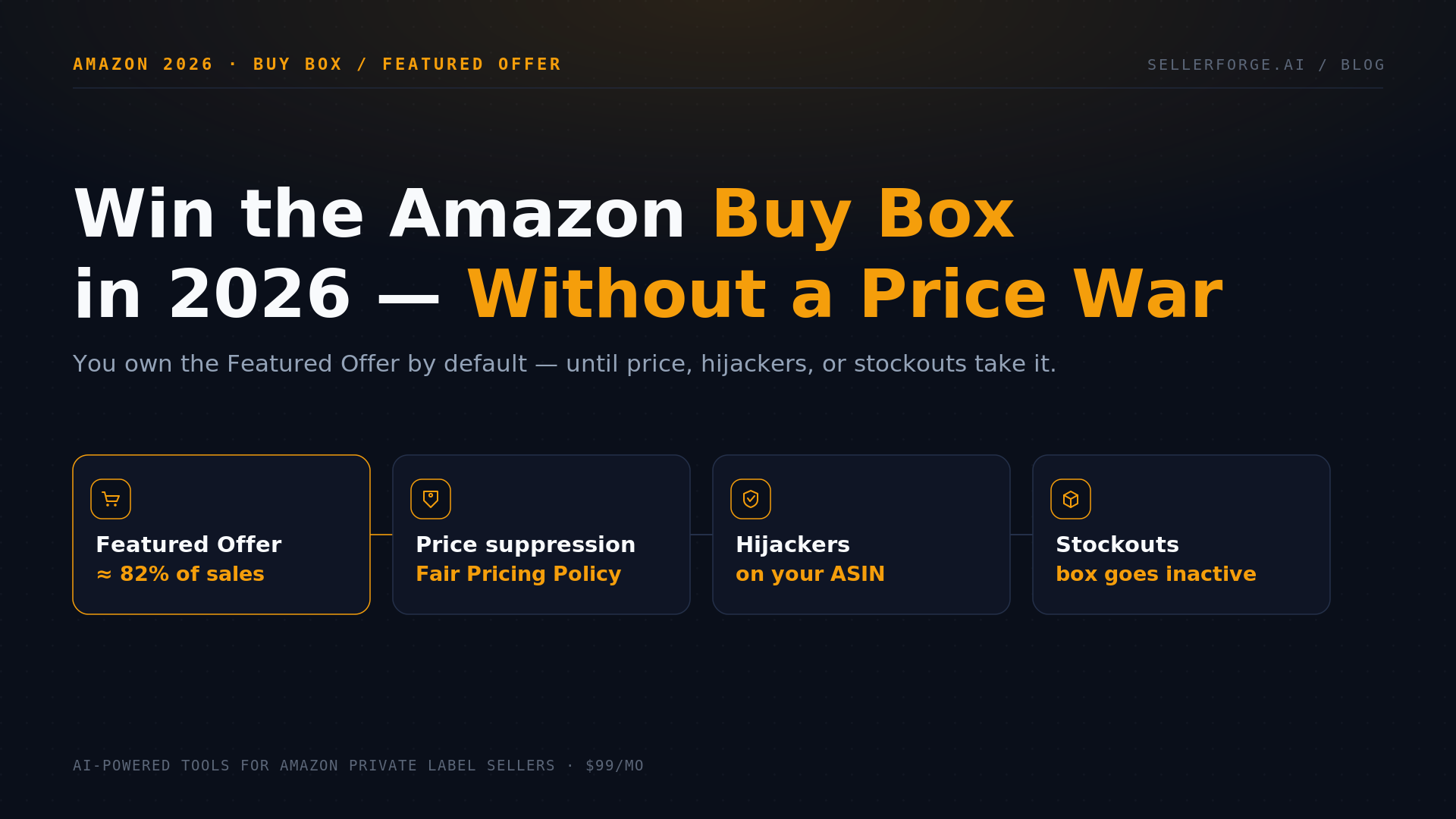
The Buy Box — officially the Featured Offer — still carries about 82% of Amazon sales, and more on mobile. In 2026 the algorithm weights delivery speed at roughly 25–30% (price tolerance widened to ~2–3%), and FBA wins the box 3–5x more often than FBM. For a private-label seller who owns the ASIN, the box is yours by default — you lose it three ways: price suppression under the Marketplace Fair Pricing Policy, a hijacker jumping your listing, or a stockout that makes the box disappear entirely. The 2026 game is defense, not a price war.
If you sell private label on Amazon, you've probably been told you don't need to think about the Buy Box. You own your ASIN, there's no one else on the listing, so the box is yours. That's true — right up until the morning it isn't. The sellers who treat the Featured Offer as automatic are exactly the ones who get blindsided when it vanishes.
The Buy Box — officially Amazon's 'Featured Offer' — still drives roughly 82% of everything sold on Amazon, and a higher share on mobile. Losing it doesn't mean you slip a few ranks. It means the 'Add to Cart' button disappears from your own product page and is replaced by a 'See All Buying Options' link that almost nobody clicks. Sales can fall off a cliff while your listing looks, to you, completely normal.
In 2026 the rules around the Featured Offer shifted in ways that matter more to private-label operators than to the resellers most Buy Box guides are written for. This is the operator's guide to how the box actually works now, the three ways a brand owner loses a box they already 'own,' and the defense routine that keeps it.
What the “Featured Offer” Actually Is in 2026
Amazon renamed the Buy Box the 'Featured Offer' years ago, but the nickname stuck because the thing it describes never changed: it's the single offer attached to the 'Add to Cart' and 'Buy Now' buttons. When more than one seller offers the same ASIN, Amazon picks one to feature. When a shopper clicks Buy Now, they're buying from whoever holds the box.
The reason it dominates everything is concentration. Industry sources — Helium 10, Repricer, ChannelEngine — consistently put the Featured Offer at roughly 80–83% of all sales, and on mobile, where the screen shows one offer and a long scroll to the rest, it's higher still. The other offers technically exist; commercially, they barely do.
Here's the 2026 reason it matters even more than the 82% figure suggests: discovery is going AI-mediated. When a shopper asks Alexa for Shopping — the assistant that replaced the standalone Rufus chatbot in May 2026 — to 'buy me a good one of these,' the assistant doesn't read out ten offers. It acts on one. The Featured Offer is the offer the AI buys on the customer's behalf. As more shopping flows through assistants, the box stops being a button on a page and becomes the entire transaction.
Reframe for 2026: the Featured Offer isn't a placement you compete for once. It's the default channel for ~82% of your sales and, increasingly, the one offer an AI assistant will act on. Treat holding it as an operating responsibility, not a set-and-forget setting.
The 2026 Algorithm: Delivery Speed Caught Up to Price
For a decade the shorthand was 'lowest landed price wins.' That was always a simplification, and in 2026 it's actively misleading. Amazon rebalanced what the Featured Offer rewards, and price is no longer the lever it once was.
The headline change: delivery-speed weighting rose to roughly 25–30% of the decision, while price tolerance widened to about 2–3%. Translated, a faster-shipping, healthier offer can now win the box at a slightly higher price than a slower competitor. You don't have to be the cheapest — you have to be competitive and fast. Landed price (product + shipping + fees) still breaks the tie when two offers are otherwise identical, but it shares the stage now.
Underneath that sit the eligibility gates that have always governed the box — fulfillment method, seller performance, and inventory depth. Here's the 2026 picture in one table:
| Factor | What Amazon wants in 2026 | Why it matters |
|---|---|---|
| Fulfillment method | FBA or Seller-Fulfilled Prime over FBM | FBA wins the box ~3–5x more often than FBM on the same listing |
| Landed price | Competitive within ~2–3% of the field | Tolerance widened — you no longer have to be the literal cheapest |
| Delivery speed | As fast as possible (Prime/2-day) | Now ~25–30% of the decision — the biggest 2026 change |
| Order Defect Rate | Under 1% (target under 0.5%) | Above 1% risks suspension, not just Buy Box loss |
| On-Time Delivery Rate | 90% floor, 97%+ to compete | 98%+ sees materially better placement in competitive niches |
| Cancellation / late shipment | Cancellation under 2.5%, late near 0% | Seller-fulfilled hygiene gates eligibility |
| Inventory depth | Ample, consistent stock | Thin or zero stock destabilizes — or forfeits — the box |
Read that table as a private-label, FBA seller and you'll notice something: FBA already handles most of it. Prime-speed delivery, valid tracking, Amazon-managed returns — all automatic. That's precisely why brand owners stop thinking about the box. The trap is that the factors FBA doesn't cover for you — your price, your catalog integrity, and your inventory depth — are exactly the three that take the box away.
The Private-Label Plot Twist: You Own the Box Until You Lose It
A reseller competes for the Featured Offer against other sellers on a shared ASIN, so 'winning the Buy Box' is a literal contest with literal opponents. A private-label brand owner is usually the only offer on the listing, which means you win by default. That's the good news, and it's also the reason complacency sets in.
Because here's the thing the generic guides skip: a brand owner can lose a box with no competitor in sight. There are exactly three ways it happens, each with a different cause and a different fix:
- 1Amazon suppresses your Featured Offer on pricing grounds — the Marketplace Fair Pricing Policy.
- 2A hijacker adds an offer to your ASIN and undercuts you, seizing the box on your own listing.
- 3You run out of stock (or your account health drops), and the box disappears or moves.
Let's take them in the order they tend to blindside private-label sellers — starting with the one that has no opponent at all.
Buy Box Killer #1: Price Suppression and the Fair Pricing Policy
This is the most disorienting one. You're the only seller, your price hasn't moved, and one day the box is simply gone — 'Add to Cart' replaced by 'See All Buying Options.' No competitor undercut you. Nothing in Seller Central obviously changed. What happened?
Almost always, it's Amazon's Marketplace Fair Pricing Policy. The algorithm doesn't only compare offers on your ASIN; it scrapes pricing off-Amazon — Walmart, Target, manufacturer sites, other marketplaces — and validates your shipping against standard carrier tables to stop margin-padding through freight. If your Amazon price looks significantly higher than a trusted external reference, Amazon suppresses the Featured Offer to keep the marketplace competitive for shoppers. The penalty escalates from there: in some cases the specific offer is suppressed so it can't be bought at all, and aggressive or repeated flags can pull the ASIN or trigger account-level action.
What's new for 2026 is the enforcement posture. The policy is being applied more tightly, more automatically, and wired deeper into seller-performance systems. Hurried price changes now collide with it constantly — a new price that looks excessive against your own historical price bands or an external benchmark can suppress the box, remove the ASIN, or escalate, with no warning email that's easy to connect to the cause.
And there's a genuinely unfair edge case private-label sellers keep hitting: your own past promotions. Brand owners have reported the box suppressed because Amazon's system treated an earlier Amazon deal price — or a low price they once ran — as the 'competitive external' reference, making the normal everyday price look inflated against their own discount. You end up competing with your past self.
Defensive pricing hygiene for 2026: keep a genuine, defensible list price; don't let a one-off flash deal quietly reset your reference price; keep your off-Amazon prices in line (enforce MAP with your resellers); and keep evidence — competitor URLs, your own price history — ready so you can prove a price is legitimate if you're ever flagged.
When you are suppressed, the fastest path back is usually to bring the price to or just under the flagged reference to restore the box while you investigate, then fix the root cause: align or enforce your off-Amazon prices, confirm your list price/MSRP is backed by a real offering price, and — critically — keep a log of every deal and price change so the next suppression is explainable instead of a mystery.
That last point is where most sellers are flying blind. If you log 'ran a 20%-off deal, May 3–7' and 'raised price 8% on June 1' the moment they happen, then when the box gets suppressed weeks later you can correlate it instead of guessing. SellerForge's Business Event Timeline exists for exactly this — a running record of your own pricing and promo events so a later Featured-Offer swing has an explanation attached.
Buy Box Killer #2: Hijackers Stealing a Box You Own
The second way to lose the box is to have it stolen. A hijacker adds their own offer to your ASIN — typically counterfeit, used, or imitation stock — and prices it well below yours. Because price and in-stock status still feed the algorithm, the hijacker can seize the Featured Offer on your own listing, the one you built.
The damage is double. You lose the sale, and because the order ships from the hijacker, the inevitable bad reviews for a fake or defective unit land on your listing — dragging down the rating you spent months and ad dollars building. Amazon seized more than 15 million counterfeit items in 2024, and listing hijacking stayed one of the most common brand attacks into 2026. If your box vanishes even though your price, speed, and account health are all fine, check for a second offer on the ASIN before anything else.
The defense stack, in order:
- Enroll in Brand Registry. It is the precondition for every other protection and gives you the authority to report and remove infringing offers.
- Turn on Brand Catalog Lock. This 2026 Brand Registry feature locks high-impact listing fields against unauthorized edits. In recent audits only about 31% of brand-registered sellers had it enabled — yet most hijacks it would have stopped were a five-minute settings change.
- Layer Transparency and Project Zero on your highest-risk ASINs for serialized authentication and faster, self-service counterfeit removal.
- Monitor the Featured Offer daily, per ASIN, so you catch a takeover in hours rather than discovering it weeks and many bad reviews later.
When a hijacker does hit, speed and evidence decide how fast you recover. You need the infringing offer documented, the report filed, and — if it escalates, or if a counterfeit complaint from the hijacker's units rebounds onto your account — a clean evidence package and a tight enforcement narrative. SellerForge's Escalation Plans give you the step-by-step path, the Document Vault keeps your proof organized for when you need it, and if the worst happens and a counterfeit complaint lands against your account, the Plan of Action Builder drafts the response. For the broader playbook on authenticity complaints, see Amazon Account Deactivated Under Section 3.
Buy Box Killer #3: Stockouts, the Self-Inflicted One
The third killer is entirely within your control, which is what makes it the most painful. Run out of stock and your listing goes inactive — and an inactive listing has no Featured Offer at all. There's nothing to win; the box ceases to exist until you're back in stock. For a private-label seller, a stockout isn't losing the box to a competitor. It's deleting the box yourself.
And the cost compounds well past the missed orders. Stockouts routinely run 3–5x the lost first-order revenue once you add ranking decay, lost organic session velocity, and the PPC you'll burn rebuilding momentum. One analysis across 240 sellers put the average stockout near $18,000 in lost revenue; a three-day gap on a product doing $500/day can cost $5,000–$8,000 in recovery once you account for the rank you have to buy back. The box doesn't snap back either — recovery studies show only about 85% of Buy Box share returning within 30 days of restocking, so you eat weeks of degraded performance after the inventory lands.
Amazon also made running lean more expensive on purpose. The low-inventory-level fee now applies once both your 30-day and 90-day historical days of supply drop under 28 days, measured per FNSKU — so the same thin buffer that risks a stockout also bleeds a per-unit fee on the way down. The platform is explicitly nudging you toward deeper, steadier FBA stock.
The fix is forecasting, not heroics. Hold enough FBA cover for your lead times — roughly 45–60 days of sellable stock for overseas SKUs with 60–90 day lead times, around 30 days for fast domestic SKUs — and keep an upstream buffer (Amazon Warehousing & Distribution, or a 3PL) behind it that can replenish FBA in days. AWD stock doesn't count against FBA capacity limits or accrue the aged-inventory surcharge, which makes small, frequent FBA top-ups the cleanest way to never hit zero.
This is the most defensible box loss of the three, because it's pure math you can run ahead of time. SellerForge's Forecasting module pulls your real sales velocity and supplier lead times into reorder triggers, so you hold enough depth to keep the Featured Offer stable without overstocking into the 28-day low-inventory fee. And when a stockout traces back to a lost or damaged inbound shipment, the Reimbursement Claims module catches the money Amazon owes you for units that never reached the shelf.
When You Actually Compete: Repricing Without a Race to the Bottom
Even a pure private-label brand ends up in price competition somewhere: a multipack variation cross-shopped against your single, a reseller liquidating units onto your ASIN, a near-identical competitor the algorithm treats as interchangeable. When you do, two things are true in 2026. First, manual repricing is no longer realistic past a handful of SKUs — and Amazon itself now rewards automated pricing, including through its own native tool. Second, the cheapest offer rarely wins by itself anymore, because delivery speed and seller health carry real weight.
The discipline that separates profitable repricing from a margin bonfire is the floor. Set floors on net profit per unit — after fees, ads, and returns — not on gross sale price. A repricer told to 'win the box' with no genuine floor will happily hand you the box and a loss on every unit. With the 2026 price tolerance around 2–3%, a healthy FBA offer that ships fast can sit slightly above a sloppy competitor and still hold the box, so there's usually no reason to chase the absolute bottom.
Setting a real floor means knowing your true contribution margin per SKU, which is a different — and more useful — number than ACoS or gross margin. We make the full case for managing to contribution margin in Beyond ACoS: The Amazon Advertising Metrics That Actually Matter in 2026. And because steady, converting sales reinforce the sales-history and stock-stability signals the box rewards, your advertising does double duty here — a point worth weighing when you plan spend on the Advertising side.
The 2026 Buy Box Defense Checklist
- 1Confirm the Featured-Offer basics: Professional account, FBA (or SFP with 2-day shipping and 99%+ valid tracking/on-time), and account health inside the thresholds — ODR under 1%, OTDR 97%+.
- 2Monitor the box daily, per ASIN. A suppression or hijack caught in hours costs a fraction of one found in weeks.
- 3Keep prices defensible: a genuine list price, off-Amazon prices in line (enforce MAP), and no flash deal allowed to reset your reference price.
- 4Log every price change and promotion on a timeline, so a future suppression is explainable rather than a guessing game.
- 5Lock the catalog: Brand Registry + Brand Catalog Lock, plus Transparency on your highest-risk ASINs.
- 6Forecast so you never hit zero: 45–60 days of FBA cover for long-lead SKUs, an AWD or 3PL buffer behind it, reorder triggers off real velocity and lead time.
- 7Reprice on net-profit floors only, automated, wherever you face any competing offer.
- 8Feed velocity: steady converting sales, organic and paid, reinforce the stability signals the Featured Offer rewards.
Where SellerForge Fits
The Featured Offer isn't won with one heroic move; it's held with a routine — monitor, price defensibly, lock the catalog, never run dry. SellerForge automates the parts of that routine that quietly slip when you're busy running the rest of the business.
Never delete your own box. The biggest self-inflicted loss is the stockout, and the fix is boring, continuous math. The Forecasting module turns velocity and lead time into reorder triggers so you hold depth without tipping into the 28-day low-inventory fee.
Make suppression explainable. Log a deal or a price change once on the Business Event Timeline and when the box gets suppressed weeks later, you can correlate it instead of guessing whether it was price, a hijacker, or stock.
Win the hijacker fight on evidence and speed. The Escalation Plans give you the enforcement path, the Document Vault keeps the proof package ready, and the Plan of Action Builder handles any counterfeit complaint that rebounds onto your account.
Ask in plain English. The built-in AI Assistant knows your catalog, so 'which ASINs lost the Featured Offer this week, and why?' is a question you can actually answer against your own data — not a generic best-practices lecture. Pair it with a strong listing foundation so the conversion signals underneath the box stay strong.
The Bottom Line
For a private-label brand, winning the Buy Box in 2026 isn't about out-pricing a rival — it's about not handing back the Featured Offer you already hold. Three things take it from you: price suppression under the Fair Pricing Policy, a hijacker on your ASIN, and a stockout that deletes the box outright. All three are defensible with monitoring, a defensible price, a locked catalog, and enough inventory to never go to zero.
Treat the box as automatic and it will surprise you on a Tuesday morning. Treat it as something you defend on a schedule and it stays yours — which, since it carries about 82% of your sales, is most of the business.
Want the monitoring, forecasting, and enforcement routine running without adding it to your own to-do list? Start a free SellerForge trial and connect your account — the Forecasting, Timeline, and Escalation tools do this defense continuously, so the next box loss is a flagged alert instead of a sales report you can't explain.
About the author
David Gallo is the founder of SellerForge.ai. He previously managed 57 Amazon accounts representing over $350M in sales at Worldfront before building SellerForge to give sellers AI-powered tools at agency quality without the agency price.