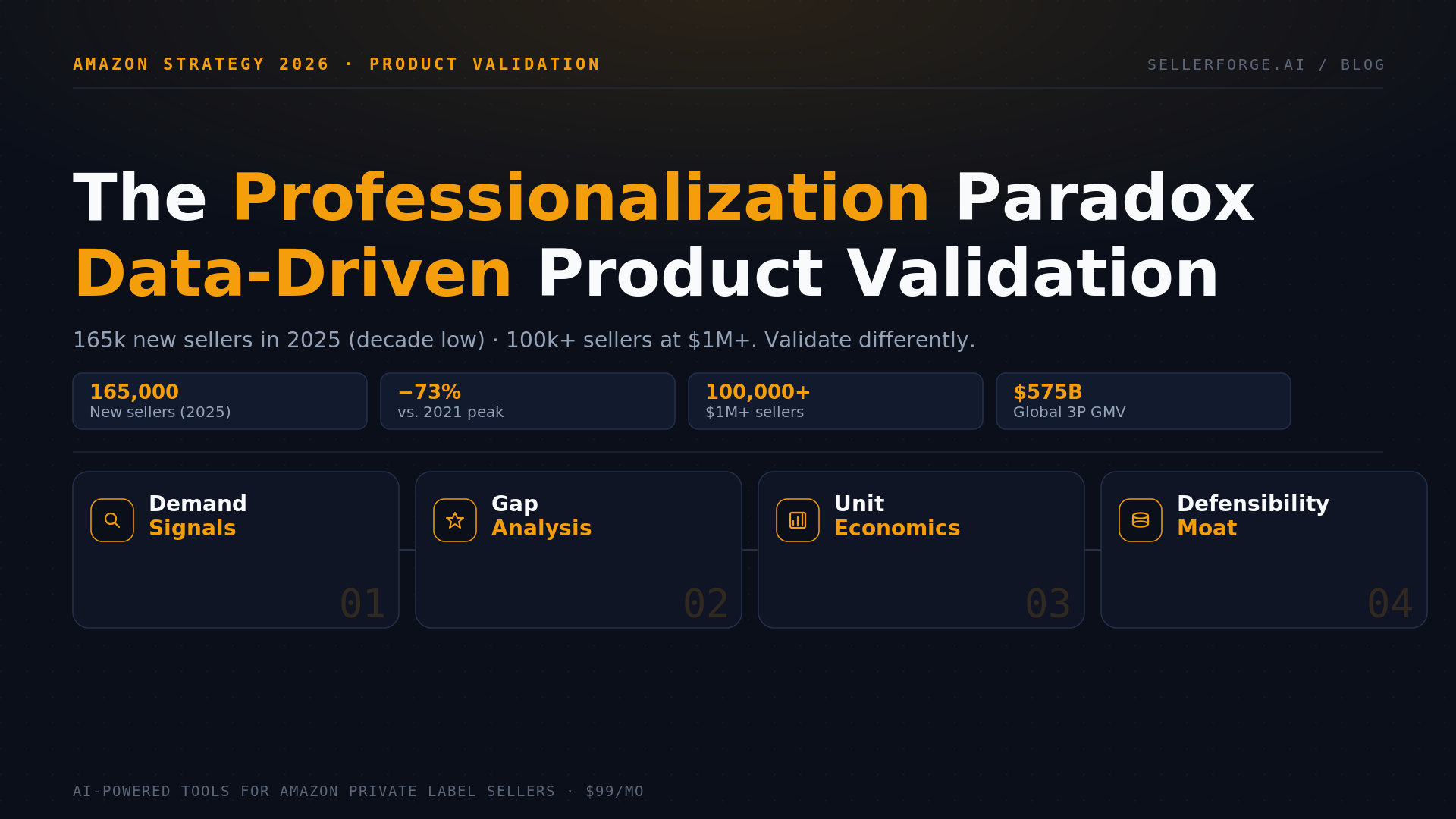
Amazon saw only 165,000 new sellers launch in 2025 — a decade low, down 73% from the 2021 peak — while the count of $1M+ sellers climbed past 100,000. The marketplace is emptying of hobbyists and filling up with operators. In this environment, gut-feel product picks are a fast way to lose money. A data-first validation framework — using Amazon's own Search Query Performance data, competitor review mining, and AI-assisted gap analysis — is the new minimum bar before committing inventory.
Amazon registered 165,000 new sellers who launched their first product listing in 2025. That sounds like a big number until you learn it's the lowest annual total since Marketplace Pulse began tracking in 2015 — down 44% from 2024 and 73% below the 2021 peak of roughly 600,000 new entrants.
At the same time, the count of Amazon sellers generating $1 million or more annually has climbed past 100,000, up from 60,000 in 2021. The number of sellers generating over $100 million on a single marketplace hit 235, up from about 50 four years ago.
This is the professionalization paradox: the marketplace is simultaneously emptying at the bottom and concentrating at the top. Fewer people start, but the ones who do generate more revenue, and the ones who've been around long enough to compound are richer and more entrenched than ever.
The implication for product validation is simple and uncomfortable: the gut-feel, trend-chasing approach to product selection that worked when the competition was two weak listings and a slow-moving incumbent no longer works. The person on the other side of your product launch in 2026 has been selling on Amazon for four years, has 1,800 reviews, a locked-in PPC structure, and a supplier relationship that gives them a $2 COGS advantage. You need to validate differently.
Why the Old Validation Framework Is Broken
The classic beginner validation checklist was: find a product with 300+ monthly sales, 3-star average reviews, low review count, selling between $15 and $50, and a BSR under 5,000 in a parent category. Run it through a demand estimator tool. If it clears the bars, source it.
That framework is built for a marketplace where the competition is thin and uninformed. Apply it today and you'll correctly identify categories that have demand — and walk straight into a heavily defended market where the review leader has six years of listing optimization and a PPC efficiency ratio you can't match in year one.
The failure mode is that the framework tells you demand exists, but doesn't tell you whether you can win against the current supply. In 2020, demand was enough. In 2026, you need demand plus a defensible entry angle.
The question isn't 'does this category have enough sales?' It's 'is there a real gap in what the current leaders are offering — and can I fill it better than anyone entering in the next 18 months?'
Step 1: Identify Demand Signals Worth Chasing
Demand validation starts upstream from Amazon. The problem with using Amazon search volume as the primary demand signal is that by the time a keyword has meaningful search volume on Amazon, established sellers have usually already entered and optimized for it. You want signals earlier in the demand curve.
Three early-stage demand signals are worth tracking in 2026:
TikTok product virality is consistently 6–18 months ahead of Amazon search volume. A product format, material innovation, or use case that's generating organic content on TikTok today will show up as Amazon keyword demand within a year. The filter here isn't "is it viral" — it's "is there genuine utility driving the interest, not just novelty?" Novelty fades; solved problems don't.
Google Trends directional data tells you whether a category is growing, plateauing, or declining. It doesn't give you Amazon-specific demand, but a 5-year trend showing consistent upward slope on a relevant keyword cluster is a better foundation than a flat or declining one. Pay attention to seasonality shape — a product that spikes once a year is a much harder inventory and cash-flow problem than one with a year-round baseline.
Amazon's own Brand Analytics — specifically the Search Query Performance report (SQP) and Market Basket data — is the highest-signal tool available once you have Brand Registry. SQP shows you impressions, clicks, cart-adds, and purchase share at the keyword level for your own ASINs (or closely related ones). Market Basket shows you what people buy alongside a product, which tells you bundling opportunities and adjacent demand. If you're pre-launch and don't have Brand Registry yet, the publicly available Amazon Best Seller and Movers & Shakers data gives you a rougher directional signal.
Step 2: Map the Competitive Landscape Honestly
Most sellers underestimate competition by counting competitors rather than measuring their moat depth. In 2026, the right questions aren't 'how many sellers are in this category?' — it's how entrenched the top five are.
| Moat factor | Low barrier | High barrier (caution) |
|---|---|---|
| Review count (top 5 avg) | Under 500 reviews | Over 2,000 reviews with 4.5+ stars |
| Review recency | Reviews slowing or plateauing | Steady weekly review velocity |
| Listing quality | Generic copy, weak A+ | Full A+, brand video, Premium A+ |
| Price point | High price with room to undercut | Already at or below your cost floor |
| Brand strength | No off-Amazon presence | Strong social, website, repeat buyers |
| IP / design patents | No utility or design patents found | Registered design or utility patents |
A category where the top five all have fewer than 600 reviews, inconsistent listing quality, and no detectable off-Amazon presence is one where execution discipline wins. A category where the top five are all at 3,000+ reviews with Premium A+ content and a recognizable brand name is one where you need a genuine product differentiation angle — not just better photos — to break through.
One useful shortcut: look at how the review velocity is distributed. If one ASIN dominates the top 50% of reviews in a subcategory and the rest are thin, you're looking at a winner-take-most dynamic. If reviews are distributed more evenly across 8–10 competitors, that's a category where consistent execution and a differentiated product can earn a durable position.
Which research suite you map the landscape with matters less than using it consistently, but the two split the job differently: Jungle Scout vs Helium 10 covers which one fits competitive mapping at your stage, with verified 2026 plan limits.
Step 3: Mine Competitor Reviews for the Real Gap
Review mining is the most underused product research technique available to Amazon sellers, and AI has made it dramatically more powerful. The concept is straightforward: read the 1- and 2-star reviews for the top 5–10 ASINs in your target subcategory and cluster the complaints. Recurring complaints that don't get resolved across multiple sellers — not one seller's quality control miss — are market gaps.
What you're looking for are complaints that fall into these four categories:
- 1Design flaw (leaks, breaks, doesn't fit, too small/large) — addressable in manufacturing
- 2Materials complaint (too cheap, wrong texture, not as durable as described) — addressable in sourcing
- 3Missing feature (no carrying case, no measuring guide, no adjustability) — addressable in product spec
- 4Expectation mismatch (looks different in photo, size misleading, confusing instructions) — addressable in listing
Category 1 and 2 require product-level changes that take sourcing lead time but create a genuine competitive advantage. Categories 3 and 4 are faster to address but also easier for competitors to copy.
The best product validation outcome isn't finding a category with no complaints. It's finding a category where everyone complains about the same solvable thing, and no current seller has fixed it — because now you know exactly what your product needs to do.
Doing this manually means reading hundreds of reviews per ASIN across 10 ASINs — a multi-day process. AI collapses it to minutes. Paste the review export into an AI assistant with a prompt like 'cluster these reviews by recurring complaint theme and give me the top 5 unresolved product problems' and you get a structured gap analysis in a single pass.
This is one of the AI workflow patterns SellerForge is built to support — if you want to see how the AI Assistant handles this kind of competitive analysis against your actual account data and market context, it's worth exploring alongside the research tooling you're already using.
Step 4: Model the Unit Economics Before You Write Any POs
This is the step that separates sellers who validate from sellers who research. Knowing demand exists and knowing a gap exists tells you an opportunity might be there. Knowing whether you can make money on it requires modeling the numbers, not estimating them.
The full per-unit P&L stack for 2026 FBA looks like this:
| Cost line | Notes for 2026 |
|---|---|
| All-in COGS | Materials + manufacturing + packaging + freight (air or sea) + import duties (model with and without tariff risk) |
| FBA prep & labeling | Amazon ended in-house prep Jan 1, 2026 — 3PL prep now adds $0.15–$0.70 per unit depending on complexity |
| Inbound placement fee | Minimal (generally single-location) splits: $0.14–$1.90/unit for standard-size by size tier and weight band; bulky $1.10–$6.50. Amazon-Optimized split (5+ locations, needs at least 5 identical cartons or pallets per item): $0 |
| FBA fulfillment fee | Set by size tier, shipping weight and price band on the Jan 15, 2026 card: small standard $3.32–$3.96 at $10–$50 ($2.43–$2.95 under $10, $3.58–$4.22 over $50); large standard $3.73–$6.67 up to 3 lb; plus the 3.5% fuel and logistics surcharge since Apr 17, 2026 |
| Amazon referral fee | Usually 15% of the sale price; 8% in a few categories such as Consumer Electronics, and tiered by price in others (Clothing 5–17%, Beauty and Health 8% at $10 or less); $0.30 minimum per unit in most categories |
| PPC advertising | Budget 25–40% of revenue at launch; models should include a stabilized target of 12–20% TACoS |
| Returns processing (if apparel) | Per-return fee in high-return categories since Jan 2026 |
| Target contribution margin | Aim for 20–30%+ after all fees and advertising at steady state |
Model three scenarios: a conservative case (high COGS, high freight, competitive ad spend, average conversion), a base case (your best estimate of each variable), and a bull case (lower freight, lower CPC, higher conversion from your differentiation angle). If the conservative case comes in below 15% contribution margin, the product economics are fragile enough to avoid. If the base case is below 20%, you need a clear plan for how you get there.
The most dangerous validation mistake is modeling best-case COGS against best-case ad efficiency against best-case pricing — and then discovering, four months after your first shipment lands, that each variable came in at the middle of its range.
Step 5: Define Your Defensibility Angle Before Launch
The last validation question is the hardest: even if the numbers work, why will you keep the position you're launching into?
In 2026, with 100,000+ sellers at the $1M+ level, any niche that shows demonstrable profit without a meaningful moat will attract well-capitalized competition within 12–18 months. The sellers who have built durable businesses in the current landscape share one of these defensibility patterns:
Review moats. Not review count alone — the combination of review volume, recency, and average rating built over years. New entrants can't copy this directly; they have to earn it. Products that accumulate reviews fast (Vine, follow-up sequencing, strong organic satisfaction) compound faster than products that sit in a launch limbo.
COGS advantages. Sellers with direct factory relationships, exclusive supplier agreements, or manufacturing flexibility that lets them iterate faster than sourcing agents have a structural cost or speed advantage. The Chinese sellers who represent ~60% of new product launches in 2025 often have this by default; Western sellers need to build it deliberately.
Brand equity off-Amazon. A product that generates repeat buyers, social proof, and name recognition that exists outside the Amazon algorithm is harder to displace than one that only ranks. This doesn't require a major brand-building operation — it requires that your packaging, your insert, and your post-purchase follow-up treat the buyer as someone you want to keep, not just as a conversion.
Listing quality compounding. The combination of keyword optimization, image quality, A+ content, and brand video takes time to build correctly. A listing that was fully optimized 18 months ago and has been maintained since has conversion rate history, indexed keyword depth, and a Browse Node position that a new competitor listing can't replicate at launch.
The Validation Scorecard
Here's the full framework condensed into a pre-launch scorecard. A product that clears at least 6 of these 8 gates is worth moving to sourcing. One that clears fewer than 4 should be reconsidered or re-angled.
- 1Demand gate: Consistent search volume trend (not a single viral spike); growing or stable for 12+ months
- 2Gap gate: Clear unresolved complaint pattern in competitor reviews that your product can address
- 3Competition depth gate: Top 5 ASINs average under 1,500 reviews OR you have a genuine differentiation angle at the product level
- 4Financial gate (conservative): Even conservative model achieves 15%+ contribution margin after fees and realistic ad spend
- 5Financial gate (base): Base case model achieves 20%+ contribution margin
- 6Defensibility gate: You can name a specific moat — COGS, product IP, listing history, brand — that will exist 18 months from now
- 7Compliance gate: No IP issues, no restricted category requirements you can't meet, no patent conflict
- 8Capital gate: You can fund a full launch — inventory, PPC, and 90-day working capital bridge — without taking on dangerous leverage
Where SellerForge Fits in the Validation Workflow
Most of the research described above — review mining, demand analysis, competitive landscape mapping — happens before you have an Amazon account with data. SellerForge is built for operators who've launched, not just for research. But two modules are directly relevant to validation-phase work, and one is directly relevant to the ongoing decisions that product validation is really about.
The AI Assistant for review mining and gap analysis. You can paste competitor ASIN review exports directly into the AI Assistant and ask it to cluster complaints by theme, identify the top unresolved pain points, and flag any that map to addressable product changes. This is the structured review-mining workflow done in minutes rather than a research sprint.
The Custom Breakdowns module for unit economics modeling. Custom Breakdowns lets you build per-ASIN, per-SKU, or per-market financial models with the actual fee schedule and your cost inputs. When you're validating a product pre-launch, you can model the P&L before the ASIN exists and run the conservative/base/bull scenarios against real Amazon fee data rather than estimates. After launch, the same module tells you whether you're tracking toward the model — or drifting away from it.
For the broader listing and account health context that every validated product eventually needs, the Listing Audit module and Listing Builder carry the product forward from validation into a competitive listing. A well-validated product with a weak listing is still a lost opportunity — the audit tells you exactly where the gap is.
If you're newer to the post-launch analytics side, our post on how to use AI to build and optimize Amazon listings covers the execution layer in detail. And the 2026 seller tools roundup has the full context on where each category of tool fits in a modern Amazon operation.
The Bottom Line
The professionalization of Amazon is not a reason to stop launching products. The $1M+ seller count doubling in four years — while active seller count fell — is evidence that the ceiling has risen, not lowered. More money is being made by better-prepared operators than at any point in the marketplace's history.
But the floor has risen too. The product that would have been a comfortable winner in a soft 2020 subcategory is a marginal entrant in a hardened 2026 one. The gap is research — specifically, the gap between the validation frameworks that most beginner content still teaches and the validation depth that the current competitive landscape actually requires.
Do the full eight-gate scorecard. Mine the reviews. Model the conservative case. Define your moat before launch. That's not over-engineering — it's the minimum table stakes for an environment where your competitor has been operating this category for four years.
If you're at the stage where validated products need the infrastructure to execute — listing optimization, account health monitoring, reimbursement tracking, advertising analytics, and AI-assisted operations — start a free SellerForge trial and connect your Amazon account. The tools are there when the product is.
About the author
David Gallo is the founder of SellerForge.ai. He previously managed 57 Amazon accounts representing over $350M in sales at Worldfront before building SellerForge to give sellers AI-powered tools at agency quality without the agency price.