There are hundreds of Amazon seller tools competing for your budget in 2026. This guide covers every major category — research, PPC, AI, accounting, repricing, inventory, listing optimization, review management, reimbursements, and analytics — with specific rankings, current pricing, and the right choice for your business stage. We also include three complete tool stacks for beginner, growth, and scale sellers.
Short version, by category: Helium 10 is the best all-in-one for established sellers and Jungle Scout the better first platform for newer ones, Perpetua leads PPC automation above $5K a month in ad spend, A2X leads accounting, Seller Snap leads repricing, SoStocked leads inventory forecasting, Data Dive leads listing optimization, FeedbackWhiz leads review management, Sellerboard is the best value in profit analytics, Keepa is essential for any reseller, and SellerForge (ours) is the account-wide AI and account-health layer. Below are all 11 categories with the leading tools in each, then three complete stacks by business stage. Pricing is current as of July 2026.
The Amazon seller software market has over 200 active tools competing for your subscription budget in 2026. Some are genuine force multipliers. Many are redundant with what you can get for free inside Seller Central. A handful genuinely change how a business runs, but only if you're at the right stage to use them.
This guide covers every major category, ranks the leading tools in each, and ends with three complete tool stacks — the exact subscriptions we'd recommend for a new seller, a seven-figure brand, and an established operator looking to systematize. Pricing is current as of July 2026.
Before buying anything: Amazon's free native tools (Brand Analytics, Search Query Performance, Listing Quality Dashboard, Amazon Dynamic Canvas) have improved dramatically. Audit what you already have access to before adding paid subscriptions.
1. All-in-One Research Platforms
For most sellers, an all-in-one platform is the right starting point — one subscription covering product research, keyword research, listing optimization, and basic analytics. The two dominant options have clear and distinct strengths.
#1 — Helium 10 (Best for established sellers)
Helium 10 remains the most feature-complete all-in-one platform available. Its 25+ tools span every stage of the seller workflow: Black Box (product research), Cerebro (reverse ASIN keyword research with up to 2 years of trend data), Magnet (keyword research), Scribbles (listing optimization), Adtomic (PPC automation), and Refund Genie (FBA reimbursements). The 2026 pricing restructure retired the sub-$50 Starter tier and raised monthly rates: paid plans now begin at $129/month (Platinum, or $99/month billed annually), with an Enterprise tier from $1,499/month for $10M+ brands and agencies. "Elite" is no longer a plan — it's now a training/networking add-on. For PPC users, the Diamond plan at $359/month ($279 billed annually) is the sweet spot — it includes full Adtomic access and most advanced research tools. The biggest knock: Helium 10 is legitimately overwhelming for new sellers, and the cost compounds quickly when you realize you need Diamond to unlock the features that actually matter.
Weighing Helium 10 specifically? We wrote an honest, criterion-by-criterion breakdown — where Helium 10's product research and keyword depth genuinely win, and where SellerForge wins on operations, account health, true-profit P&L, and price. Read SellerForge vs Helium 10.
Shopping alternatives after the 2026 price increase? We mapped every serious option to the job it actually does — research, keywords, profit, account health — with current pricing and an honest call on when to keep Helium 10. Read Helium 10 Alternatives in 2026: An Honest Buyer’s Guide.
#2 — Jungle Scout (Best for product research and new sellers)
Jungle Scout consistently outperforms Helium 10 on product research accuracy (84% vs. 76-80% in independent studies) and is the only all-in-one platform with a dedicated supplier database — a genuine differentiator for private-label sellers sourcing from overseas factories. Pricing runs $49/month (Starter, ~$29 billed annually), $79/month (Growth Accelerator), and $149/month (Brand Owner + CI) — still meaningfully more accessible for early-stage sellers than Helium 10. The platform is cleaner and less intimidating than Helium 10. Where it falls short: PPC automation (Jungle Scout's advertising tools lag Helium 10 Adtomic), and its listing optimization tools are more basic. Best use case: validation-stage research and supplier sourcing for private label.
#3 — SmartScout (Best for competitive market intelligence)
SmartScout takes a fundamentally different approach — it's built around market mapping rather than individual product research. Its 43,000+ subcategory analysis, historical market share data, and brand-level competitor mapping give established sellers a strategic view of the competitive landscape that Helium 10 and Jungle Scout don't match. Pricing: $29-$187/month. The main limitation is what it doesn't do: no inventory management, no review automation, no listing optimization workflow. It's a strategic intelligence layer, not an operational tool.
#4 — ZonGuru (Best budget all-in-one)
ZonGuru covers the essentials — product research, keyword tracking, listing optimization, competitor insights — for $39-$49/month (or as low as $23-$24/month on annual billing). The interface is clean, the feature set is honest about what it is (not trying to compete with Helium 10's breadth), and the 7-day free trial is genuinely useful for evaluation. Best for: sellers who want a solid foundation without the Helium 10 budget.
If Jungle Scout is the platform you are reconsidering, the dedicated Jungle Scout alternatives referee guide breaks the switch down by job — including the 2026 Catalyst/Cobalt split, the Viral Launch shutdown, and live-verified pricing for every replacement.
2. PPC and Advertising Management
Advertising management is the highest-leverage software category for most active Amazon sellers. A good PPC platform pays for itself within the first campaign optimization. The right choice depends almost entirely on your ad spend level and how hands-on you want to be.
#1 — Perpetua (Best automation for $5K+/month ad spend)
Perpetua (which acquired and absorbed Sellics in 2022) is the leading goal-based PPC automation platform in 2026. You set the objective — target ACoS, target sales velocity, Buy Box share — and Perpetua's machine learning engine adjusts bids and budgets automatically across Sponsored Products, Sponsored Brands, Sponsored Display, and DSP. Pricing is based on ad spend, typically running $150-$250+/month for mid-market accounts; enterprise pricing is custom. The platform's limitation is context: it optimizes for advertising goals without visibility into your inventory levels, your margins, or your pricing — so you can end up paying to drive traffic to a product you're about to stock out of. Best for: hands-off automation at meaningful ad spend levels.
#2 — Teikametrics Flywheel 2.0 (Best for inventory-aware PPC)
Teikametrics differentiates itself with inventory-aware bidding — the platform's Flywheel 2.0 AI reduces bids automatically when an ASIN's inventory is running low, preventing you from paying to drive traffic to a listing that will stock out before the campaign pays back. Pricing is 3% of managed ad sales over $10,000/month. Teikametrics also has stronger Walmart integration than most competitors, making it the right choice for omnichannel sellers. Best for: sellers with $2K-$50K/month in ad spend who want automation that accounts for operations.
#3 — Helium 10 Adtomic (Best for Helium 10 users)
If you're already paying for Helium 10 Diamond or Elite, Adtomic is the right PPC tool — no additional subscription, direct integration with your existing Helium 10 data, and solid keyword harvesting and bid management automation. As a standalone PPC tool evaluated independently, Adtomic trails Perpetua and Teikametrics on algorithmic sophistication. But for sellers who want one platform and one login, it's the clear choice.
#4 — Scale Insights (Best for granular manual control)
Scale Insights sits between full automation and fully manual management — it gives sellers granular rule-based control over bidding logic, extensive segmentation, and detailed performance reporting. Pricing is flat-rate (not ad-spend-based), which is attractive for high-spend accounts. Best for: experienced PPC managers who want precision tools rather than black-box automation.
Enterprise: Skai (formerly Kenshoo)
Skai supports 80+ advertising platforms including Amazon DSP and Amazon Marketing Cloud (AMC) integration. At $95,000+ annually, it's built for enterprise brands managing omnichannel campaigns at scale. Not relevant for the vast majority of sellers, but the gold standard for national brands with major media budgets.
Going deeper on PPC tools specifically? We compared every major Amazon PPC platform by ad-spend bracket — with real 2026 pricing and the percentage-of-spend math the affiliate roundups skip — in Best Amazon PPC Software in 2026: An Honest Buyer's Guide.
3. AI-Integrated Tools
2026 is the year every platform added "AI" to its marketing copy. The meaningful distinction is between tools that bolt AI onto existing features (generating keywords, writing copy) and tools where AI is the core architecture — the intelligence that connects your data and drives decisions across your account. That distinction matters enormously for what you actually get.
#1 — SellerForge (Best purpose-built AI for Amazon operators)
SellerForge is the only platform in 2026 built from the ground up around persistent account intelligence — the AI knows your specific ASINs, campaigns, inventory levels, account health, and history before you ask it a single question. Every module (POA Builder, Listing Audit, Advertising, Forecasting, Promotions Planner, Escalation Plans, Deliverable Builder) shares the same account context, so the AI can surface cross-functional insights that siloed tools miss: a listing audit that flags a conversion problem while your advertising is spending into it, or an inventory alert that triggers a bid reduction recommendation in the same session. At $99/month for full access to all nine modules, it's priced as a platform, not as a feature add-on. Purpose-built by operators who ran 57 Amazon accounts and $350M+ in sales managed.
#2 — Amazon Dynamic Canvas (Free native AI dashboard)
Amazon's own AI dashboard, launched in March 2026, is a meaningful development. Dynamic Canvas uses Amazon's Bedrock infrastructure (with Nova models and Claude) to surface performance analysis, inventory planning, and what-if scenario testing directly inside Seller Central. It's free for U.S. and U.K. sellers and replaces $30-50/month of basic analytics subscription value. Its limitation is the same as every Amazon native tool: it knows your Amazon data but nothing about your costs, your supplier relationships, or your business goals outside the platform.
#3 — Jungle Scout Cobalt (Best AI for enterprise market intelligence)
Jungle Scout's enterprise product layers AI agent workflows on top of its market data — enabling complex competitive analysis, trend visualization, and instant report generation through natural language queries. Custom enterprise pricing. Best for large brands and agencies that need to operationalize market intelligence at scale, not for individual sellers.
#4 — SellerApp (Best AI all-in-one for cost-predictable budgets)
SellerApp combines keyword intelligence, AI PPC automation, listing optimization, and profit tracking at a flat monthly rate (not ad-spend-based), which is attractive for sellers who want to control costs. The AI features are solid but not as deeply contextual as SellerForge — it optimizes within data categories rather than synthesizing across them.
Wondering whether the AI-native, whole-account approach is actually worth paying for? We wrote an unusually blunt first-party answer — real per-tier caps, honest cons, and an explicit who-should-not-buy list — in Is SellerForge worth it? Honest pros, cons, and pricing.
4. Accounting and Bookkeeping
Amazon payouts are notoriously difficult to reconcile — a single settlement contains hundreds of line items covering sales, refunds, FBA fees, storage charges, reimbursements, and more. Generic bookkeeping software can't parse them. You need Amazon-specific accounting software, or you'll end up with financials that are technically balanced but operationally meaningless.
#1 — A2X (Best for accuracy-first sellers)
A2X is the accounting gold standard for Amazon sellers. It pulls every settlement and breaks it into properly categorized components — sales, shipping, returns, FBA fees, storage, commissions — then posts clean summaries to QuickBooks Online, Xero, or Sage. Accountants love it because the data is clean and auditable. The tradeoff: A2X is more complex to set up and more expensive than alternatives. If you have a dedicated bookkeeper or accountant, A2X is almost certainly what they'll recommend. If you're doing your own books as a new seller, the learning curve is real.
#2 — Seller Ledger (Best for simplicity and value)
Seller Ledger was created by the original team behind Outright (later GoDaddy Bookkeeping) and TaxJar — two of the most respected names in ecommerce accounting. The result is an Amazon-native bookkeeping tool that's far simpler to operate than A2X at a fraction of the price: starting at $10/month for 250 transactions, scaling to $20+/month for high-volume accounts. 30-day free trial, no credit card required. Best for: sellers doing their own bookkeeping who need clean financials without an accounting degree.
#3 — Link My Books (Best for UK and EU sellers)
Link My Books automates Amazon payout reconciliation and posts to QuickBooks, Xero, or Sage, with particularly strong VAT handling for UK and European marketplaces. If you're selling in EU markets, Link My Books' VAT automation alone can save hours of manual work per settlement period. Best for: UK/EU sellers with existing QuickBooks or Xero setups.
#4 — Finaloop (Best for hands-off full-service bookkeeping)
Finaloop combines software automation with a human bookkeeping team — you connect your accounts and get monthly financial statements without doing any reconciliation yourself. Pricing is higher than pure software options, but lower than hiring a dedicated bookkeeper or accounting firm. Best for: sellers who want financial statements without managing software.
5. Repricing
Repricing software automatically adjusts your prices in response to competitors, with the goal of winning the Buy Box while protecting your margins. For resellers and wholesale sellers with competing listings, a good repricer is not optional — manual pricing will cost you the Buy Box on thousands of products every day. For private-label sellers with unique ASINs, repricing is less critical but still useful for promotional adjustments.
#1 — Seller Snap (Best for established resellers)
Seller Snap uses game theory AI — modeling competitor behavior as a repeated game and adjusting prices to maximize long-term Buy Box share rather than just matching the lowest price. It supports AI mode, rules-based mode, and manual mode, and its documented ROI for mid-tier resellers runs 80-120x the software cost. Pricing: $250-$800/month. Best for: established resellers with catalogs of 500+ ASINs and strong margins.
#2 — Feedvisor (Best for goal-based brand repricing)
Feedvisor's algorithmic repricing supports multiple goal modes: maximize Buy Box share, maximize sales velocity, or liquidate aging inventory. Its AI learns your competitive environment and adapts over time. Pricing is variable (not publicly listed). Best for: brands and private-label sellers with specific strategic pricing goals rather than pure reselling.
#3 — Repricer.com (Best for multi-marketplace speed)
Repricer.com positions itself as the fastest repricer on the market, with real-time updates across 11 marketplaces including Amazon, eBay, Walmart, and more. If you're selling across multiple channels and need centralized pricing management, Repricer.com is the most capable option. Best for: multi-marketplace operators who need repricing consistency across channels.
#4 — BQool (Best value entry-level repricer)
BQool starts at $22.50/month and reprices every 15 minutes — slow enough to matter against competitors but fast enough for most sellers. It includes feedback management and basic product research tools, making it a reasonable value-stack for sellers who want repricing without paying for a dedicated enterprise platform. Best for: budget-conscious resellers with under 500 ASINs.
#5 — Amazon Automate Pricing (Free native option)
Amazon's built-in repricing tool is free, responds quickly to price changes, and works for sellers with simple pricing rules. Its limitations: no margin protection (it will price below your cost if you don't set it carefully), limited rule sophistication, and no multi-marketplace support. Worth testing before paying for a third-party repricer, especially for new sellers.
6. Inventory Management and Forecasting
A stockout on your top ASIN costs you more than lost sales — it costs you BSR, keyword ranking, and ad quality score. A well-executed reorder system is one of the highest-leverage operational improvements available to private-label sellers.
#1 — SoStocked (Best for complex multi-SKU operations)
SoStocked (now part of Carbon6) is purpose-built for Amazon FBA inventory management with a forecasting engine that uses 14 variables: sales velocity, seasonality, lead times, days in transit, FBA receiving delays, promotions, and more. The 12-month forecasting view is the most reliable of any tool in this category. Pricing starts at $158/month. It also integrates with Amazon's AWD (Amazon Warehousing and Distribution) and handles FBA transfer management between warehouses. Best for: sellers with 20+ active SKUs and complex supply chains.
#2 — RestockPro (Best FBA-focused restock automation)
RestockPro by InventoryLab focuses specifically on FBA restock management: intelligent suggestions based on velocity and lead time, purchase order generation, supplier tracking, margin calculations, and bundle/kit support. Pricing: $119-$654/month based on FBA volume, with a 21-day free trial. It's part of the InventoryLab ecosystem that also includes Scoutify (mobile product scouting) and RevenueLab (P&L accounting). Best for: FBA-centric sellers who want an integrated buying workflow.
#3 — Linnworks (Best for multi-channel inventory)
Linnworks manages inventory centrally across Amazon, eBay, Shopify, Walmart, and other channels — automatically updating stock levels across platforms when a sale happens on any one of them. Its SkuVault Core module adds warehouse management. Best for: sellers who sell across multiple channels and need a single source of truth for inventory levels.
#4 — Inventory Lab (Best for new and mid-size FBA sellers)
Inventory Lab is a full-ecosystem FBA tool: Scoutify for mobile product scouting, listing creation, shipment management, and RevenueLab for P&L and accounting. It's more accessible than SoStocked for sellers earlier in their growth, with a cleaner interface for day-to-day operations. Best for: FBA sellers under 100 active SKUs who want integrated buying, shipping, and basic accounting.
7. Listing Optimization
Listing optimization sits at the intersection of keyword research, copywriting, and conversion rate optimization. The best tools help you find the keywords Amazon's algorithm rewards, use them efficiently in your copy, and score your listing against specific quality dimensions.
#1 — Data Dive (Best for keyword clustering and listing architecture)
Data Dive has become the preferred tool for serious listing optimization in 2026. Its Master Keyword List aggregates data from Helium 10, Keepa, Google Trends, and competitor ASINs into a single view, with cluster analysis showing which keyword groups are most important to cover. Pricing: $32-$490/month. The infographic-style reports make it easy to map keywords to listing sections (title, bullets, description, backend). Best for: sellers who want to build listings that dominate keyword coverage systematically.
#2 — Keywords.am (Best for relevance scoring)
Keywords.am uses a proprietary Knowledge Purchase Score (KPS) to rank keywords by relevance and purchase intent — not just search volume. At $49-$299/month, it supports 21 marketplaces and includes Amber AI, an assistant for keyword clustering and listing structure. Best for: agencies and experienced sellers optimizing listings across multiple marketplaces.
#3 — ProductScope AI (Best for rapid AI listing generation)
ProductScope AI generates titles, bullets, and descriptions using GPT-4o trained on 1,500+ real converting Amazon listings, with A+ Content generation and support for 13 marketplaces. Pricing: $24-$69/month. Best for: sellers who need to create or refresh multiple listings quickly and want AI to do the first draft.
#4 — Helium 10 Scribbles (Best within Helium 10 ecosystem)
Scribbles is Helium 10's listing optimization tool — it color-codes keywords by search volume (red = high, yellow = moderate, blue = supplementary) and tracks which terms you've used in each listing section. The 2026 update added AI-generated title and bullet suggestions. It's the right choice if you're already paying for Helium 10 Diamond ($229+/month). As a standalone tool it's outclassed by Data Dive.
Free first step: Amazon's Listing Quality Dashboard inside Seller Central flags missing attributes and provides AI optimization guidance for free. Run every ASIN through it before opening a paid listing tool.
8. Review Management and Feedback Automation
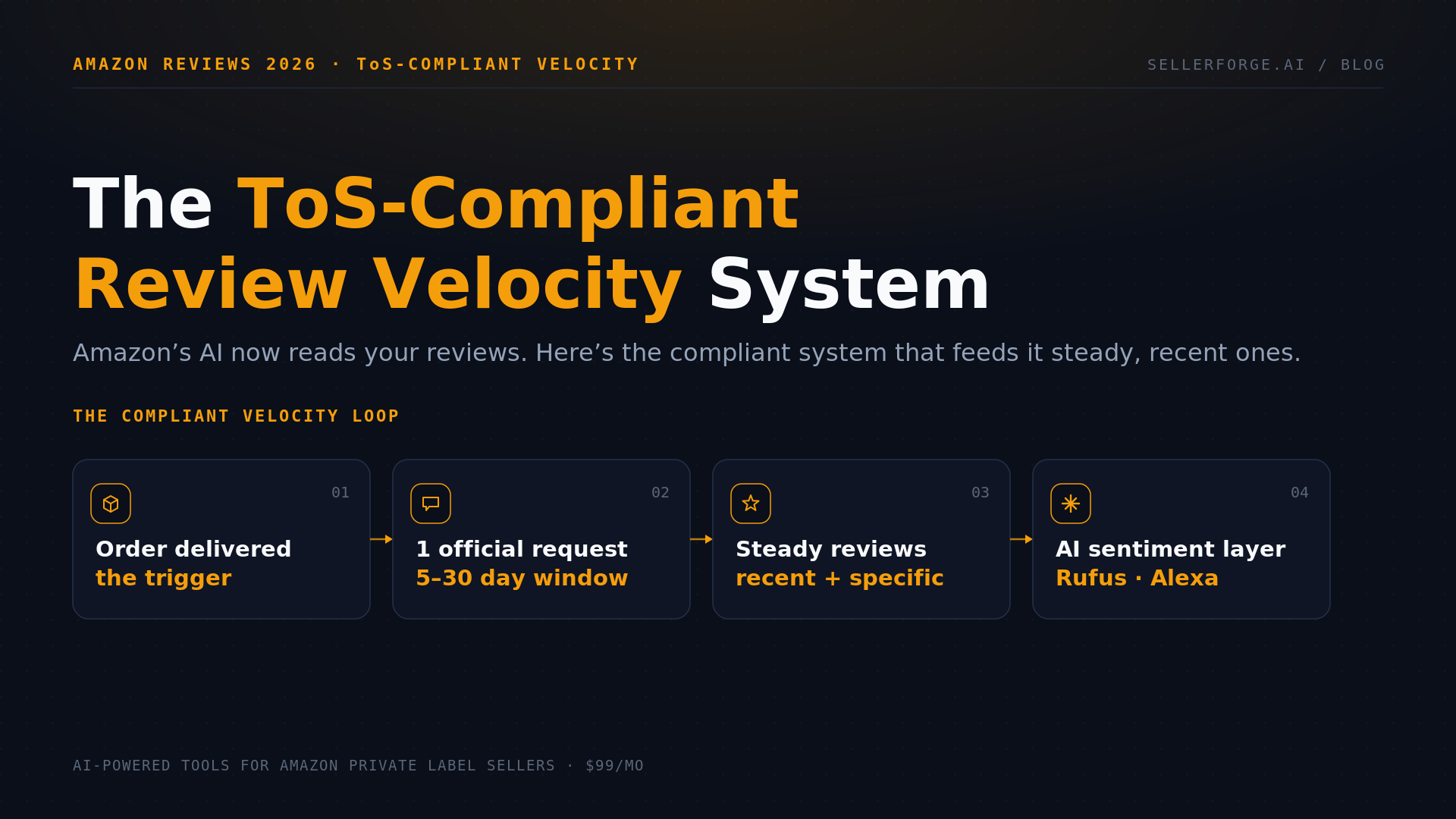
Amazon's policies around review solicitation are strict, but the platform's built-in "Request a Review" button is approved and effective. The best review management tools automate that process at scale and alert you to negative feedback before it compounds.
#1 — FeedbackWhiz (Best dedicated review management tool)
FeedbackWhiz automates Amazon-compliant review requests using the official Request a Review button, monitors all incoming reviews and feedback in real time, and sends alerts for negative feedback so you can respond before a pattern develops. It also tracks competitor reviews, maintains a global buyer blacklist, and provides response management for seller feedback. The 30-day free trial is one of the most generous in the category. Best for: sellers who want dedicated, automated review solicitation and monitoring without it being a secondary feature of a larger platform.
#2 — Helium 10 Follow-Up (Best within Helium 10 ecosystem)
Helium 10's Follow-Up automates review request campaigns through the Amazon messaging system. It's fully compliant with Amazon's policies and integrates with your existing Helium 10 ASIN data. Not as feature-rich as FeedbackWhiz for monitoring, but sufficient for most sellers already in the Helium 10 ecosystem.
#3 — FeedbackFive (Best for monitoring and hijacker alerts)
FeedbackFive ($24/month) combines review monitoring, product review alerts, and hijacker detection in a single lightweight tool. It's particularly useful for sellers who've been targeted by listing hijackers or negative review campaigns. Best for: sellers who need monitoring-first rather than solicitation-first review management.
9. FBA Reimbursements and Compliance
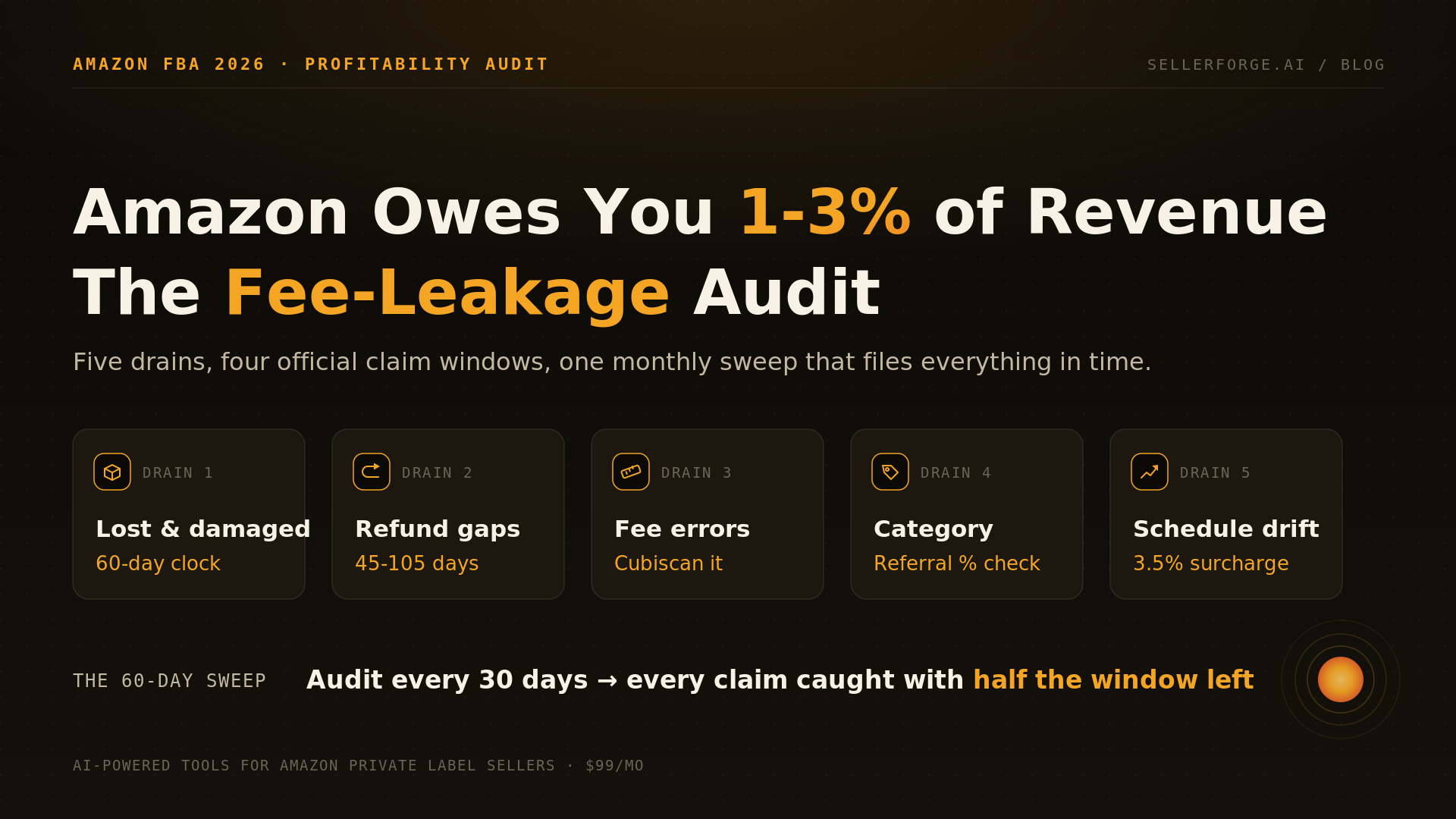
Amazon loses, damages, and miscalculates fees on FBA inventory constantly — and only reimburses sellers who proactively file claims. The average FBA seller is owed $1,000-$5,000 in unclaimed reimbursements at any given time. Recovery tools audit your account and file claims on your behalf.
#1 — SellerForge (Best for complete account health management)
SellerForge covers the full spectrum of Amazon compliance — not just reimbursements, but the complete account health workflow: monitoring Account Health metrics, generating case-specific Plans of Action for suspension appeals (the most critical compliance need), building Escalation Plans when an initial appeal fails, and managing the POA revision process through to reinstatement. For sellers who have experienced a suspension or are at risk of one, SellerForge's POA Builder is in a category by itself — it uses your specific violation type, affected ASINs, and account history to generate a compliant, case-specific document, not a template. This is the compliance tool that matters most when your business is at risk.
#2 — Getida (Best hands-off reimbursement recovery)
Getida audits your FBA account going back 18 months, identifies lost, damaged, and miscalculated inventory, and files claims on your behalf. Their team has a 90% success rate on submitted claims and clients report an average recovery of $3,459. Pricing: 25% commission on recovered funds (no monthly fee), with the first $400 recovered free for new accounts. Best for: sellers who want reimbursements handled without managing the process themselves. Note: Getida's 25% commission is industry-standard; some alternatives charge 20%.
#3 — Helium 10 Refund Genie (Best commission-free reimbursement tool)
Refund Genie identifies FBA reimbursement opportunities and generates the reports needed to file — but you do the actual filing yourself through Seller Central. Included in Helium 10 Diamond+ plans, so there's no commission taken on recoveries. For sellers who have time to file their own claims, this is a significant cost advantage over commission-based services. A Managed Refund Service option (hands-off filing) is also available for a fee.
#4 — Seller Locker (Best for fee analysis)
Seller Locker focuses specifically on FBA fee analysis — identifying overcharges on dimensional weight, storage fees, and fulfillment fees, in addition to lost/damaged inventory. It's particularly useful for sellers with heavy or oversized products where dimensional weight fees are frequently miscalculated.
10. Analytics and Profitability Tracking
Amazon's Seller Central provides revenue data but buries profitability. After FBA fees, storage charges, return costs, advertising spend, and COGS, your actual profit margin is often unknown until you run a separate analysis. Profitability tools make that calculation automatic and continuous.
#1 — Sellerboard (Best value profit analytics)
Sellerboard delivers real-time profit dashboards that track 100+ fee types, COGS by batch and time period, and multi-account consolidated reporting for $19-$69/month. For sellers tired of building their own spreadsheet models, Sellerboard is the highest-ROI tool in this category — clear, accurate, and inexpensive.
#2 — Conjura (Best EBITDA-focused analytics)
Conjura is designed around actual profitability rather than revenue and ACoS metrics — its dashboards prioritize EBITDA and contribution margin, which is the right frame for sellers who think in terms of business value rather than platform performance. Best for: sellers and investors evaluating the real economics of an Amazon business.
#3 — Nova Analytics (Best for high-volume operators)
Nova Analytics offers hourly data refreshes (most tools update daily), 99.5% P&L accuracy, and unlimited KPI customization. It's premium-priced and best suited for $1M+ annual revenue sellers who need precision over accessibility.
#4 — ManageByStats (Best free-tier analytics)
ManageByStats (part of Carbon6) offers a meaningful free tier alongside paid tiers with detailed reporting and multi-marketplace support. Best for: sellers who want to test detailed analytics before committing to a paid subscription.
11. Price Tracking and Market Intelligence
Beyond active repricing, price tracking tools monitor historical pricing and competitor movements — useful for buy decisions in wholesale, identifying margin-eroding trends, and understanding competitive dynamics.
Keepa (Essential for any reseller or arbitrage seller)
Keepa tracks the complete price history of every Amazon product — sales rank, buy box price, FBA/FBM offers, new/used pricing — and visualizes it over time. At $17/month (unlimited API access), it's one of the most cost-effective tools in the ecosystem. For resellers evaluating whether a product is worth buying, Keepa data is non-negotiable. The Chrome extension shows price history graphs directly on Amazon product pages.
CamelCamelCamel (Free Keepa alternative)
CamelCamelCamel provides free price history tracking for Amazon products. Less data-rich than Keepa and without API access, but sufficient for casual price checks and setting price drop alerts on specific products.
Recommended Tool Stacks by Business Stage
The right tool stack depends on where you are in your Amazon journey. Here are three stacks we'd build from scratch in 2026 — with specific tools, the reason for each choice, and realistic monthly costs.
Beginner Stack (~$80-$130/month) — Launch Stage
At launch, the priorities are product validation, basic listing quality, and staying financially organized. You don't need automation yet — you need signal.
- Jungle Scout Starter ($29/month) — Product research and supplier database for sourcing decisions
- Seller Ledger ($10/month) — Clean bookkeeping from day one; it's 10x easier to maintain books than to reconstruct them
- FeedbackWhiz free trial, then $20/month — Review monitoring and automated request campaigns once you have sales
- Amazon native free tools — Brand Analytics, Listing Quality Dashboard, Search Query Performance (use these before adding paid tools)
- Total: ~$60-$80/month cash, with your time as the variable cost
Growth Stack (~$350-$500/month) — $250K-$2M Annual Revenue
At the growth stage, advertising optimization and inventory predictability become the highest-leverage improvements. You're spending enough on ads for automation to pay for itself, and a stockout is starting to cost real money.
- Helium 10 Diamond ($279/month billed annually; $359 month-to-month) — Full research suite, listing optimization (Scribbles), Adtomic PPC, and Refund Genie for reimbursements
- SellerForge ($99/month) — Account health monitoring, POA Builder for any compliance issues, AI-driven listing audits, and forecasting intelligence that integrates with your SP-API data
- Keepa ($17/month) — Price history and market intelligence for competitive monitoring
- Seller Ledger ($10-20/month) — Financial reconciliation (upgrade to A2X if you bring on an accountant)
- Total: ~$405-$415/month
Scale Stack (~$900-$1,400/month) — $2M+ Annual Revenue
At scale, every category needs a best-in-class tool. The platform integrations start to compound — better inventory data improves ad efficiency, better ad data improves listing decisions, better compliance monitoring protects the account generating all the revenue.
- Helium 10 Diamond ($279/month billed annually) — Full suite including advanced keyword research, competitive intelligence, and all Adtomic features (the former $399 "Elite" plan was discontinued in 2026; Enterprise now starts at $1,499/month)
- Perpetua ($200-$695/month depending on ad spend) — Goal-based PPC automation for hands-off campaign management
- SellerForge ($99/month) — Account health, POA Builder, AI cross-account analysis, and full compliance workflow
- SoStocked ($158+/month) — 12-month inventory forecasting with 14-variable model
- Getida (commission-based) — Hands-off FBA reimbursement recovery; at scale the 25% commission is worth the time savings
- Seller Snap ($250-$800/month) — Game theory repricing for reseller or wholesale lines
- A2X + QuickBooks Online (~$80/month combined) — Accounting-grade financial reporting
- Total: ~$1,200-$1,700/month (excluding commission-based tools)
Tool spend at scale is not a cost center — it's a leverage ratio. If a $400/month tool saves 20 hours of analysis time and catches one $5,000 compliance issue per quarter, its ROI is obvious. The mistake is buying tools without a specific outcome in mind.
Tools Worth Watching in Late 2026
- Amazon's AI expansion — Dynamic Canvas is version 1 of what will become a much more capable native intelligence layer. Watch for AMC (Amazon Marketing Cloud) becoming accessible below the enterprise level.
- SmartScout AI Listing Architect — Market mapping + AI listing generation is a compelling combination that no major platform currently does end-to-end.
- Carbon6 ecosystem consolidation — Carbon6 has acquired SoStocked, ManageByStats, and others. Watch for platform integration that could make the Carbon6 bundle competitive with Helium 10.
- SellerForge AI expansion — The persistent account intelligence architecture is inherently extensible as SP-API data sources expand.
Final Recommendation: Choose Depth Over Breadth
The most common mistake Amazon sellers make with software is subscribing to many tools and using none of them well. A seller who deeply understands Jungle Scout and SellerForge will consistently outperform a seller who has eight subscriptions they check occasionally.
Start with one research platform and one account intelligence platform. Build the workflows. When you identify a specific gap — you need better repricing, or your inventory forecasting is failing, or your ads are unoptimized — add the purpose-built tool for that gap. That approach compounds. The alternative, subscribing to everything and figuring it out later, mostly generates invoices.