Amazon's storage side got tighter and pricier through 2026. FBA capacity is calculated on roughly five months of projected sales, down from six, and the IPI floor sits at 400 for most sellers. Two separate mechanisms punish overstock, and sellers routinely confuse them: a low IPI shrinks your cubic-foot allocation and can block new shipments, while the storage utilization surcharge bites independently above 22 weeks of cover, topping out at $1.88 per cubic foot on standard-size. AWD and MCF fees both rose on January 15, a 3.5% fuel surcharge landed in April and May, and standard-size storage still more than triples every Q4, from $0.78 to $2.40 per cubic foot. The winning pattern is lean FBA cover of 30 to 60 days, a deep AWD buffer with auto-replenishment on, and a forecast that protects IPI before the surcharge does it for you.
Most of the 2026 fee coverage focused on the fulfillment side, the per-unit fee bumps, the end of Amazon's in-house prep, the new returns fee. Those matter. But there's a second set of changes that hits a different and arguably more dangerous part of your business: the storage side. Capacity, IPI, aged inventory, and the cost of warehousing inventory you haven't sold yet.
This is the side that quietly ties up your cash. A fulfillment fee is a known cost you pay when a unit sells. A capacity limit, a storage surcharge, or a tanking IPI score is a constraint that decides how much you can stock, what it costs to hold it, and whether you go out of stock at the worst possible moment. In 2026 all of those got tighter and more expensive at the same time.
This is the operator's playbook for the storage-and-capacity side of Amazon in 2026: what the IPI floor actually does, how the five-month cubic-foot cap is calculated, where the surcharges hide, how the AWD and MCF rate hikes change the math, and the part most coverage buries, which is how to use AWD to legally sidestep the FBA capacity limit entirely.
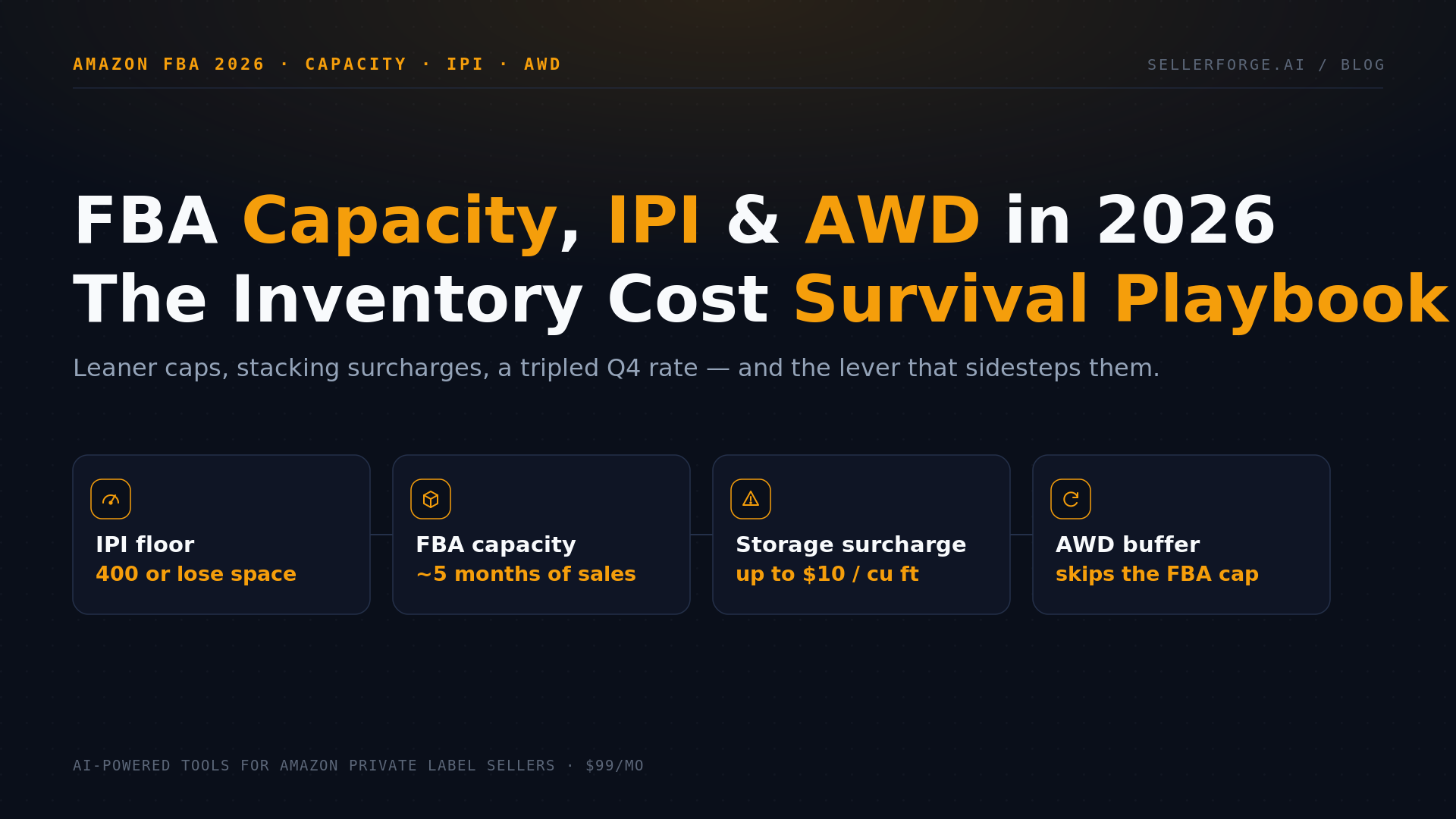
The IPI Floor: 400, and Why It Decides Everything Downstream
Your Inventory Performance Index (IPI) is the score Amazon uses to decide how much it trusts you with its warehouse space. It runs from 0 to 1,000, updates weekly, and blends several measurement windows rather than one: a trailing 90-day sell-through rate, a trailing 30-day in-stock rate, and a current read on excess and stranded inventory. The working threshold in 2026 is 400 for most sellers. Amazon does not publish that number in one authoritative place, and credible trackers have cited 350 and 450 at different points, so plan against 400 rather than treating it as a constant.
Cross below it and Amazon tightens your cubic-foot capacity limit and can stop you creating new FBA shipments. What it does not do is trigger a storage surcharge. This is worth being pedantic about, because the two get welded together constantly in seller forums and in a lot of published advice: capacity restriction is an IPI consequence, and the storage utilization surcharge is a weeks-of-cover consequence. They often arrive together because the same overstock causes both, but fixing your IPI will not remove a surcharge, and paying a surcharge will not restore your capacity.
One number to distrust: if you read that a low IPI can cost you $10 per cubic foot, that advice is recycling a dead fee. The $10 figure was the FBA inventory storage overage fee, charged on volume above your capacity limit, and Amazon eliminated it in the US, UK, EU and Canada retroactive to July 1, 2024. Exceeding your capacity limit today blocks new shipments rather than billing you. The real utilization surcharge maxes out at $1.88 per cubic foot.
Four factors drive the score, and Amazon weights two of them heavily:
- Excess inventory %, units beyond roughly a 90-day supply. This is the single biggest lever; overstock is what Amazon penalizes hardest.
- FBA sell-through rate, units sold and shipped over 90 days relative to your average available inventory. Lean, fast-moving stock scores best.
- Stranded inventory %, units in a fulfillment center with no active, buyable listing. Easy to fix, and fixing it is free points.
- FBA in-stock rate, how reliably your replenishable, in-demand ASINs stay in stock. It does not hurt your score directly, but improving it helps.
The thing to internalize: IPI is not a vanity metric. It is the gate on your capacity. A low score does not just look bad. It shrinks how much you're allowed to send, exactly when a healthy score would let you stock up. And because it moves on a 90-day window, you can't fix it the week before peak. You fix it in the weeks before the weeks before peak.
Treat 400 as a fire line, not a target. If you're hovering near it, you're one slow month away from restock restrictions and a surcharge on the very inventory that's dragging the score down. Aim comfortably above it, and watch the trend, not just the number.
The Five-Month Cubic-Foot Cap (and the Return of ASIN-Level Limits)
Since March 2023, FBA capacity has been a monthly limit measured in cubic feet, not a quarterly unit count. In mid-2025 Amazon tightened the calculation in two ways that are still shaping 2026 planning. First, it cut the projection horizon from roughly six months of forecasted sales to about five, so the same sales velocity now buys you less stored inventory. Second, it reactivated ASIN-level restock limits, meaning an individual SKU can be capped even when your account has headroom overall.
Mechanically, Amazon publishes your capacity in the third full week of each month via the Capacity Monitor: one confirmed limit for the coming month and estimates for the two months after. Amazon's own description of what sets that limit is broader than most guides admit. It names your IPI score plus sales forecasts for your ASINs, shipment lead time, and fulfillment center capacity. The last two matter more than they used to, because they are not about you at all: network conditions in your region can shrink your allocation while your own metrics hold steady. Higher IPI and faster sell-through still earn more room, but they no longer fully explain the number you get.
The practical consequence of the five-month cap plus ASIN-level limits is that the old strategy of sending a big slug of inventory and letting it sit is now actively punished on three fronts at once: it eats your cubic-foot allocation, it drags your excess-inventory factor (hurting IPI, which shrinks the allocation further), and if it tips past 22 weeks of cover it starts drawing the utilization surcharge on top of base storage. Bulk-and-sit is the most expensive inventory strategy on Amazon in 2026.
The Surcharges That Stack: Utilization and Aged Inventory
On top of standard monthly storage fees, Amazon runs two surcharges that target slow inventory, and they stack.
The storage utilization surcharge arrived on April 1, 2023 at a 26-week threshold and was tightened to 22 weeks on April 1, 2024, which is where it sits today. It applies to Professional sellers averaging at least 25 cubic feet per day in a size tier, and only to inventory aged over 30 days. It tiers from $0.44 per cubic foot at 22 to 28 weeks up to $1.88 at 52 weeks and beyond on standard-size, with oversize topping out at $1.26.
The aged-inventory surcharge is the one that actually hurts, because it escalates steeply rather than smoothly. It starts at day 181 and stays mild through day 270, then roughly triples at 271 days and keeps climbing. A unit that is both overstocked and aging draws both surcharges at once, on top of base storage. Note the 181 to 270 day tiers exclude clothing, shoes, bags, jewelry and watches.
| Days in a fulfillment center | Aged-inventory surcharge |
|---|---|
| 181-210 | $0.50/cu ft |
| 211-240 | $1.00/cu ft |
| 241-270 | $1.50/cu ft |
| 271-300 | $5.45/cu ft |
| 301-330 | $5.70/cu ft |
| 331-365 | $5.90/cu ft |
| 366-455 | $6.90/cu ft or $0.30/unit, greater of |
| 456+ | $7.90/cu ft or $0.35/unit, greater of |
Two changes landed here on January 16, 2026 that are easy to miss: the per-unit floor on the 12 to 15 month band rose from $0.15 to $0.30, and Amazon added the 456-day tier at the bottom of the table above. If you are sitting on inventory older than fifteen months, it just got more expensive to keep procrastinating.
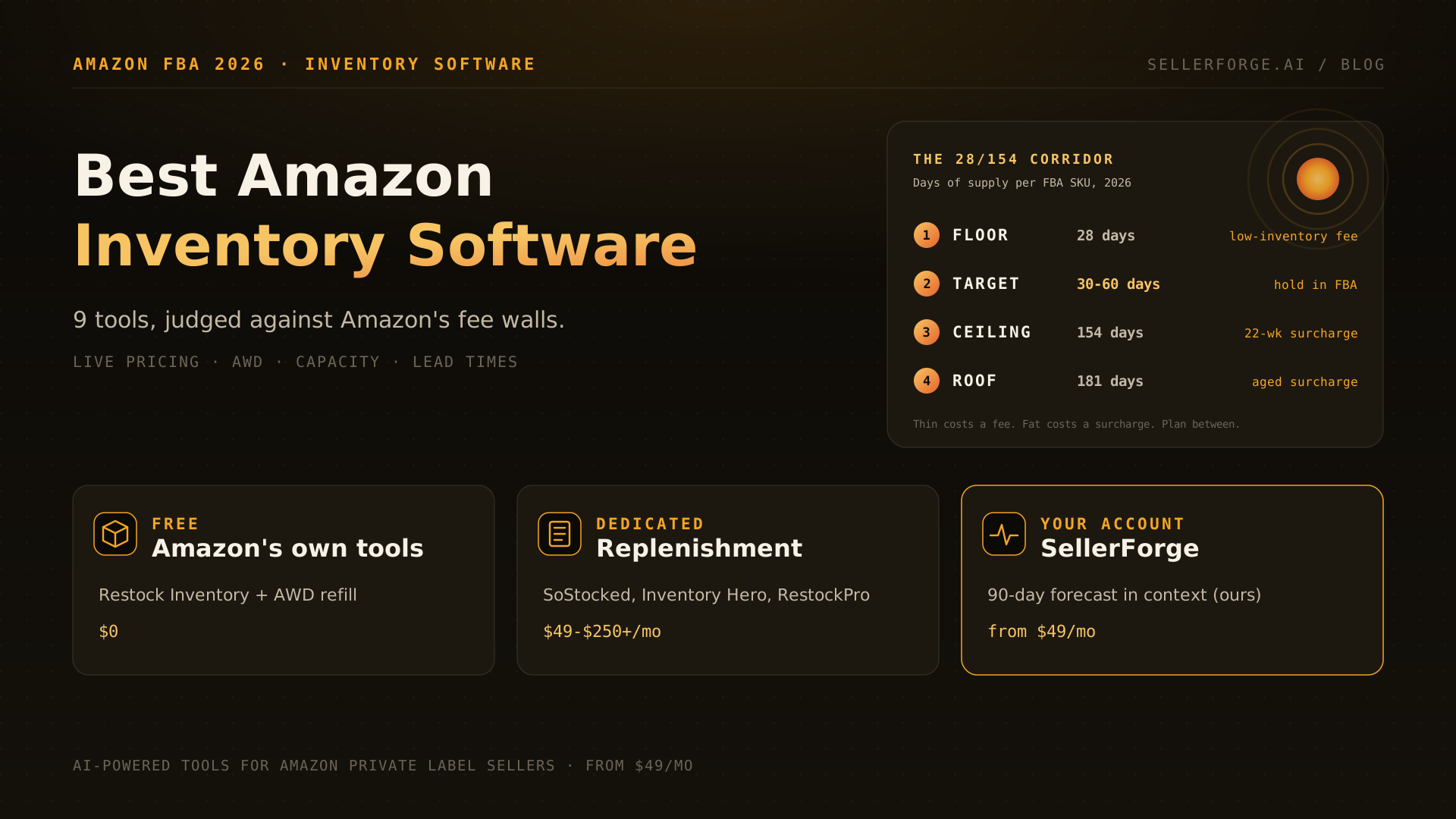
There's also a fee at the opposite extreme. The low-inventory-level fee charges you when a SKU drops below about 28 days of historical supply at the FNSKU level, Amazon's way of penalizing the understocking that creates unreliable Prime delivery. So you're squeezed from both sides: too much inventory triggers surcharges and capacity pressure; too little triggers the low-inventory fee and stockout risk.
The 2026 sweet spot for most private-label SKUs is roughly 30 to 60 days of FBA cover: comfortably above the 28-day low-inventory-fee line, and well under the 22-week utilization-surcharge line. The art is staying inside that band on every SKU, every week, which is a forecasting problem, not a guessing problem.
Q4 Changes the Math Again: Storage More Than Triples
Every fourth quarter, FBA storage rates jump for peak season, and 2026 is no exception. Standard-size storage runs about $0.78 per cubic foot per month from January through September, then rises to roughly $2.40 per cubic foot in October through December, more than triple. Oversize goes from about $0.56 to $1.40 per cubic foot over the same period.
That seasonal spike collides with the exact moment you most want inventory in position for the holidays. Hold your full peak buy in FBA through Q4 and you pay the tripled rate on all of it, including the safety stock you may not sell until January. The sellers who manage this well don't store their whole peak buy in FBA; they keep FBA lean and stage the surplus somewhere cheaper that doesn't count against their capacity limit. Which brings us to AWD.
Amazon published the Q4 2026 detail in late July, and there is one piece of good news in it. Peak fulfillment fees run from October 15, 2026 to January 14, 2027 across FBA, Remote Fulfillment, MCF and Buy with Prime, at the same per-unit increase over non-peak rates as last year, averaging about $0.32 per unit. Flat year over year is the best outcome anyone was going to get. The 3.5% fuel and logistics surcharge does stack on top of those peak fulfillment fees, so the all-in number still rises even though the peak differential did not.
The part worth planning around is buried in the same announcement. Amazon says its fulfillment centers focus on receiving holiday shipments through September and October, then switch to processing customer orders in November and December, and that sellers may therefore see lower capacity limits during that period. So the capacity you are allocated in Q4 is not the capacity you had in Q3, and the month you most need headroom is the month Amazon is most likely to trim it. Plan the peak buy against your October limit, not your August one.
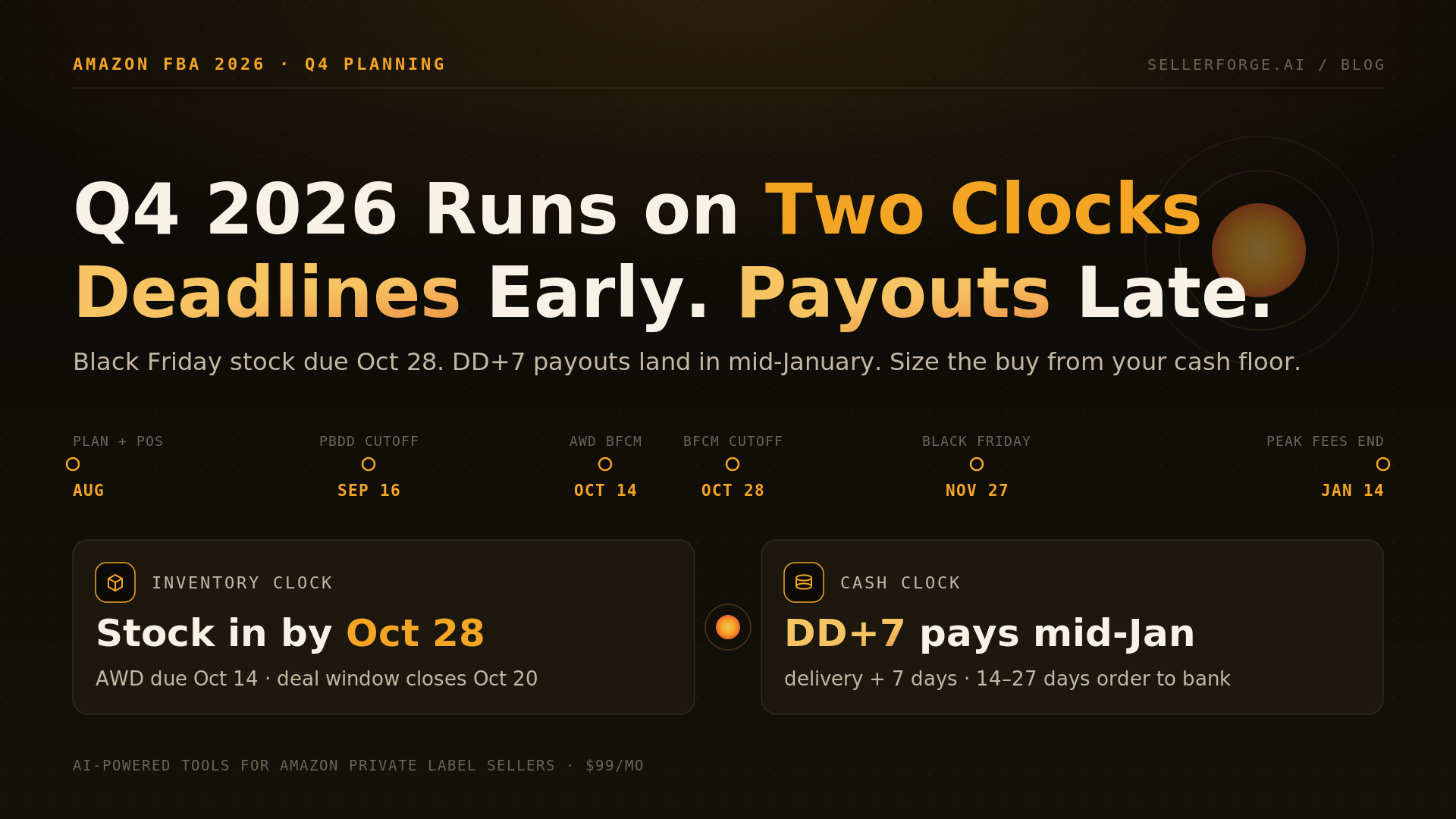
For the full holiday calendar this collides with, including the October 28 Black Friday inbound cutoff and the payout math under DD+7, see the Amazon Q4 2026 inventory and cash-flow plan.
AWD Got Pricier, and More Valuable
Amazon Warehousing & Distribution (AWD) is Amazon's upstream bulk-storage layer: you send inventory there in bulk, and it feeds your FBA stock as you sell. On January 15, 2026, AWD got more expensive, though not evenly. West Coast storage rose to $0.57 per cubic foot per month from roughly $0.48. Base storage in the East Coast, South East and South Central regions did not move and remains $0.48. Inbound and outbound processing each went from $1.35 to $1.40 per box, with West Coast palletizable inbound discounted to $1.05.
The increase that mattered most got the least coverage: transportation from AWD into FBA rose from roughly $1.15 to $1.40 per cubic foot, about 22%. If you are modelling AWD, that is the line to re-run, and be careful not to confuse it with the $1.40 per box processing fees. They are the same number attached to different units.
Watch the discount ladder before you quote yourself a rate. Non-West AWD storage has three tiers off the same $0.48 base: $0.48 standard, $0.43 with Smart Storage, and $0.38 Amazon Managed. Several published guides present $0.38 and $0.43 as an old-and-new rate pair, which reads as a fee increase when it is actually a discount schedule. Smart Storage is earned, not granted: qualification turns on how much of a SKU moved into FBA through AWD auto-replenishment over the preceding 90 days.
Here's the part that most fee-increase coverage skips: even after the rate hike, AWD became more strategically valuable in 2026, not less, because of one structural fact.
This is the lever. In Amazon's own words, if you leave auto-replenishment enabled, your products count as in stock when AWD receives them and Amazon manages replenishment so you do not have to worry about FBA capacity limits. AWD also carries no aged-inventory surcharge. So you can hold deep, seasonal or bulk inventory upstream without it eating your FBA cubic-foot allocation or dragging your IPI. Read the condition literally though: the benefit is tied to auto-replenishment being on, not to AWD as such.
Stack that against the Q4 storage spike and the logic gets sharper, because AWD has no peak season. Amazon prices it as flat pay-as-you-go with no additional cost for the holidays, so while FBA standard-size storage triples to $2.40 per cubic foot from October, AWD holds its regional rate all year. That is the whole argument: flat versus seasonal, on top of the capacity exemption. For a seasonal or fast-growing catalog the 2026 pattern is lean FBA, deep AWD, auto-replenish in between.
Amazon extended that advantage further in July 2026. If you send inventory through AWD and keep automatic replenishment enabled, you continue paying the off-peak monthly storage rate through October 31, 2026, even though the FBA peak fee window opens on October 15. That is roughly two extra weeks at off-peak pricing on your upstream buffer, in the exact fortnight when everyone else's storage bill steps up.
The cost of routing through AWD is lead time, and Q4 is where it bites. Amazon's inbound deadlines for AWD run materially earlier than FBA's: September 2 for Prime Big Deal Days against September 9 or 16 for FBA depending on shipment splits, and October 14 for Black Friday and Cyber Monday against October 21 or 28 for FBA. Auto-replenishment transfers can take days to weeks, so an AWD-first Q4 needs its plan locked roughly two weeks earlier than an FBA-first one. Miss the window and the Prime badge goes with it.
The catch is that this only works if your forecast is good. Auto-replenishment maintains a level you set, and your AWD buy has to be sized to real demand or you've just moved the overstock problem upstream. That's a planning discipline, and it's exactly the kind of per-SKU coverage math the SellerForge Forecasting module is built to run continuously.
If you are choosing a tool to run that forecast, our comparison of the best Amazon inventory management software judges nine options, from Amazon's free Restock Inventory tool to SoStocked and Inventory Hero, on whether they plan inside the fee floor and ceiling described above.
MCF Is Rising Faster Than FBA, Watch Your Off-Amazon Routing
If you use Amazon's network to fulfill orders from your own site or other channels via Multi-Channel Fulfillment (MCF), the January 15 increase hit you too, and it concentrated on the small orders most DTC sellers ship. Amazon states two things plainly: MCF fulfillment fees rose by an average of $0.30 per unit, and fees are unchanged for orders containing three or more units in the small and large standard-size categories. The arithmetic of that leaves one and two-unit orders absorbing the whole increase. Amazon does not publish the split, but third-party analyses put single-unit orders up roughly $0.35 to $0.41 and two-unit orders up $0.17 to $0.28.
Then a second increase landed that most January coverage never circled back to add: a 3.5% fuel and logistics surcharge applied to US MCF fulfillment fees from May 2, 2026, with no announced end date. The equivalent surcharge hit FBA and Buy with Prime fulfillment fees on April 17. It does not touch storage fees, so nothing in the storage math above changes, but if you are comparing MCF against a 3PL on unit economics you need both increases in the model, not just January's. Buy with Prime fulfillment rose about $0.24 per unit on the same January date.
The strategic read: MCF is now rising faster than core FBA fulfillment, which narrows the case for routing off-Amazon volume through Amazon's warehouses. If a meaningful share of your orders are single-unit DTC, it's worth re-pricing MCF against a dedicated 3PL for that channel. MCF Preferred Pricing offsets part of it, but set expectations correctly: it is invitation-only, notified by email and Seller Central rather than something you can switch on. The six-month term gives 15% off outbound MCF fees plus a $1 FBA credit per MCF unit shipped, capped at $50,000. The twelve-month term gives up to 15% and up to $1 per unit across up to 100,000 units. Underneath all of it, the trend is Amazon pricing its fulfillment network to favour on-Amazon sales.
| 2026 lever | What changed | The number | What to do |
|---|---|---|---|
| IPI threshold | Floor held at 400 (was 450); enforced weekly | Below 400 → restock limits + up to $10/cu ft surcharge | Cut excess, fix stranded, keep best SKUs at 30 to 60 days |
| FBA capacity | Projection cut to ~5 months; ASIN-level limits back | Monthly cubic-foot cap by IPI + velocity | Lean FBA; stage surplus in AWD |
| Utilization surcharge | Since Apr 2023; tightened Apr 2024 | $0.44 to $1.88/cu ft above 22 weeks of cover | Keep days-of-cover under the 22-week line |
| Q4 peak storage | Seasonal spike, Oct to Dec | $0.78 → $2.40/cu ft standard (3.3×) | Hold peak surplus upstream, not in FBA |
| AWD fees | Up Jan 15, 2026 | West $0.57/cu ft; processing $1.40/box | Use as capacity buffer, does not count vs. FBA cap |
| MCF fees | Up Jan 15, 2026 | +~$0.30/unit avg; single-unit +$0.35 to $0.41 | Re-price vs. 3PL; apply MCF Preferred Pricing |
The 2026 Inventory Plan, Step by Step
Put the pieces together and a repeatable operating plan falls out. None of it is exotic. It's the discipline of keeping each SKU in the right band and staging the rest where it's cheapest and doesn't cost you capacity.
- 1Set a target days-of-cover band per SKU, roughly 30 to 60 days in FBA for most private-label items: above the 28-day low-inventory-fee line, below the 22-week surcharge line.
- 2Audit excess and aged inventory now. Remove, liquidate, or discount anything past ~90 days of supply or approaching the 181-day aged tier, before Q4 rates triple the cost of holding it.
- 3Fix every stranded listing. Stranded units are pure IPI drag and storage cost with zero upside; making them buyable is the cheapest score improvement available.
- 4Protect IPI six to eight weeks ahead. Because the score moves on a 90-day window, start improving sell-through and cutting excess well before peak so your capacity allocation is healthy when you need to stock up.
- 5Stage your peak buy in AWD, not FBA. Send near-term demand to FBA at lean cover and hold the surplus upstream where storage is cheaper and the capacity cap doesn't apply.
- 6Turn on auto-replenishment with a sensible threshold. Let Amazon refill FBA from AWD to hold your target band automatically, but size the AWD buy to real forecasted demand, or you've just relocated the overstock.
- 7Re-price MCF against a 3PL for single-unit off-Amazon orders, and apply MCF Preferred Pricing if eligible.
- 8Log the dates. Record the Jan 15 fee changes and each monthly capacity reset so future storage-cost swings are explainable, not mysterious.
Where SellerForge Fits
Every step above is a forecasting and bookkeeping problem at heart: knowing each SKU's days-of-cover this week, catching the ones drifting toward a surcharge or a stockout, sizing the AWD buy to real demand, and remembering what changed so you can explain the cost swings later. Doing that by hand across a real catalog, every week, is exactly where sellers fall behind. It's the work SellerForge automates.
Coverage and reorder math, continuously. The Forecasting module pulls your sales velocity and supplier lead time into one calculation, so you can see which SKUs are drifting out of the 30 to 60 day band, when to reorder, and how deep an AWD buffer to stage for peak, instead of finding out from a surcharge or a stockout.
Per-SKU excess and aging, on demand. Custom Breakdowns let you slice days-of-cover, excess units, and aging by SKU, brand, or category, so the IPI-dragging, surcharge-bound inventory is a sorted list you can act on, not a number buried in a Seller Central dashboard.
Capacity plans you can hand off. The Deliverable Builder turns your inventory plan into a clean report for a 3PL, a freight partner, or your own files, the FBA-vs-AWD split and the reorder schedule in one place.
Explainable cost swings. Log 'January 15, 2026: AWD/MCF fee increase' and each monthly capacity reset once on your Business Event Timeline, and every future storage-cost or capacity change the AI explains will correctly correlate to it instead of guessing.
A weekly read, automatically. The Weekly Business Report surfaces the inventory and cost movements that matter each week, and the built-in AI Assistant can answer 'which of my SKUs are over 90 days of cover heading into Q4?' against your real account data, the kind of question a generic chatbot can't touch because it doesn't know your numbers.
If you want the cash-flow companion to this, how the storage costs above interact with Amazon's payout timing, see Amazon's DD+7 Payout Policy and What It Does to Your Cash Flow, and for the fulfillment-side fee restructure that landed the same week, see Amazon's 2026 FBA Fee Overhaul and the End of FBA Prep.
The Bottom Line
Amazon's 2026 storage changes all point the same direction: it wants lean, fast-moving inventory in its fulfillment centers and it will charge you for anything else, in fees, in capacity, and in IPI. The five-month cap, the 400 IPI floor, the utilization and aged surcharges, and the tripled Q4 rate are not separate problems; they're one incentive expressed four ways.
The sellers who win in 2026 don't fight that incentive. They align with it. Lean FBA, a deep AWD buffer that doesn't count against the cap, auto-replenishment in between, and a forecast disciplined enough to keep every SKU in its band. Do that and the surcharges never trigger, the capacity is there when you need it, and your cash isn't trapped in inventory sitting in a warehouse at peak-season rates.
If you'd rather not rebuild a per-SKU coverage model by hand every week, start a free SellerForge trial and connect your account. The Forecasting and reporting modules run this math continuously, so staying off the surcharge list and out of stock-outs is a dashboard you check, not a spreadsheet you dread.
Sources and how to verify these numbers yourself
Amazon publishes its AWD and MCF rate cards publicly, and those figures above are taken directly from them: Amazon Warehousing & Distribution pricing and Multi-Channel Fulfillment pricing. The March 2023 shift to a single monthly cubic-foot capacity limit, the third-week publication schedule, and Amazon's own list of the factors behind your limit come from its seller-forum announcements: Simplifying FBA capacity limits and the Ask Amazon capacity Q&A. The Q4 2026 peak window, the flat year-over-year peak fee, and the inbound deadlines are from Amazon's Holiday 2026 announcement. The retirement of the $10 per cubic foot storage overage fee was reported by Fortune and documented with Amazon's statement at Value Added Resource. The 3.5% fuel and logistics surcharge was covered by Retail Dive, and the January 2026 MCF and Buy with Prime increases by Supply Chain Dive.
One honest caveat. Amazon keeps its FBA storage and aged-inventory fee tables behind a Seller Central login, so the storage figures here are drawn from multiple independent sources that agree, not from a page we can link you to. Before you make a large inventory commitment, open your own Seller Central fee schedule and confirm the current rate for your size tier. Be especially wary of guides quoting $0.87 per cubic foot as a current off-peak rate: that was the April 2023 figure, and Amazon reduced it by $0.09 in April 2024.
About the author
David Gallo is the founder of SellerForge.ai. He previously managed 57 Amazon accounts representing over $350M in sales at Worldfront before building SellerForge to give sellers AI-powered tools at agency quality without the agency price.