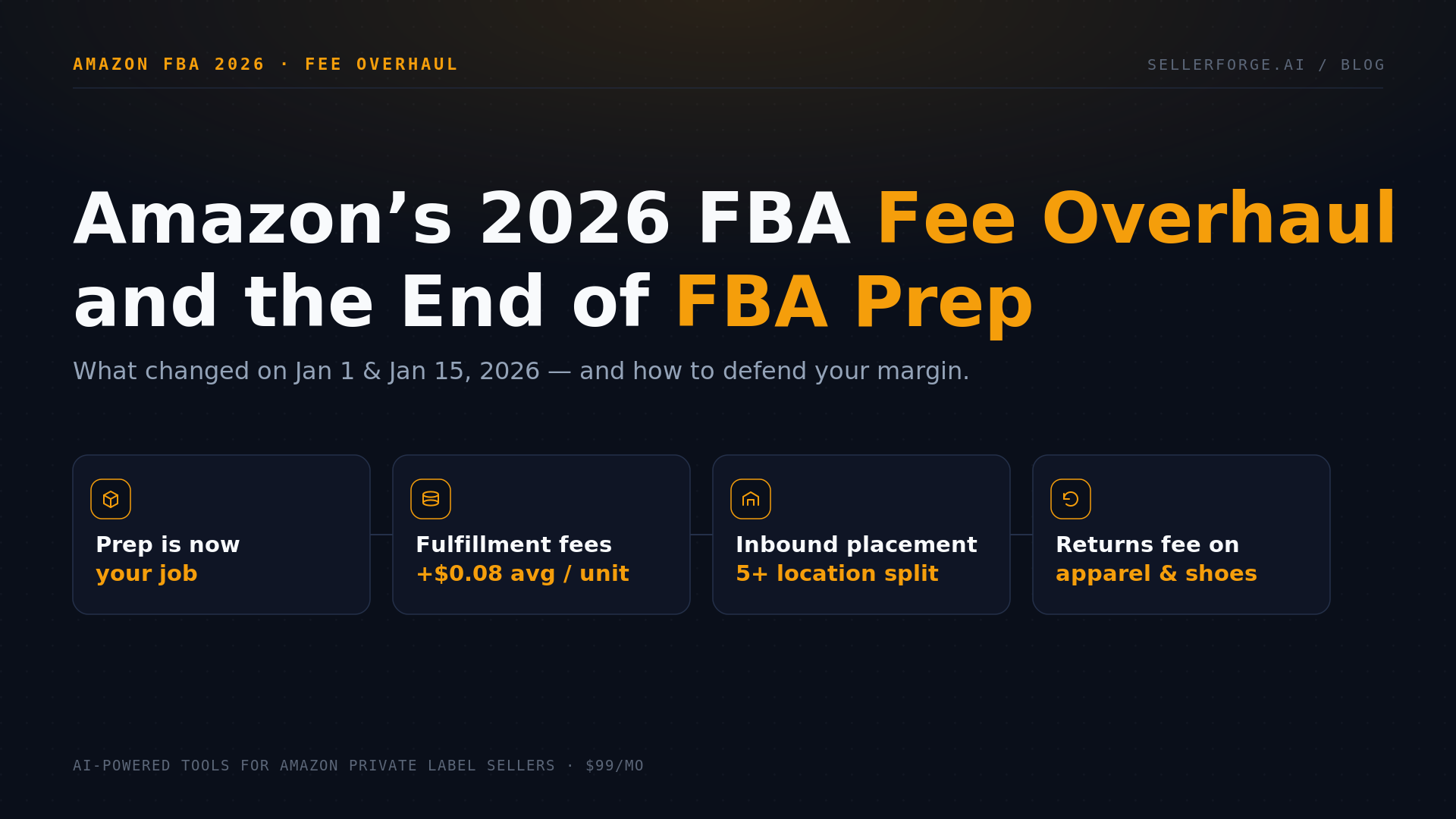
On January 1, 2026 Amazon stopped doing your FBA prep and labeling — bagging, bubble-wrap, barcodes, bundling are now your responsibility, and non-compliant shipments can be refused or disposed of with no reimbursement. On January 15, fulfillment, inbound-placement, and referral fees were restructured: the Large Bulky tier split into Small Bulky and Large Bulky, the Low-Price FBA discount rose to $0.86, and a Returns Processing Fee hit high-return categories like apparel. Net effect for most private-label sellers is a small per-unit fee increase plus a new prep cost line — but the SKUs near breakeven are the ones to model now.
Two changes landed in the first half of January 2026 that quietly rewired the economics of selling on Amazon, and most sellers only noticed one of them.
The one everybody saw was the fee increase — Amazon's annual fulfillment and referral fee update, effective January 15, 2026. The one that matters more long-term is the one that landed two weeks earlier and didn't come with a fee table: on January 1, 2026, Amazon stopped doing your FBA prep and labeling. Bagging, bubble-wrapping, barcode application, opaque coverings, bundling — all of it is now your responsibility before inventory ever reaches a fulfillment center.
Taken together, these aren't a rounding error. They change which SKUs are profitable, how you ship into Amazon, and how much operational work sits between your supplier and your Buy Box. This is the operator's guide to what changed, with the actual numbers, and the playbook to protect your margin.
Change #1: Amazon Stopped Doing Your Prep (January 1, 2026)
For years, Amazon offered an in-house prep service: send in unprepped units, pay a per-unit fee, and Amazon would label, polybag, or bubble-wrap them at the fulfillment center. As of January 1, 2026, that service is gone in the US.
The discontinued services include:
- Barcode and FNSKU labeling
- Polybagging and opaque/blackout coverings
- Bubble-wrapping and other protective packaging
- Boxing
- Set creation, kitting, and bundling
The shift is not just a cost line — it's a responsibility transfer. Every unit you send to FBA must now arrive fully prep-compliant. And Amazon was explicit about the consequence: items shipped to FBA that don't meet prep standards may be refused, returned, or disposed of without reimbursement. A pallet of unbagged units that used to cost you a per-unit prep fee can now cost you the entire shipment.
The hidden risk isn't the prep cost — it's the disposal risk. A non-compliant shipment that gets refused or destroyed with no reimbursement is a far bigger hit than the prep fee you were trying to avoid. Compliance is now a margin-protection issue, not a convenience.
You have three realistic paths, and most sellers will end up using more than one:
1. Prep in-house. Best for low-volume or single-category catalogs where prep is simple (a poly bag and a label). Cheapest per unit if you have the labor and space; doesn't scale well past a few hundred units a week.
2. Use a 3PL prep center. A dedicated prep-and-forward warehouse receives from your supplier, preps to Amazon's spec, and ships into FBA. This is where most growing private-label sellers are landing in 2026. It adds a per-unit cost and a day or two of lead time, but it removes the compliance risk and the labor.
3. Go hybrid FBA/FBM on the worst-hit SKUs. For SKUs where the new prep cost plus the fee increase pushes contribution margin near zero, fulfilling yourself (or via a 3PL direct to customer) can net more than FBA — even after losing some Buy Box share. This is a per-SKU decision, not an account-wide one.
Change #2: The January 15 Fee Restructure, By the Numbers
The fulfillment and referral fee update took effect January 15, 2026. Amazon framed it as an average increase of about $0.08 per unit — under half a percent of a typical item's price. That average is technically true and practically misleading, because the change is tiered and some SKUs moved a lot more than $0.08.
Here's the per-tier reality for standard-size items:
| Price tier | Approx. fulfillment fee change (per unit) | What it means |
|---|---|---|
| Under $10 | +~$0.12 (small standard) | Partly offset by a higher Low-Price FBA discount (now $0.86, up from $0.77) |
| $10–$50 | +~$0.25 small standard / +~$0.05 large standard | The core private-label band — model these carefully |
| Over $50 | +~$0.51 small standard / +~$0.31 large standard | Steepest increases; premium SKUs absorb more |
Two structural changes matter beyond the per-unit numbers:
The Large Bulky tier split into Small Bulky and Large Bulky. This is the rare piece of good news: fulfillment fees actually dropped for some bulky products under the new tiers. If you sell oversize goods, re-pull your size-tier classification — some SKUs moved tiers and your old fee assumptions are now wrong in your favor (or against you).
The Low-Price FBA discount increased to $0.86. For items priced low enough to qualify, this offsets part of the standard fee increase. If you have SKUs hovering just above the low-price threshold, it may now be worth pricing into the low-price band deliberately.
April 2026 update: the January numbers were not the year's last word. On April 17, 2026 Amazon added a 3.5% fuel and logistics surcharge on FBA fulfillment fees in the US and Canada — roughly $0.17 per unit on average, calculated on the fulfillment fee, not your sale price — and extended it to Buy with Prime and Multi-Channel Fulfillment on May 2, per Supply Chain Dive. Stack it on top of every per-tier figure in the table above when you re-run your margins.
Change #3: Inbound Placement — The 5-Warehouse Decision
Inbound placement fees were also restructured on January 15, 2026, with new weight bands. The mechanic that matters: if you send a 'Minimal Shipment Split' — all your inventory to a single fulfillment center — you pay an inbound placement fee that rose by roughly $0.05 per unit on average for standard items. If you qualify for the 'Amazon-Optimized' split — at least five identical cartons or pallets per item, shipped to every location Amazon assigns (usually five or more), and only when Amazon offers it — placement remains fee-free.
So the question on every shipment is now explicit: is the labor and freight of splitting into 5+ shipments cheaper than the placement fee for the convenience of one? For most sellers moving more than a few hundred units, the optimized split wins — especially if your 3PL or prep center can split for you. For small or test shipments, paying the placement fee to keep it simple can still be the right call.
Rule of thumb for 2026: default to the Amazon-Optimized (5+ location) split for any meaningful replenishment, and only pay the placement fee on small or one-off shipments where splitting isn't worth the labor.
Change #4: The Returns Processing Fee Hits Apparel
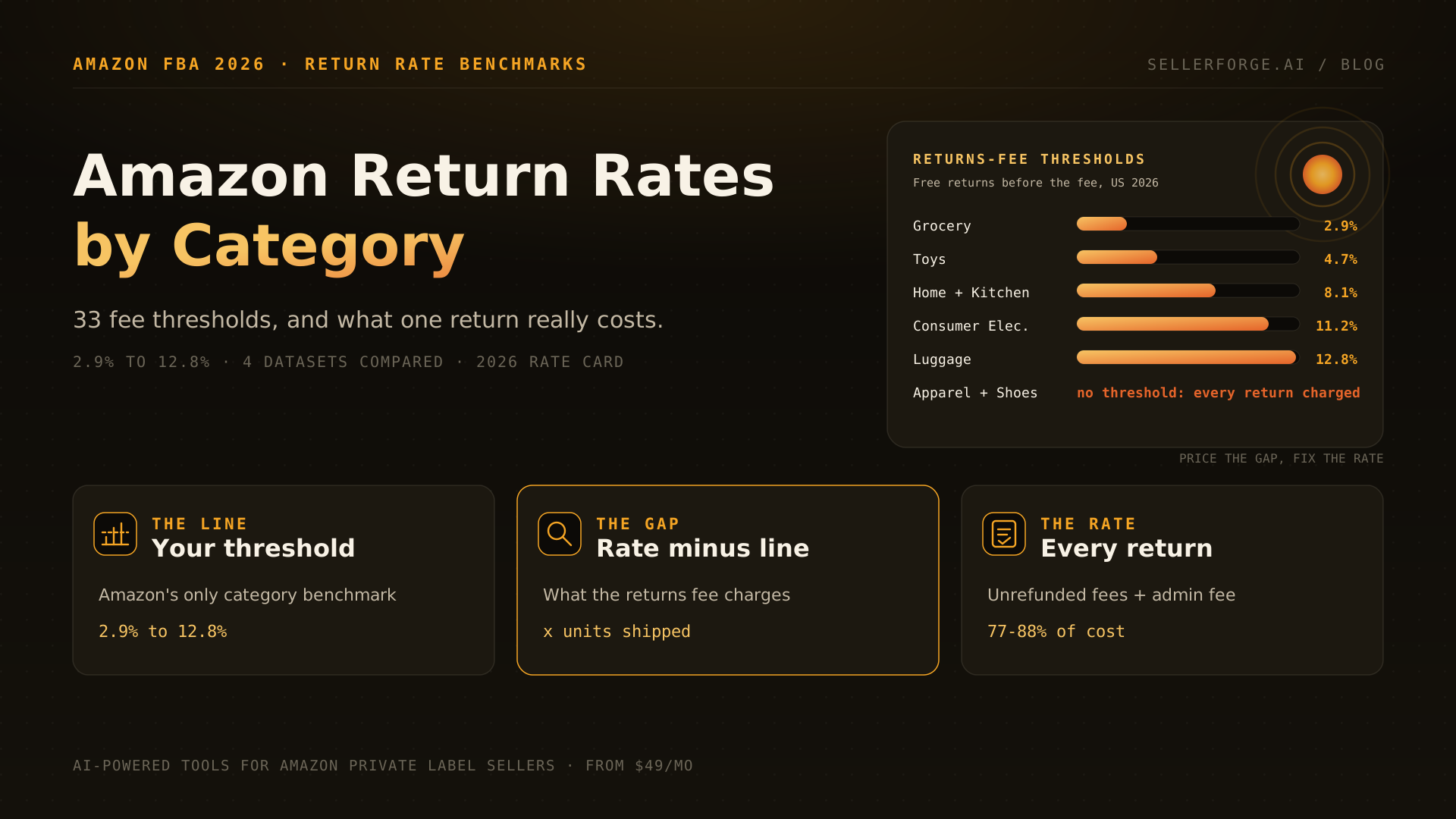
Starting in 2026, Amazon applies a Returns Processing Fee to categories with historically high return rates — most prominently apparel, footwear, and fashion accessories. If you sell in those categories, every return now carries an explicit fee on top of the lost sale and the cost of handling the returned unit.
This changes what a high return rate is worth. A sizing problem that drove a 25% return rate used to cost you the refund and the goodwill; now it also costs you a per-return fee on a quarter of your orders. That makes three things directly worth money: accurate sizing charts, fit and expectation-setting in your images and A+ content, and systematic analysis of return reasons so you can fix the SKUs driving the most returns.
This is one place where listing quality and fee defense converge. The same return-reason data that tells you which SKUs to fix also tells you which listings are over-promising. If you want the listing-side playbook for the AI era, see How to Use AI to Build and Optimize Amazon Listings.
What This Actually Does to Your P&L
Put the changes together and the net effect for a typical private-label seller is: a modest per-unit fulfillment fee increase, plus a brand-new prep cost line that didn't exist before January, plus a placement decision on every shipment, plus (for apparel) a returns fee — plus, since April 17, a 3.5% fuel and logistics surcharge (~$0.17/unit average) on top of the fulfillment fee itself. None of these is catastrophic alone. Stacked, they're enough to flip a thin-margin SKU from profitable to breakeven.
The sellers who get hurt in 2026 are the ones who don't re-run the math and keep selling SKUs that quietly went underwater in January. The sellers who win are the ones who model contribution margin per SKU under the new schedule, cut or re-fulfill the losers, and double down on the winners.
Here's the per-SKU triage I'd run:
- 1Recompute landed cost and contribution margin for every SKU under the January 15 fee schedule — including your new prep cost per unit.
- 2Flag any SKU within ~$1.00 of breakeven contribution margin. These are your at-risk list.
- 3For each at-risk SKU, decide: raise price, re-fulfill via FBM/3PL, re-source to lower COGS, or discontinue.
- 4Confirm your inbound placement default (Amazon-Optimized 5+ split for meaningful shipments).
- 5For apparel, pull return reasons and fix the top return-driving SKUs first.
- 6Audit the last 6–18 months for prep-rejection reimbursements and fee overcharges you never claimed.
Where SellerForge Fits
The hard part of all of this isn't understanding the changes — it's doing the per-SKU math across a real catalog, every time a fee or a cost moves, and then catching the money Amazon owes you back. That's exactly the work SellerForge is built to automate.
Per-SKU margin math, continuously. The Forecasting module pulls your sales velocity, fees, and supplier lead time into one calculation, so when a fee schedule changes you see which SKUs moved toward breakeven instead of discovering it a quarter later in your accounting.
Recover prep-rejection and fee-overcharge money. The Reimbursement Claims module scans your reports for the eight claim categories — including fee overcharges and lost/damaged inventory — bundles the evidence, and prepares the case for you to submit. With Amazon refusing or disposing of non-compliant shipments in 2026, the volume of reimbursable events is going up, not down.
Self-describing margin reports. The Deliverable Builder turns the new per-SKU economics into a clean report you can hand to a partner, a lender, or your own files — no manual spreadsheet pulls.
Remember the fee-change date so your AI can explain swings. Log 'January 15, 2026 — FBA fee restructure' once on your Business Event Timeline and every future margin or rank swing the AI explains will correctly correlate to it instead of guessing.
Ask in plain English. The built-in AI Assistant can answer 'which of my SKUs are within a dollar of breakeven after the 2026 fee change?' against your actual account data — the kind of question a generic chatbot can't touch because it doesn't know your numbers.
The 30-Day Action Plan
- 1Week 1 — Lock down prep. Decide in-house vs. 3PL vs. hybrid for each product line and get a compliant prep pipeline running before your next reorder ships.
- 2Week 1 — Re-pull size tiers. Especially for bulky goods; some SKUs moved tiers in January and your fee assumptions are stale.
- 3Week 2 — Re-run contribution margin per SKU under the new schedule. Build the at-risk list (within ~$1 of breakeven).
- 4Week 2 — Set inbound placement default to Amazon-Optimized for meaningful shipments.
- 5Week 3 — Triage the at-risk SKUs: reprice, re-fulfill, re-source, or discontinue. For apparel, fix the top return-driving listings.
- 6Week 4 — Audit and file reimbursements for prep rejections and fee overcharges. Set up continuous monitoring so you catch them going forward.
The Bottom Line
Amazon's 2026 changes didn't make FBA unviable — they made it less forgiving. The convenience layer that absorbed your prep is gone, the fee math shifted under your feet, and the categories with structural return problems now pay for them explicitly. The margin still exists; it's just less automatic.
If you'd rather not rebuild a per-SKU margin model by hand every time Amazon moves a fee, start a free SellerForge trial and connect your account. The Forecasting, Reimbursement, and reporting modules do this math continuously — so the next fee change is a dashboard update, not a fire drill.
About the author
David Gallo is the founder of SellerForge.ai. He previously managed 57 Amazon accounts representing over $350M in sales at Worldfront before building SellerForge to give sellers AI-powered tools at agency quality without the agency price.