The best Helium 10 alternatives in 2026 are Jungle Scout for product research, SmartScout for competitor and AI-visibility intelligence, Keepa for price history, Sellerboard for profit analytics, and SellerForge for account health and true profit (our own tool). No single tool replaces Helium 10. Amazon’s free Canvas dashboard now absorbs basic analytics, and a focused two-tool stack still beats one suite for most sellers.
The best Helium 10 alternative in 2026 depends on the job you are hiring it to do, because no single tool replaces all of Helium 10. Jungle Scout wins product research, SmartScout wins competitor and AI-visibility intelligence, Keepa wins price history, Sellerboard wins profit analytics, and SellerForge (ours) covers the account-health and true-profit side none of them touch. If you genuinely need all of those jobs behind one login, Helium 10 is still the honest answer — and this guide shows you when that is worth $359 a month and when it is not.
Two things changed since the April 2026 price increase that most alternatives listicles missed. Helium 10 got more expensive and better value at once: the PPC tool that was a $199/month add-on now ships with the $129 entry plan. And Amazon shipped a free AI analytics dashboard that eats the bottom of the paid-tool market. Full disclosure: one tool here, SellerForge, is ours, and I will be specific about what it does not replace — including where our own pricing page contradicts what this article used to say.
Why are sellers looking for Helium 10 alternatives in 2026?
Sellers are hunting for Helium 10 alternatives because the platform got more expensive in 2026 while its cheap options disappeared. Helium 10 raised prices in April 2026, retired its sub-$50 Starter plan for new sign-ups, and now starts paid access at $129/month, with the feature-complete Diamond plan at $359. For a validation-stage seller that is a big jump.
The current lineup, per Helium 10’s own pricing page: a limited free plan that locks out the core tools, Platinum at $129/month ($99 billed annually), Diamond at $359/month ($279 annually), and Enterprise from $1,499/month for brands above roughly $10M in sales. The old “Elite” tier is no longer a plan — it is a training add-on from $99/month, alongside Market Tracker 360 (from $500/month) and extra keyword tracking (from $19/month).
Helium 10 did not get worse — it is still the most feature-complete suite on the market. What changed is the price-to-value math for smaller sellers: if you use two or three of its 25-plus tools, you are paying all-in-one money for a partial-use case.
The background matters, because the seller population buying this software is thinning. Third-party sellers accounted for 60% of Amazon’s paid units in Q1 2026, down from 61% and 62% in the two prior quarters — the first back-to-back decline since Amazon began reporting the metric in 2004, per Marketplace Pulse. Only about 165,000 new sellers launched a first listing on Amazon.com in 2025, a decade low and down roughly 44% year over year. Fewer, larger, more professional sellers is exactly the market where paying for unused depth gets punished. Full landscape: our guide to the best Amazon seller tools.
What is Helium 10 still best at? (the honest part)
Helium 10 is still hard to beat on three things: deep keyword research, bundled PPC automation, and keeping everything under one login. Cerebro and Magnet are why keyword-heavy sellers stay — reverse-ASIN research with up to two years of trend data, and search-volume precision reviewers rate at or near the top. Add Black Box, Scribbles and Refund Genie and the suite covers the whole workflow. A comparison that pretends Helium 10 has no advantages is lying to you.
The change most competing articles missed: Adtomic is gone, replaced by Helium 10 Ads — rebuilt on Pacvue’s advertising engine and now included with the $129 Platinum plan rather than sold as a $199/month add-on. Platinum gets AI-automated campaigns; Diamond adds rules-based controls and charges 2% on ad spend above $5,000/month, per RevenueGeeks’ July 2026 breakdown. At $3K–$5K a month in ads, that alone can make Platinum cheaper than an unbundled stack.
Where it stops making sense is partial use: if keyword research is not your daily job and you are not running ads, you are paying for depth you will not touch. For the keyword side — how keywords became a floor rather than a strategy in the COSMO era — see our keyword and search-term strategy guide.
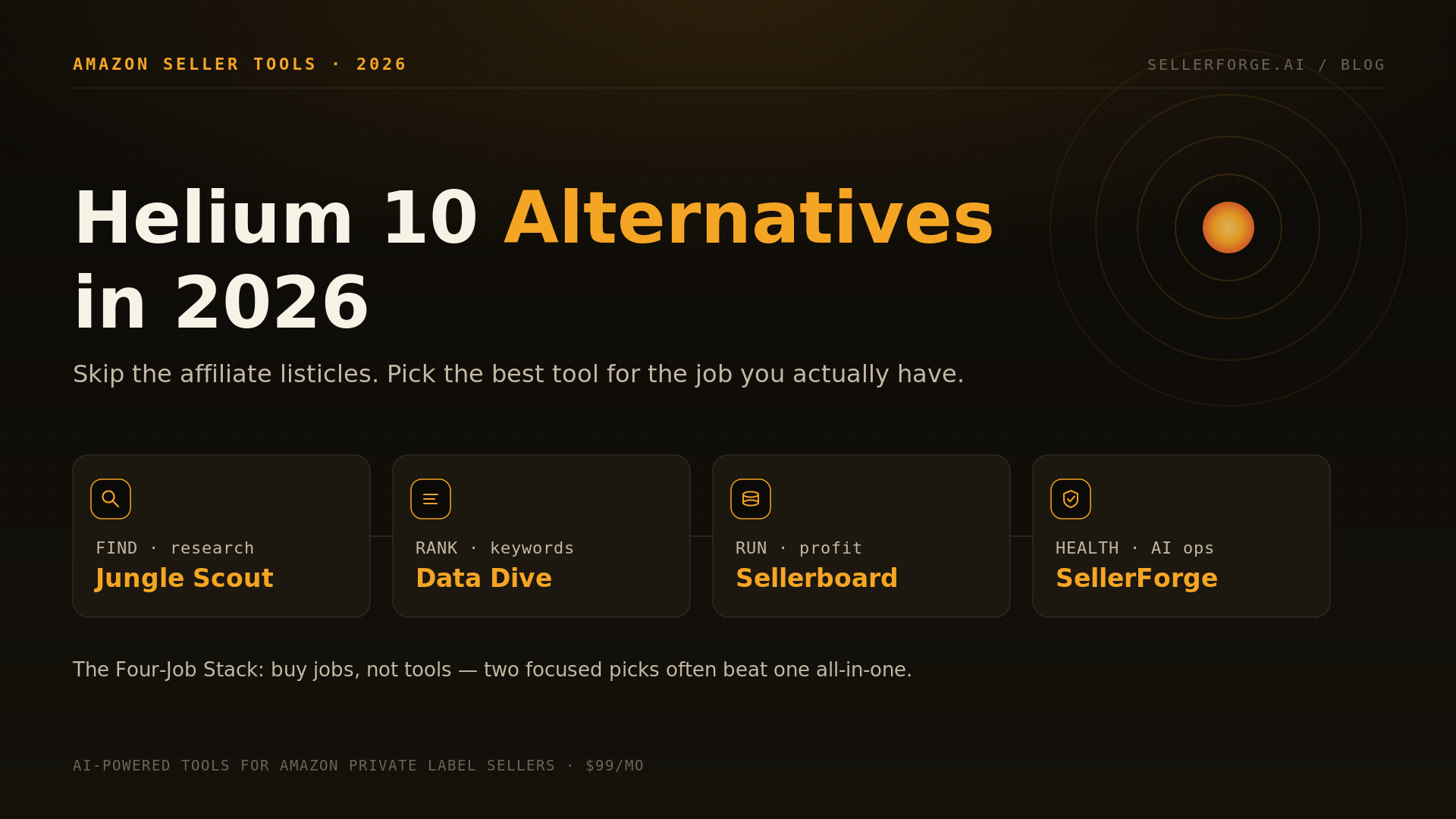
The Four-Job Stack: buy jobs, not tools
The mistake that makes Helium 10 feel expensive is not the price — it is paying for an all-in-one to do one or two jobs. Every dollar of Amazon software buys one of four jobs: Find (research), Rank (keywords, listing and AI visibility), Run (profit, inventory, account health), and Advertise (PPC). I call it the Four-Job Stack. Map your real needs to those four and the right tools — often just two — get obvious.
- Find — opportunity research, demand and competition data, supplier sourcing. Black Box and Jungle Scout territory.
- Rank — keywords, listing architecture, indexing, and now visibility inside Amazon’s AI and off-platform answer engines. Cerebro, Data Dive, SmartScout.
- Run — true-profit P&L, forecasting, account health, Plans of Action, reimbursements. Sellerboard, SellerForge, native Seller Central.
- Advertise — PPC bid and budget management. Helium 10 Ads, Perpetua, Teikametrics.
Now overlay what I call the Launch/Run line. Before launch you live almost entirely in Find and Rank — exactly where the big suites shine. After launch, most of your money moves to Run and Advertise, a completely different toolset. That is why established sellers quietly cancel the suite they bought as beginners: they crossed the Launch/Run line and never re-picked their tools.
The Four-Job Stack rule: name the one or two jobs you actually need done this quarter, buy the best tool for each, and refuse to pay all-in-one prices for jobs you are not doing. Two focused tools frequently cost less than one Diamond plan — and you will actually use both.
The best Helium 10 alternatives by job
The best Helium 10 alternative by job in 2026: Jungle Scout for product research, SellerSprite or AMZScout for budget research, SmartScout for competitor and AI-visibility intelligence, Data Dive for keyword and listing architecture, Keepa for price history, Sellerboard for profit analytics, and SellerForge (ours) for account health and true profit.
| Job to be done | Best-in-class pick | Budget / free option | Entry price (Sep 2026) |
|---|---|---|---|
| Product & market research | Jungle Scout | SellerSprite, AMZScout, ZonGuru | $49/mo ($29 annual) |
| Keyword & listing optimization | Data Dive | Amazon Search Query Performance (free) | $39/mo |
| Competitor & AI-visibility intelligence | SmartScout | Amazon Brand Analytics (free) | $49/mo ($29 annual) |
| Price & BSR history | Keepa | CamelCamelCamel (free) | €29/mo (~$32) |
| Profit & P&L analytics | Sellerboard | Amazon Canvas (free) | $19/mo ($15 annual) |
| PPC / advertising | Helium 10 Ads, Teikametrics, Perpetua | Amazon campaign manager (free) | $129 · $179 · $250/mo |
| Account health, true profit & AI ops | SellerForge (ours) | Amazon Account Health (free) | $49/mo (Forge Core) |
Jungle Scout — best for product research and new sellers. The friendliest serious research tool, and the only all-in-one with a real supplier database. Catalyst plans run $49/month (Starter, $29 annual), $79 (Growth Accelerator, $49 annual) and $149 (Brand Owner + CI, $129 annual), per Jungle Scout’s pricing page. Weaker on PPC now that Helium 10 Ads ships with Platinum.
- SellerSprite — the strongest multi-marketplace coverage here. Standard is the only true monthly plan at $79/month; Basic, Advanced and VIP are annual-only ($390, $1,290, $1,890 a year).
- AMZScout — the budget option at $59.99/month, or roughly $33/month on the $399.99 annual plan, plus a lifetime licence.
- ZonGuru — worth a look purely because it still offers a true 7-day free trial on every plan, which Helium 10, Jungle Scout and SmartScout no longer do. Researcher starts at $49/month ($29 annual).
- Data Dive — the Rank specialist at $39 (Starter, 14-day trial), $149 and $490/month, clustering Helium 10, Keepa and competitor keywords by listing section.
SmartScout — best for competitor intelligence, and now for AI visibility. It maps brand-level share across 40,000+ subcategories instead of hunting individual products, and in February 2026 added an Amazon AI Scorecard and an AI Visibility Monitor that tracks how often ChatGPT surfaces your ASINs and which sites it cites. Pricing moved up this year: Basic $49/month ($29 annual), Essentials $119 ($99), Business $299 ($239). A strategic layer, not an operational tool.
Keepa and Sellerboard — the cheap, essential Run tools. Sellerboard gives real-time profit and loss down to the SKU with FIFO cost accounting and reimbursement flagging, from $19/month ($15 annual) — still the highest-ROI tool in its category. Keepa now runs €29/month or €290/year, not the sub-$20 it used to be. On PPC the floor moved too: Teikametrics starts near $179/month and Perpetua near $250, so Helium 10 Ads inside a $129 plan is now the cheap option — see Best Amazon PPC Software in 2026.
What changed in 2026: the Rank job now has two audiences
The biggest gap in every Helium 10 alternatives list, including the earlier version of this one, is that Rank stopped being only about Amazon search. Your product now has to be findable by Amazon’s own AI, and separately by the answer engines shoppers use before they open Amazon. No keyword suite covers both.
The shift is not small. AI referral traffic to US retail sites grew 393% year over year in Q1 2026, and in March 2026 that traffic converted about 42% better than non-AI traffic. Meanwhile Amazon blocked ChatGPT’s crawlers in November 2025, so when a shopper asks ChatGPT for a recommendation it leans on other retailers’ pages and roundups — not your listing. Your Amazon SEO does not travel.
| Discovery surface | What decides what shows up | Covered by a keyword suite? | What actually moves it |
|---|---|---|---|
| Amazon search results | A9 keyword relevance plus sales velocity | Yes — this is what Cerebro and Data Dive are for | Keyword research, indexing, conversion rate |
| Amazon’s AI (COSMO, Alexa for Shopping) | Structured attributes and behavioural intent, not keyword density | Only partly | Backend discovery attributes, image and A+ quality |
| ChatGPT, Perplexity, Gemini | Third-party pages the model can crawl — Amazon listings are blocked | No | Off-Amazon brand content, reviews, roundups |
| Google AI Overviews | Web content and citations, not your listing | No | Your own site, PR, comparison content |
Practically: keep a keyword tool for the Amazon half, then treat the AI half as its own job. SmartScout’s AI Visibility Monitor is the only mainstream seller tool tracking the ChatGPT side directly today. For the Amazon-AI half — the backend attributes and image work COSMO and Alexa for Shopping actually read — see our Answer Engine Optimization guide and the AI competitor teardown workflow.
Helium 10 vs Jungle Scout: which is better in 2026?
For most sellers who really mean "Helium 10 or Jungle Scout," Jungle Scout is the better pick for product research and new sellers, and Helium 10 is the better pick for keyword depth and bundled PPC. What you should not do is decide on sales-estimate accuracy: the 2026 tests contradict each other.
Worth correcting, because this article previously stated it as settled: independent reviewers have put Jungle Scout at 84–86% and Helium 10 at 74–80%, but DemandSage’s own 2026 test found the reverse — 80.1% overall accuracy for Helium 10 against 78% for Jungle Scout, with Helium 10 hitting the exact figure 29.5% of the time versus 15.9%. Neither is gospel. Cross-reference any estimate against Amazon Brand Analytics and Keepa before you bet inventory dollars.
| Criteria | Helium 10 | Jungle Scout |
|---|---|---|
| Best for | Established, keyword-heavy sellers who run ads | New sellers, product research, sourcing |
| Entry paid price | $129/mo ($99 annual) | $49/mo ($29 annual) |
| Feature-complete plan | Diamond $359/mo ($279 annual) | Brand Owner + CI $149/mo ($129 annual) |
| Sales-estimate accuracy | Contested — 74–80% or 80.1% by test | Contested — 84–86% or 78% by test |
| Keyword research | Best-in-class (Cerebro, Magnet) | Good, less deep |
| PPC automation | Helium 10 Ads, included from Platinum | Basic |
| Supplier database | No | Yes |
| Free trial | Free plan only, no trial | No trial, 7-day refund |
| Learning curve | Steep (25+ tools) | Gentle |
Pick Jungle Scout if you are validating products, sourcing overseas, or want a tool you can learn in an afternoon. Pick Helium 10 if keyword research is your core discipline, or if you spend more than about $2,000 a month on ads — at that point bundled Helium 10 Ads does work you would otherwise pay $179 to $250 a month for. Full head-to-head: Jungle Scout vs Helium 10.
The mirror-image referee page exists too: the Jungle Scout alternatives guide covers the 2026 Catalyst/Cobalt repackaging, the Viral Launch shutdown, and which replacement fits each job when Jungle Scout is the suite you are leaving.
Is there a free or cheap Helium 10 alternative?
Yes, and the free option got substantially stronger in 2026. The cheapest paid alternatives are Sellerboard (from $19/month), SmartScout Basic ($49/month, $29 annual) and Keepa (€29/month) — but before you pay, audit what Amazon now gives you for nothing.
The headline addition is Amazon Canvas, launched March 3, 2026 and free for all US and UK sellers (Amazon’s announcement). It is an AI workspace inside Seller Central: ask a plain-English question about sales, ads or inventory and it builds interactive dashboards and what-if scenarios on the spot, no waitlist. For many sellers it replaces an entry-level analytics subscription outright.
- Amazon Canvas — free AI dashboards and what-if scenarios, US and UK sellers, no opt-in required.
- Brand Analytics and Search Query Performance — first-party share-of-voice and funnel data on your top keywords, free to Brand Registry sellers. No third-party estimate beats it.
- Listing Quality Dashboard — Amazon telling you which listings fail its own content standards.
- CamelCamelCamel and Keepa’s free tier — enough price and BSR history to sanity-check a sourcing decision.
A focused two-tool stack still beats a single suite on price and usefulness. For a validation-stage seller, Jungle Scout Starter ($49/month) plus Sellerboard ($19/month) covers Find and Run for under $70 — roughly half of Helium 10 Platinum, with Canvas and Brand Analytics filling the analytics layer free.
How do you audit your tool stack?
Run this hour-long audit before you switch anything — it is the only reliable way to know whether your problem is Helium 10’s price or your own unused subscriptions.
- 1Total the last 12 months of software charges. That annual figure, not the monthly one, is the real decision.
- 2Check the last login date on every tool. Anything untouched for 60 days is a cancellation, not a debate.
- 3Name the single job each surviving subscription does — Find, Rank, Run or Advertise. If you cannot name one, it is doing zero.
- 4Where two tools do the same job, keep the cheaper one unless you used a feature this month only the expensive one has.
- 5Cancel anything a free native tool absorbed — Canvas, Brand Analytics, Search Query Performance, Listing Quality Dashboard.
- 6Price the best single-purpose tool per remaining job against your suite, and switch only if the gap beats a migration week. Re-run in 90 days.
When should you keep Helium 10 — and when should you switch?
Keep Helium 10 if keyword research is central to your work, if you run meaningful ad spend, or if you are doing enough revenue that Diamond’s $359/month is a rounding error. Switch — or unbundle into focused tools — if you are pre-launch, budget-constrained, or honestly only using two or three of its modules.
- Keep it: sellers past $5K/month who live in Cerebro and run PPC through Helium 10 Ads, where the bundling now saves real money.
- Keep it: agencies running many audits and launches, where the breadth pays for itself in a day.
- Switch or unbundle: validation-stage and budget sellers — a two-tool stack costs less and teaches the fundamentals faster.
- Switch or unbundle: operators whose real problem is profit visibility, account health or reimbursements — Run jobs Helium 10 was never built to lead on.
If the underlying problem is fee leakage rather than software, start with a profitability audit before buying anything. If your worry is account risk, we compare the tools built for it in Best Amazon Account Health Software. And for the criterion-by-criterion version of this matchup, we keep an honest SellerForge vs Helium 10 breakdown that admits where Helium 10 wins.
Where SellerForge fits (and where it does not)
Full disclosure: SellerForge is our product, so weigh this accordingly. It is not a Helium 10 replacement for product research or supplier sourcing — it does not do Black Box-style opportunity hunting, and I will not pretend otherwise. It is a Run tool: account health, true-profit P&L, reimbursements, listing audits and AI operations for a catalog you are already selling. The difference is context, not feature count — because the AI already knows your ASINs, campaigns, inventory and account health before you ask, it catches what siloed tools miss, like a conversion problem your ads are actively spending into.
One correction we owe readers of the earlier version of this article: it said SellerForge was “$99/month, flat, no per-tier gating.” That is no longer true. Plans are now Forge Core $49/month, Forge Growth $99, Forge Pro $199 and Forge Agency $499 (annual billing knocks roughly two months off), with a 7-day free trial. Core carries the account-protection modules at lower run limits; Growth adds forecasting, promotions, the weekly report and team seats; Pro raises the caps; Agency runs ten seller accounts with a per-client switcher. Current numbers live on the pricing page, not in a blog post.
Concretely, on the Run side: the POA Builder and Escalation Plans for suspension and compliance work; Custom Breakdowns and the Weekly Business Report for net profit after fees, returns and ad spend; Reimbursement Claims; the Listing Audit; Forecasting; and the advertising module for profit-aware PPC.
How I would actually build a stack: pair a Find/Rank tool (Jungle Scout or Helium 10) with a Run tool (SellerForge or Sellerboard), lean on Canvas and Brand Analytics for free analytics, and skip the rest until a specific gap appears. That is the argument for purpose-built over generic, made in full in why generic AI tools are failing Amazon sellers and applied to profit in TACoS and contribution margin per ASIN. For every plan’s real caps and the buyers we turn away, read Is SellerForge worth it?
The bottom line
Helium 10 is not overpriced — it is over-bought. Sellers frustrated with the 2026 price increase are usually paying all-in-one money for one or two jobs, and some are paying a separate PPC platform for something Platinum now includes. Name the jobs you need done, buy the best tool for each, and the alternative question answers itself. Then re-run the audit quarterly — in 2026 alone the entry price moved, the PPC tool changed tiers, Keepa and SmartScout repriced, and Amazon started giving away an analytics dashboard.
One context this guide does not cover: sellers assembling a stack to replace a $2,500–$5,000/month retainer. The math changes when the alternative is an agency rather than another tool — see why Amazon sellers are leaving their agencies for the Three-Door Test that decides which jobs a tool can take over.
Want the Run half handled without an agency price tag? Start a free SellerForge trial, connect one account, and see your true profit, account-health risks and unclaimed reimbursements in a few minutes — then keep whatever research tool you already love.
About the author
David Gallo is the founder of SellerForge.ai. He previously managed 57 Amazon accounts representing over $350M in sales at Worldfront before building SellerForge to give sellers AI-powered tools at agency quality without the agency price.