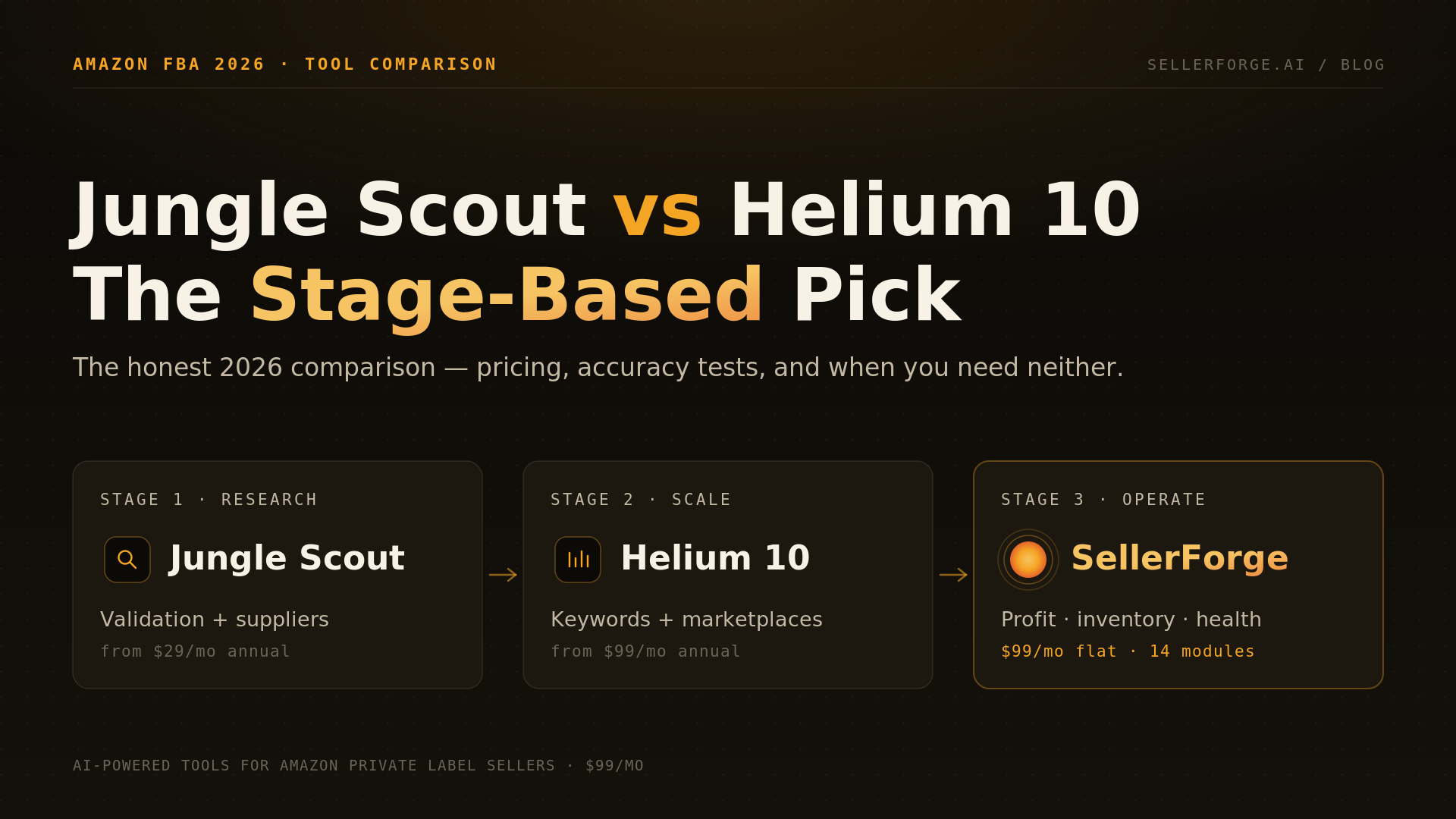
Jungle Scout is the better pick for pre-launch product research and supplier sourcing; Helium 10 is the better pick for keyword depth, in-suite ads, and multi-marketplace scale, but only on Diamond ($279/mo annual), because the $99 Platinum plan now caps keyword research at 100 searches a month. Independent tests put their sales-estimate accuracy within about 1.3 points. Once products are live, most sellers need an operations layer more than either suite.
Pick Jungle Scout if you are validating your first products and vetting suppliers. Pick Helium 10 if keyword research, in-suite ads, and multiple marketplaces are your daily work, and budget for its Diamond plan, because the $99 entry tier was cut back in April 2026. If your products are already live and your real problems are profit, stockouts, and account health, the honest answer is neither. That job belongs to an operations platform like SellerForge, which is our product; this page discloses that up front and tells you where we do not fit.
I used both suites across the 57 Amazon accounts I managed at Worldfront, and the same pattern repeated on nearly every one: the research suite earned its subscription intensely for about ninety days around each launch, then sat unopened while the account manager wrestled with fees, inventory, and ad waste in spreadsheets. That pattern, not a feature checklist, is what should drive your choice.
This version was re-verified on September 30, 2026 against both vendors' live pricing pages. It covers what changed this year, what each entry plan actually includes, what the independent accuracy tests show, the new AI agents and MCP connectors, and a simple test for when to stop paying for either tool.
Jungle Scout vs Helium 10: The 60-Second Answer
Jungle Scout Catalyst is the stronger pick for pre-launch work, meaning product validation, sales estimates, and supplier sourcing, at a lower entry price. Helium 10 is the stronger pick for keyword depth, rules-based ad automation, and multi-marketplace coverage, but most of that advantage now lives on Diamond, not Platinum. Neither tool is meaningfully better at everything, and neither runs a live account.
Decide by job, not by feature count. Here is the head-to-head the way an operator uses it:
| Job to be done | Better tool | Why |
|---|---|---|
| First product research and validation | Jungle Scout | Opportunity Finder is unlimited from Growth Accelerator; the workflow is built for first-time sellers |
| Supplier sourcing and vetting | Jungle Scout | Supplier Database matches ASINs to import records; Helium 10 has no equivalent. Starts at Growth Accelerator, not Starter |
| Heavy keyword research | Helium 10 Diamond | Cerebro and Magnet are the deepest reverse-ASIN tools, uncapped on Diamond; Platinum is capped at 100 searches a month |
| In-suite PPC automation | Helium 10 Diamond | Rules-based automation and dayparting, billed as a 2% managed-spend fee; removed from Platinum in 2026 |
| Multi-channel selling | Helium 10 | Covers Amazon, Walmart, and TikTok Shop; Jungle Scout Catalyst is Amazon-focused |
| Market data inside an AI assistant | Helium 10 Diamond | Its MCP is free on Diamond; Jungle Scout's MCP is limited to Cobalt enterprise customers |
| Post-launch operations: profit, inventory, account health | Neither (SellerForge) | Research suites stop at launch; SellerForge (ours) is the operations layer, from $49/mo |
What Changed in 2026, and Why Most Comparisons Are Now Wrong
Four things changed this year: Helium 10 removed its Starter plan and raised prices by roughly 30%, then cut Platinum's entitlements in April; Jungle Scout reorganized into Catalyst for sellers under $1M and Cobalt for enterprise; both vendors shipped AI connectors gated to upper tiers; and the independent accuracy numbers narrowed. Comparisons written before April miss most of this.
- Helium 10 repricing: month-to-month Platinum rose from $99 to $129 (+30%) and Diamond from $279 to $359 (+29%), and the cheap Starter tier was retired, per RevenueGeeks' 2026 pricing tracker.
- Platinum entitlement cuts (April 2026): Cerebro and Magnet capped at 100 searches a month, Listing Builder AI optimizations capped at five lifetime uses, alerts limited to five ASINs, and Helium 10 Ads removed from the plan.
- Jungle Scout's split: Catalyst (Starter, Growth Accelerator, Brand Owner + CI) for sellers under $1M; Cobalt, custom-priced and demo-gated, for $1M+ brands and agencies.
- AI layer: Helium 10 launched its MCP connector on July 16 and Helium, an AI agent that diagnoses account performance, on August 24; Jungle Scout's MCP, announced July 6, serves Cobalt customers.
- Accuracy: DemandSage's independent test, updated August 21, now puts the gap at 79.3% versus 78%, closer than either vendor's marketing suggests.
The Platinum cuts are the change that matters most for the head-to-head, and they are why the old "$29 versus $99" framing misleads. EcomCrew documented the April 1 entitlement reductions and the seller pushback that followed, and Helium 10's own help-center article on Ads availability (updated August 20, 2026) confirms ad management now starts at Diamond.
How Much Do Jungle Scout and Helium 10 Cost in 2026?
Jungle Scout Catalyst runs $29 to $129 a month billed annually ($49 to $149 month-to-month). Helium 10 runs $99 to $279 a month billed annually ($129 to $359 month-to-month), plus Enterprise from $1,499 a month. Jungle Scout is cheaper at every comparable tier, and Helium 10 is the only one with a permanent free plan.
| Plan | Month-to-month | Billed annually (per month) | Best for |
|---|---|---|---|
| Jungle Scout Starter | $49 | $29 ($348/yr) | Validating ideas; no rank tracker or Supplier Database |
| Jungle Scout Growth Accelerator | $79 | $49 ($588/yr) | Launching: adds Supplier Database, rank tracking, review automation |
| Jungle Scout Brand Owner + CI | $149 | $129 ($1,548/yr) | Brands needing competitive intelligence |
| Jungle Scout Cobalt | Custom | Custom (demo) | $1M+ brands, agencies; includes MCP |
| Helium 10 Free | $0 | $0 | Sanity-checking one idea |
| Helium 10 Platinum | $129 | $99 ($1,188/yr) | Light keyword work, one product line |
| Helium 10 Diamond | $359 | $279 ($3,348/yr) | Multi-ASIN sellers using Ads, Helium agent, MCP |
| Helium 10 Enterprise | From $1,499 | Custom | Large brands and agencies |
| SellerForge (ours) | From $49 | Core $49 / Growth $99 / Pro $199 / Agency $499 | Post-launch operations; 7-day free trial |
Prices verified September 30, 2026 against Jungle Scout's Catalyst plans page and Helium 10's pricing page. Both vendors run constant promotions, so check again at checkout. Extra Jungle Scout seats on Growth Accelerator and above cost $49 a month ($459 a year); Helium 10 Platinum includes one additional user and Diamond includes five.
Billing-period trap: every price in this category has two numbers. Jungle Scout Starter is $29 on annual billing but $49 month-to-month; Helium 10 Diamond swings $80 a month between the two. A comparison that prints one number without naming the billing period is the most common source of checkout shock.
What Does the Entry Plan Actually Get You?
At the entry tiers most sellers actually buy, Jungle Scout's $49 Growth Accelerator includes more usable research than Helium 10's $99 Platinum: unlimited Opportunity Finder, 1,000 sales estimates, 500 tracked keywords, and the Supplier Database, versus Platinum's 100 keyword searches a month and five lifetime AI listing optimizations. Diamond is where Helium 10 pulls ahead.
| What you get | JS Growth Accelerator ($49 annual) | H10 Platinum ($99 annual) | H10 Diamond ($279 annual) |
|---|---|---|---|
| Keyword research | Keyword Scout; 500 rank-tracked keywords | Cerebro + Magnet: 100 searches/mo | No monthly cap |
| Product research | Unlimited Opportunity Finder; 1,000 estimates/mo | Black Box and Xray | Black Box and Xray |
| Product tracking | 150 products | 20 ASINs | 1,000 ASINs |
| Supplier sourcing | Supplier Database | None | None |
| AI listing help | AI Assist, 100 uses/mo | Listing Builder AI: 5 lifetime uses | Higher limits |
| PPC management | None (Cobalt only) | None | Rules-based + dayparting, 2% of managed spend |
| AI agent / MCP | None (MCP is Cobalt only) | MCP add-on from $50/mo | Helium agent + MCP included |
The practical read: Platinum is now a sampling plan for sellers who run a handful of keyword projects a month. If you do more than that, the honest Helium 10 price is $279, and at $279 you are comparing it against Jungle Scout's $129 Brand Owner + CI tier, not its $29 Starter.
What Does Jungle Scout Do Better Than Helium 10?
Jungle Scout wins on product-research workflow, supplier sourcing, and cost per usable feature. Its Supplier Database, which matches products and competitors to import records, is still the most differentiated feature either platform offers, and Growth Accelerator bundles it with unlimited Opportunity Finder searches for $49 a month billed annually.
- Supplier Database: look up a competitor ASIN and see which manufacturers ship it, with shipment history to compare. Helium 10 has nothing equivalent. Note that it starts at Growth Accelerator; Starter does not include it.
- Research workflow: Opportunity Finder, the Product Database, and the extension share one flow that new sellers learn in an afternoon. Helium 10's Black Box is more configurable but takes longer to use well.
- Predictable limits: Catalyst caps are generous and monthly (1,000 estimates, 500 tracked keywords on Growth Accelerator), rather than lifetime caps that quietly run out.
- AI Assist: drafts titles, bullets, and descriptions from your keyword list, 100 times a month on Growth Accelerator, useful for first listings.
- Refund safety: a 7-day money-back guarantee on every Catalyst plan, no questions asked.
What Does Helium 10 Do Better Than Jungle Scout?
Helium 10 wins on keyword depth, breadth of tooling, multi-channel reach, and in-suite automation, and in 2026 it also leads on AI: an MCP connector and the Helium agent both ship with Diamond. For a multi-ASIN seller doing daily keyword and ad work, Diamond is the strongest single research subscription on the market.
- Cerebro and Magnet: reverse-ASIN and seed keyword research with advanced filtering. Serious keyword operators rarely give these up, which is exactly why Platinum's 100-search cap stings.
- Multi-channel coverage: Amazon, Walmart, and TikTok Shop in one suite. Helium 10 lists 21 Amazon marketplaces, though RevenueGeeks' July 2026 map shows the full toolset in only about six core ones.
- In-suite PPC: Helium 10 Ads provides rules-based automation and dayparting on Diamond and above, billed at 2% of managed ad spend with no minimum.
- Helium agent: launched August 24, 2026, it diagnoses performance changes and recommends actions across your account. It is read-and-recommend today; Helium 10 says write actions come later.
- Free plan: the only permanent free tier of the two, useful for testing the interface before paying.
Which Is More Accurate, Jungle Scout or Helium 10?
Independent testing puts them about 1.3 points apart. DemandSage's test, updated August 21, 2026, measured 79.3% overall accuracy for Helium 10 versus 78% for Jungle Scout, with Helium 10 matching exact sales 29.5% of the time versus 15.9% and missing by an average of 22 units versus 35. The gap is real but small.
The vendor studies are where it gets entertaining. Helium 10's own November 2024 case study of 29,906 products puts itself at 89.6% versus 60% for Jungle Scout; Jungle Scout's commissioned study puts itself at 84% and Helium 10 at 74%. Both cannot be right, and methodology choices (which categories, which BSR bands, exact versus banded scoring) explain the spread. DemandSage's side-by-side test is the most recent independent read, and it clusters the two tools tightly.
Operator rule for accuracy claims: if the study names a winner, check who paid for it. Across independent tests, Jungle Scout and Helium 10 land within a couple of points of each other, close enough that workflow fit and plan limits, not estimate accuracy, should decide the purchase.
Whichever suite you use, never bet an order quantity on one estimate. The triangulation I taught every account manager takes ten minutes:
- 1Pull the sales estimate from your primary suite, then cross-check the same ASIN in the other suite's free plan or your one-month trial.
- 2Sanity-check against review velocity: monthly new reviews multiplied by 25 to 40 gives an independent unit-sales band. Treat it as an operator heuristic, not a law.
- 3Check the Keepa or Product Opportunity Explorer trend line for seasonality before trusting a single month.
- 4Treat the final number as a plus or minus 25% band and size your first purchase order to survive the low end of it.
Do Jungle Scout and Helium 10 Work With ChatGPT and Claude?
Yes, through MCP connectors, but both are gated to upper tiers and both expose the vendor's market data rather than your own Seller Central account. Helium 10's MCP is free on Diamond and an add-on from $50 a month on Platinum; Jungle Scout's MCP is for Cobalt enterprise customers. Plan-level access, not the AI itself, is the real difference.
That distinction matters when you choose a stack. A research MCP answers "how big is this niche and who ranks for this keyword." It cannot answer "why did my margin on this ASIN drop last week" or "which of my listings has an open policy violation," because it never sees your fees, settlements, or account-health data. We break down which connectors reach which data, including Amazon's own options, in our Seller Central MCP guide.
The 90-Day Shelf Test: When You Need Neither
The 90-Day Shelf Test is the one-question audit I apply to every tool subscription: if nobody on the account has opened the tool in the last 90 days, you are paying for launch software during the operating phase of your business, and the subscription should be downgraded, paused, or replaced. Research suites fail this test more than any other category.
Across the 57 accounts I managed, research-suite logins told the same story: heavy daily use in the month before and the two months after a launch, then silence. The subscription kept billing while the real work moved to fee reports, inventory spreadsheets, and case logs, none of which a research suite touches. At Diamond's $279 a month, eight or nine quiet months is more than $2,200 a year of pure tool waste on one account.
- Your last three logins were rank checks, which is a tracker's job, not a $99-plus suite's.
- You compute true profit per ASIN in a spreadsheet because the suite cannot see your fees, returns, and cost history together.
- Your last launch was six or more months ago and none is planned this quarter.
- The tabs open next to Seller Central are case logs and fee reports, not Black Box or Opportunity Finder.
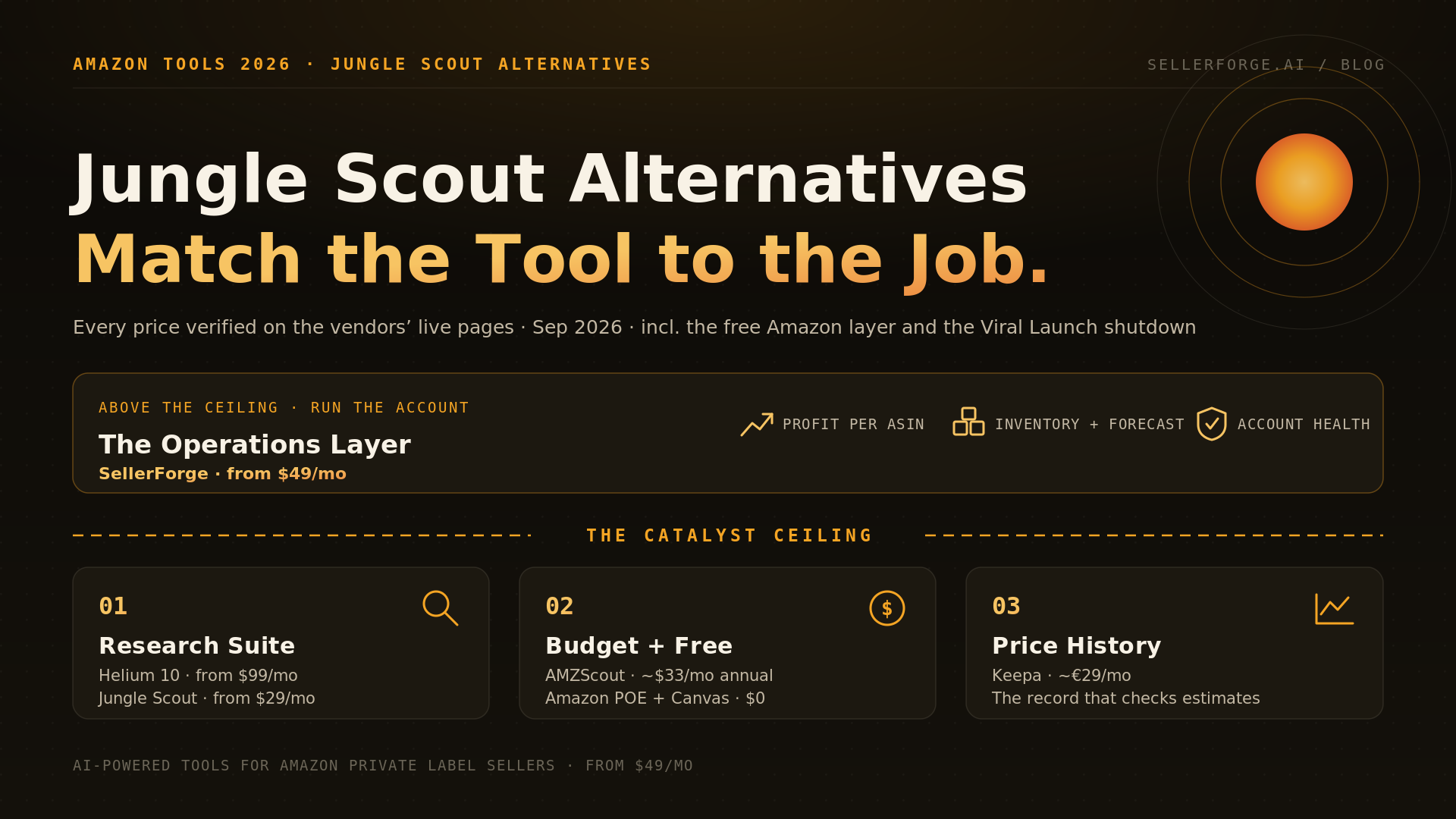
If two or more of those apply, your money is in the wrong category. The job-by-job rebuild is the Four-Job Stack in our Helium 10 alternatives guide, and if you are leaving Jungle Scout specifically, our Jungle Scout alternatives map covers SmartScout, AMZScout, Keepa, and Amazon's free tools with September 2026 pricing. The full category map, research through operations, lives in our best Amazon seller tools roundup.
Where SellerForge Fits, and Where It Does Not
Full disclosure again: SellerForge is our product, and it is not a research suite. There is no supplier database and no product-idea browser; if that is your job, buy Jungle Scout or Helium 10. SellerForge covers what those suites stop at: AI-native operations for sellers with live products, from $49 a month with a 7-day free trial.
In practice that means the post-launch jobs from the first table: Custom Breakdowns for real contribution margin per ASIN after fees, returns, and ads; inventory forecasting against actual lead times; reimbursement claims for the fee errors nobody checks; a listing audit that scores what is live; a Weekly Business Report a human actually reads; and an advertising module that ties spend to profit.
And the honest routing for everything else: measuring true net margin is covered in our Amazon profit tracking software comparison, and if what you need is enterprise-grade PPC autobidding rather than in-suite rules, the category leaders are refereed in Perpetua vs Pacvue.
Who Should Pick What in 2026
Match the plan to your stage and the job in front of you this quarter, not to the brand you heard of first. Start on the cheapest tier that covers that job and upgrade only when you hit a limit you can name. For most sellers that means Growth Accelerator first and Diamond only at scale.
- First product, budget-tight: Jungle Scout Growth Accelerator at $49 a month billed annually. Starter saves $20 but lacks the Supplier Database and rank tracking you will want by launch week.
- Launching this quarter with moderate keyword work: Jungle Scout Growth Accelerator, or Helium 10 Platinum ($99 annual) only if 100 Cerebro and Magnet searches a month genuinely covers you.
- Multi-ASIN, multi-channel scaling: Helium 10 Diamond ($279 annual). Uncapped keyword research, in-suite Ads, the Helium agent, and the MCP make it the strongest single research subscription at this stage.
- Agency managing client accounts: Jungle Scout Cobalt or Helium 10 Enterprise for research and market intelligence, paired with SellerForge Agency ($499 a month) for the operations and client-reporting layer.
- Established brand, no launches planned: neither suite at full price. Run the 90-Day Shelf Test, keep a cheap tracker if rank checks are all you use, and put the budget into the operations layer.
If your products are live and the problems on your desk are margin, stockouts, and account health, that is the job SellerForge was built for. Start a 7-day free trial and see what an operations layer looks like when it reads your whole account, or compare plans on the pricing page.
About the author
David Gallo is the founder of SellerForge.ai. Before building it, he managed 57 Amazon seller accounts representing more than $350M in sales at Worldfront, where he bought, used, and canceled more seller software than he can remember. He writes the SellerForge blog for operators, not affiliates.