Pick Jungle Scout if your recurring question is what product to launch next; pick SmartScout if it is who is winning a market: which brands, sellers or wholesale accounts. Both start at $29/mo billed annually, but SmartScout's brand data starts at Essentials ($99) and its seller maps at Business ($239). SellerForge, our product, is neither: it reads your own account from $49/mo.
SmartScout vs Jungle Scout comes down to one question: are you trying to decide what to sell, or who is winning a market? Jungle Scout is the better product-research tool for private-label sellers picking and launching their next ASIN. SmartScout is the better market-intelligence tool for wholesale sellers, agencies and brands that need to see which brands and sellers own a category. Disclosure up front: SellerForge, which publishes this blog, is our product, and it is neither of these. It reads your own account from $49/mo, and I will show where it fits near the end.
Every price here was checked on both vendors' live pricing pages on October 20, 2026. That matters more than usual for this matchup, because the plan you buy decides which data you can see. SmartScout's brand-level data starts at Essentials and its seller maps at Business, so the $29 entry price most roundups quote does not buy the thing SmartScout is famous for.
Across the 57 accounts I managed at Worldfront, more than $350M in sales, the expensive research-tool mistake was never picking the wrong brand of tool. It was paying for a tier that could not answer the question the team actually asked every week. This page is built to stop that.
Which Is Better, SmartScout or Jungle Scout?
Jungle Scout is better for private-label product research: finding a product, validating demand, sourcing a supplier and launching. SmartScout is better for market intelligence: mapping which brands and sellers own a subcategory, prospecting wholesale accounts or agency clients, and tracking competitors. Most private-label sellers under $1M in revenue need Jungle Scout; most wholesale sellers and agencies need SmartScout.
Independent reviewers land in the same place. RevenueGeeks' August 2026 head-to-head named Jungle Scout the overall winner for private label on price, features and ease of use, called data accuracy a draw, and positioned SmartScout as the stronger tool for wholesale sourcing and market mapping. Where I part company with most comparisons is the framing. These are not two versions of the same product. They start from opposite ends of the catalog.
- Jungle Scout starts from the product: type a niche, read sales estimates, check keyword demand, find the factory in import records, launch.
- SmartScout starts from the market: open a subcategory, see brand market share and seller counts, then drill down to the products and sellers driving it.
- Both now sell AI connectors (MCP servers) for Claude and ChatGPT, but at very different price points, covered below.
How Much Do SmartScout and Jungle Scout Cost in 2026?
Both tools start at $29 a month billed annually, or $49 month to month. The gap opens at the top: Jungle Scout's most complete self-serve plan, Brand Owner, is $129 a month on annual billing ($149 monthly), while SmartScout Business is $239 a month annual ($299 monthly). Neither offers a free trial; both give a 7-day money-back guarantee instead.
| Tier | Jungle Scout Catalyst (monthly / annual per month) | SmartScout (monthly / annual per month) |
|---|---|---|
| Entry | Starter: $49 / $29 | Basic: $49 / $29 |
| Middle | Growth Accelerator: $79 / $49 | Essentials: $119 / $99 |
| Top self-serve | Brand Owner: $149 / $129 | Business: $299 / $239 |
| Enterprise | Cobalt: demo only | Enterprise: custom |
| Top self-serve, per year (annual) | $1,548 | $2,868 |
| Extra users | $49/mo per seat (not on Starter) | $49/mo per user |
| Trial | None; 7-day money-back for first purchases | None; 7-day money-back (not Enterprise) |
Sources: Jungle Scout Catalyst plans and SmartScout pricing, both read on October 20, 2026 with the monthly and yearly toggles checked separately.
Pricing caution: when we checked on October 20, 2026, SmartScout's own SmartScout-vs-Helium-10-vs-Jungle-Scout comparison page listed different SmartScout figures than its live pricing page, and several 2026 roundups still print older numbers. Trust the pricing page, toggle monthly versus yearly, and confirm at checkout.
What Does Each Plan Actually Unlock?
The entry plans are not comparable on the job that matters. SmartScout Basic unlocks product-level data only; brand-level data starts at Essentials ($99 annual) and seller-level and subcategory-level data at Business ($239 annual). Jungle Scout Starter caps the Product Database at 100 searches a month, and its Supplier Database starts at Growth Accelerator ($49 annual).
| Job | Jungle Scout: cheapest plan | SmartScout: cheapest plan | Better pick |
|---|---|---|---|
| Product research with sales estimates | Starter, $29/mo annual (100 Product Database searches a month) | Basic, $29/mo annual (product-level data) | Tie on price; Jungle Scout on workflow |
| Keyword research | Starter: 50 Keyword Scout searches a month; Growth Accelerator 250; Brand Owner unlimited | Basic, $29/mo annual (limited); unlimited keyword research and tracking from Essentials, $99/mo annual | Jungle Scout for light use, SmartScout for heavy tracking |
| Supplier sourcing from import records | Growth Accelerator, $49/mo annual | Not offered (its wholesale tool is a UPC and price-list scanner) | Jungle Scout |
| Brand market share in a category | Brand Owner, $129/mo annual (Competitive Intelligence, 5 segments) | Essentials, $99/mo annual (brand-level data) | SmartScout |
| Seller-level maps and subcategory dashboards | Not in Catalyst (Cobalt, demo only) | Business, $239/mo annual | SmartScout |
| Market data inside Claude or ChatGPT (MCP) | Cobalt only, demo-gated | Business, $239/mo annual (Snapshot MCP); full MCP on Enterprise | SmartScout |
| Tracking how AI assistants mention your products | Not listed on Catalyst plans | AI Visibility Monitor: 1 dashboard on Basic, 10 on Essentials, 25 on Business | SmartScout |
| Your own profit, inventory and account health | Not covered (market data only) | Not covered (market data only) | SellerForge, from $49/mo (ours) |
Read the table by your weekly question, not by feature count. A private-label seller who asks what to launch and who makes it gets both answers from Jungle Scout Growth Accelerator at $49 a month annual. A wholesale buyer who asks which brands sell through many resellers and which sellers carry them needs SmartScout Business at $239, because Basic and Essentials cannot see seller-level data. Those two buyers should never be reading the same verdict.
The Who-What-Why Test: Pick by the Question You Ask Every Week
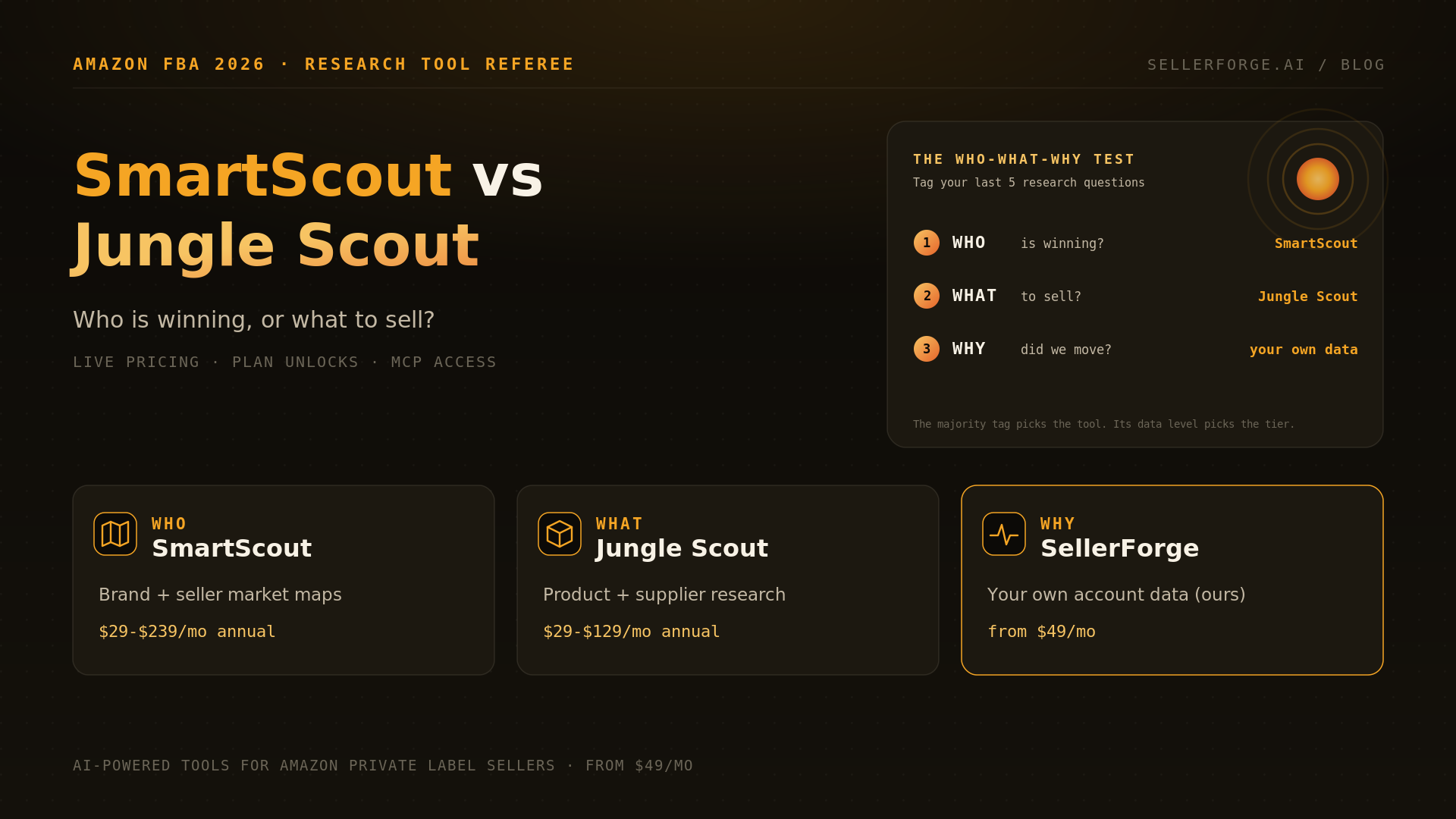
The Who-What-Why Test settles the choice in five minutes. Write down the last five research questions your team actually asked and tag each one WHO (which brands, sellers or accounts are winning), WHAT (which product or keyword to pursue) or WHY (why your own numbers moved). The majority tag picks the tool, and the tag's data level picks the tier.
- 1List the last five research questions your team asked out loud or in Slack, word for word. Not the ones you think you should ask.
- 2Tag each one. WHO: who owns this subcategory, which sellers carry this brand, which brands should we pitch. WHAT: is this product worth launching, which keywords drive this niche, who manufactures this. WHY: why did our margin drop, why did this ASIN stop selling, why is our account health down.
- 3Mostly WHO: buy SmartScout, at the tier that sees the level you named. Essentials for brands, Business for sellers and subcategories.
- 4Mostly WHAT: buy Jungle Scout. Growth Accelerator is the sweet spot because it adds the Supplier Database and five times the Starter keyword searches.
- 5Mostly WHY: neither tool can answer it, because both read the public catalog, not your Seller Central data. That is an operating-layer job, not a research job.
- 6Split between WHO and WHAT: start with Jungle Scout plus Amazon's free Product Opportunity Explorer, and add SmartScout only when a WHO question blocks a real decision.
The Who-What-Why Test in one line: WHO is winning, SmartScout. WHAT to sell, Jungle Scout. WHY your own numbers moved, neither; that question lives inside your account.
In my experience the WHY column fills up fastest after launch. Once a brand has a handful of ASINs live, the weekly questions shift from the market to the account, and that is exactly when research seats start going unopened while the subscription renews.
This is a different cut from the Catalyst Ceiling in our Jungle Scout alternatives guide, which tells you when you have outgrown Jungle Scout. The Who-What-Why Test tells you which tool your questions need in the first place.
Where Does Each Tool Win?
SmartScout wins on top-down market visibility: brand and seller maps, subcategory share, traffic networks between products, and tracking of AI-assistant mentions. Jungle Scout wins on the launch workflow: product database, keyword research, supplier sourcing from import records, and an interface new sellers learn in an afternoon. Each tool's weakness is the other's strength.
SmartScout wins: wholesale, agencies and category sizing
- Seller and brand maps: on Business you can see which sellers carry a brand and how a subcategory's revenue splits across brands. That is how wholesale buyers find accounts and agencies find prospects.
- Scale of the map: SmartScout says it analyzes more than 20 million U.S. ASINs across 40,000+ subcategories.
- Wholesale tooling: a UPC and price-list scanner, 5,000 ASINs a month on Basic and 50,000 on Essentials, checks a distributor's catalog against Amazon demand.
- AI visibility: its AI Visibility Monitor tracks how often LLM assistants mention your products, a job Jungle Scout's Catalyst plans do not list. Every SmartScout plan now also lists TikTok Shop data.
Jungle Scout wins: private-label launches
- Supplier Database: match a competitor's product to the manufacturers that ship it, using import records. SmartScout has no equivalent.
- Launch workflow: Opportunity Finder, the Product Database, Keyword Scout and the browser extension share one flow, with listing and review-request tools alongside.
- Price at the top: the most complete self-serve Jungle Scout plan costs $1,548 a year against $2,868 for SmartScout Business.
- Depth of history: Jungle Scout says it has 11 years of sales-estimate refinement, tracks 600M+ products and has served 1M+ customers. Catalyst covers 8 Amazon marketplaces.
Where Jungle Scout loses: its market-share and competitive-intelligence features sit on Brand Owner only, with 5 segments included and extra segments at $950 a year per five. If your main job is watching competitors across many categories, that pricing pushes you toward SmartScout or toward a Cobalt contract.
Is SmartScout More Accurate Than Jungle Scout?
Nobody has published an independent, reproducible accuracy test of both tools, so treat every accuracy claim as marketing until you check it yourself. SmartScout's own comparison page claims 95% average accuracy against 78% for Jungle Scout. Jungle Scout says its data is the most accurate in the market. RevenueGeeks' August 2026 review called it a draw.
My advice is the one I gave teams for every research tool: calibrate on ASINs whose real sales you know. Take three of your own products, or a client's, with known monthly units. Look them up in both tools and note which lands closer across all three. Include one low-volume ASIN and one seasonal ASIN, because those are where every estimator misses most.
Neither tool offers a free trial; both give a 7-day money-back guarantee. Run the three-ASIN calibration inside those seven days, before the refund window closes.
Do SmartScout and Jungle Scout Work With ChatGPT and Claude?
Yes, both now ship MCP servers, but at very different price points. SmartScout's Snapshot MCP comes with the Business plan at $239 a month annual, with full MCP access on Enterprise. Jungle Scout's MCP connects Cobalt, its enterprise platform, to Claude, ChatGPT, Gemini or Copilot, and starts with a demo request rather than a checkout.
SmartScout says its MCP server adds 8 analytics tools inside Claude in under two minutes. Jungle Scout positions its MCP for brand, category and leadership teams and says plainly that it extends Cobalt rather than replacing it. For a self-serve seller, SmartScout is the only one of the two you can connect to an AI assistant this week without a sales call.
Both connectors answer market questions: who is gaining share, which price tiers are growing, who owns a keyword. Neither sees your fees, settlements, inventory or account health. Since September 23, 2026, Amazon's own Selling Partner plugin has put Seller Assistant inside Claude in beta for U.S. stores, which covers part of that inside view for free.
We map which connector reaches which data, including Amazon's own, in our Amazon Seller Central MCP guide, and the plugin itself in our Amazon Accelerate 2026 recap.
Where SellerForge Fits (and Where It Does Not)
SellerForge is not a research tool and does not replace SmartScout or Jungle Scout. It is AI-native account intelligence from $49 a month that reads your own Seller Central data, profit, inventory, ads and account health together, and answers the WHY questions both research tools cannot see. It shows no competitor sales estimates and no market maps.
In practice that means contribution margin per ASIN after every fee with Custom Breakdowns, reorder timing from inventory forecasting, a weekly business report that flags what moved and why, and a listing audit for the ASINs you already sell. You can ask all of it from Claude or ChatGPT through SellerForge MCP, which reads your own account, not the market.
What it will not do: estimate a competitor's sales, map a subcategory or find a supplier. If those are your questions, buy from the table above. Agencies doing both jobs usually pair SmartScout for prospecting with an operating layer for the accounts they win; our Agency plan covers 10 accounts for $499 a month.
Who Should Pick What
Choose by the question you ask most and the data level it needs. Private-label sellers launching products: Jungle Scout Growth Accelerator. Wholesale sellers and agencies prospecting: SmartScout Business. Brands watching category share: SmartScout Essentials. Sellers whose questions are about their own numbers: neither research tool; start with the account layer.
- First private-label product on a tight budget: Jungle Scout Starter at $29/mo annual, plus Amazon's free Product Opportunity Explorer.
- Private-label seller launching two or more products a year: Jungle Scout Growth Accelerator at $49/mo annual, for the Supplier Database.
- Wholesale or online-arbitrage seller: SmartScout. Basic for the price-list scanner, Business at $239/mo annual once you need seller-level data to find accounts.
- Agency prospecting brands: SmartScout Business, and budget $49/mo for each extra user.
- Established brand watching one or two categories: SmartScout Essentials at $99/mo annual, or Jungle Scout Brand Owner if you also launch often.
- $1M+ brand that wants market data inside an AI assistant: compare SmartScout Business or Enterprise MCP against a Jungle Scout Cobalt demo.
- Seller whose questions are about margin, stock and account health: SellerForge from $49/mo (ours), alongside either research tool or neither.
If you are rebuilding a whole stack rather than choosing one tool, the Four-Job Stack in our Helium 10 alternatives guide sorts research, ranking, running and reporting, the 90-Day Shelf Test in Jungle Scout vs Helium 10 tells you when you need no research suite at all, and our best Amazon seller tools guide maps every category.
Research tool picked, but the weekly WHY questions still land on you? Start a SellerForge trial, connect your Amazon account, and see margin per ASIN, inventory risk and account health next to whichever research tool you run. Plans start at $49/mo.
About the author
David Gallo is the founder of SellerForge.ai. Before building SellerForge, he managed 57 Amazon seller accounts representing more than $350M in sales at Worldfront, where he learned that market research and account operations are different jobs, and that most teams overpay for the first while starving the second.