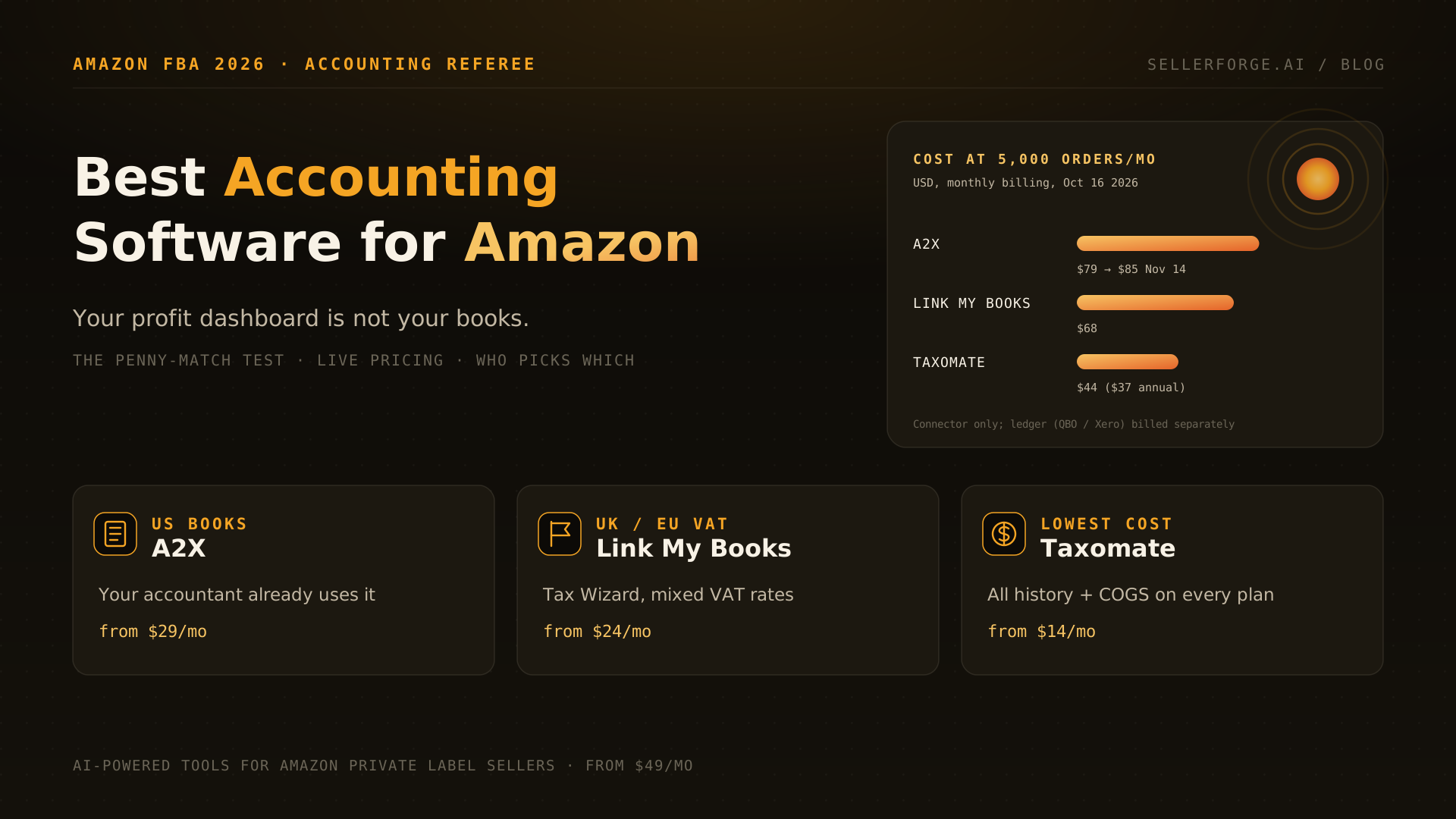
The best accounting software for Amazon sellers is a settlement connector feeding QuickBooks Online or Xero: A2X for accountant-led U.S. books, Link My Books for UK and EU VAT, and Taxomate when cost per order matters most. Prices verified October 16, 2026: $44 to $79 a month at 5,000 orders. SellerForge (ours, from $49/mo) is not a connector; it is the operating layer above the books.
The best accounting software for Amazon sellers is not one product. It is a ledger, QuickBooks Online or Xero, fed by a settlement connector: A2X if your accountant runs U.S. books, Link My Books if you sell in the UK or EU, Taxomate if you want the lowest cost per order. SellerForge, which is our product, is deliberately not on that list, and this post explains where it fits instead.
Every page ranking for this query today is written by one of the connectors, and each one ranks itself first. So we priced A2X, Link My Books, Taxomate and Synder ourselves on October 16, 2026, at five order volumes, from each vendor's live pricing page. Two findings change the usual advice: A2X raises most plans on November 14, 2026, and the cheapest Link My Books plans quietly limit you to three months of settlement history.
I managed 57 Amazon accounts and $350M+ in sales at Worldfront, and the most expensive accounting mistakes I saw were never about which connector a brand chose. They were about brands treating a profit dashboard as their books until an accountant, a lender or a buyer asked for a reconciled general ledger. This guide is the vendor-neutral referee page I wanted then. For the dashboard side of the stack, see our best Amazon profit tracking software comparison, which this post links to rather than repeats.
What Is the Best Accounting Software for Amazon Sellers?
The best accounting setup for an Amazon seller is a general ledger (QuickBooks Online or Xero) plus a settlement connector that posts each Amazon payout as one reconciled journal entry. A2X, Link My Books and Taxomate are the three serious connectors. The right one depends on your accountant, your marketplaces and your order volume, not on feature counts.
It helps to separate the four jobs that sellers lump together as "accounting." Each has a different tool, and most bad purchases happen when one tool is bought to do another's job.
- The ledger: QuickBooks Online or Xero. This is the legal record your accountant files from. Neither understands an Amazon settlement natively.
- The connector: A2X, Link My Books, Taxomate or Synder. It reads Amazon's settlement data and posts summarized, categorized journals into the ledger so the books match the bank.
- The profit view: Sellerboard, Shopkeeper or a platform like SellerForge. It shows margin per ASIN in near real time. It is management information, not accounting.
- The human: a bookkeeper or ecommerce accountant who maps accounts, books COGS and inventory, and closes the month. Software shrinks this job; it does not remove it.
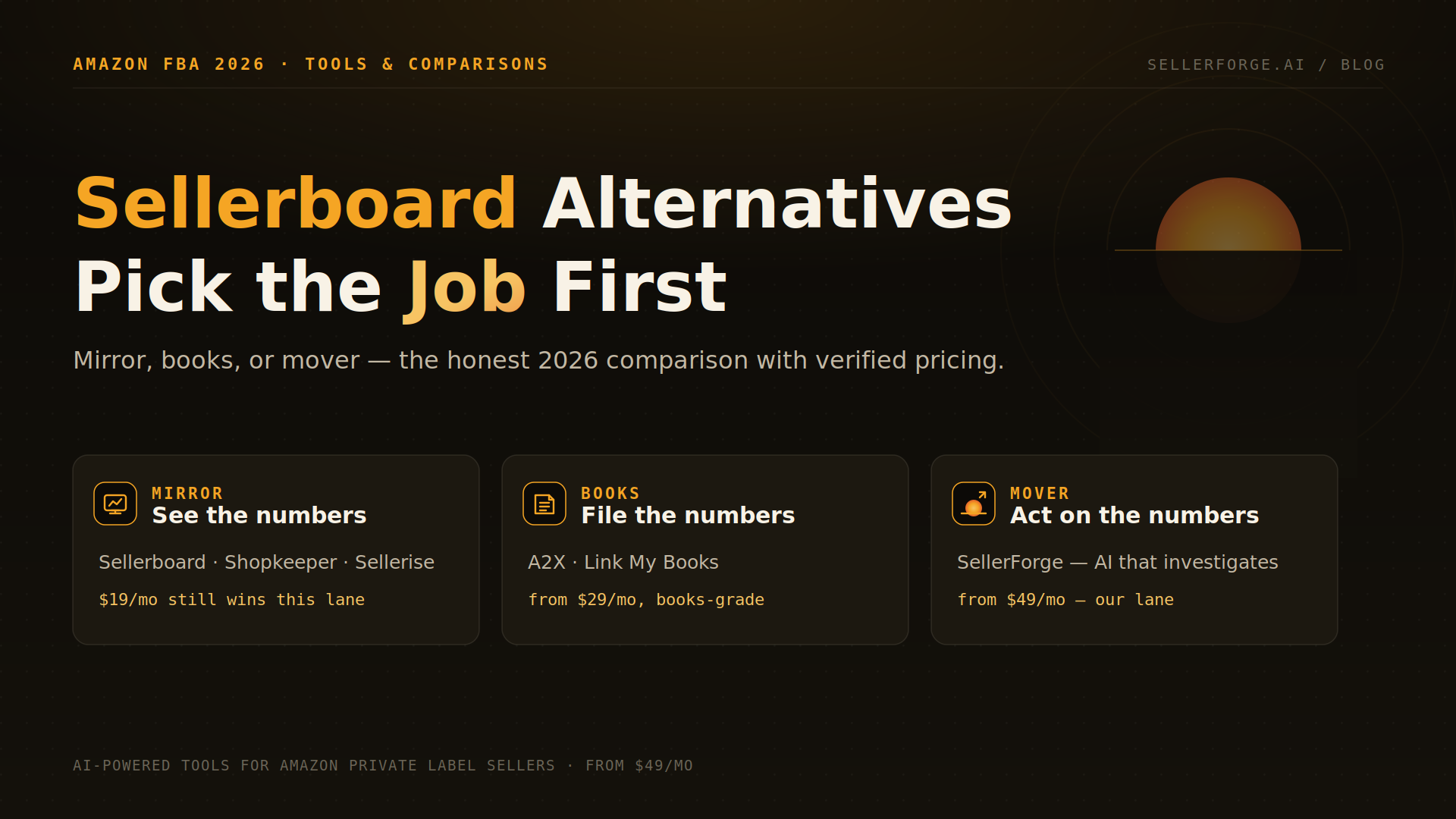
If you are still deciding whether you need the books layer at all, our Sellerboard alternatives guide sorts tools into mirrors, books and movers. This post is the deep dive on the books lane.
Why Can't QuickBooks or Xero Handle Amazon on Their Own?
QuickBooks and Xero cannot handle Amazon on their own because Amazon pays you a net deposit, not a sale. Each settlement, typically every 14 days, nets sales against refunds, referral fees, FBA fees, storage, advertising, reserves and marketplace-collected tax. Booking the deposit as revenue understates sales and hides every fee, which makes the ledger technically balanced and operationally useless.
Three 2026 realities make this harder than it was a few years ago, and each is a reason to stop booking deposits by hand.
- Marketplace-collected sales tax. Every U.S. state with a sales tax now has a marketplace facilitator law, so Amazon collects and remits tax on your sales. That tax flows through your settlement and must be booked as a wash, not as revenue.
- Deferred payouts. Under Amazon's delivery-date-based payment policy (DD+7), funds release seven days after delivery, so settlement-period sales no longer match fulfillment dates. A2X notes the deferred amounts are not in Amazon's API at all and need a month-end adjustment.
- The 1099-K reset. The One Big Beautiful Bill Act, signed July 4, 2025, reinstated the 1099-K threshold of $20,000 and 200 transactions, as IRS Fact Sheet 2025-08 confirms. Fewer small sellers get the form, but every dollar still has to be in the books.
On the deferral point, A2X's own explainer on Amazon deferred transactions is candid that no connector can see those amounts until they release, which is why your month-end close needs a manual step. Our DD+7 payout policy guide covers the cash-flow side. QuickBooks does offer a basic Amazon connection, but it syncs sales without the full fee breakdown and does not tie out to settlements, so treat it as a sales feed, not a reconciliation tool.
A2X vs Link My Books vs Taxomate: 2026 Pricing Compared
At 5,000 Amazon orders a month on one Merchant ID, A2X costs $79 (rising to $85 on November 14, 2026), Link My Books $68, Taxomate $44 on monthly billing or $37 billed annually, and Synder from $299. All four price by order or transaction volume, so the gap widens as you grow: at 20,000 orders it is $289 versus $198 versus $139.
| Orders per month (1 Amazon Merchant ID) | A2X (now / from Nov 14) | Link My Books (1 channel) | Taxomate Starter (monthly / annual) | Synder (list price, from) |
|---|---|---|---|---|
| Up to 200 | $29 / $29 (Mini, no COGS) | $24 | $14 / $12 | $65 (Basic, 500 synced) |
| Up to 1,000 | $59 / $65 | $47 | $24 / $20 | from $129 (Essential) |
| Up to 5,000 | $79 / $85 | $68 | $44 / $37 | from $299 (Pro) |
| Up to 10,000 | $159 / $169 | $112 | $79 / $66 | from $299 (Pro) |
| Up to 20,000 | $289 / $309 (Premium 20k) | $198 | $139 / $116 | from $599 (Pro Max) |
Method: list prices in USD, monthly billing unless noted, excluding tax, read from each vendor's live pricing page or calculator on October 16, 2026. Link My Books prices are from its USD calculator with one sales channel; add channels and the price rises (5,000 orders across two channels is $77). Taxomate's Multi-channel plan is $59 at 5,000 orders. None of these include the ledger itself.
Three details matter more than the headline numbers. First, A2X's price list from November 14, 2026 raises Starter to $65, Standard to $85 and Standard 10k to $169, while Mini stays at $29; every comparison page printed before this week is about to be stale. Second, Link My Books' calculator shows three months of settlement history on single-channel plans, 12 months at two channels and 24 months at ten, while Taxomate's pricing page includes all available history and COGS on every plan. Third, A2X Mini, its entry plan, has no COGS and three months of history, so it suits new sellers only.
Then add the ledger. QuickBooks Online list prices after Intuit's August 1, 2026 increase are $38 (Simple Start), $85 (Essentials), $140 (Plus) and $340 (Advanced) a month, applied as plans renew. Xero's U.S. plans rose on October 1, 2026 to $27 (Early), $59 (Growing) and $97 (Established). A typical 5,000-order private-label brand on Xero Growing plus Link My Books spends about $127 a month on software before any bookkeeping fees; the same brand on QuickBooks Plus plus A2X spends $225 after November 14.
Which Is Better: A2X or Link My Books?
Link My Books is better for UK and EU sellers and for price-sensitive sellers on Xero; A2X is better for U.S. sellers whose accountant already runs it, for NetSuite users, and for single-channel sellers who need more than three months of history. Both post reconciled settlement journals; the differences are tax depth, ecosystem, history and price.
| Tool | Best at | Where it loses | Ledgers | Trial |
|---|---|---|---|---|
| A2X | Accountant-led U.S. books; the connector most ecommerce accountants already use; COGS from Starter up | Highest price per order; Mini lacks COGS; one Merchant ID per plan below Premium; prices rise Nov 14, 2026 | QuickBooks Online, Xero, NetSuite and others | Free trial, post 3 settlements |
| Link My Books | UK/EU VAT: guided Tax Wizard, mixed-rate product groups, PAN-EU; unlimited marketplaces per Merchant ID | Single-channel plans include 3 months of history; Xero and QuickBooks Online only | Xero, QuickBooks Online | 14 days, no card, 90 days of data |
| Taxomate | Lowest cost per order; all history and COGS on every plan; supports Wave | Card required for trial; QuickBooks inventory sync still in beta; smaller accountant network | QuickBooks Online, Xero, Wave | 14 days, card charged at end |
| Synder | Per-transaction sync for multi-channel brands with Shopify and Stripe volume | Priced per synced transaction; heavy for Amazon-only summary books | QuickBooks Online, Xero | Check vendor |
| SellerForge (ours, from $49/mo) | Operating layer above the books: per-ASIN contribution margin, reimbursement claims, forecasting, weekly reports | Not a bookkeeping connector; posts nothing to your ledger | Reads Amazon data; pairs with any connector | Free trial |
Where A2X genuinely wins: if your accountant has 40 Amazon clients on A2X, choosing anything else adds friction to every month-end, and accountant time costs more than the price gap between connectors. A2X's Premium tiers also cover five to twenty Merchant IDs, which suits sellers running North America and Europe accounts side by side.
Where Link My Books genuinely wins: VAT. A UK seller on PAN-EU with standard, reduced and zero-rated goods needs tax rules applied per product group, and that is Link My Books' home turf. It is also cheaper than A2X at every volume we priced. The catch is history: if you are catching up on a year of unbooked settlements, the single-channel plan's three months will not get you there without buying extra history.
Is Taxomate Good for Amazon Sellers?
Taxomate is a good choice for Amazon sellers who do their own books and want the lowest cost per order: $44 a month at 5,000 orders, all available history, COGS on every plan, and support for QuickBooks Online, Xero and Wave. The tradeoffs are a card-required trial, inventory sync still in beta, and fewer accountants who already know it.
Taxomate's plans differ only in channel count and inventory sync, which makes it the easiest pricing page in the category to read. If you exceed your order tier, it auto-upgrades you to the next tier so syncing never stops. For a solo seller on Wave or a small brand doing a catch-up year, unlimited history is worth more than any feature on the other pages.
I would not pick Taxomate if your accountant has a strong preference for another connector, or if you need QuickBooks inventory sync in production today. Beta features belong in a sandbox file, not in the books a lender will read.
The Penny-Match Test: Pick Your Connector in One Settlement
The Penny-Match Test is a five-check trial you run on one real settlement before paying for any connector: the journal must equal the bank deposit to the cent, split fees by type, treat marketplace tax as a wash, carry COGS, and reach back to the start of your fiscal year. Any connector that fails one check fails the test.
The Penny-Match Test: one settlement, five checks. Deposit matches to the cent. Fees split by type. Marketplace tax books as a wash. COGS posts. History reaches your fiscal-year start. Five passes or keep looking.
- 1Pick your messiest recent settlement: one with refunds, a reimbursement, a reserve movement and some advertising. Clean settlements prove nothing.
- 2Post it to a test file or sandbox company, never your live ledger. A2X, Link My Books and Taxomate trials all let you post real settlements before you pay.
- 3Check that the journal's net equals the bank deposit to the cent. A one-cent gap means rounding or a missed line, and it compounds every 14 days.
- 4Check that referral fees, FBA fees, storage, advertising and refunds land on separate accounts, and that marketplace-collected sales tax nets to zero rather than inflating revenue.
- 5Check COGS: does it post as a journal from your unit costs, and on which plan? A2X Mini and some entry tiers will fail here by design.
- 6Check history: can the plan you would actually buy reach back to the first day of your fiscal year? If not, price the extra history now, not at year-end.
- 7Ask your accountant to review the posted journal. If they would change the account mapping, do it before connecting the live file.
The test is deliberately a sibling of the Settlement-Back Test we use to audit profit dashboards in our profit tracking software comparison. Dashboards are judged on whether their numbers trace back to the settlement; connectors are judged on whether their journals trace forward to the bank. Together they close the loop.
Do You Still Need a Bookkeeper With Amazon Accounting Software?
Most Amazon sellers past a few thousand orders a month still need a bookkeeper, just for fewer hours. A connector removes data entry, but a human still maps the chart of accounts, books inventory and COGS correctly, handles deferred-transaction adjustments and reserves, reconciles reimbursements, and prepares tax and sales-tax filings outside Amazon's marketplace collection.
Across the 57 accounts I managed, the brands with clean books were not the ones with the best software. They were the ones with a fixed monthly close: connector posts, bookkeeper reconciles, owner reviews contribution margin against the ledger, all inside the first ten days of the month. The brands with messy books usually had a great connector and nobody responsible for reading what it posted.
- Doing it yourself works when you are on one marketplace, under roughly 1,000 orders a month, with no inventory financing and a simple tax position.
- Hire a bookkeeper when you add a second marketplace or channel, hold significant inventory, carry a loan or line of credit, or sell into the EU or UK with VAT.
- Hire an ecommerce accountant before you raise money, take on a lender, or talk to a buyer. Quality-of-earnings work starts from your ledger, and buyers discount anything they cannot reconcile.
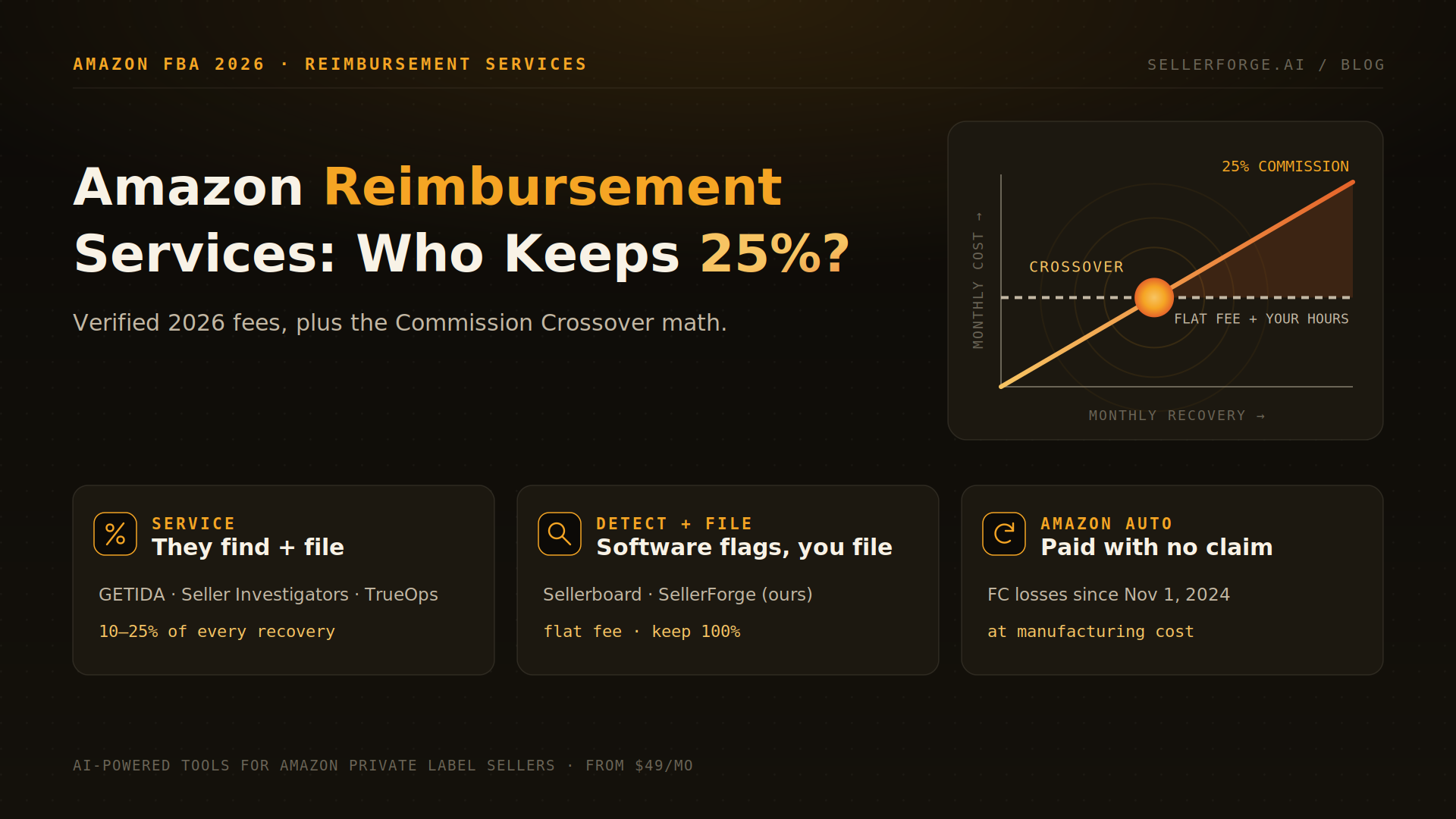
One adjacent cleanup pays for itself: reconcile reimbursements in the same close. Lost and damaged inventory claims show up as settlement lines, and the ones that never appear are money left with Amazon. Our profitability audit and fee-leakage guide covers the monthly sweep, and our best Amazon reimbursement service comparison covers who should file them.
Where SellerForge Fits (Disclosure: It Is Ours)
SellerForge is not accounting software and does not replace A2X, Link My Books or Taxomate. It is AI-native account intelligence from $49 a month that sits above the books: it reads your Amazon sales, fees, ads, inventory and account health together and acts on what the ledger only records. It runs alongside a connector, not instead of one.
The split is simple. Your connector answers "what happened, in a form my accountant can file." SellerForge answers "what should I do about it this week." In practice that means contribution margin per ASIN with custom breakdowns, a weekly business report that flags fee and margin changes before month-end, reimbursement gaps flagged from the evidence, and inventory forecasting so the cash in those settlements is not tied up in the wrong stock. The Document Vault keeps invoices and compliance documents in one place for the day your accountant or Amazon asks.
What it will not do: post journals, file VAT or sales tax, or produce a general ledger. If that is the job in front of you, buy a connector from the table above and come back to us when the question changes from "are my books right" to "why did margin drop on my top ASIN."
Who Should Pick What
Pick by your accountant, your marketplaces and your volume, in that order. The accountant's existing tool beats a cheaper one, VAT exposure points to Link My Books, and cost sensitivity at volume points to Taxomate. Synder fits multi-channel brands that need per-transaction detail, and SellerForge sits above whichever connector you choose.
- U.S. seller with an accountant who already uses A2X: A2X. Lock in before November 14 if you are signing up anyway, and buy the tier with COGS.
- UK or EU seller, PAN-EU or mixed VAT rates: Link My Books on Xero. Budget for extra history if you are catching up.
- Self-bookkeeping seller who wants the lowest cost per order, or a Wave user: Taxomate, billed annually.
- Multi-channel brand with heavy Shopify and Stripe volume that wants transaction-level detail: Synder, with eyes open on per-transaction pricing.
- Brand whose books are fine but whose margin keeps surprising them: keep the connector and add an operating layer like SellerForge.
- Agency running books for clients: standardize on one connector across the book so month-end is a process, not a project, and see our agency playbooks for the reporting side.
For the rest of the stack, from research to repricing, our best Amazon seller tools guide maps every category, and our FBA profit margin benchmarks give you the ranges your newly reconciled books should land in.
Books reconciled, margin still a mystery? Start a SellerForge trial, connect your Amazon account, and see contribution margin per ASIN, reimbursement gaps and next week's inventory risk alongside whatever connector you run. Plans start at $49/mo, and you can ask your account questions from Claude or ChatGPT through SellerForge MCP.
About the author
David Gallo is the founder of SellerForge.ai. Before building SellerForge, he managed 57 Amazon seller accounts representing more than $350M in sales at Worldfront, where he learned that clean books and good decisions come from different tools, and that most brands need both.