The best Amazon reimbursement service depends on how much Amazon still owes you after its own automation: GETIDA (from 20%) and Seller Investigators (25%) suit large or long-unaudited catalogs, TrueOps (10%) is the cheapest full-service option, and flat-fee software such as Sellerboard (from $19/mo) or SellerForge (from $49/mo, our product) wins once monthly recoveries pass the Commission Crossover. Fees verified October 2026.
The best Amazon reimbursement service in 2026 is the one whose commission is smaller than the hours it saves you, and for a growing share of sellers that is no service at all. Done-for-you services charge 10–25% of what they recover. Amazon now auto-reimburses most warehouse losses itself and pays at manufacturing cost, so the pie those percentages are cut from has shrunk.
I hired reimbursement services across many of the 57 Amazon accounts I managed at Worldfront, and fired a few of them. This page compares the main options with fees verified against each vendor's live page on October 1, 2026: GETIDA, Seller Investigators, TrueOps, Refunds Manager, Helium 10's managed refunds, Sellerboard, and SellerForge. SellerForge is our product, and I will be specific about what it does not do.
You will also get the Commission Crossover, a one-line formula that tells you the monthly recovery level at which paying a percentage stops making sense. Run it before you sign anything.
What is an Amazon reimbursement service?
An Amazon reimbursement service is a company that audits your FBA data for money Amazon owes you, such as lost or damaged inventory, refunds for returns that never came back, and fee overcharges, then files the claims in Seller Central on your behalf. Most work on contingency: no upfront fee, and 10–25% of whatever Amazon pays out.
The model exists because the work is tedious, not because it is hard. Every claim a service files is one you are allowed to file yourself. What you pay for is the detection (cross-referencing the Inventory Ledger, Reimbursements report, returns, and removal orders), the evidence (invoices, proof of delivery, carrier tracking), and the persistence of reopening cases that Seller Support closes on the first pass.
There is a second category that page-one lists blur together: reimbursement software. Software finds the discrepancies and leaves the filing to you, for a flat monthly fee and no commission. The choice between the two is the real decision, and it is mostly arithmetic.
What changed: how 2024–2025 rewrote reimbursement economics
Three Amazon policy changes between October 2024 and March 2025 cut the value of a typical reimbursement claim and shrank the pool of claims that need human work. Claim windows dropped from 18 months to as little as 60 days, Amazon began auto-reimbursing warehouse losses, and payouts moved from selling price to manufacturing cost. Every service's pitch predates or underplays at least one of these.
November 1, 2024: Amazon starts paying first. Units identified as lost in a fulfillment center are now reimbursed proactively, no case required. That was historically the easiest, highest-volume claim type, and it was the backbone of most services' recoveries.
| Change | Effective | What it did to a service's economics |
|---|---|---|
| Claim windows cut to ~60 days | Oct 23, 2024 | Killed the big back-catalog sweep; services must now run monthly, like you would |
| Proactive FC-loss reimbursement | Nov 1, 2024 | Amazon now pays the easiest, highest-volume claim class itself, commission-free |
| Manufacturing-cost valuation | Mar 31, 2025 | Cut the dollar value per lost unit by roughly the gap between your price and your cost, often 50–75% |
| Manage Your Sourcing Cost page | Feb 2025 rollout | Made your cost data, not the claim, the biggest lever on what you get paid |
The highest-value reimbursement action in 2026 is not filing a claim. It is submitting accurate per-SKU sourcing costs, backed by supplier invoices, so every automatic and manual reimbursement pays your real cost instead of Amazon's guess. No service charges a commission on that, and few of them mention it.
One more 2026 wrinkle cuts the other way. Amazon stopped offering FBA prep and labeling services in the US on January 1, 2026, so more units now arrive prepped by sellers and third-party warehouses. In my experience, new inbound handoffs mean new inbound discrepancies, and inbound shortages are exactly the evidence-heavy claim type that automation misses.
How much do Amazon reimbursement services charge?
Amazon reimbursement services charge between 10% and 25% of what they recover, billed after Amazon pays, with no upfront fee. Reimbursement software charges a flat monthly fee and takes no commission, but you file the claims yourself. The table below lists each option's fee as verified against the vendor's own page on October 1, 2026.
| Option | Model | Fee (verified Oct 1, 2026) | Who files | Best for |
|---|---|---|---|---|
| GETIDA | Done-for-you service | From 20% of recoveries; no monthly fee; first $400 fee-free (current offer) | GETIDA | Hands-off sellers who want a long-running, dedicated recovery team |
| Seller Investigators (SPS Commerce) | Done-for-you service | 25%, charged after you are paid | Seller Investigators | Large catalogs; sellers who want a big, acquisition-backed vendor |
| SPS Commerce via Jungle Scout | Done-for-you service | 25%; you keep 75% | SPS Commerce | Jungle Scout users who want recovery in the same relationship |
| TrueOps | Done-for-you service | 10% of recoveries; $9.99+ minimum in low-recovery months | TrueOps | The lowest commission on a full-service option |
| Refunds Manager | Done-for-you service | Contingency ("No Recovery, No Fee"); rate not published | Refunds Manager | Sellers willing to get a custom quote |
| Helium 10 managed refunds | Service bundled with a suite | 15% on Platinum ($129/mo) or 10% on Diamond ($359/mo) | Helium 10 | Sellers already paying for Helium 10 |
| Sellerboard Reimbursement Gap | Detection software | Included from $19/mo; no commission | You | Sellerboard users who will file their own cases |
| SellerForge (our product) | Detection inside account intelligence | Included from $49/mo (Core); no commission on any plan | You | Sellers and agencies who want discrepancies flagged alongside profit, inventory, and account health |
Two warnings about other lists you will find. Several still describe Helium 10's refund tool as commission-free; the live pricing page now shows a 15% or 10% fee on its managed service. And the vendor-written lists quote recovery rates and success percentages that nobody independently audits, so treat any "98% success rate" as marketing, not data.
The Commission Crossover: when does software beat a service?
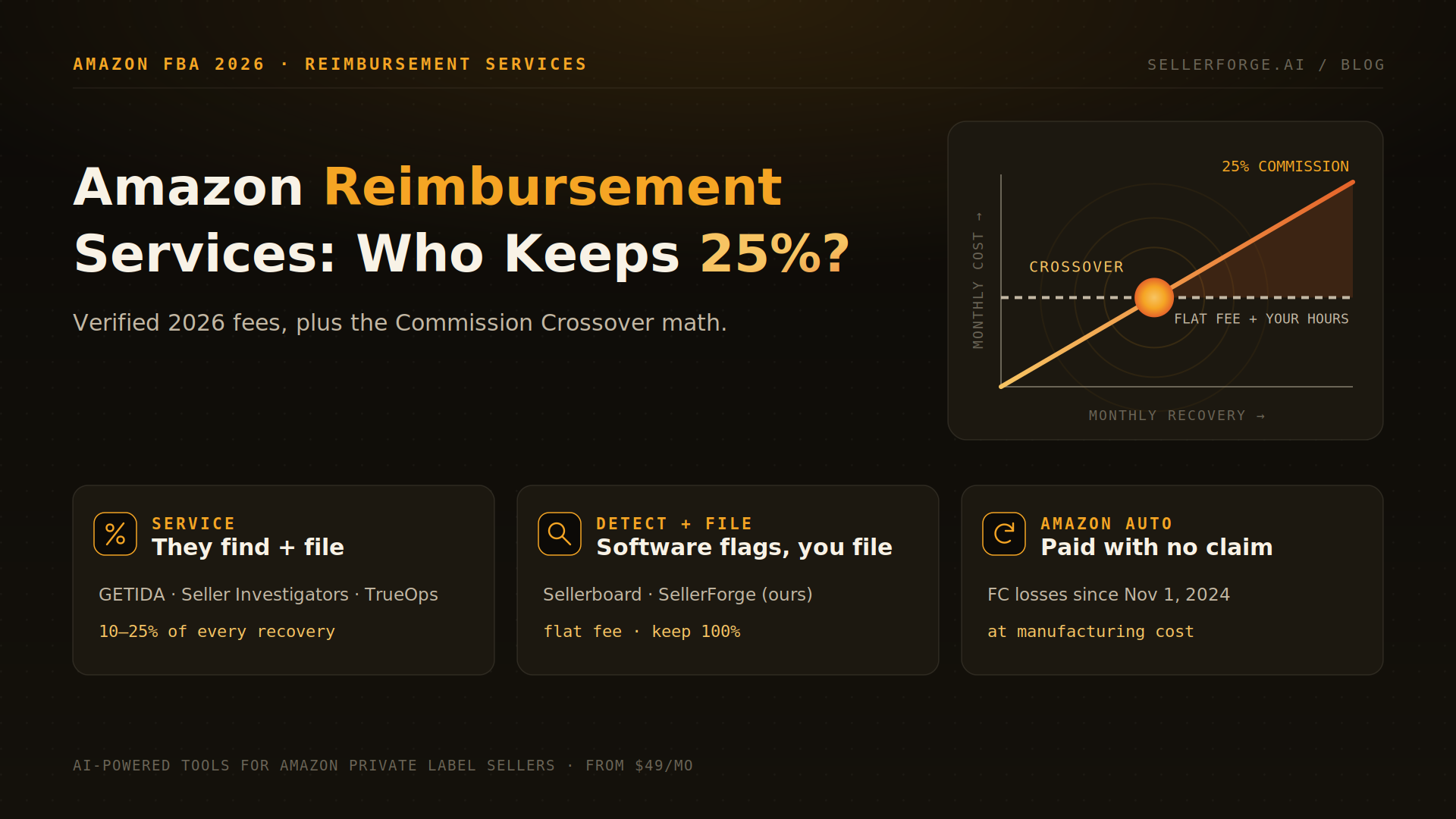
The Commission Crossover is the monthly recovery amount above which paying a percentage costs more than doing it yourself. The formula: Crossover = (flat software cost + your monthly filing hours × your hourly value) ÷ the service's commission rate. Below the crossover, a service is cheaper. Above it, every extra dollar recovered is a dollar you are overpaying.
Worked example. Say detection software costs you $49 a month, filing takes two hours a month, and your time is worth $50 an hour. Your do-it-yourself cost is $149. At a 25% commission the crossover is $596 a month in recoveries; at GETIDA's 20% it is $745; at TrueOps' 10% it is $1,490. If the software is already earning its fee on other jobs, such as profit tracking, drop it from the numerator and the 25% crossover falls to $400.
The hard part is estimating what you will actually recover. Seller Labs puts unclaimed reimbursements at one to three percent of annual revenue, a figure it attributes to reimbursement services that audit thousands of accounts. That number largely predates proactive reimbursement and cost-based payouts, and it comes from the companies selling recovery. My planning assumption for a reasonably run 2026 FBA account is to halve it: roughly 0.5% to 1.5% of revenue.
| Annual FBA revenue | Likely monthly recovery (0.5–1.5%) | 25% commission per month | DIY cost (example: $149) | Verdict |
|---|---|---|---|---|
| $250K | $105–$315 | $26–$79 | $149 | Service is cheaper, or simply set your costs and let Amazon's automation work |
| $1M | $415–$1,250 | $104–$313 | $149 | Near the crossover; software wins once recoveries are steady |
| $3M | $1,250–$3,750 | $313–$938 | $149–$249 | Software plus an internal owner wins clearly |
| $10M+ | $4,150–$12,500 | $1,040–$3,125 | Part of an ops role | In-house with software; use a service only for one-off backlog cleanups |
Two honest adjustments. If you will not actually spend the hours, your hourly value is irrelevant and the service wins by default: 75% of found money beats 100% of money you never chase. And if you have never audited at all, a one-time service engagement on the current 60-day window can make sense before you switch to a monthly in-house routine.
Which Amazon reimbursement service is best? Honest picks
No single Amazon reimbursement service is best for everyone. GETIDA and Seller Investigators are the established full-service choices, TrueOps is the cheapest done-for-you option at 10%, Helium 10's managed refunds make sense only if you already pay for the suite, and detection software suits sellers who will file their own claims.
GETIDA: the established hands-off option
GETIDA has been doing this for years, files on your behalf, and now advertises pricing starting at 20% with the first $400 of recoveries free. Where it wins: persistence on rejected cases and zero effort from you. Where it costs you: at steady volume above the crossover, the 20% compounds into real money every month for work Amazon's automation increasingly does anyway.
Seller Investigators and SPS Commerce: the acquisition-backed option
Seller Investigators charges 25% after you are paid and offers a free audit, typically within 48 hours. Its owner, SPS Commerce, also runs the 25% recovery service Jungle Scout recommends. Where it wins: scale and a large vendor behind it, which matters to brands that answer to finance teams. Where it costs you: 25% is the top of the market.
TrueOps: the lowest done-for-you commission
TrueOps charges 10% of recovered cash and inventory claims, with a platform minimum starting at $9.99 in low-recovery months. Where it wins: it halves the commission of most rivals, which pushes the crossover up to around $1,500 a month in recoveries in the example above. Where it costs you: smaller vendor, so ask about case-reopening persistence and reporting before you commit.
Helium 10 managed refunds and Refunds Manager
Helium 10's managed refund service is included with Platinum at a 15% fee and with Diamond at 10%. It is convenient if you already live in Helium 10, but buying the suite for refunds alone makes no sense. Refunds Manager advertises "No Recovery, No Fee" and $800M+ recovered across 15,000+ clients, but does not publish its rate, so get the percentage in writing before you connect your account.
Detection software: Sellerboard and SellerForge
Sellerboard's Reimbursement Gap and Money Back reports, included from $19 a month, flag reimbursements paid below your cost of goods and give you template text, but you open each case yourself. SellerForge flags discrepancies too; its exact scope and limits are in the dedicated section below. Neither takes a commission, and neither will chase a rejected case for you.
What to ask a reimbursement service before you sign
Before you sign with an Amazon reimbursement service, get five answers in writing: whether the fee applies to Amazon's automatic reimbursements, how it avoids filing duplicate claims, which Seller Central permissions it needs, what happens to open cases if you cancel, and how it values claims under manufacturing cost. Vague answers to any of these are a reason to walk.
- 1Ask whether the commission applies only to cases the service filed, or to every reimbursement in your report, including the ones Amazon issued automatically. The second is a fee on money you would have received anyway.
- 2Ask how the service checks for claims Amazon already paid or already resolved. Duplicate cases waste Seller Support goodwill, and in my experience a pattern of claims for items already reimbursed is the kind of thing that draws scrutiny to an account.
- 3Ask exactly which Seller Central user permissions the service needs, and grant only those. A recovery vendor does not need access to pricing, listings, or payment settings to file inventory cases.
- 4Ask what happens to cases already open, and whether you still owe commission on them, if you cancel. Get the notice period in writing.
- 5Ask whether the service will help you submit sourcing costs. Since March 31, 2025 that one step changes what every future reimbursement pays, and a service that only files claims is leaving your largest lever untouched.
The duplicate-claim question is the one I would weight most. The fastest way to turn a recovery program into an account-health problem is volume over accuracy, and contingency pricing rewards volume.
Can you file Amazon reimbursement claims yourself?
Yes. Any FBA reimbursement claim a service files, you can file yourself in Seller Central and keep 100% of the payout. The real work is reconciliation and evidence, not the case form. A monthly routine sized to the 60-day windows takes one to three hours for a mid-size account, less with detection software doing the cross-referencing.
- 1Submit or correct your sourcing cost for every active SKU, with a supplier invoice, so every reimbursement pays your real manufacturing cost.
- 2Reconcile the Inventory Ledger's lost and damaged events against the Reimbursements report; flag anything without a matching reimbursement once Amazon's automation has had time to act.
- 3Cross customer refunds against returned units; flag refunds with no unit back once the 60-day mark passes, and file before day 120.
- 4Check closed inbound shipments for received-versus-shipped shortages and pull proof of delivery and carton counts while they are fresh.
- 5Review removal orders delivered back to you for missing units within 60 days of delivery.
- 6Log every case number and outcome so you never refile something Amazon already resolved.
Where SellerForge fits (and where it does not)
SellerForge is our product, an AI-native account intelligence platform for Amazon sellers and agencies from $49 a month, and it takes no commission on reimbursements on any plan. It is not a done-for-you reimbursement service. It flags potential FBA discrepancies inside the same view as your profit, inventory, and account health, and you file the claims.
Who should pick what
Pick a done-for-you service if your recoveries sit below the Commission Crossover or you will not spend the hours. Pick flat-fee detection software if recoveries sit above it and someone on your team will file monthly. Everyone, regardless of choice, should submit accurate sourcing costs first.
- Under ~$500K a year in FBA revenue: submit your sourcing costs, let Amazon's automation work, and either file the occasional case yourself or use a low-commission service like TrueOps (10%).
- Never audited, large catalog, no spare hours: start with GETIDA (from 20%) or Seller Investigators (25%) for the current 60-day window, then reassess against the crossover after three months.
- Already paying for Helium 10 Diamond: its managed refunds at 10% are a reasonable default; on Platinum, compare 15% against TrueOps.
- Already on Sellerboard and willing to file: use its Reimbursement Gap report before buying anything new.
- $1M+ a year with an ops person, or an agency running several accounts: flat-fee detection plus a monthly filing routine wins above the crossover. SellerForge (from $49/mo, Agency $499/mo for 10 accounts) is our answer when you want those flags inside whole-account intelligence; it is our product, and the filing stays yours.
The bottom line: reimbursement services were a great deal when claims paid at selling price over an 18-month window. Since late 2024 Amazon pays the easiest claims itself, pays everything at cost, and closes most windows in 60 days, so a 20–25% commission buys less than it used to. Set your sourcing costs, run the Commission Crossover on your real numbers, and hire a service only where the math or your calendar says you should.
About the author
David Gallo is the founder of SellerForge. Before building SellerForge, he managed 57 Amazon seller accounts representing over $350M in sales at Worldfront, where he hired reimbursement services, audited their invoices, and learned which recoveries were worth a commission and which ones Amazon would have paid anyway.