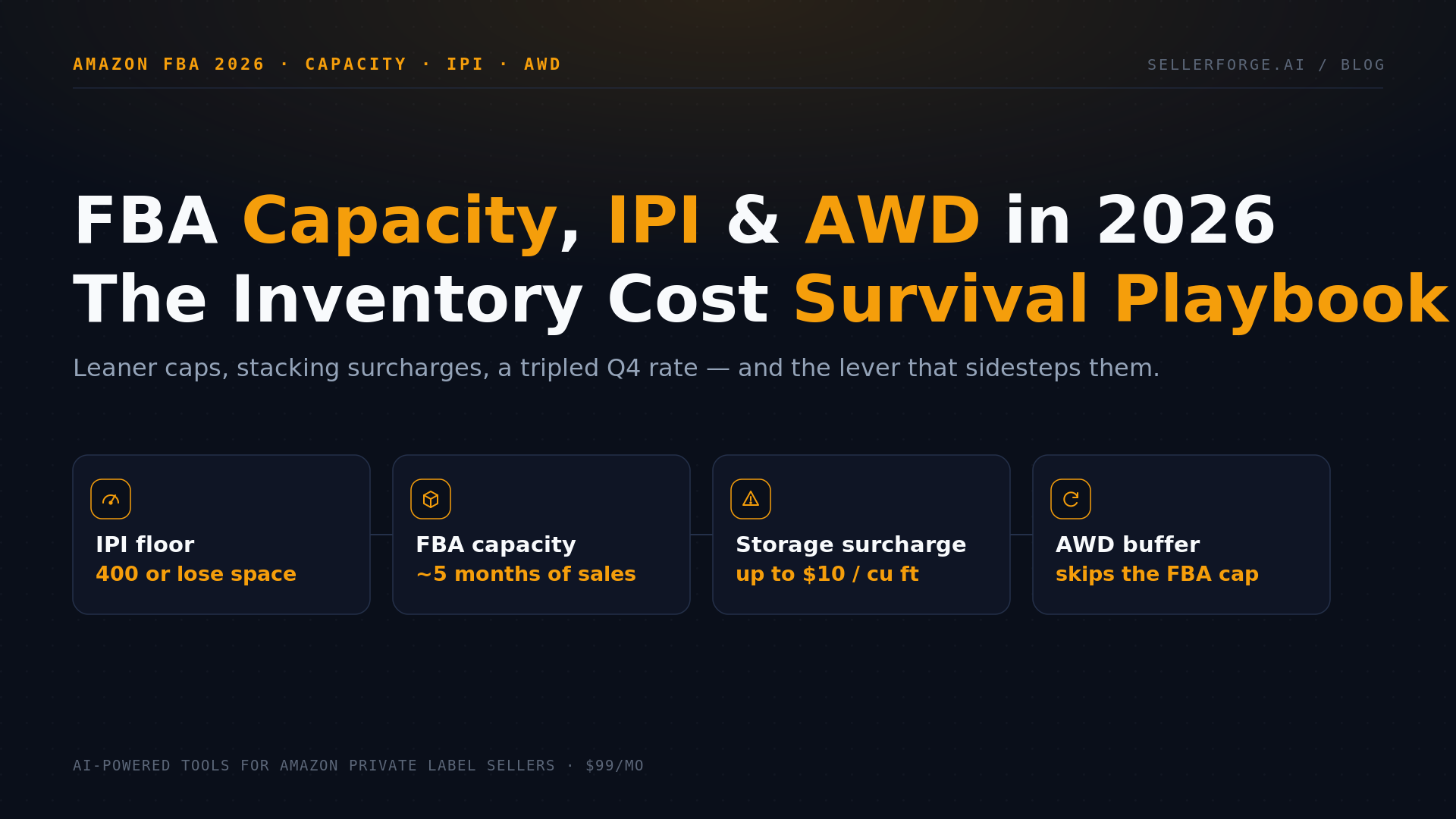
Amazon's inbound placement fee charges $0.14–$6.50 per unit on minimal splits under the January 15, 2026 rate card ($0.14–$1.90 for standard-size, $1.10–$6.50 for bulky); Amazon-Optimized Splits (five-plus locations; they need at least five identical cartons or pallets per item and appear only when Amazon offers them) stay free, and Extra-Large items pay no placement fee. The right call is per-SKU, not portfolio-wide: small, light SKUs often profit from consolidating and paying the fee because freight savings exceed it, while oversize SKUs should spread. AWD sidesteps the fee on the FC-to-FC leg. Model the break-even, weight it by regional demand, and re-run it each quarter.
Every FBA shipment you create puts the same question in front of you, and most sellers answer it on autopilot. Amazon shows you a recommended destination split — your inventory fanned out across five or more fulfillment centers — and then dangles a shortcut: ship everything to a single location instead, for a per-unit fee. Click the cheaper-looking option enough times across a year of restocks and you've made a five-figure decision without ever running the math behind it.
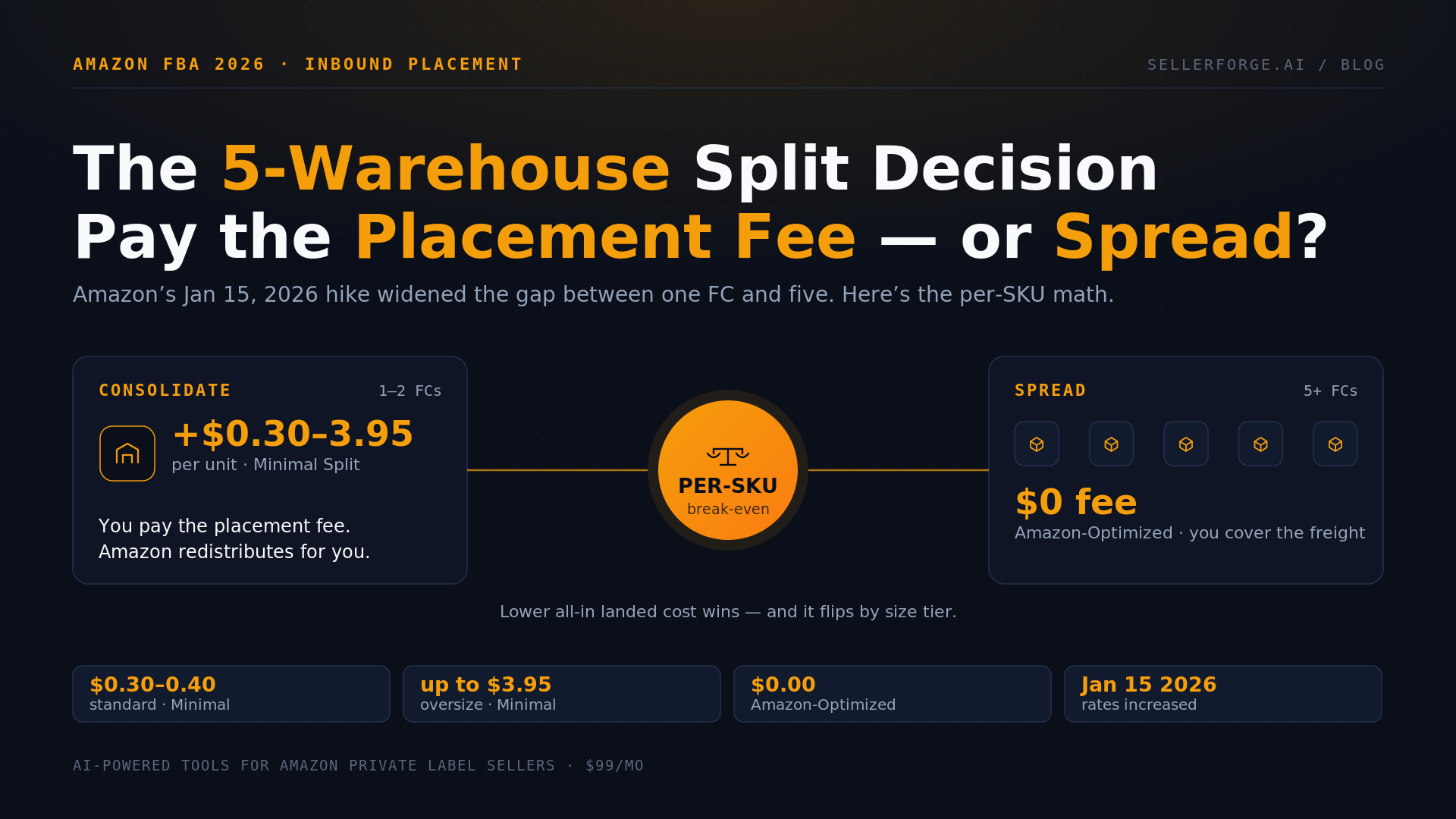
On January 15, 2026, Amazon raised the inbound placement service fee and widened the gap between the two paths. Shipping to the full recommended set of FCs — 'Amazon-Optimized Splits' — is still free. Consolidating to the fewest destinations, generally one — 'Minimal Splits' — now runs up to $1.90 per unit for standard-size items and as much as $6.50 for bulky ones. Amazon is effectively paying you, in avoided fees, to do its regional distribution work. The only question that matters is whether the freight and labor to do that work costs you more or less than the fee you'd avoid.
That's the real decision, and it is not 'always spread' or 'always consolidate.' It is per-SKU, it flips on size tier and freight lanes, and it tangles with three other 2026 fees most sellers model in separate spreadsheets. This is the framework — the break-even math, the four levers that change the answer, the AWD escape hatch, and the cash-flow timing nobody accounts for — for getting the five-warehouse split decision right every time you restock.
What the inbound placement fee actually is
When you build a shipping plan in Seller Central, Amazon computes where it would prefer your inventory to land. Its preference is to spread your units across multiple fulfillment centers — typically five or more for a given SKU — so stock sits close to the customers most likely to buy it and Amazon avoids eating the cost of shuffling it around its own network. You can accept that, or you can override it and consolidate to fewer destinations. Amazon gives you three options:
- Amazon-Optimized Shipment Splits — Amazon picks the destinations (five or more) and you ship to all of them. No placement fee, but it needs at least five identical cartons or pallets per item and appears only when Amazon offers it.
- Partial Shipment Splits — Small and Large Bulky items only: ship to two or three destinations instead of the full set. A reduced per-unit fee applies to every unit.
- Minimal Shipment Splits — the most consolidated option, shipping to the fewest destinations, generally one. The highest per-unit fee applies.
The fee is per unit, charged on every unit Amazon receives, and scaled by size tier and weight band. Amazon shows an estimate for each placement option when you build the plan and bills the fee 45 days after the shipment is received. It is a distinct line item — not your FBA fulfillment fee, not your referral fee, not storage. And because it's buried inside the shipment-creation flow rather than shown on your product detail page, it's the fee sellers most often forget to put into their unit economics.
The mental shorthand: Amazon-Optimized splits move the labor to you (more destinations, more freight) in exchange for $0. Minimal splits move the labor to Amazon (it redistributes after receipt) in exchange for a fee. You're not choosing whether to pay for distribution — you're choosing who does it and how it shows up in your costs.
The 2026 rate card
Here are Amazon's published per-unit placement fee ranges by size tier for shipment plans created on or after January 15, 2026. Where you land inside each range depends on your item's weight band (unit weight for small standard; the greater of unit or dimensional weight above that) and on the inbound location — Amazon doesn't publish per-region tables. Always confirm the number inside your actual shipment plan before you lock it in.
| Size tier (2026) | Amazon-Optimized (5+ locations) | Partial (2–3 locations) | Minimal (generally 1 location) |
|---|---|---|---|
| Small standard | $0.00 | Not offered | $0.14–$0.32 / unit |
| Large standard | $0.00 | Not offered | $0.20–$1.90 / unit |
| Small Bulky | $0.00 | $0.55–$3.32 / unit | $1.10–$5.95 / unit |
| Large Bulky | $0.00 | $0.55–$3.50 / unit | $1.30–$6.50 / unit |
| Extra-Large | No fee | No fee | No fee |
Put a volume on it and the stakes get concrete. A seller moving 5,000 standard-size units a month on Minimal Splits at $0.40 pays $2,000 a month — $24,000 a year — purely for the convenience of shipping to one place. Swing that to a bulky SKU at $1.10 per unit and 2,000 units a month, and you're looking at roughly $26,400 a year in placement fees alone. Those are the numbers Amazon is waving in front of you to make you do the distribution yourself.
This increase didn't arrive alone. The same January 15, 2026 update raised FBA fulfillment fees — standard-size items by about $0.08 per unit on average, more for higher-priced and oversize items — so the placement fee is one layer in a broader 2026 cost stack. For the full map of what moved and how to defend margin across all of it, see The 2026 FBA Fee Overhaul Survival Guide.
The decision is per-SKU, not portfolio-wide
Almost every guide you'll read ends at the rate card with one piece of advice: choose Amazon-Optimized splits and pay nothing. That advice is wrong about half the time, because 'free' placement isn't free. You pay for it in freight and prep labor to send inventory to five-plus destinations instead of one. The honest comparison is total landed cost, and it has exactly two terms:
- The placement fee you avoid by spreading — the per-unit fee times the units in the shipment.
- The extra freight and prep you take on by spreading — the cost difference between one consolidated truck to a single location and multiple smaller shipments fanned out to five or more.
If the placement fee you'd pay to consolidate is smaller than the extra freight to spread, consolidate and pay the fee. If the placement fee is larger, spread and take the free option. That's the whole rule. What makes it interesting is that the answer flips by size tier, because the two terms scale differently: placement fees climb steeply with size while small-parcel freight savings from consolidation are modest, and oversize freight barely consolidates at all.
Worked example: small standard SKU
A 1,000-unit shipment of a small standard item. Consolidating to a single FC costs $0.30 a unit, or $300. But shipping one consolidated LTL load is far cheaper than fanning the same units out as parcels to five FCs — often a $400 to $600 difference on a shipment this size. The fee is the smaller number.
| Line | Consolidate (1 location) | Spread (5+ locations) |
|---|---|---|
| Units shipped | 1,000 | 1,000 |
| Placement fee | $0.30 × 1,000 = $300 | $0 |
| Inbound freight (illustrative) | $650 | $1,150 |
| Total inbound cost | $950 | $1,150 |
| Cheaper option | Consolidate — saves ~$200 | — |
Worked example: Large Bulky SKU
Now a 500-unit shipment of a light (5 lb or under) Large Bulky item. Consolidating costs $1.58 a unit, or $790. And oversize freight doesn't consolidate efficiently — you might save only $200 to $400 by shipping to fewer destinations. The fee is now the bigger number, so the math inverts: take Amazon's split, pay more in freight, save more in fees.
| Line | Consolidate (1 location) | Spread (5+ locations) |
|---|---|---|
| Units shipped | 500 | 500 |
| Placement fee | $1.58 × 500 = $790 | $0 |
| Inbound freight (illustrative) | $900 | $1,150 |
| Total inbound cost | $1,690 | $1,150 |
| Cheaper option | — | Spread — saves ~$540 |
Same company, same week, opposite answers. The small SKU wants to consolidate; the oversize SKU wants to spread. Apply one blanket rule across the catalog and you're guaranteed to be wrong on a chunk of your volume — and the leakage compounds on every restock for the life of the SKU. The freight numbers above are illustrative; the point is the structure, not the exact dollars. Plug in your own 3PL's consolidated-versus-spread rates and the breakeven will land where it lands.
The four levers that flip the math
Size tier is the dominant variable, but four other forces decide the close calls. Ignore them and even a correct size-tier instinct can cost you money.
1. Regional demand skew
Amazon's 'five-plus FCs' recommendation assumes your demand is roughly national. Most private-label SKUs aren't. If 80% of a product's sales come from the East Coast, two or three of the West Coast FCs in Amazon's optimized split will sit on inventory that mostly won't sell from there — you've paid to spread units into locations that don't serve your buyers. For demand-skewed bulky SKUs, a Partial Split (two or three locations, offered only for Small and Large Bulky items), fee and all, can beat both the fully consolidated and the fully spread options. This is where demand forecasting stops being a planning nicety and becomes a direct fee lever.
2. Freight-lane and 3PL proximity
If your prep center or 3PL sits inside a major FC cluster — the Inland Empire in Southern California, the I-81 corridor in the Mid-Atlantic, the Dallas–Fort Worth metroplex — then spreading to nearby FCs is short-haul and cheap, which shrinks the freight side of the equation and makes the free Amazon-Optimized option easy to justify. If your inventory originates somewhere remote from Amazon's network, every additional destination is expensive, and consolidating to pay the fee looks better. Your physical starting point quietly sets your breakeven.
3. Inbound location and plan mix
The rate card gives ranges, not prices. Where a unit lands inside its range depends on the inbound location Amazon assigns: the West and capacity-constrained locations can cost more, and Amazon publishes no per-region table. Its own worked example puts a 6 lb large-standard item into one East location at $0.42 a unit. Plan mix matters too. A plan that mixes standard-size and bulky items can be sent to several locations even on minimal splits, with the minimal rate charged on each shipment, so you can pay the fee without getting the one-truck freight saving that justified it. Read the fee estimate Amazon shows for each placement option before you pick one. Placement is only one of the per-unit fees that stack on a SKU; the 2026 returns-fee margin defense playbook shows how they compound on the returns side.
4. Cash-flow timing
This is the lever nobody puts in the spreadsheet. You pay the extra freight for spreading when the shipment leaves your supplier or 3PL. The placement fee arrives later: Amazon charges it 45 days after the shipment is received, on the units actually received. For a fast-moving SKU, much of that shipment has already sold by then, so consolidating defers part of your inbound cost while spreading pays all of it up front. For a slow mover the fee still lands before most units sell, and Amazon's deferred disbursement pushes the matching revenue out further. For a thinly capitalized brand restocking into Q4, book the fee in the month it posts, not the month you ship. We walk through the payout-delay mechanics in the DD+7 payout policy and cash-flow guide.
What doesn’t flip it: the low-inventory fee
Many guides warn that consolidating strands other regions and triggers Amazon's low-inventory-level fee. It doesn't work that way. That fee measures historical days of supply across the whole US network, counting sellable units in every fulfillment center, including units in transfer between FCs, and it charges only when both the 30-day and the 90-day figures fall below 28 days. Where a shipment lands doesn't change the number. How much you send, and how early, does, because units still inbound don't count until they're received. Manage it with restock size and lead time, and keep the placement decision about freight versus fee.
AWD: the structural escape hatch
There's a way to make most of this decision disappear: don't ship directly to fulfillment centers at all. Send inventory upstream to Amazon Warehousing and Distribution (AWD) and Amazon handles the FC-to-FC distribution internally — with no inbound placement fee on the AWD-to-FC leg. You ship one consolidated truck into AWD, Amazon fans it out to FCs based on real demand, and the placement decision you'd otherwise sweat over every restock becomes Amazon's job.
AWD isn't free, and it isn't right for everyone. AWD storage rose in 2026 — the West region climbed roughly 19% to about $0.57 per cubic foot per month, while other regions held flat — and you're adding a storage layer between your supplier and the FCs. But there's a tailwind worth noting: Amazon is running a promotional inbound-processing discount of $0.35 on eligible AWD shipments received through December 31, 2026, and there's no fee to enroll. For brands with steady, high throughput and continuous restocks, the placement fees AWD eliminates can offset a real share of its storage and transportation cost — and you get demand-based distribution and replenishment thrown in. Run AWD's own economics on your volume, but for the right profile it converts a recurring per-shipment decision into a one-time structural one.
Rule of thumb: if you're a high-velocity brand consolidating to dodge placement fees anyway, you're already paying for distribution — AWD often does it more cheaply and without stranding regional inventory. If you're low-volume or ship infrequently, the added storage layer usually isn't worth it; just run the per-SKU split decision each time.
AWD also changes the Q4 equation: auto-replenishment enrollees keep off-peak storage rates through October 31, 2026, while FBA rates roughly triple. The Q4 2026 inventory and cash-flow plan covers when to stage holiday surplus upstream.
A per-SKU rule you can actually run
You don't need a model that recalculates on every shipment. You need a simple decision rule, applied per SKU, refreshed when something material moves. The process:
- 1For each active SKU, pull its size tier and the per-unit Minimal-Split placement fee from your shipment plan, and multiply by your typical inbound shipment size.
- 2Estimate the freight-and-prep difference between shipping that quantity to a single location versus five or more — get this number from your 3PL; most brands have never asked for it.
- 3If the placement fee is smaller than the freight difference, consolidate and pay it. If it’s larger, take Amazon-Optimized splits and spread.
- 4Adjust for regional demand skew — if a bulky SKU’s sales are concentrated in one region, weigh a Partial Split (two or three locations) against the full national spread.
- 5Check the fee estimate Amazon shows for each placement option in the plan, since the inbound location moves the rate within its range.
- 6Re-run the whole pass quarterly, and whenever freight rates shift materially or Amazon updates the fee schedule (roughly twice a year).
Here's the same logic as a fast-reference matrix for the common SKU profiles:
| SKU profile | Default call | Why |
|---|---|---|
| Small / large standard, light | Consolidate, pay the fee | Fee of $0.14–$0.40 on items up to 12 oz is small; one consolidated LTL usually saves more than that in freight |
| Oversize / bulky / heavy | Spread (Amazon-Optimized) | Bulky fees of $1.10–$6.50 compound fast and oversize freight consolidates poorly |
| Skewed regional demand (bulky) | Consider a partial split (2–3 locations) | Partial splits exist only for Small and Large Bulky; don’t pay to strand units in FCs that won’t sell them |
| High, steady throughput | Move upstream to AWD | Amazon distributes FC-to-FC internally — no placement fee on that leg |
| Near low-inventory thresholds | Fix restock size and timing, not the split | The low-inventory fee measures network-wide days of supply, so placement doesn’t change it |
Where SellerForge fits
The reason most sellers default to one blanket placement choice isn't laziness — it's that the inputs live in five different places: size tiers in one report, per-FNSKU fees in another, regional demand in a third, freight rates in a spreadsheet, and cash timing nowhere at all. The decision is cheap once the data is in one view; it's just expensive to assemble. That assembly is what SellerForge is built to remove.
Forecasting that feeds the split, not just the reorder. The SellerForge Forecasting module projects demand by SKU — and, critically, surfaces the regional skew that decides whether a national spread is worth it. The same forecast that tells you when to restock tells you how to place it: which SKUs to consolidate, which to spread, and where to keep inventory in-region.
Per-SKU fee attribution you can actually see. Placement fees hide as line items inside transaction reports, never attributed to the SKU that caused them. Custom Breakdowns pull placement, storage, and fulfillment fees down to the FNSKU so you can spot the products quietly bleeding margin to a split decision you set and forgot.
Mark the change, read the impact. Drop the January 15, 2026 fee update onto your Business Event Timeline and you can see the before-and-after on your margin instead of guessing whether the new rates actually moved your numbers.
Ask in context. The built-in AI Assistant knows your catalog, so “which of my oversize SKUs am I consolidating and overpaying placement on?” is a question you can answer in seconds — not a weekend with a spreadsheet. It’s the same per-ASIN, all-in-cost discipline behind the per-ASIN profit model, applied to inbound.
The bottom line
Amazon has turned inbound placement into a recurring tax on convenience, and on January 15, 2026 it raised the rate. But the fee isn't something to reflexively avoid or reflexively pay — it's a per-shipment trade between a known fee and an unknown freight bill, and the right side of that trade depends on the SKU in front of you. Small and light usually wants to consolidate. Oversize and heavy usually wants to spread. Regional demand, freight lanes, low-inventory exposure, and cash timing decide the rest.
Model the breakeven once, weight it by where your customers actually are, and run it as a quarterly pass instead of an autopilot click. Do that and a fee Amazon designed to extract margin from inattentive sellers becomes one more line you've optimized — or made disappear with AWD entirely.
Want the placement decision made from your real demand and fee data instead of a blanket rule? Start a free SellerForge trial, run your catalog through Forecasting and Custom Breakdowns, and find the SKUs you’re overpaying to place.
About the author
David Gallo is the founder of SellerForge.ai. He previously managed 57 Amazon accounts representing over $350M in sales at Worldfront before building SellerForge to give sellers AI-powered tools at agency quality without the agency price.