Amazon agencies charge $1,500 to $25,000+ per month in 2026: entry management runs $1,500–$3,000, mid-market $3,000–$7,500, full-service $7,500–$15,000, and enterprise $15,000–$25,000+, under four models — flat retainer, 10–20% of ad spend, 3–10% of revenue, or hybrid. The model matters as much as the number. Use the Workload-Backwards Method below to turn any quote into an implied hourly rate before you sign. (Disclosure: SellerForge is our software — it appears in the comparison, honestly.)
Amazon agencies charge between $1,500 and $25,000+ per month in 2026. Entry-level management runs $1,500–$3,000, mid-market runs $3,000–$7,500, full-service runs $7,500–$15,000, and enterprise programs run $15,000–$25,000 or more — under one of four pricing models: flat retainer, percentage of ad spend, percentage of revenue, or a hybrid of the two.
Here is the problem with almost every article that answers this question: it was written by an agency. The flat-fee shops tell you flat fees are cleanest. The PPC shops tell you percentage of ad spend scales fairly. Everyone's pricing page is the reasonable one. That is not dishonesty exactly — it is just that nobody selling a model writes neutrally about models.
I spent years on the other side of this table. At Worldfront I managed 57 Amazon accounts doing $350M+ in combined sales, which means I sat in the meetings where retainers were set and account-manager loads were decided. I now build SellerForge, an AI software product that competes for part of the agency budget — disclosed up front, and I will be specific below about which part it genuinely replaces and which part it does not. What follows is the pricing breakdown I would want as a buyer, plus the section for agency operators pricing their own services.
How Much Does an Amazon Agency Cost Per Month?
Amazon agency retainers in 2026 cluster into four tiers by account complexity: $1,500–$3,000 for entry management, $3,000–$7,500 for mid-market, $7,500–$15,000 for full-service, and $15,000–$25,000+ for enterprise. Which tier you belong in tracks your revenue, catalog size, and ad spend more than anything the agency says in the pitch.
| Tier | Monthly range | Typical brand | What is actually included |
|---|---|---|---|
| Entry | $1,500–$3,000 | Under $250K/yr, small catalog | Basic listing work, light PPC, monthly report; often offshore or junior-run |
| Mid-market | $3,000–$7,500 | $250K–$2M/yr | Dedicated account manager, full PPC, content updates, bi-weekly calls |
| Full-service | $7,500–$15,000 | $2M–$10M/yr | Team support, PPC + DSP, creative, brand protection, supply-chain help |
| Enterprise | $15,000–$25,000+ | $10M+/yr or multi-marketplace | Dedicated team, international, compliance, executive reporting |
Those tier ranges are consistent across the major 2026 surveys — see SupplyKick's 2026 agency pricing breakdown and Darkroom's PPC management cost data — and they match what I saw operating inside an agency. Two rules of thumb worth memorizing: total agency fees should land around 2–5% of your Amazon revenue, and a good agency should return at least 3x its monthly fee in incremental gross profit (profit, not revenue) within six months.
What Are the Four Amazon Agency Pricing Models?
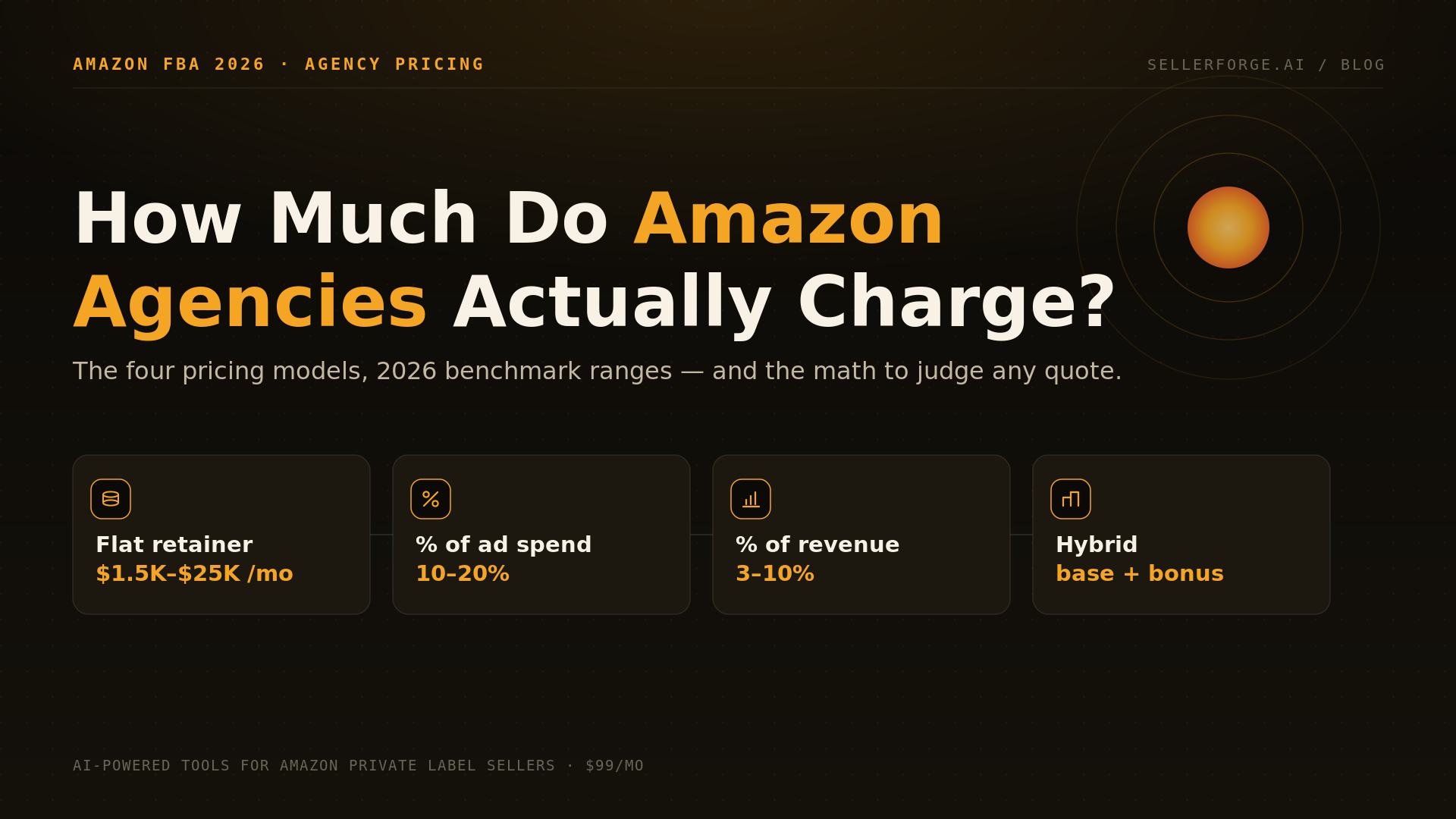
Nearly every Amazon agency prices with one of four structures: a flat monthly retainer, a percentage of ad spend (typically 10–20%), a percentage of total revenue (typically 3–10%), or a hybrid base-plus-performance model. Each one aligns the agency's incentives differently, and the misalignments are where buyers get hurt.
| Model | Typical 2026 range | Best for | The catch |
|---|---|---|---|
| Flat retainer | $1,500–$25,000/mo | Stable revenue; cost predictability | No built-in growth incentive; quality can drift once you are stable |
| % of ad spend | 10–20% of monthly spend | Aggressively scaling PPC budgets | Agency earns more when you spend more — profitable or not |
| % of revenue | 3–10% of Amazon sales | Strong-margin brands tying fees to growth | Ignores margin; gets very expensive at scale ($10M/yr at 5% = $500K/yr) |
| Hybrid | $1,000–$3,500 base + 2–5% above a threshold | Predictable base with shared upside | Hardest to compare across agencies; thresholds are negotiable — negotiate them |
The percentage models deserve the most scrutiny. Percentage of ad spend pays the agency for spending, not for results — at a $100K monthly budget, a 15% fee is $15,000, more than most full-service retainers, for work that did not get ten times harder. Percentage of revenue is worse for thin-margin catalogs, because the agency gets paid on every dollar of top line whether or not any of it reaches your bottom line. If you accept a revenue share, cap it, and pair it with a margin floor.
Margins are the lens that makes every fee negotiation clearer. If you have not benchmarked yours, start with our Amazon FBA profit-margin benchmarks by category — a 5% revenue share means something very different at a 32% margin than at 18%.
Pricing model and delivery model are linked: agencies that move production work to AI can hold margin at lower retainers. See how in our guide to scaling an Amazon agency with AI without hiring.
The Workload-Backwards Method: What a Quote Really Costs
The Workload-Backwards Method prices any agency quote in the unit that actually matters: the implied hourly rate of the humans who will touch your account. Retainers sound abstract; hourly rates are comparable to every other way you could buy the same work. Five steps:
- 1Ask how many accounts each account manager carries. Get a number, not a vibe. (Common loads run 8 to 20+.)
- 2Divide roughly 160 working hours a month by that load to estimate the ceiling of hours your account can receive.
- 3Divide the monthly retainer by those hours. That is the implied hourly rate you are paying.
- 4Compare it against freelance specialist rates for the same work — senior Amazon PPC and catalog specialists bill roughly $50–$150/hour.
- 5Ask what share of the work is done by the person you met versus juniors or offshore teams, and re-run the math on the blended reality.
Worked example: a $5,000/month retainer where the account manager carries 12 accounts means your ceiling is about 13 hours a month — an implied rate of roughly $385/hour. The same retainer with a 4-account load is about 40 hours at $125/hour, a completely different purchase. Across the 57 accounts I managed, account-manager load was the single best predictor of client outcomes I saw — better than the agency's logo wall, better than the case studies. Agencies know this, which is why the load number rarely appears in proposals. Make them say it.
The Workload-Backwards Method in one line: retainer ÷ (160 ÷ account-manager load) = the hourly rate you are really paying. If it is triple the freelance market rate, the pitch deck is doing the work, not the team.
What Hidden Fees Do Amazon Agencies Charge?
The retainer is rarely the whole bill. Five add-ons show up after signing often enough that you should price them before comparing quotes: onboarding fees, separately billed creative, software pass-throughs, termination penalties, and international add-ons.
- Onboarding and setup: $1,000–$5,000 one-time; sometimes waived on 12-month terms. Ask what the audit deliverable actually contains.
- Creative billed separately below full-service tier: A+ Content $300–$1,000 per module set, Brand Store builds $2,000–$8,000, product video $1,000–$5,000.
- Tool pass-throughs: $200–$2,000/month for the agency's software stack — and ask whether you keep access to your data in those tools if you leave.
- Early termination: commonly one to three months of retainer to exit a 6–12 month contract. Negotiate a 30-day out after the first 90 days.
- International marketplaces: expect each added marketplace (UK, DE, JP) to add 30–50% to the base retainer; Vendor Central (1P) management typically runs 15–30% above equivalent 3P work.
None of these is a scam — creative work and extra marketplaces are real work. The failure mode is comparing Agency A's $4,000 all-in quote against Agency B's $3,000 quote that becomes $5,500 after creative and tools. Get every line in writing, then compare totals.
Agency vs. In-House vs. Software: Which Should You Pay For?
The honest 2026 comparison has three columns, not two. A two-person in-house team costs $161,000–$268,500 a year with benefits, tools, and freelance creative — $13,400–$22,375 a month, which is why full-service agencies at $7,500–$15,000 usually beat in-house until roughly $15M in annual Amazon revenue. The new variable is that AI software now does a real share of what retainers used to buy: continuous monitoring, analysis, reporting, and specific recommendations from your live account data.
| Option | Monthly cost | What you get | When it wins |
|---|---|---|---|
| Full-service agency | $7,500–$15,000 | Human team: execution, creative, DSP, supply-chain support | You want hands off the wheel; complex creative and ad programs; no internal bandwidth |
| Mid-market agency | $3,000–$7,500 | Dedicated AM, full PPC, content upkeep | Established brand, growing catalog, $5K–$30K/mo ad spend |
| In-house team (2 people) | $13,400–$22,375 | Full-time focus, total control of data and accounts | $15M+/yr; specialized categories; you are building a long-term internal capability |
| Freelance specialists | $1,000–$5,000 typical | Senior hands on specific jobs at $50–$150/hr | One well-defined gap (PPC, catalog, design) rather than everything |
| SellerForge (our product) | From $49/mo (Agency $499 for 10 accounts) | AI account intelligence on your live data: monitoring, audits, ads analysis, forecasting, POAs, reporting — recommendations you approve | The analysis-and-recommendation layer of the job; pairs with a narrower agency scope or replaces one for operators who keep execution |
Full disclosure again: SellerForge is my product, so weight that row accordingly. The honest boundary is this — software does not shoot lifestyle photography, negotiate with Amazon Vendor Managers, build DSP programs, or own execution while you sleep. Agencies do. What software now does better than a shared account manager is the always-on layer: watching every campaign, ASIN, fee, and health metric daily and telling you specifically what to do — because it holds all of your data all of the time, which no human carrying 12 accounts can.
If you are mid-decision, the companion piece to this one is why Amazon sellers are leaving their agencies — including the Three-Door Test for sorting which agency jobs actually need an agency, and when you genuinely should stay.
There is a fourth option between agency and software: an AI platform that comes with a strategist. We price one against self-serve software in our Teikametrics vs Quartile comparison.
For Agencies: How Should You Price Your Own Services?
If you run an Amazon agency, the same math reads in reverse: your retainer must cover the account-manager hours a client consumes at a load that does not burn your team, and clients are getting smarter about asking. A $60,000–$90,000 account manager carrying ten accounts costs you $500–$750 per account per month before tools, management, and creative — which is why sub-$2,000 full-service retainers only pencil with loads that eventually show up in churn.
The margin lever that changed in the last two years is AI doing the analysis and reporting layer. If your account managers spend a third of their hours assembling data and writing client updates, that is the third most exposed to software — and the third clients least want to pay retainer rates for. Running that layer on tooling lets the same AM carry more accounts at higher service quality instead of more accounts at lower quality, which is the difference between scaling and eroding.
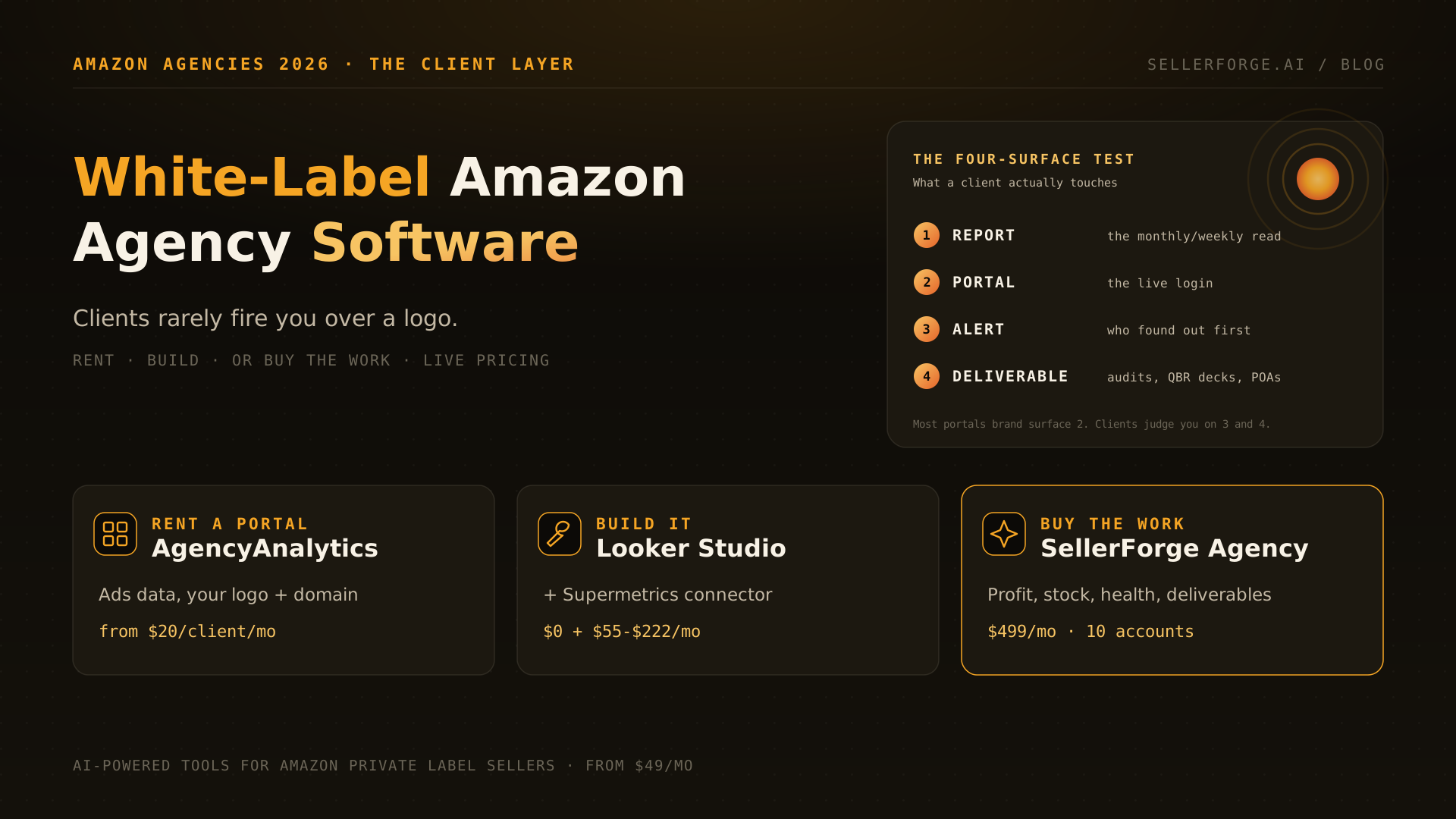
This is the operating model behind SellerForge's Agency plan — $499/month for 10 client accounts with an account switcher, AI analysis on every account's live data, and client-ready deliverables from the Deliverable Builder and Weekly Business Report. For the reporting cadence itself — what clients actually read and the metrics that build trust — see the Amazon agency client-reporting playbook.
Reporting software belongs inside the retainer, not on the invoice. Our guide to white label Amazon agency software sets a 3% ceiling for the whole client layer and shows what each tool costs per client.
What Should You Ask Before Signing With an Amazon Agency?
Seven questions separate a fair engagement from an expensive one. Ask them in writing and keep the answers next to the contract:
- How many accounts does my account manager carry? (Run the Workload-Backwards Method on the answer.)
- What exactly is in the retainer, and what is billed separately — creative, DSP, extra marketplaces, tools?
- Who owns the creative assets and campaign data when we part ways, and in what exportable format?
- What is the termination clause — notice period, penalty, and does auto-renewal require 60–90 days' notice?
- How will you report, how often, and on which metrics? (Revenue, TACoS, contribution margin, organic rank — not impressions.)
- What is your baseline for performance claims, and how do you separate your impact from seasonality and my own changes?
- If the answer to a growth target is 'spend more on ads' — who benefits from that recommendation under your pricing model?
A common thread from every credible 2026 source and my own agency years: agencies need three to six months to show real lift, fees above 5% of revenue rarely justify themselves, and any agency guaranteeing specific results is telling you something important about how they operate.
The Bottom Line
In 2026 you should expect to pay $2,500–$5,000 a month for competent mid-market Amazon account management, $7,500–$15,000 for genuine full-service depth, and you should treat percentage-based fees above 5% of revenue as a flag to renegotiate. Price every quote with the Workload-Backwards Method, get the hidden five in writing, and decide deliberately which layer of the job you are buying: execution hands, analysis brains, or both. The sellers getting the best deals right now are not the ones negotiating hardest — they are the ones who split the job, paid humans for the human parts, and put software on the rest.
If you want to see what the software layer looks like on your own account before you renegotiate anything, run SellerForge on your account free — it connects to your real data and shows you the analysis a retainer would bill for, in about two minutes.
About the author
David Gallo is the founder of SellerForge.ai. Before building SellerForge, he managed 57 Amazon seller accounts representing over $350M in sales at Worldfront — including setting the retainers. He writes from the operator's side of the table.