The best Amazon profit tracking software in 2026 is Sellerboard (from $19/mo) for the lowest-cost accurate P&L, A2X (from $29/mo) for accountant-grade settlement-to-ledger books, and SellerForge (from $49/mo — our product, disclosed) when you want per-ASIN profit intelligence that also acts: reimbursement claims, forecasts, and weekly owner reports. Whatever you pick, run the Settlement-Back Test first: a profit number that cannot reconcile to your settlement report within 1% is a guess.
Most Amazon sellers do not have a profit problem — they have a profit visibility problem. The best profit tracking software in 2026 is Sellerboard if you want the cheapest accurate P&L, A2X if you want accountant-grade books, and SellerForge — our product, so judge that claim accordingly — if you want profit intelligence that also acts on what it finds. This guide compares all of them honestly, with real pricing.
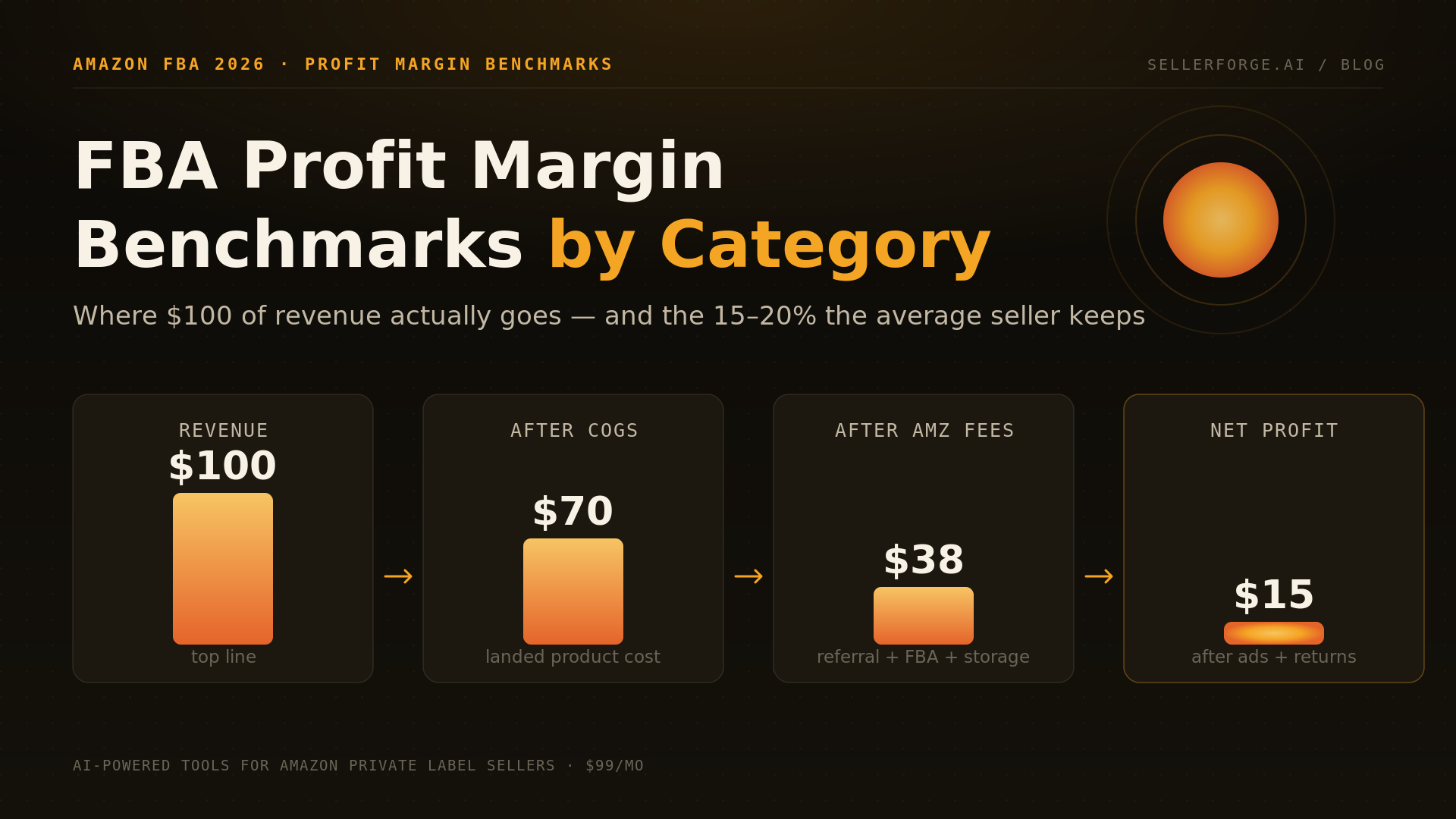
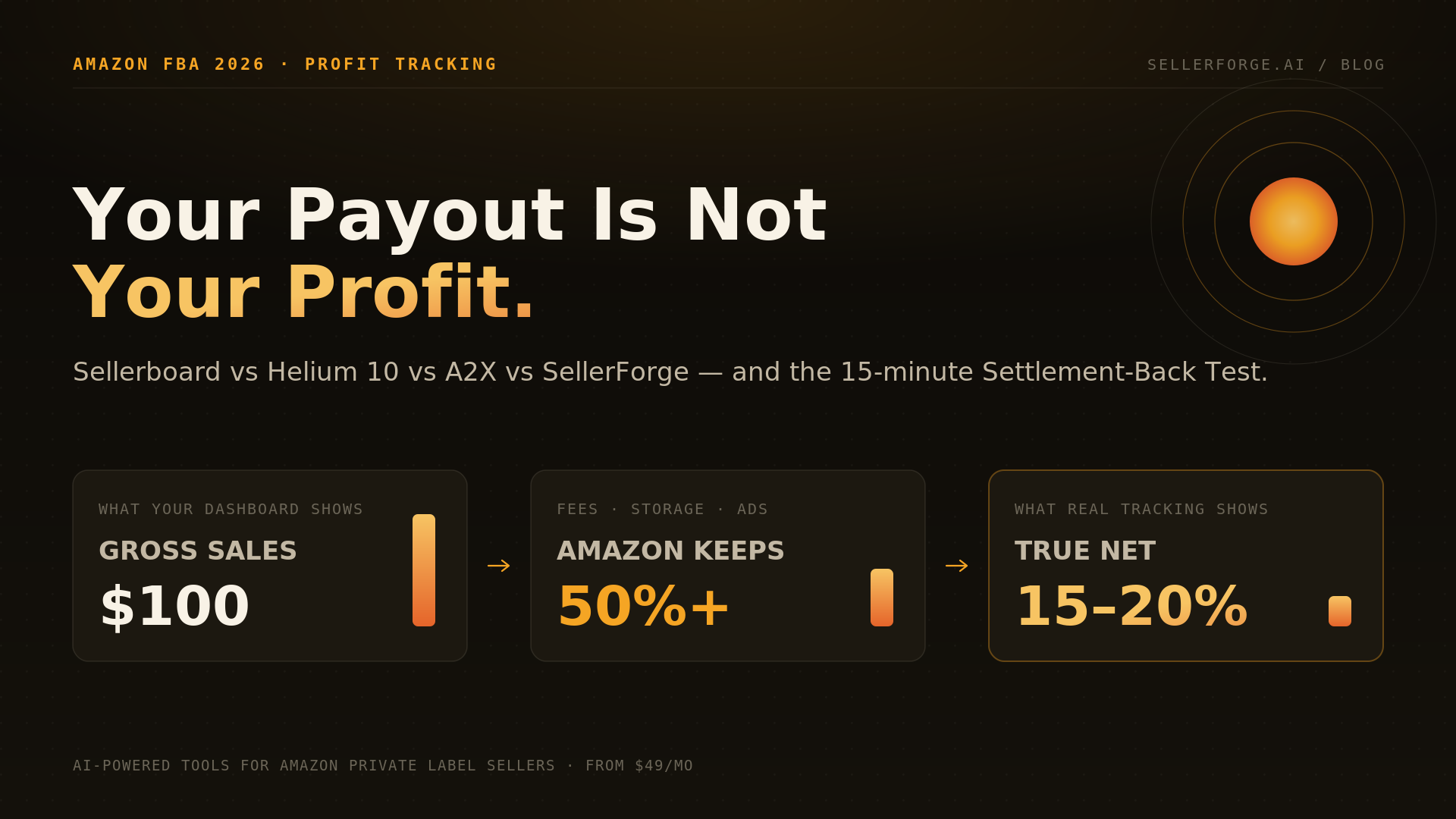
The stakes are higher than they were even two years ago. Marketplace Pulse calculates that a typical seller now hands Amazon more than 50% of revenue across fees and advertising, up from roughly 40% five years earlier. When half your topline is spoken for before your product cost enters the math, a 3% blind spot in fee tracking is the difference between a business and a hobby.
Across the 57 accounts I managed at Worldfront, the sellers who got into real trouble were almost never the ones with bad products. They were the ones reading topline sales as if it were profit — and discovering the gap at tax time, or worse, at reorder time. So before the comparison table, this guide gives you the thing the vendor listicles skip: how to tell whether any profit number — including ours — deserves your trust.
Why Is My Amazon Payout Less Than My Sales?
Your Amazon payout is smaller than your sales because Amazon deducts referral fees, FBA fulfillment fees, storage, advertising, refund costs, and a growing list of surcharges before money reaches your bank — then holds a rolling reserve on top. Payout, revenue, and profit are three different numbers, and Seller Central only ever shows you the first two.
If your bookkeeping starts from what Amazon deposits, you will never see the fees you could have disputed. If it starts from your sales dashboard, you will overstate profit every single month. Real tracking starts from the settlement report — the itemized record of what Amazon actually charged you — and builds both directions from there.
What Should Amazon Profit Tracking Software Actually Do?
Real Amazon profit tracking software reconstructs true net profit per ASIN by combining every Amazon fee event, advertising spend, refunds and their downstream fees, storage, reimbursements, and the cost of goods that applied when each unit sold — then reconciles the result against actual settlement payouts. Anything less is a sales dashboard wearing a profit label.
That definition hides five hard requirements, and they are where tools quietly diverge:
- Full fee-event coverage. Amazon’s fee schedule now spans dozens of distinct charge types. The ones tools miss most — returns processing fees, storage utilization surcharges, inbound placement, disposal and removal — are exactly the ones that grew fastest since 2024.
- Time-versioned COGS. Your landed cost changed repeatedly through the 2025–26 tariff era. A tool that applies today’s cost to January’s sales rewrites history; accurate tools store cost by date range or by inbound batch.
- The full returns lifecycle. A return is not one event — it is a refund, a refund administration fee, possibly a returns processing fee, a disposition (sellable, damaged, disposed), and sometimes a reimbursement weeks later. Tools that stop at "refund" overstate the damage or miss it entirely.
- Advertising at the ASIN level, so ad-inclusive contribution margin is visible per product, not just account-wide. TACoS at the account level hides which ASINs are quietly unprofitable.
- Reimbursement awareness. Lost and damaged inventory that Amazon owes you back is profit sitting in a queue. A profit tool that cannot see it understates what the business actually earned.
The Settlement-Back Test: Audit Any Profit Tool in 15 Minutes
The Settlement-Back Test is a 15-minute audit you can run on any profit tool, including ours: pick a closed settlement period, compare the tool’s net profit for that period against the settlement report plus your true landed costs, and demand the numbers reconcile within 1%. A tool that fails is estimating fees forward instead of reading what Amazon actually charged.
- 1Download one closed settlement report from Seller Central (Payments → Reports Repository). Pick a normal two-week period — no Prime Day, no holiday peak.
- 2Total the settlement: gross sales, every fee line, refunds, adjustments, and the closing disbursement. This is ground truth — what Amazon actually moved.
- 3Ask your profit tool for net profit over the exact same date range, and export its fee breakdown.
- 4Reconcile revenue and fees line against line. A gap above 1% means fee events are missing — returns processing, storage surcharges, inbound placement, and reimbursements are the usual suspects.
- 5Test COGS versioning: change a product’s cost today and check whether last quarter’s profit moves. It should not. If it does, the tool stores one cost per SKU and your historical P&L is fiction.
The Settlement-Back Test in one line: if a profit number cannot reconcile to your settlement report within 1%, it is not a metric — it is a guess with a user interface.
Best Amazon Profit Tracking Software Compared (2026)
Here is the field as it actually stands in September 2026, with verified pricing. Full disclosure before the table, not after it: SellerForge is our product — the last row is ours, and you should weigh it with that in mind. The other verdicts are the same ones we give sellers who never become customers.
| Tool | Starts at | Built for | Where it wins | Where it falls short |
|---|---|---|---|---|
| Sellerboard | $19/mo ($15 annual) | Pure profit & loss tracking | Cheapest accurate live P&L; PPC and reimbursement reports; 30-day trial | Order-volume pricing tiers; dated interface; shows problems, does not act on them |
| Helium 10 (Profits) | $129/mo ($99 annual) | All-in-one research suite | Bundled free if you already pay for Helium 10 research | Profit view is a side feature; very expensive if tracking is all you need |
| Jungle Scout (Sales Analytics) | $49/mo ($29 annual) | Research suite with basic P&L | Solid launch-phase combo of research plus topline P&L | Not fee-forensic; simple COGS handling; analytics secondary to research |
| Sellerise | $19.99/mo | Operations suite with profit + alerts | Strong reimbursement tooling; granular alerting | Six pricing tiers climb fast; features gated by plan |
| Shopkeeper | $20/mo | Solo sellers under ~$50K/mo | Simple, friendly profit dashboard with light forecasting | Thin PPC analytics; scales poorly past one person |
| A2X | $29/mo | Settlement-to-ledger accounting | Accountant-grade: posts every settlement to QuickBooks/Xero to the penny | Not a decision dashboard; requires accounting software and setup |
| SellerForge | $49/mo flat plans | AI account intelligence that acts | Per-ASIN Custom Breakdowns; Weekly Business Report; detects and drafts reimbursement claims; forecasting; flat pricing, not order-tiered | Not a bookkeeping system — pair with A2X for taxes; if you only want the cheapest mirror, Sellerboard costs less |
Is Sellerboard Worth It?
Yes. For pure profit visibility at the lowest price, Sellerboard is worth it — it is the tool we recommend most often after our own, and for plenty of sellers it is the better pick. Nineteen dollars a month buys a live per-ASIN P&L, ad-spend integration, fixed-cost allocation, reimbursement reports, and alerting that has been refined for years.
Its honest limits: the pricing tiers climb with order volume, so a growing seller drifts from $19 toward $79; the interface prioritizes density over clarity; and it is a mirror, not an operator. Sellerboard will show you a fee anomaly — it will not investigate it, draft the reimbursement case, or fold it into a forecast. If your workflow is "I check the dashboard and act myself," that is no limit at all. If the checking and acting is what you are trying to get off your plate, it is the whole limit.
Where SellerForge Fits (and Where It Does Not)
SellerForge is our product — this section is the pitch, disclosed as one. We built it because profit tracking, done honestly, kept ending in the same place: a dashboard that told an exhausted operator about one more problem they now had to go fix by hand. The category we own is not "prettier profit charts"; it is profit intelligence that acts.
Where SellerForge does not fit, plainly: it is not a bookkeeping system — your accountant still wants A2X feeding QuickBooks or Xero, and we tell customers that on onboarding calls. If all you want is the cheapest accurate mirror and you enjoy driving the workflow yourself, Sellerboard at $19 is the rational buy and we say that too. And if your one burning problem is PPC bid automation at scale, that is a dedicated-platform job, not a profit tool job.
Who Should Pick What
Match the tool to the job in front of you, not to a feature-count table. The honest routing:
- New seller under ~$10K/month: Sellerboard ($19) or Shopkeeper ($20). Your profit problems are still visible to the naked eye; buy visibility, not intelligence.
- Established private-label brand ($10K–$100K+/month): SellerForge (from $49) if you want the tracking plus the acting — reimbursements, forecasts, weekly reports; Sellerboard plus your own workflow if you prefer to drive.
- Already paying for Helium 10 or Jungle Scout for research: try their built-in profit views first — run the Settlement-Back Test on them, and add a dedicated tracker only if they fail it.
- Bookkeeping, taxes, or an exit on the horizon: A2X (from $29) into QuickBooks or Xero, alongside whatever dashboard you run. Buyers and accountants trust ledgers, not screenshots.
- Agencies managing multiple accounts: order-metered trackers get expensive fast across a portfolio; flat multi-account platforms — our Agency tier ($499) is built for this — plus the client-reporting workflow from our agency reporting playbook.
The Bottom Line
Amazon keeps more than half of a typical seller’s revenue and reports it to you in fragments. The sellers who compound are the ones who reconstruct the whole picture — every fee event, time-versioned costs, the full returns lifecycle — and reconcile it against what Amazon actually paid. Which tool you use matters less than whether it passes the Settlement-Back Test; that said, Sellerboard is the best pure mirror for the money, A2X is the books, and SellerForge is for sellers who want the numbers to arrive with the work already started.
About the author
David Gallo spent eight years managing Amazon accounts at scale — 57 accounts and over $350M in sales at Worldfront — before founding SellerForge to give private-label sellers the AI-powered operations layer that agencies charge thousands for.