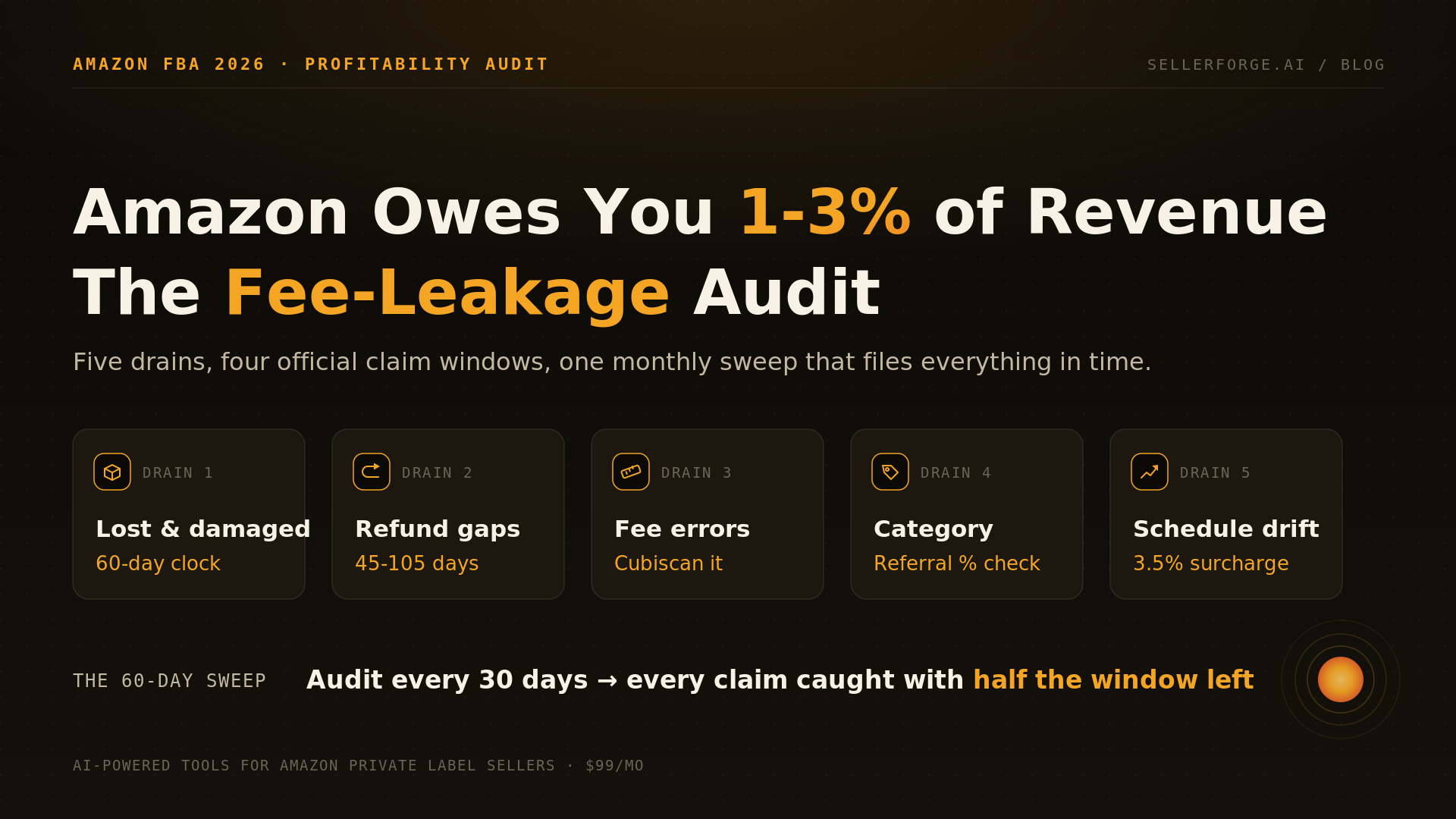
Amazon FBA reimbursements in 2026 run on short clocks: most fulfillment-center claims must be filed within 60 days, customer-return claims between 60 and 120 days after the refund (45–105 in the UK and EU), removal claims between 15 and 75 days — and since March 2025 Amazon pays your manufacturing cost, not your sale price. This playbook maps the five drains where FBA money leaks and the monthly 60-Day Sweep that files every claim in time. SellerForge (our product, disclosed) flags the discrepancies from $49/month with no commission; you file the claims.
Amazon owes most FBA sellers money right now. Industry audits consistently find 1–3% of annual revenue sitting in unclaimed reimbursements and fee overcharges: inventory lost in fulfillment centers that automation missed, refunds issued for units that never came back, fulfillment fees computed on the wrong size tier. On a $500,000 account, that is $5,000 to $15,000 a year. This playbook — built around a monthly cadence I call the 60-Day Sweep, and the reason SellerForge (our product, disclosed throughout) ships a Reimbursement Claims module — is how you get it back before the claim windows close.
The clock is the story. In October 2024 Amazon cut most claim windows from 18 months to 60 days. In November 2024 it started proactively reimbursing fulfillment-center losses, which sounds like the problem solved itself. Then in March 2025 it switched payouts from sale price to manufacturing cost, cutting per-claim recoveries 50–75%. The net effect: the easy money shrank, the deadlines tightened, and every month you skip the audit, claims expire permanently.
Across the 57 accounts I managed at Worldfront, profitability audits were monthly, not quarterly — and the difference was never sophistication. It was that a monthly rhythm sees every claimable event while it is still claimable. Here is the full audit: the five drains where FBA money leaks, the official window on each, and the sweep that files everything in time.
How do Amazon FBA reimbursements work in 2026?
Amazon FBA reimbursements in 2026 run on three rules: Amazon proactively reimburses most inventory lost in fulfillment centers (since November 1, 2024), everything else must be filed manually inside windows as short as 60 days (since October 23, 2024), and payouts are based on your manufacturing cost rather than your sale price (since March 31, 2025).
The manufacturing-cost change is the one that reset expectations. Amazon now pays what the unit cost you to source — excluding shipping, handling, and customs duties — not what you would have sold it for. You can provide your own per-unit cost, backed by supplier invoices, or accept Amazon's estimate, which sellers widely report runs low. Feeding accurate cost data for every SKU is now the single highest-leverage input in the whole reimbursement system: it is the difference between being paid your real cost and being paid Amazon's guess.
Three dates rewired this game: October 23, 2024 (claim windows cut from 18 months to 60 days), November 1, 2024 (proactive reimbursement for fulfillment-center losses), and March 31, 2025 (payouts switch to manufacturing cost). Any audit habit formed before those dates is miscalibrated today.
How far back can you claim Amazon FBA reimbursements?
Sixty days, for most claims. The 18-month lookback died on October 23, 2024, and each claim type now has its own tight window: fulfillment-center lost and damaged claims close 60 days after the loss is reported, customer-return claims open at day 60 and close at day 120 after the refund in the US (day 45 to day 105 in the UK and EU), and removal claims lost in transit run from day 15 to day 75 after shipment creation.
| Claim type | Official window | Filed by |
|---|---|---|
| Fulfillment center lost or damaged | Within 60 days of the item being reported lost or damaged | Amazon auto-pays most; you file the misses |
| FBA customer returns | 60–120 days after the refund or replacement date in the US (45–105 in the UK/EU); filing before the window opens is rejected | Amazon auto-pays most; you file the misses |
| Removal claims — lost in transit | 15–75 days from the removal shipment creation date | Always manual — automation never covers removals |
| All other removal claims | Within 60 days of the shipment being delivered back to you | Always manual |
The 60-Day Sweep: a monthly audit built for 60-day windows
The 60-Day Sweep is a monthly, five-drain audit sized to Amazon's shortest claim window: run it every 30 days and every claimable event is at most ~30 days old when you find it, leaving half the window to gather evidence and file. It replaces the quarterly audit, which made sense under 18-month windows and silently loses money under 60-day ones.
The five drains are the five distinct ways FBA accounts leak money. They live in different reports, carry different clocks, and need different fixes — which is why sellers who only check one of them (usually lost inventory) recover a fraction of what is theirs.
| Drain | What it looks like | Where it shows | Clock |
|---|---|---|---|
| 1. Lost & damaged inventory | Units vanish or break in the FC; automation pays most, misses some | Inventory Ledger vs. Reimbursements report | 60 days |
| 2. Refund gaps | Buyer refunded, unit never returned; refund exceeds the original charge | Returns report vs. refund transactions | 60–120 days (US) |
| 3. Fee measurement errors | Wrong dims or weight put the SKU one size tier up | Fee Preview vs. your own measurements | Fix stops the bleed; recent overcharges recoverable |
| 4. Category classification errors | SKU pays a higher referral-fee percentage than its category warrants | Fee schedule vs. per-SKU referral charges | Same — catch early, correct forward |
| 5. Schedule drift | New fees and surcharges land silently in unit economics | Fee announcements vs. per-SKU margin | No claim — a repricing decision |
Here is the sweep itself, in the order I ran it. Budget an hour a month for a mid-size account the first time; it gets faster.
- 1Pull the Inventory Ledger and reconcile every lost and damaged event against the Reimbursements report; flag any event with no matching reimbursement ID.
- 2Cross the Returns report against refund transactions; flag every refund past day 60 (day 45 in Europe) with no returned unit, and every refund larger than the original charge.
- 3Spot-check fulfillment fees on your top 20 revenue ASINs against your own measured dimensions and weight; queue a remeasurement case for every mismatch.
- 4Check each ASIN's referral-fee category against the current fee schedule; flag SKUs charged a higher percentage than their category calls for.
- 5Read the month's fee announcements and re-run unit economics on every SKU they touch; a surcharge here and a placement-fee change there compound quietly.
- 6File every flagged claim with evidence the same week, log the claim IDs, and carry unresolved cases into next month's sweep so nothing falls between cycles.
How do you know if Amazon overcharged you on FBA fees?
Compare Amazon's stored dimensions and weight for each SKU against your own measurements, because every fulfillment fee is computed from Amazon's numbers, not yours. Industry audits find up to 20% of inventory carries a wrong size, weight, or category — and fee tiers are cliffs, not slopes, so a fraction of an inch is real money.
Referral-fee classification is the same error in a different ledger: a SKU mapped to a category carrying a higher commission percentage than the one it belongs in overpays on every order. It happens at listing creation and after catalog edits, it survives because referral fees are percentage-based and invisible per-order, and it is worth checking whenever a fee looks large against the sale price. Fee-focused reviews put 2–5% of total FBA costs as recoverable from these measurement and classification errors combined — on fees you were never supposed to owe.
Fee-error math is per-unit × velocity: a $0.30 error on a 1,000-unit-a-month ASIN outweighs a $3 error on a slow one by 10x. Always sweep your highest-velocity SKUs first — it is where the same error costs the most.
What changed in Amazon's 2026 fee schedule?
The 2026 schedule's headline is the 3.5% fuel and logistics surcharge on FBA fulfillment fees in the US and Canada, effective April 17, 2026, extended to Multi-Channel Fulfillment and Buy with Prime on May 2 — about $0.17 per unit on average. January 15, 2026 also reset inbound placement rates. None of it asks permission; it just lands in your unit economics.
Are Amazon reimbursement services worth it?
Reimbursement services are worth it when their 20–25% contingency fee beats the value of your own time — truest for large catalogs with long unaudited histories, and for operators who know they will never run the audit. GETIDA's pricing page now advertises performance pricing starting at 20% of recovered funds (checked October 2026); Seller Investigators, owned by SPS Commerce since its $210M acquisition of Carbon6 closed in February 2025, charges 25%.
| Approach | Cost | Best for | Honest ceiling |
|---|---|---|---|
| DIY with this checklist | Free (about an hour a month) | Small catalogs, disciplined operators | Depends entirely on you actually doing it monthly |
| Contingency service (GETIDA, Seller Investigators) | 20–25% of recoveries | Big unaudited back catalogs; zero-effort preference | Fee scales with your losses; monitoring still billed at service rates |
| SellerForge (ours) | From $49/month (Core), no commission | Ongoing discrepancy detection inside whole-account intelligence | Not a done-for-you filing service; it flags discrepancies and you file the claims |
Where SellerForge fits (and where it does not)
Who should run what in 2026
- Under $10K/month: DIY. Run the six-step sweep monthly by hand, keep supplier invoices organized per SKU, and file your own claims — at this scale the leak is real but small, and the habit is the asset.
- Growing private label ($10K–$100K/month): software-assisted. The sweep needs to survive busy months, fee errors on hero ASINs get expensive, and per-SKU cost data must stay current for manufacturing-cost claims. This is the SellerForge lane, and where the margin picture should connect to the benchmarks in our FBA profit-margin guide.
- Large or long-unaudited catalogs: hybrid. Bring in a contingency service for the historical cleanup, then run monthly software-based sweeps so you never need the cleanup again.
- Agencies: make the sweep a deliverable. A monthly recovered-funds line item is the most self-justifying report an agency can send, and the Agency tier runs it across every client account.
About the author
David Gallo is the founder of SellerForge.AI. Before building it, he managed 57 Amazon seller accounts representing more than $350M in sales at Worldfront, where the monthly profitability audit was a standing calendar block and unclaimed reimbursements were treated as an accounts-receivable line, not found money. He writes the SellerForge blog for operators, not affiliates.