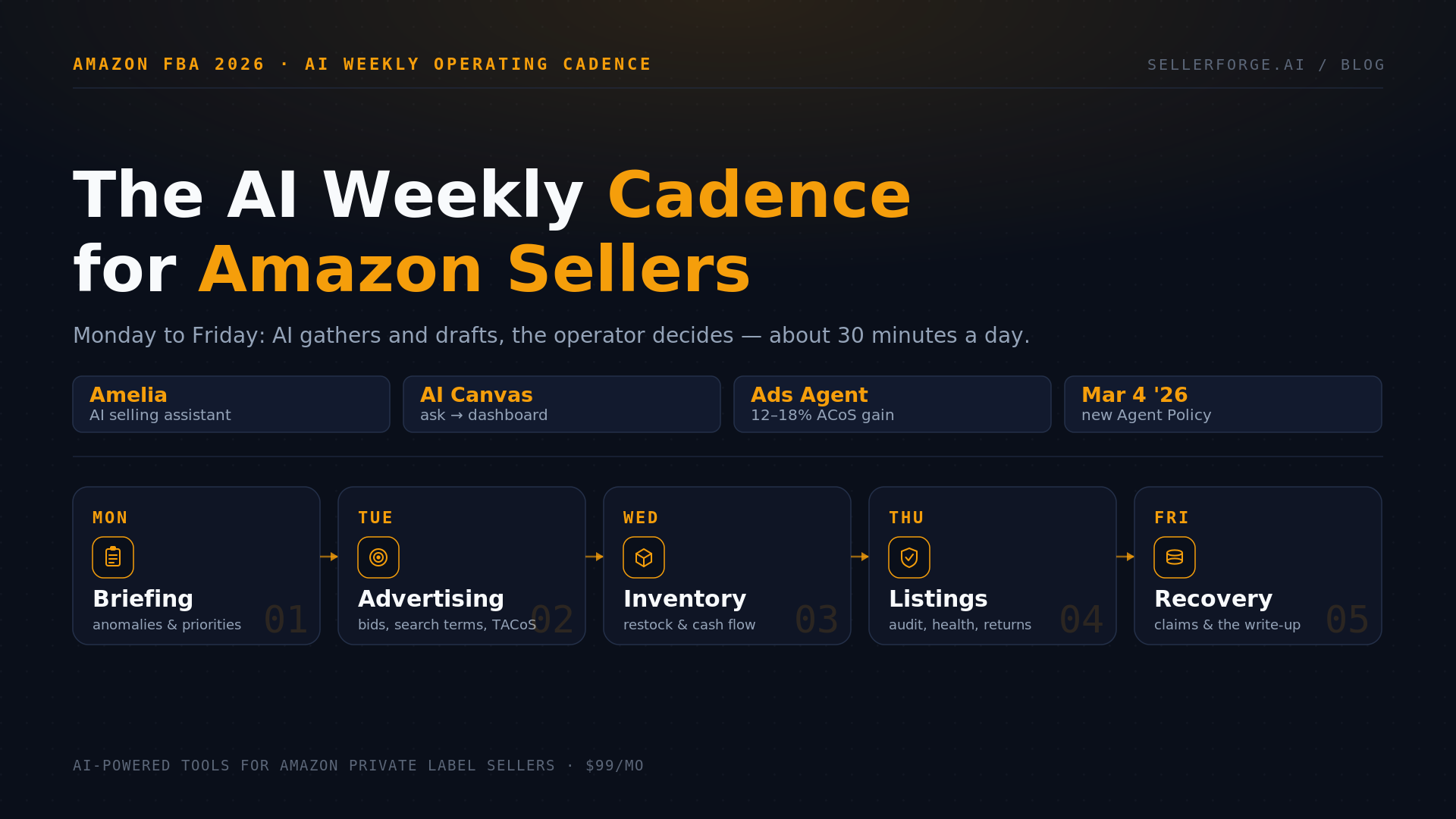
In 2026 Amazon sellers gained real AI agents — Project Amelia, the AI Canvas, and the Ads Agent — but also new rules (the March 4 Agent Policy) on what automation is allowed. The operators winning aren't automating everything; they run a weekly cadence: a fixed Monday-to-Friday rhythm where AI gathers data and drafts the work, and the human makes the decisions. Here is the full system, day by day.
Most Amazon sellers don't have a tooling problem in 2026. They have a rhythm problem. The dashboards have multiplied, the alerts never stop, and there is always one more report to pull — so the work becomes reactive. You fight whatever fire is loudest that morning and call it operations.
This is also the year that genuinely capable AI arrived inside the seller's day. Amazon shipped Project Amelia, its generative selling assistant. It launched an AI Canvas that turns a question into a dashboard. It put an Ads Agent into beta that builds and optimizes campaigns from a prompt. CEO Andy Jassy has been explicit that the future of selling is powered by AI agents, and Amazon says more than 500,000 sellers are already using generative AI in some form.
But more AI without a structure just means more things demanding your attention. The operators pulling ahead aren't the ones who automated everything. They're the ones who built a cadence: a fixed weekly rhythm where AI does the gathering and the drafting, and a human makes the decisions. This is that system — five days, about thirty minutes each — and the 2026 context (including Amazon's new rules) you have to build it on.
The Real 2026 Shift: AI Agents Arrived — and So Did the Rules
Before you design a workflow, it helps to know what's actually available now, because the landscape changed fast. Three Amazon-native tools matter for your week, and one policy reshapes how you're allowed to use all of them.
Project Amelia is Amazon's generative-AI selling assistant, built on Amazon Bedrock and embedded in Seller Central. You can ask it ‘How is my business doing?' and get a summary of recent sales, units sold, and traffic, plus account-specific guidance and integrated seller news. It's gaining agentic abilities to take actions with permission. As of mid-2026 it's still a phased beta — over 50,000 sellers have tested it — so not every account has it yet, and it advises and summarizes more than it runs anything.
The AI Canvas, introduced in March 2026 for U.S. and U.K. sellers, is the companion to that: an interactive workspace where a plain-language question becomes a personalized visual dashboard of trends and recommended actions. It's the fastest way Amazon has ever offered to assemble a view without building it yourself.
The Amazon Ads Agent, unveiled at unBoxed 2025 and in beta from the first quarter of 2026, brings campaign creation, bidding, targeting, and creative generation across Sponsored Products, Sponsored Brands, and DSP into a single natural-language system on top of Bedrock. Early beta testers reported roughly 30–40% time savings on campaign management and 12–18% ACoS improvements.
| AI tool | What it does | Status in mid-2026 | Where it fits your week |
|---|---|---|---|
| Project Amelia | Generative assistant in Seller Central; answers questions, summarizes metrics, surfaces seller news, takes some actions with permission | Phased beta (50,000+ sellers tested); not yet on every account | Monday briefing; ad-hoc questions |
| AI Canvas | Turns a natural-language question into a visual dashboard of trends and recommended actions | Launched March 2026 (US & UK first) | Monday briefing; mid-week deep dives |
| Amazon Ads Agent | Natural-language campaign creation, bidding, targeting, and creative across SP, SB, and DSP | Beta from Q1 2026; ~30–40% time saved, 12–18% ACoS improvement reported | Tuesday advertising block |
| SP-API tools | Repricing, forecasting, listing audits, reimbursement recovery, reporting — built on the Selling Partner API | SP-API now $1,400/yr + usage fees (~$0.40 per 1,000 calls); must be a registered app | Behind the scenes, every day |
If the Ads Agent tempts you to switch on every format at once, don't — the Sponsored Brands and DSP gating playbook covers which layers a private-label budget should actually unlock, and when.
The Guardrail Most ‘Automate Everything' Advice Ignores
Here's what the breathless automation threads leave out. The same year Amazon handed sellers AI agents, it also drew formal lines around them. Its updated Business Solutions Agreement, effective March 4, 2026, introduced a standalone Agent Policy governing any automated software or AI agent that touches Amazon's services.
Two principles run through it. First, traceability: every automated seller action must run through a registered Selling Partner API (SP-API) application and be attributable to it. Bot-like behavior that mimics human browsing, and using competitor data scraped outside official APIs, are prohibited. Second, proportionality — Amazon tiers automated actions by how much damage they could do, and requires more oversight as the stakes rise.
| Tier | Example actions | What Amazon requires |
|---|---|---|
| Tier 1 — Routine | Inventory sync, order acknowledgment, basic repricing within set parameters | SP-API registration; minimal extra restrictions |
| Tier 2 — Moderate | Catalog updates, advertising bid adjustments, customer-message responses | Rate limiting and audit logging |
| Tier 3 — High-impact | Bulk listing creation, large price changes, account configuration | A human authorization step |
There's a cost dimension too. Access to the SP-API now carries a $1,400 annual subscription (effective January 31, 2026) plus usage-based charges starting around $0.40 per 1,000 calls from April 30, 2026. For most sellers that's invisible — it's absorbed by the tools you use — but it's why ‘just have an agent hammer the API all day' is neither compliant nor free.
Read Amazon's three-tier framework as a blueprint, not a restriction. It's describing exactly how a healthy operation should run: let AI handle routine gathering and drafting, keep a human authorizing anything that moves real money or risks the account. Your weekly cadence should mirror that line.
Why a Cadence Beats a Bigger Tool Stack
Every credible voice in the space now says the same thing in different words: the best tools in 2026 are the ones you can turn into a routine, not the ones with the longest feature list. Tools only work when they become part of a rhythm. That sounds obvious and almost nobody does it, because the default state of selling on Amazon is interruption.
A cadence fixes three things at once. It eliminates context-switching by batching similar decisions — all advertising calls in one Tuesday block instead of scattered across the week. It guarantees coverage, so account health and reimbursements don't get skipped for three months because nothing screamed. And it gives AI a job description: each day has a defined question, which is exactly what assistants like Amelia and the AI Canvas are good at answering when you ask precisely.
One discipline holds it together: pick a single priority per top SKU per week. AI will happily generate fifty recommendations. The operator's job is to choose the one that matters and actually ship it.
The Monday-to-Friday AI Operating Cadence
Each day owns one theme. AI prepares the inputs; you make the decisions. Budget about 30 minutes a day — more during Q4 or a launch, less in a quiet week. The rule never changes: AI drafts, the human decides.
Monday — The Briefing
Start the week by orienting, not reacting. Pull a single summary of the prior week: sales, sessions, conversion, and unit economics, with anomalies flagged against the week before. This is precisely the question Amelia (‘How is my business doing?') and the AI Canvas were built to answer, and it's the job a weekly business report does without you assembling it.
- AI prepares: a week-over-week summary with the three biggest movers and any anomaly (a conversion drop, a traffic spike, a fee you didn't expect).
- You decide: the one priority for each top SKU this week — fix the listing, defend the Buy Box, reorder, or push ads.
- Output: a short written priority list the rest of the week executes against.
Tuesday — Advertising
- AI prepares: search-term harvest, negative-keyword candidates, bid and budget changes, and a TACoS-by-ASIN view.
- You decide: which suggestions to approve, what to scale, and what to cut — large budget swings get your explicit sign-off (that's a Tier 3 action).
- Output: approved changes pushed for the week, with a note on anything you're testing.
Wednesday — Inventory & Cash Flow
Mid-week, look forward. Demand forecasting, days-of-cover, capacity and IPI status, supplier lead times, and the timing of cash under DD+7 all converge into a single restock decision. Getting this wrong is the most expensive ordinary mistake on Amazon — a stockout kills rank and Buy Box share at once. Our FBA capacity and IPI playbook covers the mechanics this day depends on.
- AI prepares: a restock forecast with days-of-cover, capacity/IPI headroom, lead-time risk, and the cash-timing impact of each purchase order.
- You decide: what to reorder, how much, and when — balancing stockout risk against capacity limits and working capital.
- Output: this week's purchase orders and any inbound-placement decisions.
Thursday — Listings, Account Health & Returns
Thursday is defense and improvement. Run a listing audit for the SKUs you flagged Monday, check Account Health and the Account Health Rating, and read Voice of the Customer and return-reason trends — returns are now a hard, compounding fee in many categories, as we detailed in the returns-fee margin defense playbook. AI can summarize the signals; you choose the one fix worth making.
- AI prepares: listing-audit gaps (title, images, A+, semantics), Account Health changes, and the top return reasons by SKU.
- You decide: the single highest-leverage fix — a fit image, a policy response, a suppressed-listing repair — and whether anything needs a plan of action.
- Output: one shipped listing or health fix, and an escalation drafted if a metric is slipping.
Friday — Recovery, Reviews & the Write-Up
Close the loop and recapture money. Friday is for reimbursement candidates (lost or damaged units, fee misapplications), your compliant review and feedback cadence, a quick competitor delta, and — most importantly — writing down what happened so next Monday starts informed. Recording decisions against a timeline is what turns a busy week into compounding knowledge.
- AI prepares: a list of reimbursement candidates with evidence, feedback/review status, one notable competitor change, and a draft log of the week's events.
- You decide: which claims to file and what to formally record (a price change, a supplier issue, a policy update) for future you.
- Output: filed claims and a dated event log that feeds next Monday's briefing.
The Cadence at a Glance
| Day | Theme | What AI prepares | What you decide | ~Time |
|---|---|---|---|---|
| Monday | The briefing | Week-over-week summary; anomalies; top movers | One priority per top SKU | 30 min |
| Tuesday | Advertising | Search-term harvest; bid/budget suggestions; TACoS by ASIN | What to approve, scale, or cut | 30–40 min |
| Wednesday | Inventory & cash flow | Restock forecast; days-of-cover; capacity/IPI; DD+7 cash timing | What to reorder, how much, when | 30 min |
| Thursday | Listings, health & returns | Listing-audit gaps; Account Health; return-reason trends | The single highest-leverage fix | 30 min |
| Friday | Recovery & write-up | Reimbursement candidates; review status; competitor delta; event log | Which claims to file; what to record | 30 min |
Zoom Out: The Monthly and Quarterly Loops
Not everything belongs in the weekly rhythm, and forcing it there creates noise. Some decisions need a longer lens. Run them on their own cadence so the weekly stays fast.
- Monthly: a true P&L and per-ASIN contribution-margin review (after fees, ads, storage, and returns), plus a keep/fix/cut call on underperformers.
- Quarterly: capacity and IPI planning, seasonal demand forecasting, supplier renegotiation, and a deeper competitor and category teardown.
- Event-driven: Prime Day and Q4 prep, fee-schedule changes, and policy updates — handled when they happen, then logged on your timeline.
Running this cadence across client accounts? The same weekly checks become client-facing deliverables in our Amazon agency client reporting playbook — pulse emails, monthly reports, and the metrics that build trust.
How SellerForge Turns This Into One Workflow
The cadence works with whatever tools you have — Amelia, the AI Canvas, a spreadsheet, and discipline will get you a long way. The friction is that the inputs live in a dozen places and the AI helping you doesn't know your catalog. SellerForge was built to collapse the five days into one workflow, with an assistant that has your account context.
Monday's briefing, built for you. The Weekly Business Report assembles the week-over-week summary and anomalies automatically, and Custom Breakdowns let you slice it by brand, SKU, or marketplace — so the briefing is waiting for you, not something you build.
Tuesday through Thursday, in context. The Advertising tools surface the search-term harvest and TACoS view; Forecasting turns demand and lead times into a restock-and-cash plan; and the Listing Audit scores the SKUs you flagged and tells you the single highest-leverage fix.
Friday's recovery and record. Reimbursement Claims finds the money Amazon owes you, Seller Feedback Requests runs a ToS-compliant review cadence, and the Business Event Timeline records the week so next Monday starts informed. Need a shareable summary for a partner or VA? The Deliverable Builder exports it.
The assistant that knows your account. The built-in AI Assistant sits on every page with your catalog loaded, so ‘which SKU lost the most rank this week?' returns an answer about your business — not a generic best-practices lecture. That context gap is exactly why generic AI tools fall short for Amazon sellers, and it's the same reason a structured workflow beats a chat window. For the bigger picture on the shift, see how Amazon sellers are actually using AI and our guide to building an Amazon AI agent.
The Bottom Line
2026 didn't make running an Amazon brand easier — it made the help better and the rules clearer. The sellers who thrive won't be the ones who handed an agent the keys and walked away; Amazon's own Agent Policy makes that path both non-compliant and unwise. They'll be the ones who built a rhythm: AI gathers and drafts every day, a human decides every day, and nothing important falls through the cracks.
Start small. Pick one day this week — Monday is the easiest — and let AI prepare the briefing while you make the calls. Add a day each week. Within a month you'll have an operating system, not a to-do list, and about half your old admin time back to spend on the decisions that actually grow the business.
Want the whole cadence in one place, with an assistant that knows your catalog? Start a free SellerForge trial and run your first Monday briefing in minutes.
About the author
David Gallo is the founder of SellerForge.ai. He previously managed 57 Amazon accounts representing over $350M in sales at Worldfront before building SellerForge to give sellers AI-powered tools at agency quality without the agency price.