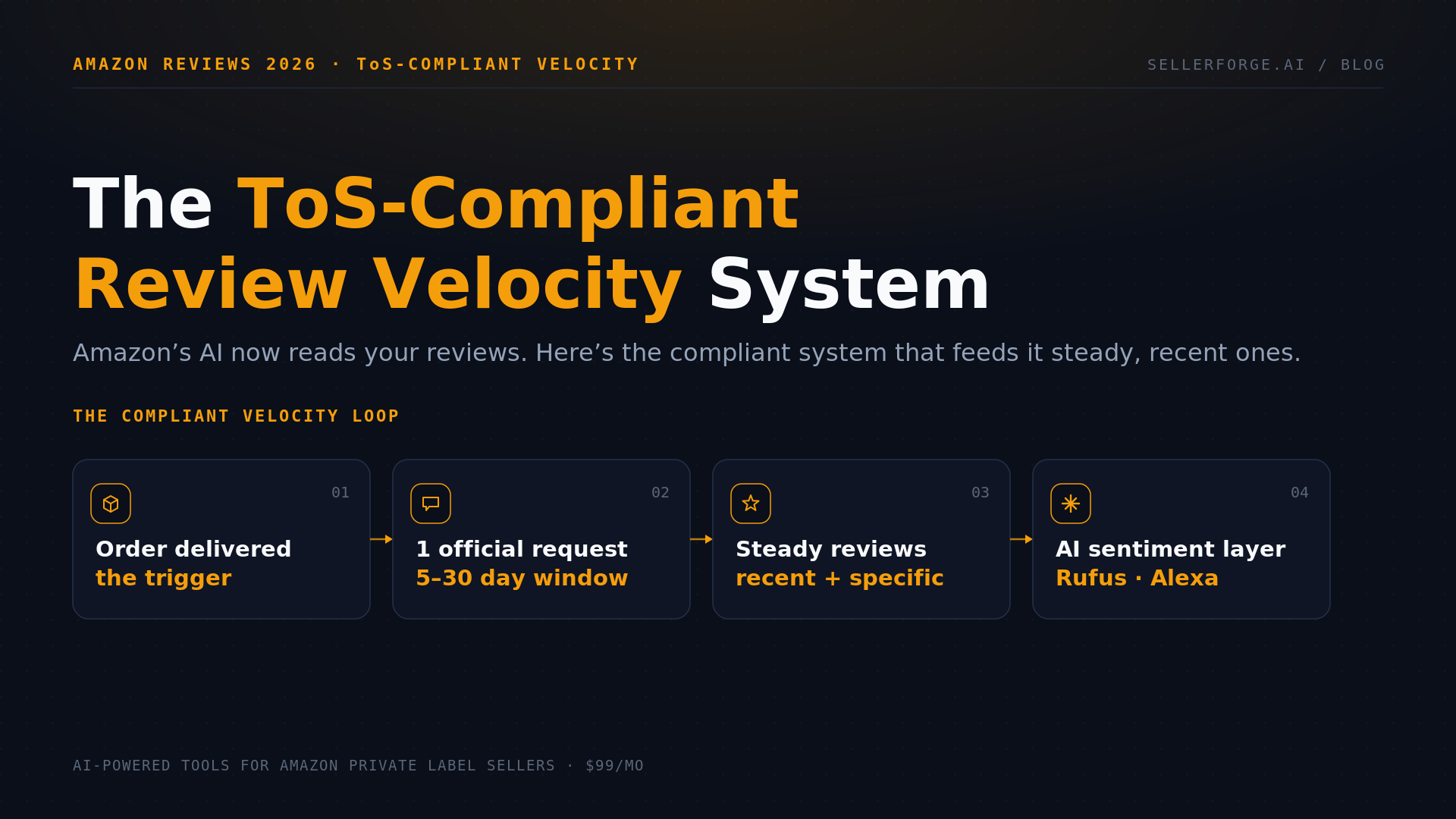
Amazon sanctions exactly one way to prompt a review: the official Request a Review action, automatable at scale through the Solicitations API, inside the 5-to-30-day post-delivery window, one per order. In the Rufus and Alexa-for-Shopping era, the AI summarizes reviews and weights recent sentiment — so a steady, well-timed velocity system beats both manual button-clicking and the incentive-based shortcuts that now freeze accounts. Time the ask, keep the flow steady, and use Vine deliberately for launches.
Reviews used to be a numbers game with one rule: get more of them, keep the average above four stars, and try not to get suspended doing it. That game is over. In 2026, your reviews are not just social proof sitting on the page — they are training data for the AI that decides whether your product gets recommended at all.
Since Amazon's shopping assistant (Rufus, renamed Alexa for Shopping in the US on May 13, 2026) moved to the center of discovery, the system actively reads, summarizes, and weights the sentiment in your reviews. A shopper no longer scrolls 400 reviews; they ask “what do buyers say about the battery life?” and the AI answers from your review corpus — leaning on the most recent sentiment. More than 250 million shoppers have now used the assistant, interactions are up over 210% year over year, and shoppers who use it convert at roughly 60% higher rates than keyword searchers. The reviews feeding it are no longer optional infrastructure.
That changes what “review velocity” means. It's no longer about a one-time burst to clear a threshold. It's about a steady, compliant flow of recent, specific reviews — generated through the one mechanism Amazon sanctions, at the moments most likely to produce an honest, detailed response. This is the operator's system for doing exactly that, and the traps that get accounts frozen along the way.
Why Velocity Matters More in the AI Era Than the Star-Rating Era
In the star-rating era, the math was simple and slow-moving: a product with 2,000 reviews at 4.6 stars could absorb a bad week without flinching. The average was a heavy flywheel. One more five-star review barely moved it, and one more one-star review barely dented it.
The AI layer broke that comfort. Alexa for Shopping doesn't average your reviews — it interprets them, and it weights recent sentiment heavily because recency is the best signal of what your product is like right now. The practical consequence is uncomfortable: a cluster of five to seven negative reviews in a short window can hurt your AI recommendations more than it hurts your star average. Your rating can still read 4.6 while the assistant quietly starts telling shoppers your latest batch “runs small” or “arrived damaged.”
Flip that around and you have the strategy. A continuous stream of recent, positive, specific reviews keeps the AI's summary of your product anchored to your best current state. Specificity matters as much as volume now: a review that says “fit my 10-gallon tank perfectly and the suction held for three weeks” gives the AI concrete sentiment to surface; “love it, five stars” gives it almost nothing. Velocity, recency, and detail are the three levers — and the timing of your request controls all three.
The 2026 mental model: you're not collecting reviews to raise a star average, you're feeding a recommendation engine that reads sentiment and weights what's recent. Steady and specific beats big and stale.
The One Engine Amazon Sanctions: Request a Review and the Solicitations API
Here's the part that cuts through years of gray-area folklore. Amazon provides exactly one built-in, fully compliant mechanism for prompting a customer to leave a review: the official Request a Review action in Seller Central. Everything else — custom “please review us” emails, package inserts that ask for five stars, follow-up nudges — lives somewhere between discouraged and bannable.
The button itself has a problem at scale: it only appears on an individual order's detail page, so using it by hand means navigating to every single order and clicking through one at a time. For a seller doing dozens or hundreds of orders a day, that's not a system — it's a part-time job nobody does consistently.
That's what the Solicitations API solves. It's Amazon's own Selling Partner API endpoint, and it fires the exact same official request — a single template-based message that asks the buyer for both a product review and seller feedback at once. Because it's Amazon's API triggering Amazon's standardized message, approved tools that use it are fully ToS-compliant. You are not sending your own copy; you're asking Amazon to send its copy, at scale, automatically.
The guardrails are baked in, and understanding them is the whole compliance story:
- One request per order. There are no compliant follow-ups or second asks — the system enforces a single solicitation per order and blocks repeats.
- A fixed 5-to-30-day window after delivery. Requests sent before day 5 or after day 30 are simply not permitted.
- No customization. You cannot edit the wording, add a coupon, ask only for positive reviews, or insert your own call to action. That non-negotiable template is precisely why the channel is safe.
- It requests both a product review and seller feedback in the same message, so you’re building both signals at once.
The takeaway: the compliant path and the scalable path are the same path. You don't have to choose between safe and efficient. You automate Amazon's own action and stay inside its own rails.
| Method | Compliant? | How it works | Best for |
|---|---|---|---|
| Request a Review button (manual) | Yes | Amazon's standard message, clicked order-by-order on each order page | Very low order volume; spot use |
| Solicitations API (automated tool) | Yes | Same official message, triggered automatically at the right time, one per order | Any seller past a handful of orders a day |
| Custom buyer-seller emails asking for reviews | Risky | Your own copy via Buyer-Seller Messaging — easy to cross the line into manipulation | Generally not worth the risk for reviews |
| Incentives, inserts for stars, review swaps | No — bannable | Offering discounts/gifts, package inserts asking for 5 stars, exchange schemes | Nothing — fastest path to suspension |
Timing Is the Lever You Actually Control
Since you can't change the message, timing is the one variable you genuinely own — and it's a strong one. Ask too early and the buyer hasn't used the product; you get a thin review or none. Ask too late and the moment's passed. The right moment is when the buyer has formed a real opinion but still has the product top of mind.
That moment depends on what you sell. The eligible window is 5 to 30 days after delivery; here's how to use it:
- 1Consumables and simple items (cables, phone cases, kitchen basics): 5-10 days. The buyer knows within a week whether it works.
- 2Most physical goods: 7-14 days. Enough use to judge quality and durability, soon enough to remember the unboxing.
- 3Products that take time to evaluate (supplements, skincare, sports and fitness equipment, electronics): 14-25 days. A skincare buyer can’t honestly review week-one results; a supplement needs a real trial. Asking at day 7 invites a shrug or a premature one-star.
There's a second timing principle that the AI era makes important: keep the flow steady. If you batch-fire 300 requests the day a shipment clears and then go quiet for two weeks, you get a spiky review pattern — a burst of reviews, then nothing. Spread requests so your reviews arrive as a continuous trickle. Steady recency is exactly what the sentiment-weighting AI rewards, and a smooth, natural cadence is also what Amazon's manipulation detection expects to see. Lumpy, unnatural spikes are the opposite of what you want on both counts.
This is also where reviews connect to the rest of your discovery strategy. The same AI that summarizes your reviews reads your listing copy and images for intent — so a review that confirms a claim you make in your bullets is doubly powerful. For how that AI actually parses your listing, see Answer Engine Optimization for Amazon, and for the strategic shift behind the assistant itself, Amazon Replaces Rufus With Alexa for Shopping.
Vine in 2026: The Controlled Exception — With New Math
The Solicitations API only works on orders you've already made, which is the new-product chicken-and-egg problem: no reviews, less conversion, fewer orders, still no reviews. Amazon Vine is the sanctioned way to break it. Vine is the one place incentivized reviews are allowed, because Amazon — not the seller — controls which reviewers receive products and what they say.
The 2026 mechanics worth knowing before you enroll:
- Enrollment is tiered by units: $0 for up to 2 units, $75 for 3–10, and $200 for 11–30 units per parent ASIN. You’re not charged until your first Vine review publishes; if no Vine review posts within 90 days, the fee is waived.
- Eligibility: a Professional seller account, enrollment in Brand Registry (Brand Representative or Reseller role), FBA fulfillment, a parent ASIN with fewer than 30 reviews, and new-condition product.
- Reviews post with a green “Vine Voice” badge, so shoppers know how they were sourced.
The big change — and the one that quietly broke a lot of launch playbooks — took effect February 12, 2026. Before that date, brand owners with multi-variation listings could enroll a single cheap variation and let its Vine reviews aggregate up to the parent, lighting up the whole family. No longer. Variations with functional differences now each stand on their own review count; only minor, non-functional variations share reviews. You have to choose the variation you enroll deliberately, not by lowest cost.
Honest guidance: Vine pays when you have a genuinely good product that simply lacks reviews — a launch, a relaunch, a new variation that now needs its own reviews under the 2026 rules. It burns you when you use it to prop up a product with real problems, because Vine reviewers are candid and their criticism is public and badged. Use it to accelerate trust you've earned, not to manufacture trust you haven't.
Quick gut-check before enrolling in Vine: would you be happy if 30 unusually thorough, brutally honest reviewers published their real opinion of this exact unit? If yes, enroll. If you flinch, fix the product first.
The Compliance Traps That Freeze Accounts
Review manipulation is among the fastest routes to a full account suspension — not a listing warning, but frozen funds, locked inventory, and reinstatement timelines that stretch into weeks or months. And enforcement got sharper: Amazon's AI now flags discrepancies between star ratings and written sentiment, the FTC's 2024 rule independently bans fake and incentivized-without-disclosure reviews, and in 2026 the crackdown expanded to influencer product testimonials. The shortcuts aren't just risky on Amazon anymore; they're legal exposure.
The prohibited list every operator should have memorized:
- Reviews from yourself, employees, family members, or anyone with a financial interest in the product.
- Offering discounts, refunds, free products, or gift cards in exchange for a review — incentivized reviews have been banned since October 2016, with Vine the sole exception.
- Package inserts or messages that ask specifically for a five-star or positive review (asking for honest feedback is fine; steering the rating is not).
- Review-exchange or review-swap schemes between sellers, and any third-party service that generates reviews.
- Posting fake negative reviews on a competitor’s listing.
- Asking a customer to change or remove a review in exchange for anything.
- Misusing ASIN variations to artificially pool reviews across unrelated products.
Buyer-Seller Messaging has its own tripwires. Amazon prohibits manipulative requests — asking only for positive feedback, offering incentives — and treats over-messaging as spam. Every extra “just checking in” email raises your risk without raising your review count. The discipline is the same as the velocity strategy: use the one sanctioned request, time it well, and stop.
If a manipulation flag or a buyer-messaging violation does land on your account, speed and structure matter more than anything. A focused, evidence-backed response in the first hours is the difference between a quick reinstatement and a months-long limbo — the playbook is in Amazon Account Deactivated Under Section 3.
Handling Negative and Fake Reviews the Right Way
Because the AI weights recent sentiment, a negative cluster is now an operational fire, not a cosmetic one. You can't pay to remove reviews, and you shouldn't try — but you do have legitimate moves.
First, separate genuine negatives from policy-violating ones. A real buyer who's unhappy is telling you something: triage the root cause fast — a quality slip, a sizing problem, a listing claim your product doesn't quite meet — because the next 50 buyers will say the same thing and the AI will summarize it. Policy-violating reviews are different: profanity, content about shipping rather than the product, a competitor's transparently fake one-star, or anything breaking the Community Guidelines can be reported through the Report option and escalated via Seller Support or Brand Registry. Document the specific guideline it breaks; vague reports get auto-denied.
The strategic point: you can't litigate your way to a clean review profile, but you can out-produce a bad week. Steady compliant velocity means a handful of negatives gets diluted by a continuous flow of recent positives — which is exactly the state you want the AI summarizing.
Building the System: A Weekly Review-Velocity Cadence
Put the pieces together and review velocity stops being a sporadic chore and becomes a quiet, weekly operating rhythm that runs mostly on autopilot:
- 1Automate the request. Send Amazon’s official solicitation through the Solicitations API on every eligible order, timed to your product’s evaluation window — not in a daily batch dump, but spread for steady arrival.
- 2Monitor velocity and sentiment weekly. Track not just new-review count but the sentiment trend and the specific themes the AI would summarize. A dip or a new recurring complaint is an early-warning signal.
- 3Triage negatives within 24-48 hours. Fix root causes on genuine ones; report and escalate policy-violating ones with documentation.
- 4Correlate dips with events. When velocity or sentiment drops, line it up against what changed — a new shipment, a price move, a stockout, a listing edit. The cause is usually in the timeline.
- 5Enroll launches in Vine deliberately. New products and — under the 2026 rules — new functional variations get their own Vine enrollment to seed the first reviews; established winners run on the API.
Where SellerForge Fits
This is a system you can run by hand, but the hand-running is exactly where it breaks down — nobody clicks Request a Review on 300 orders at the right interval every day, and nobody manually charts sentiment trends. SellerForge automates the compliant version of all of it.
Compliant requests, sent at the right moment. The Feedback Requests feature triggers Amazon’s own official review-and-feedback solicitation through the Solicitations API — one per order, inside the window, timed to your product type — so you get steady, ToS-safe velocity without touching a single order page.
See your review and sentiment gaps. The Listing Audit scores your live listings — including where review depth and sentiment are thin against the claims your listing makes — so you know which ASINs need velocity attention before the AI does.
Trace a sentiment dip to its cause. The Business Event Timeline overlays your shipments, price changes, stockouts, and listing edits, so a drop in review velocity or a new complaint theme lines up against what actually changed.
If a flag hits, respond fast. Should a review-manipulation or buyer-messaging warning ever land, the POA Builder and Escalation Plans help you assemble an evidence-backed response and escalation path instead of improvising under pressure.
Ask in context. The built-in AI Assistant knows your catalog, so “which of my ASINs has the slowest review velocity this month?” is a question you can actually answer. This is the recurring theme — generic tools give generic advice; tools that know your account give you the next action. For the full argument, see Why Generic AI Tools Are Failing Amazon Sellers.
The Bottom Line
Reviews stopped being a scoreboard the moment Amazon's AI started reading them out loud to shoppers. The number on your listing matters less than the sentiment the assistant summarizes — and that sentiment rewards recency, specificity, and a steady flow.
The good news is that the compliant path and the effective path are now the same path. Automate Amazon's one sanctioned request, time it to when buyers actually have something to say, keep the cadence steady, seed launches with Vine on purpose, and never reach for the incentives that turn a review strategy into a suspension. Do that, and you're not gaming the system — you're feeding it exactly what it's built to surface.
Want steady, compliant review velocity running on autopilot? Start a free SellerForge trial and set up Feedback Requests across your catalog — Amazon’s own official request, sent at the right time, one per order, no clicking required.
About the author
David Gallo is the founder of SellerForge.ai. He previously managed 57 Amazon accounts representing over $350M in sales at Worldfront before building SellerForge to give sellers AI-powered tools at agency quality without the agency price.