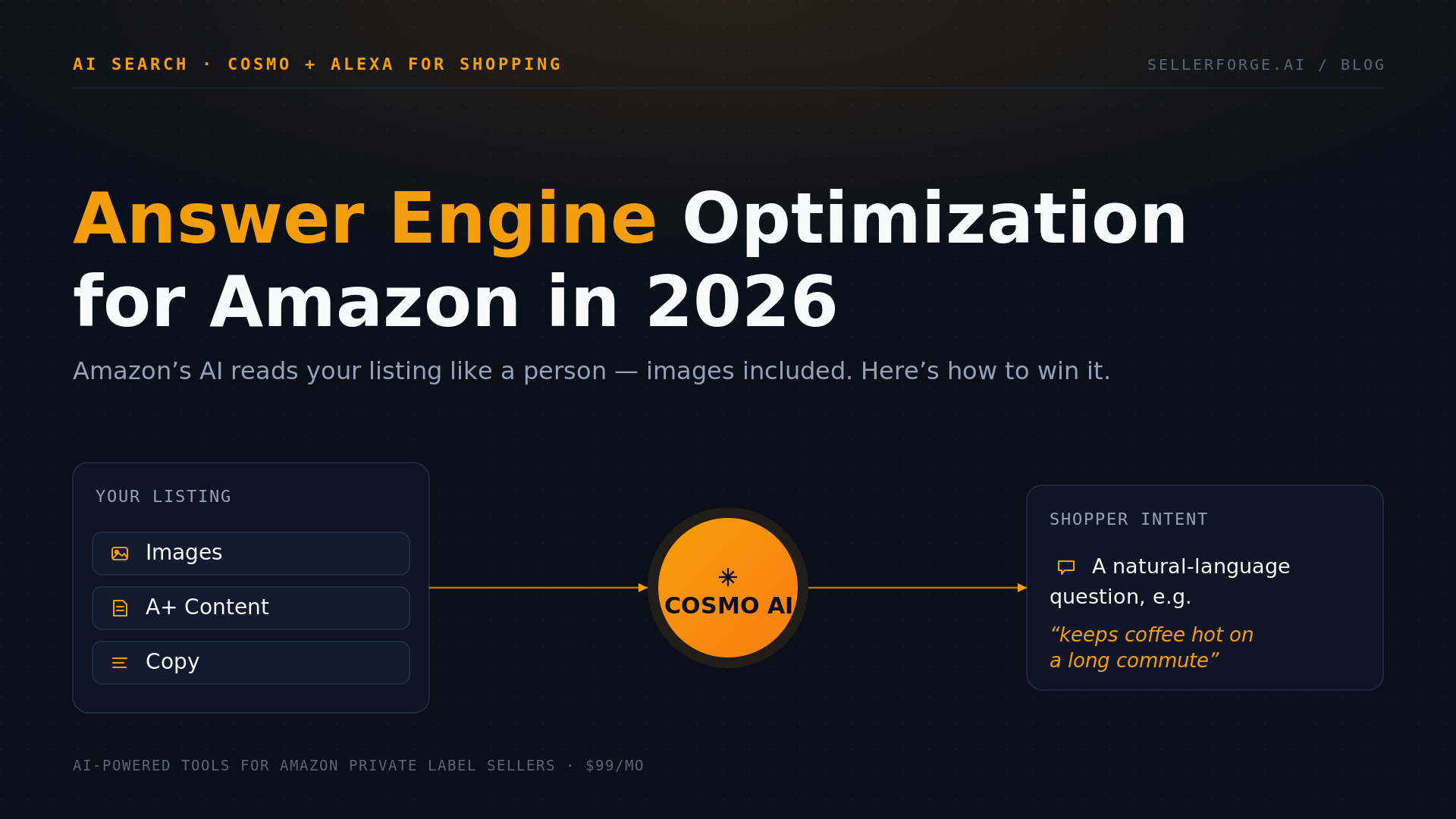
Amazon Answer Engine Optimization means structuring a listing so COSMO and Alexa for Shopping can classify what your product is, who it is for, and what it solves — then name it as the answer. The 2026 correction: COSMO does not index A+ body text, and Amazon removed the seller-written A+ alt-text field. The real levers are the structured backend attributes, a 75-character title, and images a vision model can describe.
Amazon Answer Engine Optimization is the practice of structuring a listing so Amazon's AI — the COSMO knowledge graph and the Alexa for Shopping assistant sitting on top of it — can classify what your product is, who it is for, and what problem it solves, and then name it as the answer to a shopper's question. In 2026 the winning move is not more keywords. It is filling the structured fields COSMO actually reads, shooting images a vision model can describe, and letting A+ Content do the one job it verifiably does.
I want to be direct about something, because I wrote the earlier version of this article and part of it was wrong. The common advice — including mine — was to write 500-plus words of A+ copy and descriptive alt text on every A+ image so the algorithm could 'read' them. The evidence that has surfaced since says A+ body text is not indexed, and Amazon has quietly taken the alt-text field away from sellers entirely. Both changes point the same direction, and it is not the direction most AEO guides are still pointing.
What Does COSMO Actually Do?
COSMO is a commonsense knowledge graph, not a text crawler. Amazon's own SIGMOD 2024 paper describes a production system of 6.3 million nodes and 29 million knowledge edges spanning 18 product categories, built not from listing copy but from shopper behavior: search-buy pairs and co-buy pairs sampled from session logs, with an LLM hypothesizing why each purchase happened and human annotators filtering the hypotheses.
Amazon's published example is instructive. A 'winter coat' query led to a puffer-coat purchase because the product 'is capable of providing high-level warmth.' That inferred relationship — not the words in the listing — becomes an edge in the graph. When a shopper later asks a conversational question, the edges COSMO already stored decide which handful of products answer it.
This is production infrastructure, not a lab experiment. Amazon reports that deploying COSMO across roughly 10% of US search traffic produced a 0.7% lift in product sales and an 8% lift in navigation engagement. At Amazon's volume, 0.7% is a very large number.
The mechanism is documented in Amazon's own research write-up on building commonsense knowledge graphs to aid product recommendation — worth reading directly rather than through a vendor summary, because the paper is explicit that the graph is constructed from behavior.
The assistant layer on top of it is now enormous. Amazon reported in February 2026 that Rufus had reached 300 million customers and driven nearly $12 billion in incremental annualized sales during 2025, and on its Q3 2025 earnings call said shoppers who engaged with it completed purchases at a 60% higher rate. On May 13, 2026, Amazon retired the Rufus brand and folded it into Alexa for Shopping. Research from Workflow Labs, published April 17, 2026, found the assistant handled 38% of all Amazon sessions during Black Friday 2025 — and compresses the effective consideration set from roughly 50 results to about five.
The mental model for 2026: you are not writing for a scanner and you are not writing for one AI. You are feeding three different systems that read three different things — an index, a vision model, and a behavioral graph. Most AEO advice fails because it applies the tactics of one to all three.
The Read-Watch-Train Sort
Every surface on your detail page does exactly one of three jobs for Amazon's AI. Sort them correctly and the optimization work becomes obvious; sort them wrong and you spend months polishing surfaces nothing reads. I call it the Read-Watch-Train Sort, and it is the single change that would have saved me the most wasted hours across the accounts I have managed.
| Job | Surfaces | What Amazon does with it | Optimize for |
|---|---|---|---|
| READ | Title (75 char), Item Highlights (125 char), bullets, backend search terms, backend product description, discovery attributes | Parsed as text and structured taxonomy; feeds A9 indexing and COSMO classification | Coverage and completeness — every field filled with specific, accurate values |
| WATCH | Main image, lifestyle images, infographics, video | Interpreted by computer-vision models; overlay text is read by OCR; Amazon now auto-generates the descriptions | Unambiguous clarity — the picture must state the use case without a caption |
| TRAIN | A+ Content, Premium A+, Brand Story, reviews, Q&A | Not confirmed to be indexed; produces the conversions that become COSMO graph edges | Conversion on the right query — persuade the shopper who asked the question you want to own |
The rule that falls out of it: keyword work belongs only in READ. Clarity belongs in WATCH. Persuasion belongs in TRAIN. Stuffing keywords into a TRAIN surface does nothing, and — worse — persuading the wrong shopper on a TRAIN surface actively teaches COSMO an intent your product does not serve.
That last failure mode is the one nobody warns you about. If your A+ banner is positioned for outdoor use and your product is really a home unit, the outdoor-query conversions it closes become search-buy pairs that train the graph toward an intent you will disappoint. The returns and negative reviews that follow are additional negative signals on the same ASIN. Decorative or mispositioned A+ does not merely fail to help — it can train the graph incorrectly.
READ: Structured Attributes Are the Real Ranking Lever
The highest-leverage AEO work in 2026 is unglamorous data entry. Backend discovery attributes — Subject Matter, Target Audience, Intended Use, Occasion, plus the category-specific fields — feed COSMO directly, and because they are structured taxonomy values rather than free text, the system treats them as more reliable than the same claim made in a bullet point. A bullet asserts; an attribute declares.
The gap here is enormous and almost entirely unexploited. Workflow Labs' April 2026 catalog audits found more than half of brands had wrong or missing structured content across their portfolios, and that products with 90%-plus field completion showed two to three times better assistant visibility than sparse profiles. A brand with beautiful copy and empty backend fields is functionally invisible to Alexa for Shopping.
Two other READ surfaces changed shape this year and most listings have not caught up:
| Change | Effective | What it means for AEO |
|---|---|---|
| Titles capped at 75 characters, all categories except media | July 27, 2026 (announced June 10) | Keyword-stacked titles are dead. Use the 75 characters for brand, product type, and the single dominant differentiator. |
| New Item Highlights attribute, up to 125 characters | July 27, 2026 | Searchable and shown beside the title. This is where materials, compatibility, and use cases go — a new indexed surface most sellers have left empty. |
| AI rewrites of over-cap titles | Rolling since July 27, 2026 | Brand Registry sellers get a 14-day window in Review Listing Changes; unregistered sellers get none and the change is simply applied. |
| Seller-written A+ alt text removed, AI-generated instead | Phased from 2025; full in Europe, expanding through 2026 | A keyword surface sellers controlled is gone. Image clarity replaces image metadata. |
There is also a field almost everyone abandons. When A+ Content goes live it visually replaces the plain-text product description, but the description field still exists in the backend and practitioner consensus is that A9 keeps indexing it. Brands publish A+, stop maintaining the description, and end up with an empty slot in the one indexed description field they still fully control. PPC Land's breakdown of the A+ indexing question walks through the evidence.
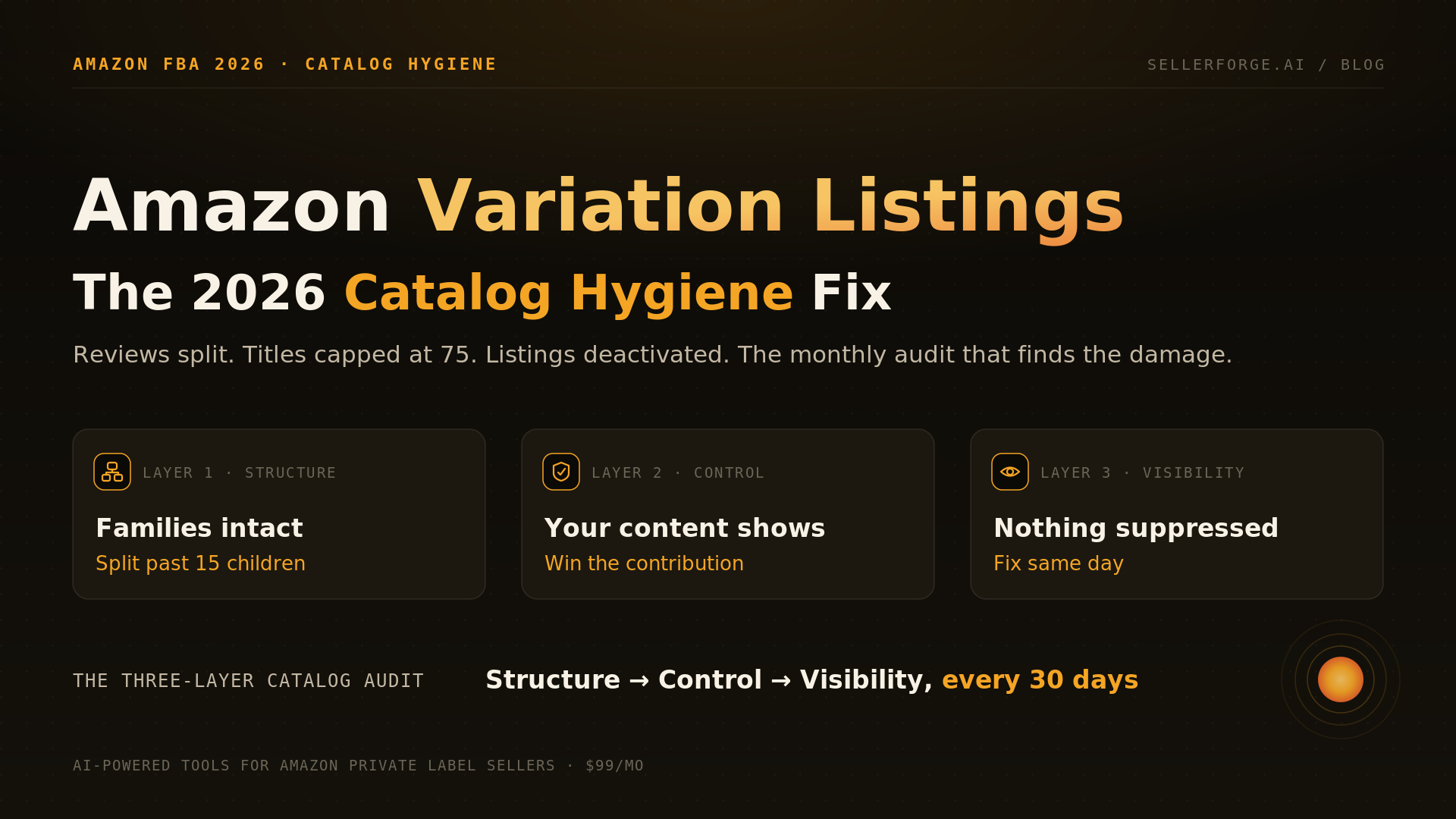
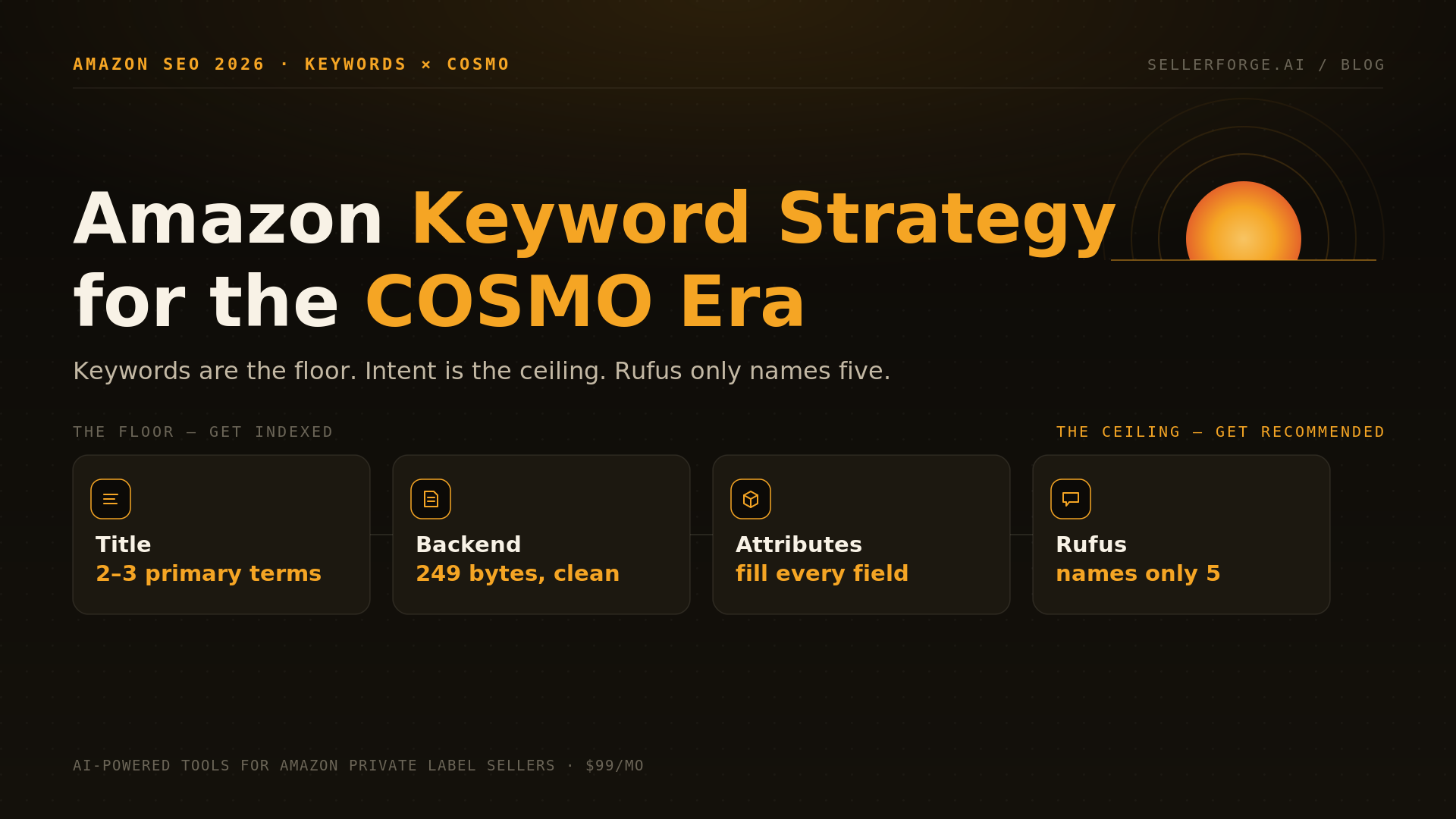
Attribute work only pays if the page underneath it is structurally sound. A fragmented variation family splits your intent signals across competing sibling pages, so COSMO sees five weak candidates instead of one strong one — the fix lives in our catalog hygiene playbook for variation listings. And the keyword half of the READ layer, including the 249-byte backend search-term field and indexing verification, has its own operating model in the Amazon keyword strategy playbook for the COSMO era.
WATCH: The Image Is the Metadata Now
Amazon's assistant is multimodal and uses Amazon's own computer-vision models to interpret product imagery — what the product looks like, who uses it, in what context. It does not need your alt text to do that, which is precisely why Amazon took the field away. The optimization lever moved from metadata to the picture itself.
A product-on-white hero tells a vision model what the object looks like. It says nothing about what the object is for, who buys it, or what problem it solves. The listings that win under COSMO answer those questions visually:
- Build the main image so the use case is legible — real environment, a clear scale reference, and a visual cue for the target buyer — so the model can classify both what it is and who it is for.
- Replace decorative icon infographics with specificity-heavy ones: real measurements, named buyer types, the exact surfaces or situations the product is used on. Overlay text is OCR-readable, so a short benefit line like "removes pet hair from car seats" guides the vision model, the shopper, and Google's crawl at once.
- Shoot lifestyle images that show a person using the product. A scene answers who, where, and doing what in one frame — three relationship types the graph is explicitly built to store.
- Make every image reinforce the same claim your text makes. If Item Highlights says it fits standard car cup holders, show it in a cup holder.
- Give each variant its own imagery. Reusing one generic shot across variants asks the model to distinguish products you have made identical.
One honest caveat: outside A+ Content, descriptive alt text still has value for accessibility compliance and for Google's crawl of your detail page, which drives external traffic Amazon rewards. Write it where you still can. Just do not expect it to carry ranking weight on its own anymore.
TRAIN: A+ Content Is Not Indexed, and That Is the Point
A+ Content is still one of the most valuable surfaces on your page — Amazon's own materials put Basic A+ at up to an 8% sales lift and Premium A+ at up to 20%. What changed is why it matters. It is not feeding a crawler; it is manufacturing the conversions that write COSMO's edges. Every sale it closes on a specific query is a training signal for which product answers that query.
That reframing has practical consequences. Build modules against intents rather than against a word count:
- 1Pick the three to five buying questions you most want to own, in the shopper's phrasing, not your category's jargon.
- 2Assign each question a module. Lifestyle imagery and video carry use-context ("used for", "used in", "used on"). Comparison charts carry identity and substitution — build them against named alternatives with the buyer each one fits, not against your own variants.
- 3Use Brand Story for audience fit: who the brand is for and why, stated plainly enough that a model could quote it.
- 4Delete anything that converts a shopper you cannot satisfy. A mismatched conversion is worse than no conversion.
- 5Keep the backend product description field current even after A+ publishes over it.
Premium A+ is worth chasing because it unlocks the Q&A module and richer comparison formats — the two highest-density structured surfaces per slot. The eligibility gate has a terminology trap: Amazon counts approved A+ project submissions, not design modules, and the current threshold is five in the trailing 12 months, not the 15 that older guides still cite.
Both A+ tiers and Brand Story require Brand Registry, which is worth having for a dozen other reasons — the enforcement side is covered in the Brand Registry playbook for stopping hijackers. Reviews and Q&A sit in the same TRAIN bucket: recent reviews that use the same intent language as your listing are among the strongest confirmation signals an assistant can find, which is why a compliant, steady review velocity routine is an AEO investment and not just a social-proof one.
How Do You Run the Sort on a Real Listing?
Here is the repeatable pass. It takes about 45 minutes per ASIN the first time and maybe 15 on subsequent rounds, and it inverts the old keyword-first workflow: you start from the questions and work back into surfaces.
- 1Write down ten questions. What is the shopper actually trying to accomplish? "Will this fit a 10-gallon tank?" "Is this safe for a newborn?" "Does it work on tile?" Pull the phrasing from your own reviews, Q&A, and returns reasons — that is free intent data most sellers never mine.
- 2Audit your READ surfaces against those ten. Open Edit Product Info and count how many attribute fields are populated. Target 90% or better. Fill Subject Matter, Target Audience, Intended Use, and Occasion with specific taxonomy values, not vague ones.
- 3Rebuild the title for 75 characters and move the overflow into Item Highlights. Lead with brand, product type, and the one differentiator that decides the purchase.
- 4Restore the backend product description if A+ has been live and you stopped maintaining it.
- 5Audit your WATCH surfaces. For each of the ten questions, ask whether any single image answers it without a caption. If not, that is a shot brief.
- 6Audit your TRAIN surfaces. Map each A+ module to one intent. Cut or rewrite anything that converts a shopper you cannot satisfy.
- 7Wait 7 to 14 days, then test. Ask Alexa for Shopping the exact natural-language question you targeted and see whether you appear in the five products it shortlists. Re-run monthly.
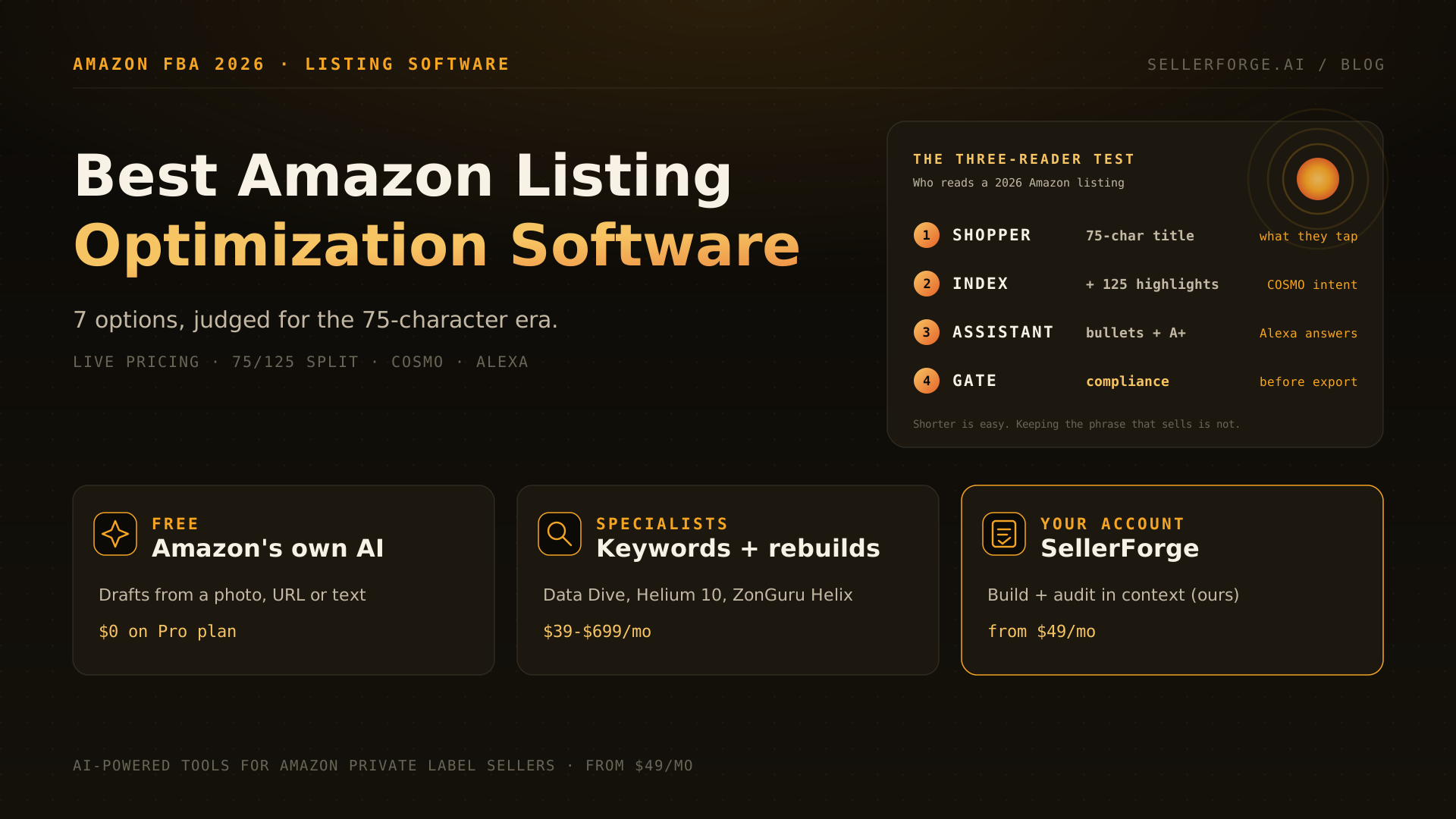
Step one gets much faster if you mine competitor pages instead of guessing — the AI competitor teardown workflow is how I pull intent language and gaps from the ASINs already winning the shortlist. For the full pre-flight on any listing, including the fields this article does not cover, use the Amazon listing audit checklist. And if you want the drafting half — prompts, compliance traps, and where generic chatbots still get Amazon listings wrong — see how to use AI to build and optimize Amazon listings.
Benchmark worth knowing: ZonGuru scored more than 5,000 live listings on AI readiness and found a median of 65 out of 100 — with semantic mapping at a median of 70 but assistant Q&A coverage at just 54. The gap between those two numbers is the opportunity. Most listings are half-built for the way discovery now works.
Where This Meets Your Ad Spend
The organic and paid sides of this converged in 2026. Sponsored Products and Sponsored Brands prompts — ad placements inside Alexa for Shopping conversations — moved from beta to general availability in the US on March 25, 2026, and active Sponsored Products campaigns are auto-eligible with no separate opt-in. Amazon reports that 20% of shoppers who interact with a conversational prompt continue the conversation, and that adding prompts produced a 6% increase in conversions.
The practical consequence: your listing quality now decides both whether COSMO recommends you organically and how well your ads perform inside the same conversation, because the assistant is drawing on the same product understanding either way. Amazon's own announcement of Alexa agentic ads spells out the formats. AEO work is one of the few investments that improves organic discovery and ad efficiency at the same time.
Where Generic AI Falls Short — and Where SellerForge Fits
Ask a general chatbot to write a COSMO-optimized listing and it will produce something that passes a best-practices checklist — and, in my testing, will still tell you to write 500 words of A+ for indexing and stuff your alt text, because that is what most of the training data says. It does not know your category's intent landscape, your competitors' positioning, or which of your attribute fields are empty. Category awareness is the whole game here.
Listings built for the surfaces that count. The SellerForge Listing Builder generates a 75-character title plus Item Highlights, bullets, backend search terms, discovery-attribute values, and a 7-slot image brief built for COSMO intent coverage and Alexa Q&A patterns. The image briefs tell you or your photographer exactly what each shot has to prove visually.
Scoring what you already have. The Listing Audit grades live listings on attribute completeness, title-cap compliance, image coverage, and semantic gaps, with specific rewrites — so you can see where your intent coverage is thin before the assistant does. Need the visual plan in a shareable format for a designer or agency? The Deliverable Builder exports it cleanly.
Ask in context. The built-in AI assistant sits on every page and knows your catalog, so "which of my ASINs have the least complete backend attributes?" is a question you can actually answer rather than a generic lecture. This is the same theme we keep coming back to: generic AI is a powerful starting point and a blind one — the full argument is in why generic AI tools are failing Amazon sellers.
The Bottom Line
Amazon's discovery layer reads a listing the way a careful human would, looks at your images the way a vision model does, and learns what you are for from what people buy after asking. Those are three different jobs and they need three different kinds of work. Sort your surfaces before you optimize them.
If you do one thing this week, open Edit Product Info on your top ten ASINs and count the empty attribute fields. More than half of brands are leaving that lever untouched, and it is the cheapest visibility you will find all year.
Want the sort run for you? Start a free SellerForge trial, connect your account, and put a few ASINs through the Listing Builder and Audit — the empty attributes and the over-cap titles show up in the first pass.
About the author
David Gallo is the founder of SellerForge.ai. He previously managed 57 Amazon accounts representing over $350M in sales at Worldfront before building SellerForge to give sellers AI-powered tools at agency quality without the agency price.