The right Sponsored Brands strategy for private label in 2026 is defense-first: keep Sponsored Products as your revenue engine (60–90% of spend), add Sponsored Brands only for branded-search defense and high-intent category conquest — with video, now ~58% of SB spend, doing the lifting — and add DSP last, once you clear roughly $1M in annual Amazon revenue or can fund $10K–15K/month. Amazon's managed DSP still requires $50K minimum; self-serve no longer has one. Query the now-free Amazon Marketing Cloud before spending a DSP dollar.
Every private-label ad account I audit has the same shape of waste in it. Sponsored Products quietly does the work. The shinier formats — Sponsored Brands banners, video, DSP — soak up the vendor pitches, the 'full-funnel' decks, and a disproportionate share of the wasted spend.
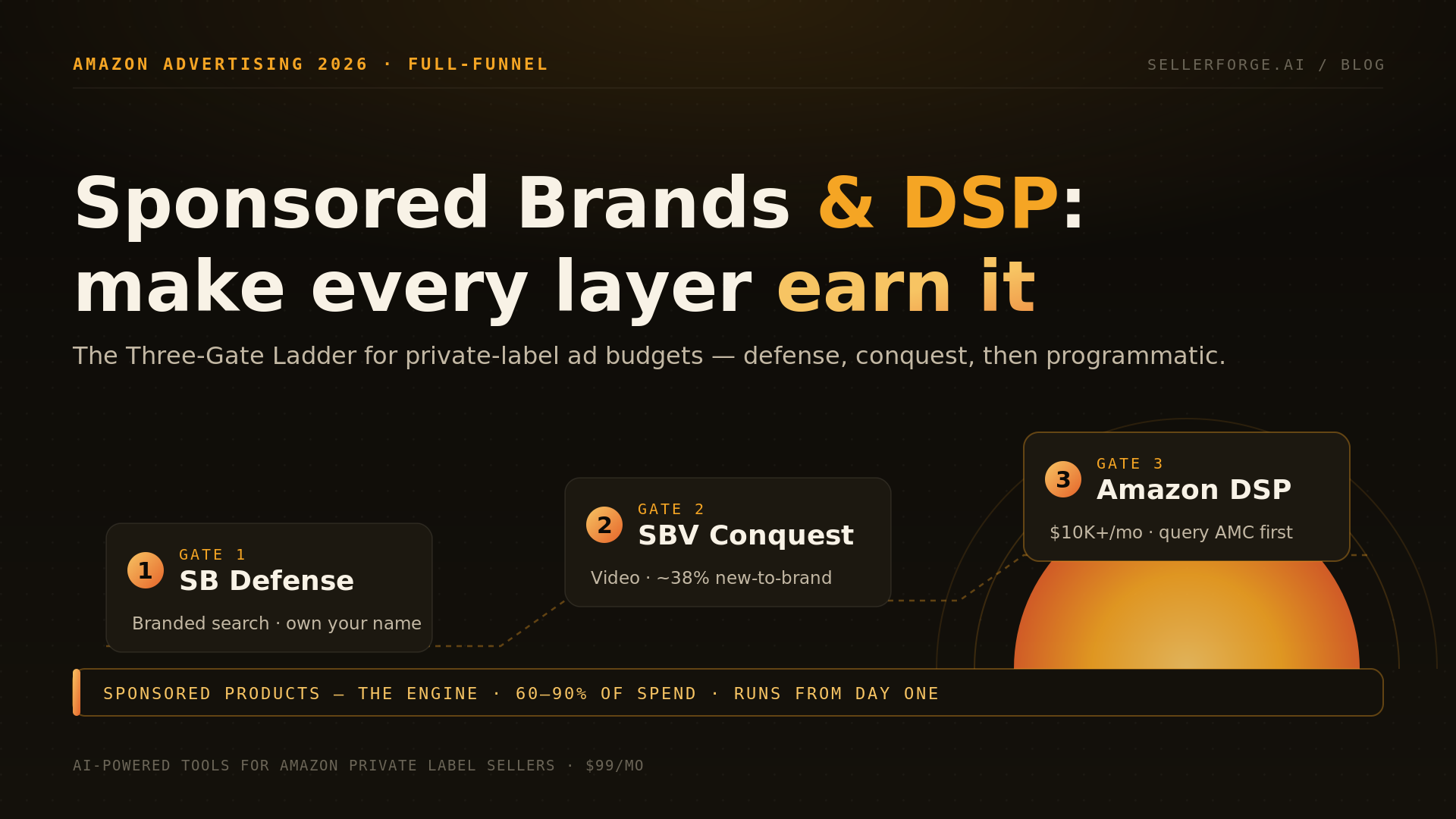
So here is the strategy in one paragraph. Sponsored Products stays your revenue engine — for most private-label brands that's 60–90% of spend. Sponsored Brands earns its slice for exactly two jobs: defending your branded search and conquesting high-intent category terms, with video doing most of the lifting. DSP comes last — a scale instrument you add once revenue and data depth justify it, not a growth hack you bolt on at $30K a month in sales.
The rest of this guide is the decision system I use to hold that line: the Three-Gate Ladder, the 2026 benchmarks that decide each gate, what each format actually costs now, and the honest cases where each one is a waste of money.
Where Sponsored Brands Fits in a Private-Label Strategy
Sponsored Brands in 2026 is a control layer, not an awareness play: it decides who owns the top of your branded search results and which brand gets the shelf on high-intent category terms. Fund it for those two jobs, after Sponsored Products is profitably covering your core keywords — not as a vague brand-building line item.
The 'awareness' framing fails private-label sellers because awareness is a budget you can't audit. Defense and conquest are. You can see exactly who is bidding on your brand name, exactly which category terms you want the brand shelf on, and exactly what each is returning — especially now that Amazon reports new-to-brand (NTB) metrics at the SKU level for Sponsored Brands, not just per campaign.
And the NTB story is real: across managed-account datasets in 2026, Sponsored Brands campaigns average roughly 38% new-to-brand purchase rates versus about 22% for Sponsored Products on comparable keywords. SB genuinely does reach buyers SP doesn't. The question is never whether the format works — it's whether it works before your SP foundation is set, and at what share of budget. That's what the gates below are for.
One more 2026 change worth knowing: Amazon's AI-powered Sponsored Brands product-collection format now features three to ten ASINs per ad and auto-optimizes which products appear in what order. Useful if you have a real catalog; another reason the format underperforms for single-ASIN brands.
Sponsored Products vs Sponsored Brands vs DSP: The Decision Table
The short version: Sponsored Products captures existing demand and belongs in every account from day one. Sponsored Brands shapes brand-level demand and earns budget once SP is profitable. DSP buys audiences programmatically — on and off Amazon — and earns budget only at scale. Here's the full comparison:
| Format | Job it does best | Typical CTR | Practical entry budget | When it earns budget |
|---|---|---|---|---|
| Sponsored Products | Capturing existing search demand; direct sales | 0.35–0.70% | Any | Day one |
| Sponsored Brands (static) | Branded-search defense; brand shelf on category terms | 0.20–0.40% | $10–20/day per campaign | Gate 1 |
| Sponsored Brands Video | Stopping the scroll on high-intent terms; new-to-brand growth | ~1.6× static SB | $15–30/day | Gate 2 |
| Sponsored Display | Retargeting detail-page visitors; competitor-page conquest | 0.10–0.30% | $5–15/day | Gate 2, opportunistic |
| Amazon DSP (self-serve) | Programmatic retargeting + streaming/off-Amazon reach | n/a (impression-buying) | $10K–15K/month effective | Gate 3 |
| Amazon DSP (managed) | Full-service programmatic with Amazon account team | n/a | $50K minimum spend | Gate 3, at scale |
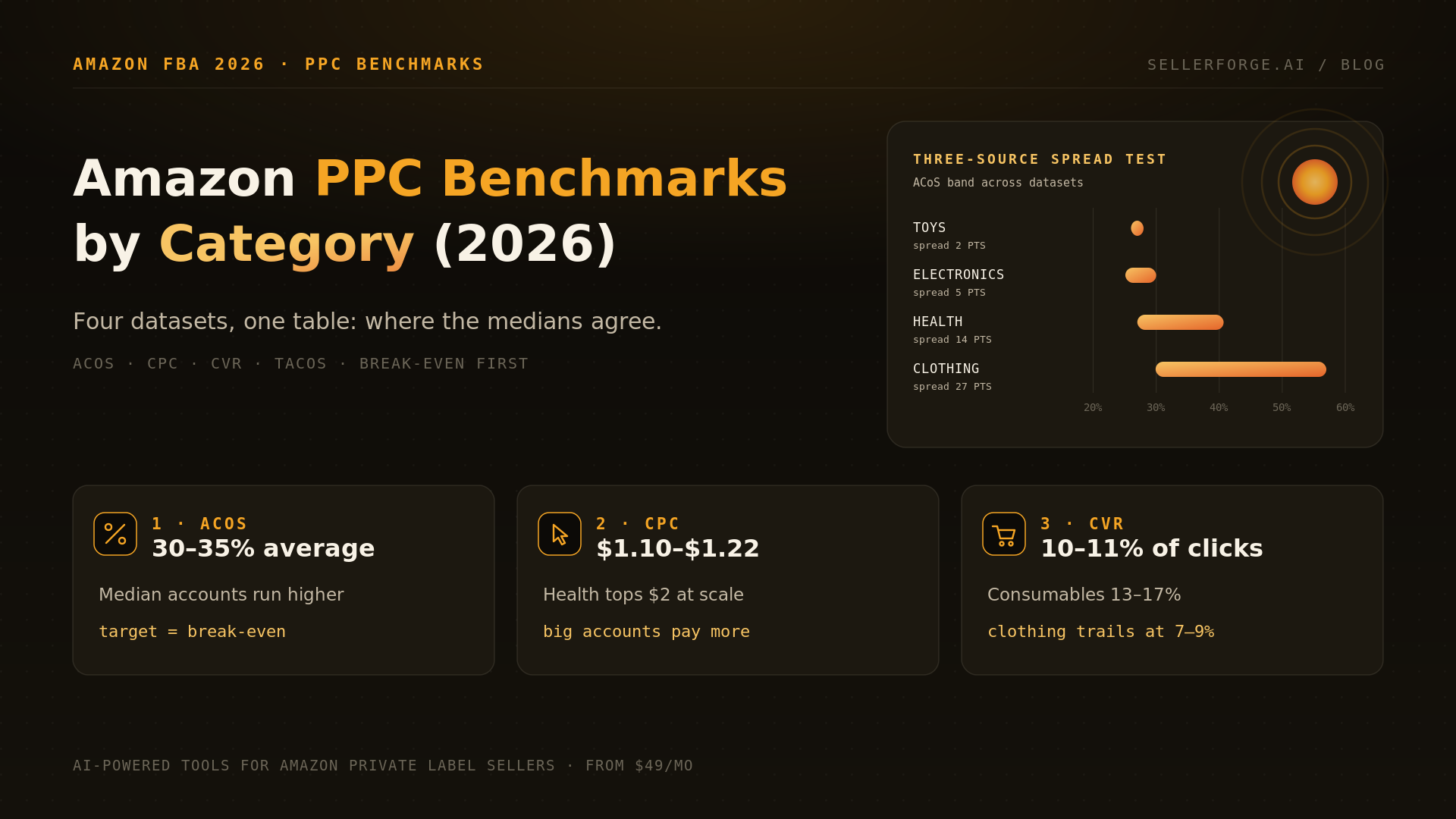
Benchmark context for those CTR ranges: the average Amazon ad account in 2026 runs about 0.56% CTR, $1.13 CPC, ~34% ACoS, and a ~10.5% conversion rate, per aggregated 2026 ad benchmarks. Judge each format against its own range, not the account average — a 0.30% Sponsored Brands CTR is healthy; a 0.30% Sponsored Products CTR is a relevance problem.
The Three-Gate Ladder: When Each Format Earns Budget
The Three-Gate Ladder is a simple budget-protection device: each ad layer must be unlocked by conditions the previous layer proved. You don't add the next format because you're curious or because an agency pitched it — you add it because the gate is objectively open.
- 1Gate 1 — unlock Sponsored Brands defense. Conditions: Sponsored Products is at or below break-even ACoS on your core keywords; organic rank on those terms is stable or climbing; measurable branded search volume exists (people actually type your brand name); and you have 3+ ASINs to fill the shelf format. Open the gate → run branded-defense SB and a small brand-shelf test on your top category term.
- 2Gate 2 — unlock video and conquest. Conditions: branded defense is holding top-of-search share at acceptable cost; you track new-to-brand rate and contribution margin per ASIN, so conquest has a real success metric; and you can produce (or generate) serviceable video creative. Open the gate → shift incremental SB budget to Sponsored Brands Video on high-intent category and competitor terms, plus opportunistic Sponsored Display retargeting.
- 3Gate 3 — unlock DSP. Conditions: roughly $1M+ in annual Amazon revenue, or $10K–15K/month of genuine budget headroom beyond profitable sponsored ads; retargeting pools (detail-page views not converting) large enough to matter; and free Amazon Marketing Cloud queries showing audience overlap or path-to-purchase gaps that sponsored ads can't reach. Open the gate → self-serve DSP or an agency seat, starting with retargeting before any prospecting.
The ladder runs both directions. If a gate condition stops being true — margins compress, branded volume drops, video CTR decays — step back down and re-concentrate budget in the layer below. The ladder is a budget-protection device, not a maturity badge you get to keep.
Are Sponsored Brands Worth It in 2026?
Worth it for defense, situationally worth it for conquest, rarely worth it as pure awareness. That's the honest three-part answer, and the defense case has gotten sharper: branded-search CPCs jumped 22–31% over the past twelve months as competitors bid your brand terms more aggressively. If you don't run Sponsored Brands defense on your own name, you either buy that traffic back at inflated Sponsored Products CPCs or watch a competitor's brand shelf sit on top of demand you created.
Across the 57 accounts I managed at Worldfront, the pattern was consistent: the brands that treated SB as a defensive moat plus a targeted conquest tool got compounding value out of it; the brands that spread SB across dozens of broad 'awareness' keywords produced beautiful impression charts and ugly contribution margins. The format rewards concentration.
When Sponsored Brands is a waste of money — skip it, honestly, if any of these describe you:
- No meaningful branded search volume yet — there is nothing to defend, and defense is the highest-ROI job the format has.
- A one-ASIN catalog — the shelf and product-collection formats exist to showcase range you don't have; SP + Sponsored Display cover you better.
- Sponsored Products still unprofitable on core terms — SB will not fix a relevance or margin problem; it will fund it.
- Static banners on broad generic terms as your main SB play — the lowest-CTR, lowest-intent version of the format, and the one the benchmarks punish.
Sponsored Brands Video: The Format That Earns the Slot
If Sponsored Brands gets incremental budget in 2026, video should carry it. SBV now accounts for roughly 58% of total Sponsored Brands spend across managed brands — and the performance gap explains why: video runs about 1.6× the click-through rate and 1.3× the conversion rate of static SB creative on the same terms.
There's also a distribution kicker. SBV inventory is eligible for Amazon's AI shopping surfaces — the placements that started with Rufus and now live in Alexa for Shopping, which replaced the standalone Rufus experience in May 2026. One video investment works both traditional search and AI-mediated discovery, which is exactly where high-intent traffic is migrating.
What makes an SBV creative work is boring and repeatable:
- Product visibly in use inside the first two seconds — no logo intros, no title cards.
- Fully legible with sound off: on-screen text carries the claim, because most feed viewers never unmute.
- One claim per video, matched to the keyword's intent — a "fits any car cup holder" video for the commuter-mug term, not a brand anthem.
- Clean loop: the format replays, so the seam between end and start should be invisible.
Measure conquest SBV on new-to-brand rate and blended account impact, not campaign ACoS alone — the metrics case for that is laid out in the advertising metrics that matter beyond ACoS.
What Does Amazon DSP Cost for a Private-Label Brand?
Three price points define DSP access in 2026. Amazon's managed service requires a minimum spend of $50,000 (varies by country). Self-service DSP no longer carries an Amazon-imposed minimum — the old threshold was dropped — but the practical effective floor is $10,000–15,000 per month, because below that the system doesn't accumulate enough conversion signal to optimize against. And most smaller brands that do belong in DSP get there through an agency's seat at roughly $5,000–10,000 per month.
The failure mode I keep seeing is not DSP performing badly — it's DSP arriving early. A brand doing $40K a month gets pitched 'full-funnel programmatic,' moves $8K from sponsored ads into DSP prospecting, and six weeks later has gorgeous reach reporting, a starved Sponsored Products program, and retargeting pools too small for the algorithm to learn from. The money didn't disappear; it moved from a proven engine to an unproven one.
When Gate 3 is genuinely open, start DSP where it's strongest for private label: retargeting detail-page viewers who didn't buy, then loyal-audience cross-sell, and only then modeled prospecting and streaming placements. Judge it on new-to-brand purchases, branded-search lift, and blended TACoS movement over 60–90 days — impression-level ROAS on retargeting flatters itself by design.
AMC Is Free Now — Query Before You Spend
The quiet headline of the past year: Amazon Marketing Cloud stopped being a DSP-club perk. Since September 2025, AMC offers self-service access to every advertiser running sponsored ads — Sponsored Products, Brands, Display, or TV — directly from the ads console, with no-code templates. Amazon also made its first-party paid signals free to query through December 31, 2026 for measurement and audience creation.
For a private-label seller, that's a free preview of whether DSP would even work for you. Three queries answer most of it: path-to-purchase overlap (do buyers touch multiple ad types before converting, or does SP close alone?), new-to-brand contribution by campaign pairing (does SB exposure actually precede SP conversions?), and time-to-convert windows (is there a consideration gap long enough for retargeting to matter?). If the answers come back flat, you just saved a $10K/month experiment. If they show gaps, you've got a data-backed DSP thesis instead of an agency pitch.
Run It on a Cadence, Not a Rescue Mission
Multi-format accounts decay quietly: branded defense loses top-of-search share, a conquest video fatigues, DSP frequency creeps up. The fix isn't heroics — it's a weekly block where the same questions get asked in the same order: defense share first, then conquest NTB and ACoS against thresholds, then search-term harvesting, then (monthly) the DSP and AMC review.
Two numbers keep the whole system honest: TACoS and contribution margin per ASIN — the framework in TACoS and contribution margin per ASIN is the scoreboard this ladder reports to, and the FBA profit-margin benchmarks tell you what a healthy net result looks like after ad spend. The weekly rhythm itself is laid out in the AI weekly operations cadence.
This is also where AI actually helps. Amazon's own Ads Agent (beta since Q1 2026) handles natural-language campaign work across SP, SB, and DSP. On the analysis side, SellerForge's Advertising module runs the ladder's bookkeeping for you — flagging defense-share slippage, fatiguing creatives, and ACoS drift against your per-ASIN margins — and the Weekly Business Report folds ad performance into the same view as fees and organic sales, so format decisions get made on contribution, not on the prettiest dashboard. Full disclosure: SellerForge is our product; the ladder works with any toolset that can track these numbers.
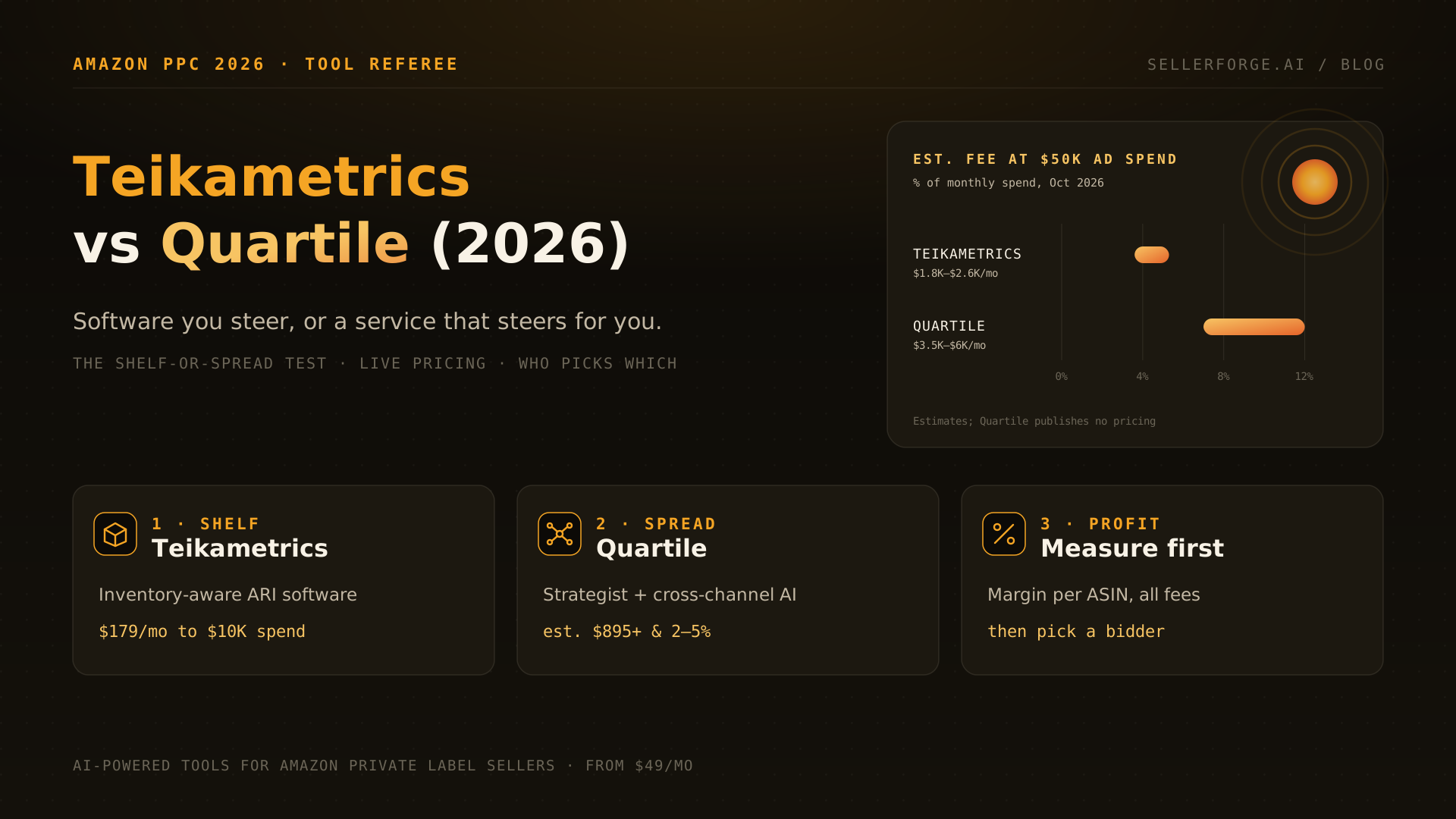
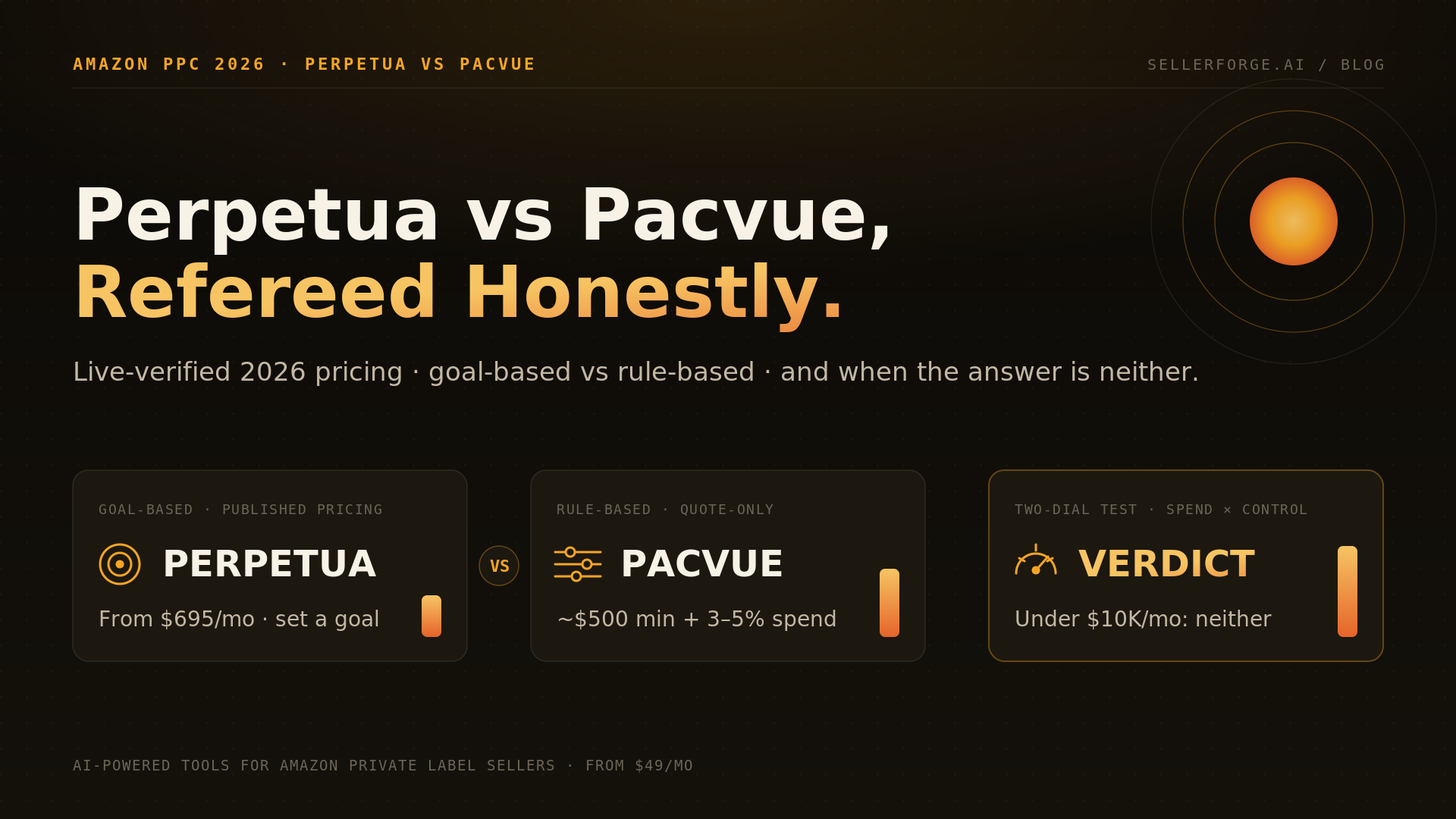
Need software to run this cadence? Compare the platforms that automate Sponsored Products, Brands, and DSP — Perpetua, Pacvue, Teikametrics and more, ranked by ad spend — in our honest guide to the best Amazon PPC software in 2026.
The Bottom Line
Sponsored Products earns first, always. Sponsored Brands earns its budget the day you have a brand worth defending — and spends it best on video. DSP earns its budget the day your revenue, retargeting pools, and free AMC queries all say so, and not a day sooner. Climb the Three-Gate Ladder in order, check the gates quarterly, and be willing to climb back down. The brands that lose money on 'full-funnel' advertising aren't running bad campaigns — they're running the right campaigns in the wrong order.
Want the gate metrics — TACoS, contribution margin, NTB, defense share — tracked for you every week? Start a free SellerForge trial and connect your account in minutes.
About the author
David Gallo is the founder of SellerForge.ai. Before building SellerForge, he managed 57 Amazon seller accounts representing over $350M in sales at Worldfront, where premature DSP budgets were the single most common ad-spend mistake he unwound.