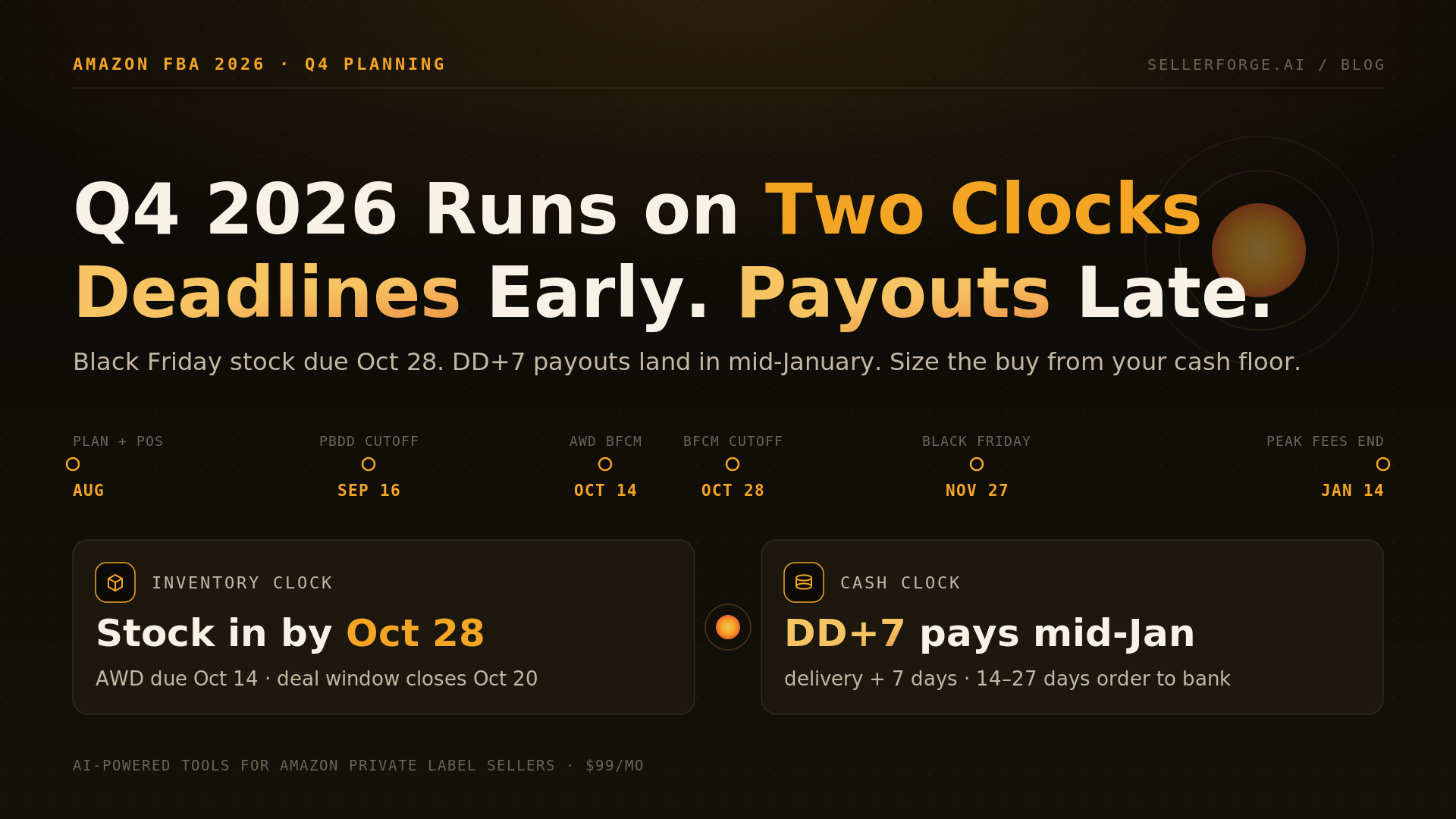
Plan Q4 2026 backwards from Amazon's inbound deadlines (September 16 for Prime Big Deal Days, October 28 for Black Friday and Cyber Monday on optimized splits), then size the buy against your cash position under DD+7, which holds payouts until seven days after delivery. Keep four to six weeks of cover in FBA, stage surplus in AWD at off-peak rates through October 31, and hold a returns reserve near 17%. SellerForge puts both clocks in one dashboard.
Amazon published its Holiday 2026 calendar in early July with an unusually friendly headline: same fees, same eligibility, earlier deadlines. Promotion fees, peak fulfillment fees, and deal mechanics all carry over from last season unchanged. The catch is the calendar itself. Every inbound cutoff moved earlier, and for most sellers the binding date is now October 28 for Black Friday stock, with Prime Big Deal Days inventory due September 16.
Here is what fifteen years of Q4s taught me, first as a seller and then managing 57 accounts at Worldfront: the sellers who get hurt in Q4 usually don't run out of stock. They run out of cash. The purchase orders get paid in August and September, and under Amazon's DD+7 payout policy the revenue doesn't finish landing until mid-January. That gap, not the deadline list, is the actual planning problem, and it's the reason we built cash-aware forecasting into SellerForge.
This guide covers both halves: every date that matters for Holiday 2026, and the working-capital math that decides how big your Q4 buy should actually be.
When Should You Send Inventory to Amazon for Q4 2026?
For Black Friday Week and Cyber Monday, inventory must arrive by October 14 (AWD), October 21 (FBA, minimal shipment splits), or October 28 (FBA, Amazon-optimized splits). For Prime Big Deal Days in early October, the deadlines are September 2, September 9, and September 16. Stock that lands after your date is not guaranteed the Prime badge during the event.
| Event | AWD deadline | FBA: minimal splits | FBA: optimized splits |
|---|---|---|---|
| Prime Big Deal Days (early October) | Sep 2, 2026 | Sep 9, 2026 | Sep 16, 2026 |
| Black Friday Week + Cyber Monday | Oct 14, 2026 | Oct 21, 2026 | Oct 28, 2026 |
Which column applies to you depends on the shipment-split option you pick at shipment creation. Amazon-optimized splits spread your inventory across the network up front, which shortens Amazon's internal handling and earns you the latest cutoff; most sellers are on this setting. Minimal splits keep your outbound simpler but cost you a week of runway. AWD cutoffs come first in every case because bulk-stored inventory has a longer internal journey to fulfillment centers.
The deal calendar is compressed too. Submission windows opened July 8; Prime Big Deal Days deals close September 8 and Black Friday/Cyber Monday deals close October 20. Fees are unchanged: $100 upfront per Best Deal, Lightning Deal, or Prime Exclusive Discount plus 1.5% of promotional sales capped at $5,000, and submitting Black Friday deals by September 5 takes $50 off the upfront fee. Full details are in Amazon's Holiday 2026 announcement, and PPC Land's breakdown is a good annotated read on what changed.
One pricing mechanic worth knowing: Prime Big Deal Days promotional prices are excluded from the 30- and 60-day lookback windows, so a steep October discount will not wreck your maximum allowed deal price for Black Friday. You can run both events aggressively without one poisoning the other.
The Two-Clock Rule: Q4 Planning Is Cash-Flow Planning
Every Q4 decision sits between two clocks. The inventory clock is Amazon's deadline calendar, and it pulls spending earlier: purchase orders paid in August and September, freight in September and October, all before a single holiday sale. The cash clock is Amazon's payout timing, and it pushes collections later: under DD+7, funds are held until seven days after delivery.
DD+7 has applied to all North American sellers since March 12, 2026, including long-tenured accounts that previously enjoyed faster reserve terms. Combined with the standard disbursement cycle, FBA sellers typically see 14 to 27 days from order to bank deposit. The mechanics are covered in depth in our DD+7 payout policy guide; what matters here is the seasonal consequence: November revenue arrives in December, and late-December revenue arrives in mid-January.
The Two-Clock Rule: your Q4 buy is only as big as the cash clock allows, no matter what the inventory clock demands. Size the buy backwards from your projected cash floor in October through December, not forwards from your December sales forecast.
Run the two clocks as one timeline and the shape is obvious: cash out peaks in September, cash in peaks in December and January, and the trough in between is where sellers get forced into bad decisions like panic discounts, skipped ad spend during peak traffic, or expensive short-term borrowing. The whole point of Q4 planning is to make sure the trough never goes below zero.
How Much Inventory Should You Send for Q4?
Forecast per SKU from your last two Q4s of weekly velocity, adjusted for this year's growth rate and promotional lift, then net out returns and cap the total at what your capacity limits and your cash position can carry. Weeks of cover, not unit counts, is the number to manage: four to six weeks in FBA, surplus staged upstream.
- 1Pull weekly (not monthly) Q4 velocity per SKU for the last two years. Weekly granularity is what exposes the event spikes and the early-December cliff.
- 2Apply your trailing growth rate, then layer promotional lift onto event weeks only: deal placements and higher PPC budgets amplify Black Friday week far more than the first week of November.
- 3Plan net sell-through, not gross sales. The National Retail Federation and Happy Returns expected about 17% of 2025 holiday sales to come back as returns, and apparel runs materially higher. Units that sell in December and return in January are inventory, not revenue.
- 4Convert safety stock into weeks of cover. Four to six weeks in FBA is the working ceiling; October to December storage rates make FBA the most expensive warehouse you have access to.
- 5Check your capacity limits before you commit. Estimates update in the third full week of each month, and Amazon has said fulfillment centers may run lower limits during the September and October receiving crunch.
- 6Run the cash-clock check from the next section. If the buy fails it, cut from the bottom: lowest contribution margin per unit of cash tied up goes first.
The reason to do this carefully instead of just ordering big: for seasonal categories the stakes are asymmetric in both directions. Toys, gifts, and holiday-specific products can take 30 to 50% of their annual revenue in Q4, so a stockout in the last two weeks of November is a wound that cannot be re-dressed. But across the 57 accounts I managed, the more common self-inflicted injury was the opposite one: sellers who nailed December and then limped into February because every spare dollar was sitting in unsold January safety stock, at exactly the moment returns clawed back a sixth of their holiday revenue.
How DD+7 Changes Your Q4 Cash Position
The practical effect of DD+7 in Q4 is a 60-to-120-day gap between paying for holiday inventory and banking the revenue it generates. A Black Friday order placed November 27 delivers around November 30, its funds become available around December 7, and depending on where that lands in your disbursement cycle, it reaches your bank in mid-December. The same math pushes late-December sales into mid-January.
Worked example. You order 3,000 units of a $30 product at $9 landed cost and pay the $27,000 purchase order on September 10 to hit the October 28 cutoff comfortably. Selling starts in earnest in mid-November. Your first meaningful post-DD+7 deposits land in early-to-mid December, roughly 90 days after the cash left. Full collection, minus the January returns wave, completes around mid-January: 120 days or more on the tail. Multiply that shape across your whole catalog and you have your Q4 financing requirement, whether you fund it from reserves or from someone else's money.
Two costs stack on top during the exact same window. Holiday peak fulfillment fees run October 15, 2026 through January 14, 2027, averaging $0.32 more per unit (unchanged from last season), and the 3.5% fuel and logistics surcharge that took effect April 17, 2026 applies on top of those peak rates, as Supply Chain Dive's coverage of the announcement notes. Neither is large per unit; both are certain, and both belong in your per-SKU Q4 margin model rather than in the rounding error.
The planning output you want from this section is a single number per month: projected cash floor for October, November, December, and January, after PO payments, freight, storage, ads, and peak fees, with revenue arriving on the DD+7 schedule rather than the day of sale. If any month goes negative, the buy is too big or the spending is mistimed, and it is far cheaper to learn that in August than in November.
FBA or AWD: Where Should Your Peak Surplus Sit?
Keep four to six weeks of sell-through in FBA and stage the rest of the peak buy in AWD or a 3PL. From October through December, FBA monthly storage for standard-size inventory roughly triples versus off-peak rates, and every cubic foot of January safety stock parked in a fulfillment center pays that tripled rate while also eating your capacity limit.
AWD gets a specific carve-out this season: sellers who send inventory through AWD with automatic replenishment enabled keep paying the off-peak monthly storage rate through October 31, 2026. Amazon also reports that sellers enrolled in AWD during Q4 2025 shipped over 13% more units with over 30% fewer out-of-stock days. Those are Amazon's own program numbers, not independent ones, but the structural logic holds: cheap upstream storage plus automatic replenishment means FBA stays lean without you manually re-shipping every two weeks.
The tradeoff is the calendar. AWD inbound deadlines are the earliest of the set, October 14 for Black Friday, and AWD-to-FBA replenishment is not instant during peak receiving. If you go the AWD route, the whole plan shifts about two weeks earlier than a pure-FBA plan.
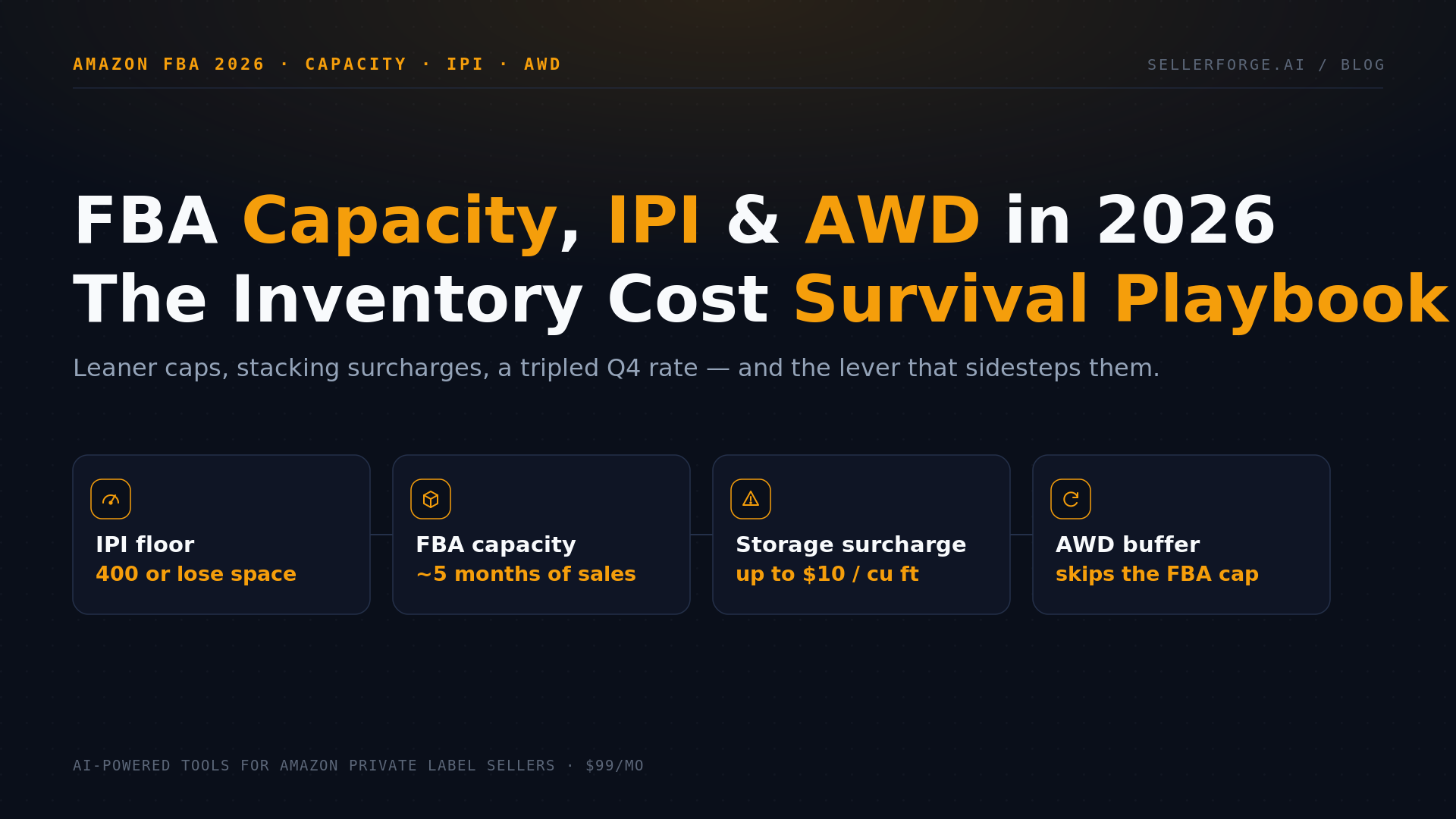
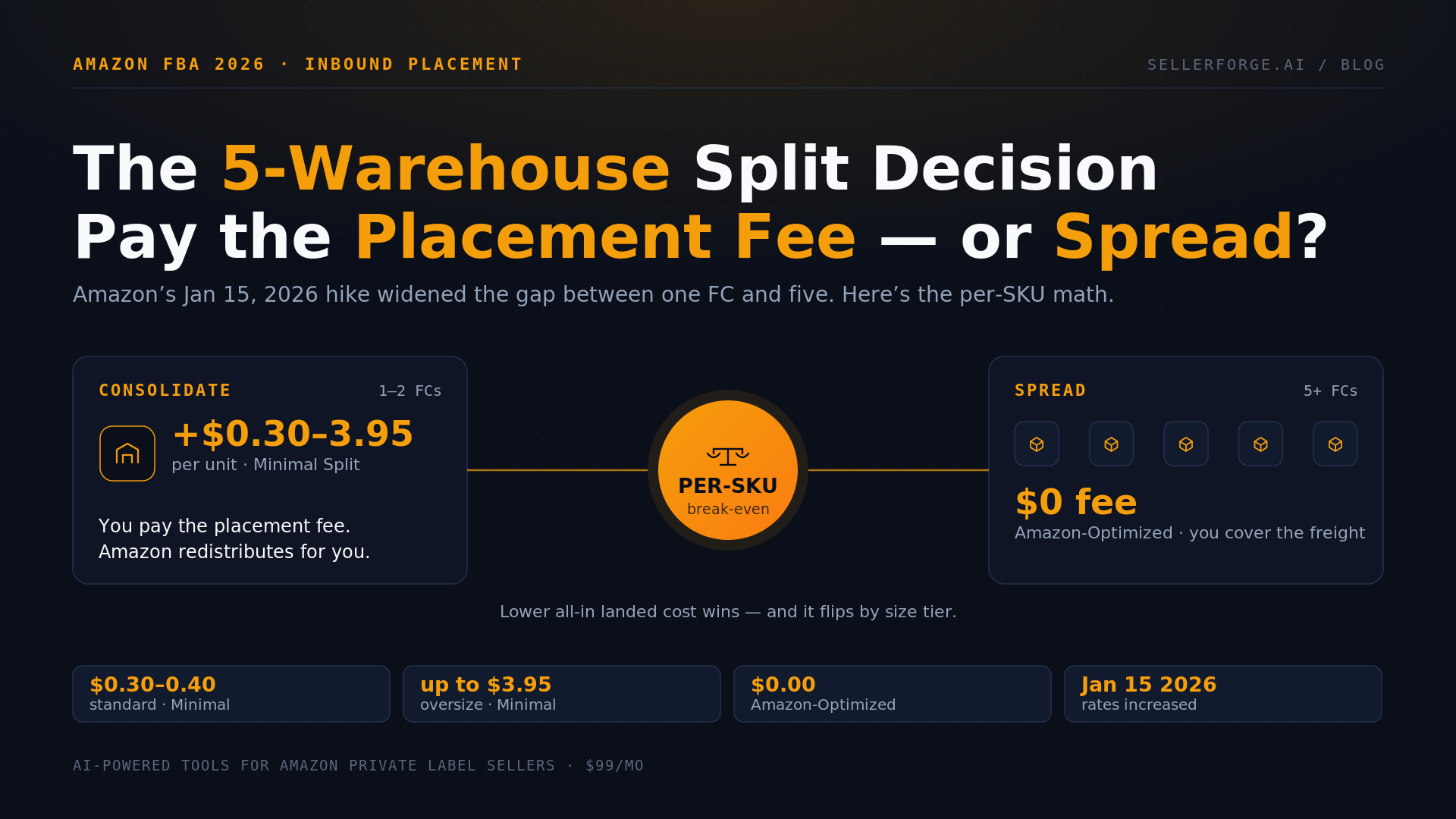
The complete storage-economics picture, including the five-month capacity cap, the IPI floor, and the utilization surcharge, is in our 2026 FBA capacity, IPI, and AWD playbook. And if you are weighing inbound placement fee options for those Q4 shipments, the inbound placement fee decision guide covers when minimal splits are worth the earlier deadline.
The Q4 2026 Timeline, Week by Week From Mid-August
Working backwards from the deadlines above, here is the operating sequence from today. Dates are arrival deadlines, so back your ship dates out by your actual freight and receiving lead times, plus a one-to-two-week buffer for peak congestion.
- 1Now through August 31: lock the per-SKU forecast, place or confirm purchase orders, and run the monthly cash-floor projection. Audit aged inventory now, while removal and liquidation still finish before peak storage rates start.
- 2By September 2: AWD inventory for Prime Big Deal Days must arrive.
- 3By September 5: submit Black Friday/Cyber Monday deals to capture the $50 early-bird discount on the upfront fee.
- 4By September 8: Prime Big Deal Days deal submission closes.
- 5By September 16: Prime Big Deal Days FBA stock (optimized splits) must arrive.
- 6Late September: clear anything approaching the 181-day aged-inventory tier. Holding slow stock through tripled Q4 rates is paying premium rent on merchandise that is not selling.
- 7By October 14: AWD inventory for Black Friday Week and Cyber Monday must arrive.
- 8October 15: holiday peak fulfillment fees begin (through January 14, 2027). Re-check per-SKU margins with peak fees and the 3.5% surcharge applied.
- 9By October 20: Black Friday/Cyber Monday deal submission closes.
- 10By October 28: Black Friday/Cyber Monday FBA stock (optimized splits) must arrive. This is the last Prime-badge date of the season.
- 11November: track sell-through weekly against forecast, replenish FBA from AWD, and protect ad budgets for event weeks; this is the wrong month to discover your cash floor was optimistic.
- 12December: manage stock-to-demand in real time. Resist panic discounts on healthy SKUs; December traffic converts without them.
- 13January: absorb the returns wave, reconcile actual against forecast while the data is fresh, and note what you would order differently. The January retro is the highest-leverage hour of next year's Q4 plan.
Cash Levers When the Gap Bites
If the cash-floor projection dips near zero, you have more levers than a loan. Most of them are cheaper and most of them work better the earlier you pull them.
- Take the early-bird deal discount: $50 off per deal by September 5 is small money, but it is the same decision you were going to make anyway, made two weeks earlier.
- Prune deal participation on thin-margin SKUs. A $100 upfront fee plus 1.5% of promotional sales is real money on a product clearing $3 a unit; deals are for SKUs where volume lift compounds rank, not for charity.
- Liquidate aged stock in September instead of storing it through peak. Cash recovered at 60 cents on the dollar in September routinely beats 85 cents in February after tripled storage, peak fees, and the aged-inventory surcharge.
- Hold a returns reserve. If the NRF's 17% holiday-returns expectation holds and your category is average, one dollar in six of December revenue is not yours yet. Treat it that way until February.
- Be careful with financing stacked into the gap. Revenue-based advances repaid daily from Q4 sales can collide with DD+7 timing, taking repayment from deposits that arrive weeks after the sales they came from. If you borrow, match the repayment schedule to the payout schedule, not the sales schedule.
Where SellerForge Fits
SellerForge is our product, so weigh this section accordingly, but this post is essentially a description of what it does. The Forecasting module builds the per-SKU velocity model from your actual sales history, event lift included. Custom Breakdowns shows contribution margin per SKU with fees applied, which is the number the cut-from-the-bottom step needs. The Weekly Business Report tracks November sell-through against plan, and the Business Event Timeline logs your deadline dates so the AI can explain variances against them later.
The piece I lean on most in Q4 is the assistant itself: asking "which SKUs are over 90 days of cover heading into October?" or "what did each SKU's Black Friday lift look like last year?" and getting answers computed from your real account data. A generic chatbot cannot answer either question because it has never seen your numbers. That difference is the whole product, from $49/mo. What SellerForge is not: a lender, a 3PL, or a freight forwarder. The cash still has to be yours; the software's job is making sure you see the trough in August instead of feeling it in November.
The Bottom Line
Amazon handed sellers an unusually predictable Q4: fees frozen, mechanics unchanged, dates published in July. The entire difficulty has been moved into timing. Stock must arrive earlier than ever, the money to buy it leaves your account in August and September, and the revenue it earns arrives on a delivery-plus-seven clock that stretches into mid-January.
So run both clocks. Put the deadline table on the wall, but size the buy from the cash floor. The sellers who have a good February are the ones who planned Q4 as a working-capital problem in August, and the ones who have a bad one usually planned it as a stocking problem in October.
Want both clocks on one dashboard before the September POs go out? Start a free SellerForge trial and connect your account; the forecast, margins, and weekly tracking are live in minutes.
About the author
David Gallo is the founder of SellerForge.ai. Before building SellerForge, he managed 57 Amazon seller accounts representing over $350M in sales at Worldfront, including more Q4 inventory plans, and more January cash crunches, than he cares to count.