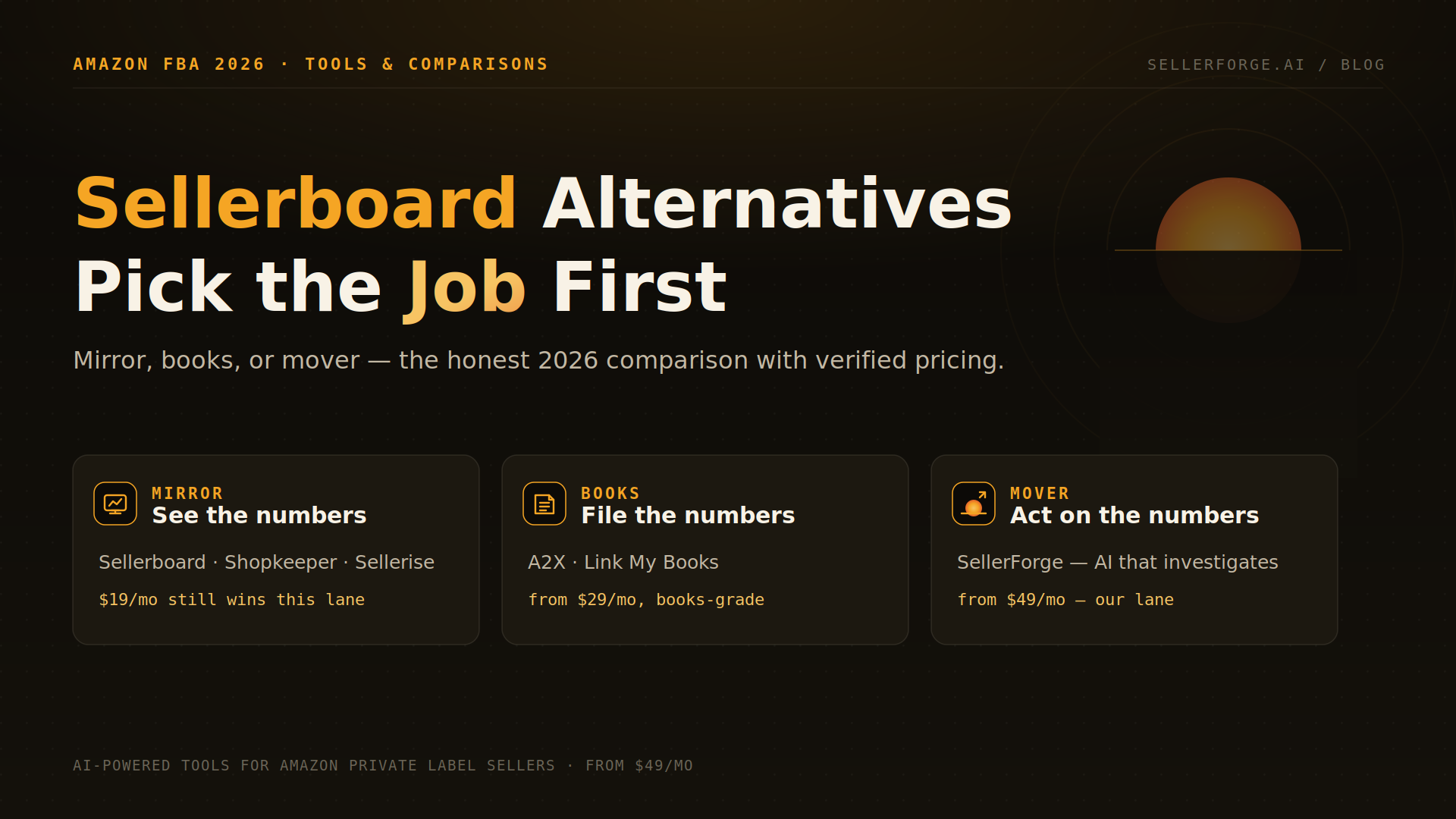
The best Sellerboard alternative depends on the job: Shopkeeper (from $20/mo) and Sellerise (from $19.99/mo) are the closest like-for-like profit mirrors, A2X (from $29/mo) is the upgrade when you need accounting-grade books, and SellerForge (from $49/mo — our product) is the pick when you want AI that acts on your numbers instead of just displaying them. If all you need is a cheap, accurate profit dashboard, keep Sellerboard — at $19/mo it is still the category's best value.
The best Sellerboard alternative depends on which job you are actually hiring for. If you want the same job done — a cheap, accurate profit mirror — Shopkeeper (from $20/mo) and Sellerise (from $19.99/mo) are the closest like-for-like swaps. If the real problem is that your accountant cannot file from a dashboard, the answer is not another dashboard: it is A2X (from $29/mo) feeding QuickBooks or Xero. And if you are tired of software that shows you a margin drop but leaves the investigating, claiming, and reordering to you, the category to look at is AI account intelligence — which is where SellerForge (from $49/mo) lives.
Why Sellers Look for a Sellerboard Alternative
Sellers rarely leave Sellerboard because it is bad at its job. They leave because the job changed: the accountant asked for reconciled books a dashboard cannot produce, order volume pushed them into higher tiers where prices converge with bigger suites, or they realized that seeing a margin problem every morning is not the same as fixing one. Price is almost never the honest reason — at $19/mo, Sellerboard is usually the cheapest competent option on the board.
Across the 57 Amazon accounts I managed at Worldfront, nearly every one arrived with a profit dashboard already installed, and the dashboard was almost never the problem. The pattern I saw instead: the seller had outgrown the JOB the dashboard does, then blamed the tool. They would switch from one mirror to another mirror, pay a migration tax in re-entered cost-of-goods data, and land exactly where they started — staring at the same margin number, still personally responsible for doing something about it.
The Mirror-Books-Mover Sort: Pick the Job Before the Tool
The Mirror-Books-Mover Sort is a 60-second exercise that prevents most bad switches: every profit tool is hired for exactly one of three jobs, and every disappointing "alternative" is a tool hired for the wrong one. A mirror shows you the numbers. A books tool makes the numbers filable. A mover acts on the numbers. No tool on the market is best at all three, whatever its pricing page says.
- 1MIRROR — daily profit truth. Live P&L by SKU, fees broken out, cost of goods applied, alerts when a fee changes. Sellerboard, Shopkeeper, Sellerise, and Helium 10's Profits module are all mirrors. If this is the job, price and UI are the only real differentiators.
- 2BOOKS — accounting-grade records. Settlement-by-settlement journals posted to QuickBooks, Xero, or NetSuite that reconcile to the penny against payouts, so your accountant can close the month and file taxes. A2X and Link My Books do this job; no dashboard does.
- 3MOVER — action on the numbers. Something notices contribution margin slipped on one ASIN, investigates whether it was a fee change, an ad bleed, or a COGS shift, drafts the reimbursement case or the reorder plan, and brings you the decision. This is the newest category — AI account intelligence — and it is the job SellerForge was built for.
The Mirror-Books-Mover Sort in one line: decide whether you need to SEE the numbers, FILE the numbers, or ACT on the numbers — then shop only in that lane. Sellers who skip the sort usually buy a second mirror and call it an upgrade.
Sellerboard Alternatives Compared (2026)
Six real alternatives cover the three jobs; every price below is monthly, with the verification date and source named. Where a vendor gates its pricing page behind scripts, the price comes from a dated third-party guide and is flagged as such — treat those two rows as approximately right and confirm at checkout.
| Tool | Job in the Sort | Entry price (verified) | Where it honestly wins |
|---|---|---|---|
| Sellerboard | Mirror | $19/mo, 3,000 orders (sellerboard.com, Sep 29, 2026) | Best value mirror in the category; 1-month free trial |
| Shopkeeper | Mirror | $20/mo, 250 orders (RevenueGeeks guide, Jul 2026) | Forecast view; pay-as-you-grow order ladder |
| Sellerise | Mirror (+ ops extras) | $19.99/mo Starter (RevenueGeeks guide, Jul 2026) | Review/keyword extras bundled beside the P&L |
| Helium 10 (Profits) | Mirror (inside a suite) | $129/mo Platinum, $99 annual (verified Sep 2026) | Only worth it if you use the research suite anyway |
| A2X | Books | $29/mo, 200 orders (a2xaccounting.com, Sep 29, 2026) | Accounting-grade settlement journals to QBO/Xero/NetSuite |
| Amazon SKU Economics report | Free checkup | $0 (Seller Central) | Per-SKU fees and proceeds straight from the source |
| SellerForge | Mover | From $49/mo (Core $49 / Growth $99 / Pro $199 / Agency $499) | AI that investigates, drafts claims, and forecasts — not just displays (our product) |
When You Should Just Keep Sellerboard
Keep Sellerboard if a mirror is genuinely all you need — that is the honest answer this query's page-one results will not give you, because most of them are written by a vendor hoping you switch. At $19/mo for 3,000 orders with a one-month free trial, no like-for-like alternative undercuts it meaningfully, and switching mirrors costs you re-entered COGS history and a learning curve for near-zero gain.
- Keep it if you check profit daily, file through a human bookkeeper who is happy with exports, and act on problems yourself — the mirror job is done and done cheaply.
- Keep it if you are under ~3,000 orders/month: Sellerboard's entry tier covers more volume than any rival's entry tier on this table.
- Keep it and ADD a lane instead of switching: Sellerboard + A2X (mirror + books) is a common, sane stack at under $50/mo combined; Sellerboard + SellerForge (mirror + mover) is equally coherent — we see both daily and they are not redundant.
- Switch mirrors only for a concrete feature you will use weekly (Shopkeeper's forecast view, Sellerise's bundled review tools) — never for a landing page's adjectives.
The Closest Like-for-Like Mirrors: Shopkeeper and Sellerise
Shopkeeper and Sellerise are the two honest answers to "apps like Sellerboard" — same job, different trade-offs. Shopkeeper (from $20/mo for 250 orders, scaling $45/$90/$250 by volume, 14-day trial) reads as the more polished single-purpose mirror, with a forecast view sellers consistently praise. Its ladder is the catch: at 1,000+ orders you pay $45–$90 for volume Sellerboard covers at $19–$29.
Sellerise (Starter $19.99/mo up through Top-Seller $599.99, 7-day trial) bundles a profit dashboard with review-request automation, keyword tracking, and alerting — closer to a mini-suite than a pure mirror. If you would otherwise pay separately for those extras, the bundle can pencil out; if you only want the P&L, the extras are UI weight. Helium 10's Profits module belongs in this conversation only for sellers already paying for Platinum ($129/mo, $99 annual) — as we said in the Helium 10 alternatives breakdown, nobody should buy a full research suite to get a profit mirror.
When the Answer Is Books, Not a Dashboard
If your accountant asked for "real numbers," no Sellerboard alternative that is also a dashboard will satisfy them — the job you need is books, and the tools are A2X and Link My Books. A2X (verified live September 29, 2026: Mini $29/mo for 200 orders, Starter $59 for 1,000, Standard $79 for 5,000, Premium tiers to $1,499 for 250K) posts every Amazon settlement to QuickBooks, Xero, or NetSuite as a reconciled journal that matches the payout to the penny. Link My Books does the same job UK-first and raised its base plan from £29 to £36/mo on July 1, 2026 — worth knowing because several roundups still print the old price.
Where SellerForge Fits (and Where It Does Not)
SellerForge is the Mover lane: AI-native, whole-account intelligence that starts from your profit, inventory, and account-health data and does the work a mirror leaves to you. When contribution margin slips on an ASIN, it investigates whether the cause was a fee change, ad spend, or landed-cost drift; when Amazon owes you money, it drafts the reimbursement case inside the claim window; when stock is going to run out mid-surge, the forecast tells you before the mirror shows the damage. It starts at $49/mo (Core), with Growth $99, Pro $199, and Agency $499 for multi-account agencies.
And where it does not fit, plainly: SellerForge is not the cheapest mirror — Sellerboard is, and if a $19 dashboard closes your gap, buy the $19 dashboard. It is not a bookkeeping system — A2X owns that job and we routinely see it running alongside us. It is not a repricer or a PPC bid engine either; those lanes have their own honest winners. SellerForge earns its fee when the expensive part of your week is acting on what the dashboard showed you.
Who Should Pick What
- Under ~$10K/mo revenue, watching costs: keep Sellerboard ($19/mo) or start with Amazon's free SKU Economics report until the gap hurts.
- Happy with your mirror, accountant unhappy with your books: keep the mirror, add A2X (from $29/mo) — that is a books problem, not a dashboard problem.
- Want one clean mirror with better forecasting UI and low volume: Shopkeeper (from $20/mo); want review/keyword extras bundled in: Sellerise (from $19.99/mo).
- Already on Helium 10 Platinum for research: use its Profits module as your mirror and spend nothing extra — do not buy the suite for this job alone.
- Spending hours weekly acting on what the dashboard shows — investigating drops, chasing reimbursements, planning reorders — or running multiple accounts as an agency: that is the Mover job, and SellerForge (from $49/mo; Agency $499) is our answer to it. It is our product; the free trial is how you check whether the AI pays for itself.
The Bottom Line
Run the Mirror-Books-Mover Sort before you spend a dollar switching. Most sellers searching for a Sellerboard alternative do not have a Sellerboard problem — they have a job that quietly changed. If the job is still seeing the numbers, keep the $19 mirror. If the job is filing the numbers, add A2X. If the job is acting on the numbers — the hours you spend every week turning what the dashboard shows into claims, reorders, and fixes — that is the lane we built SellerForge for.
About the author
David Gallo is the founder of SellerForge. Before building SellerForge, he managed 57 Amazon seller accounts representing over $350M in sales at Worldfront — where he watched more sellers switch profit dashboards than fix profit problems, and built the tool that closes that gap.