The best Amazon PPC software in 2026 depends on your monthly ad spend, and entry prices moved sharply this year: under ~$2,000/mo Amazon's free native automation is enough; $2K–$10K belongs to Helium 10 Ads (included in the $129 Platinum plan) and Scale Insights (from $78/mo); $10K–$50K is goal-based AI, but Perpetua now starts at $695/mo and Teikametrics retired its free tier; $50K+ justifies Pacvue or Quartile. Several platforms now claim margin-aware bidding — here is the four-question test for that claim.
The best Amazon PPC software in 2026 is still the one that matches your monthly ad spend — but the prices behind that answer changed sharply this year, and most buyer's guides have not caught up. Below roughly $2,000 a month, Amazon's own native automation is free and usually enough. Between $2,000 and $10,000, Helium 10 Ads (now included with the $129/month Platinum plan) and Scale Insights (from $78/month) give you the most control per dollar. Above $10,000, Teikametrics ($179/month up to $10K in spend, then 3% over) and Perpetua ($695/month up to $10K, then a percentage) start to earn their pricing, and past $50,000 the enterprise platforms — Pacvue and Quartile — take over.
There are two kinds of "best Amazon PPC software" articles. The first ranks whatever tool pays the highest affiliate commission. The second — the useful kind — opens with a question the vendors would rather you skip: how much are you actually spending on ads each month?
That single number decides almost everything. Under a couple thousand dollars a month, the best PPC software is often the free automation Amazon now ships natively. At ten times that spend, a platform that shaves three points off your ACoS pays for itself in a week. So this is an operator's buyer's guide, not a leaderboard: what Perpetua, Pacvue, Teikametrics, Scale Insights, Helium 10 Ads and Quartile actually cost right now, what their automation really does, and a simple rule — the Ad-Spend Bracket — for matching a tool to your business. And yes, SellerForge is our product; I'll show you where it fits, where it doesn't, and what it costs, including a number this article got wrong.
What Is the Best Amazon PPC Software in 2026?
The best Amazon PPC software in 2026 isn't a single product — it's whichever platform matches your monthly ad spend. Pacvue and Quartile lead the enterprise tier, Teikametrics and Perpetua own goal-based AI in the middle, Scale Insights and Helium 10 Ads win the value bracket, and under roughly $2,000 a month Amazon's own free automation is usually all you need.
Sitting alongside those bidders is a second category that got competitive in 2026: tools that judge advertising against margin and inventory rather than clicks. A year ago almost nobody claimed that lane; today Teikametrics, Trellis, Profasee and SellerForge (ours) all do, in meaningfully different ways. So the honest answer is two-part — choose a bidder by spend, then decide whether anything in your stack knows what your products actually make.
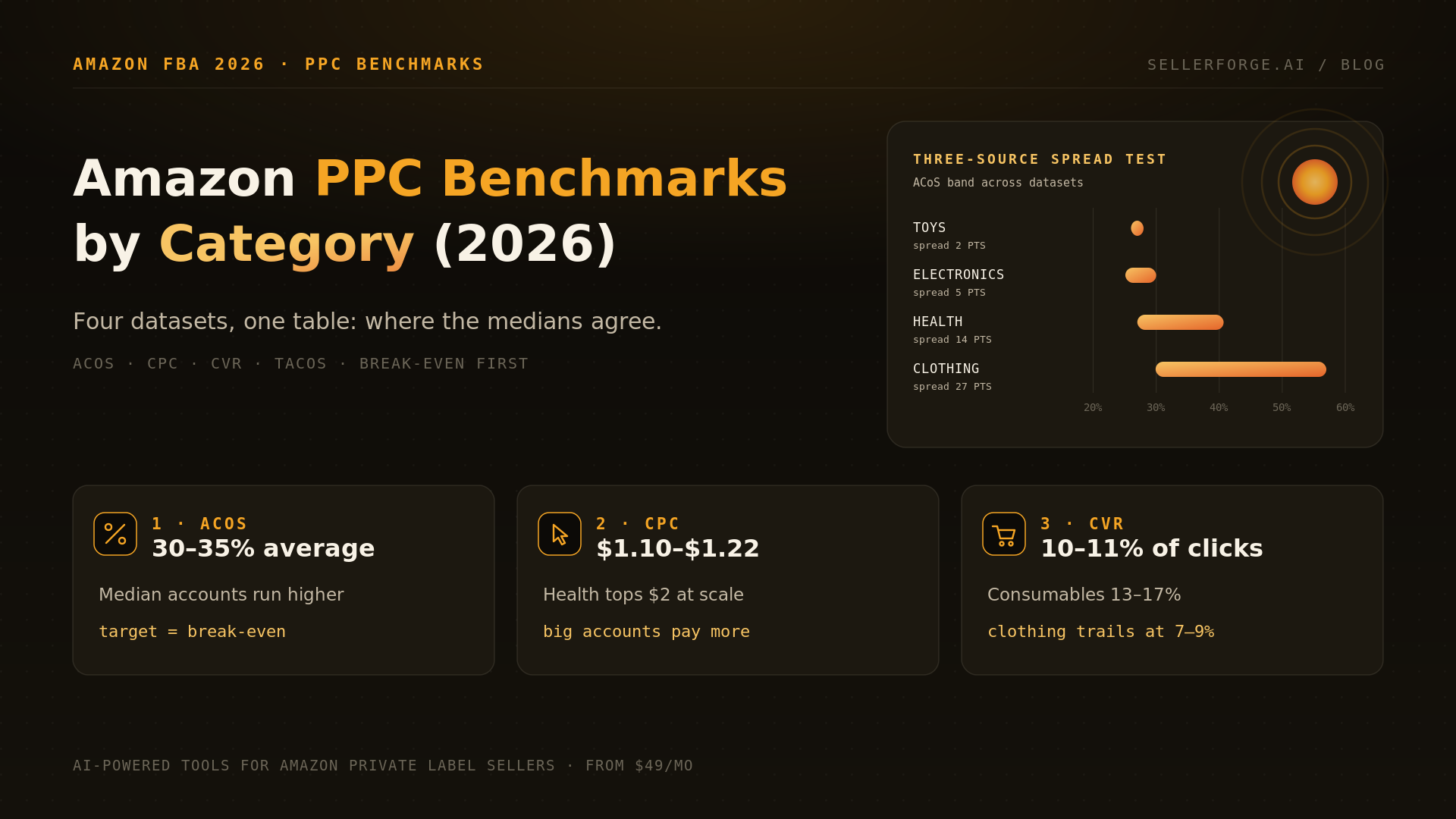
Why anchor everything to spend? Because Amazon advertising keeps getting more expensive and more crowded, so the leverage a tool adds scales with what you already spend. More than 70% of Amazon sellers now run ads, up from roughly 40% five years ago, and 74% of third-party sellers use Sponsored Products. Benchmarks vary by dataset: SellerPlex's H1 2026 managed-portfolio data puts the median at a 38% ACoS, 15% TACoS and a $1.07 CPC, while Trellis and Autron place a healthy account nearer a 30–34% ACoS and a $1.18–$1.22 CPC. Take the spread, not any single number.
The Ad-Spend Bracket: Match the Tool to Your Spend
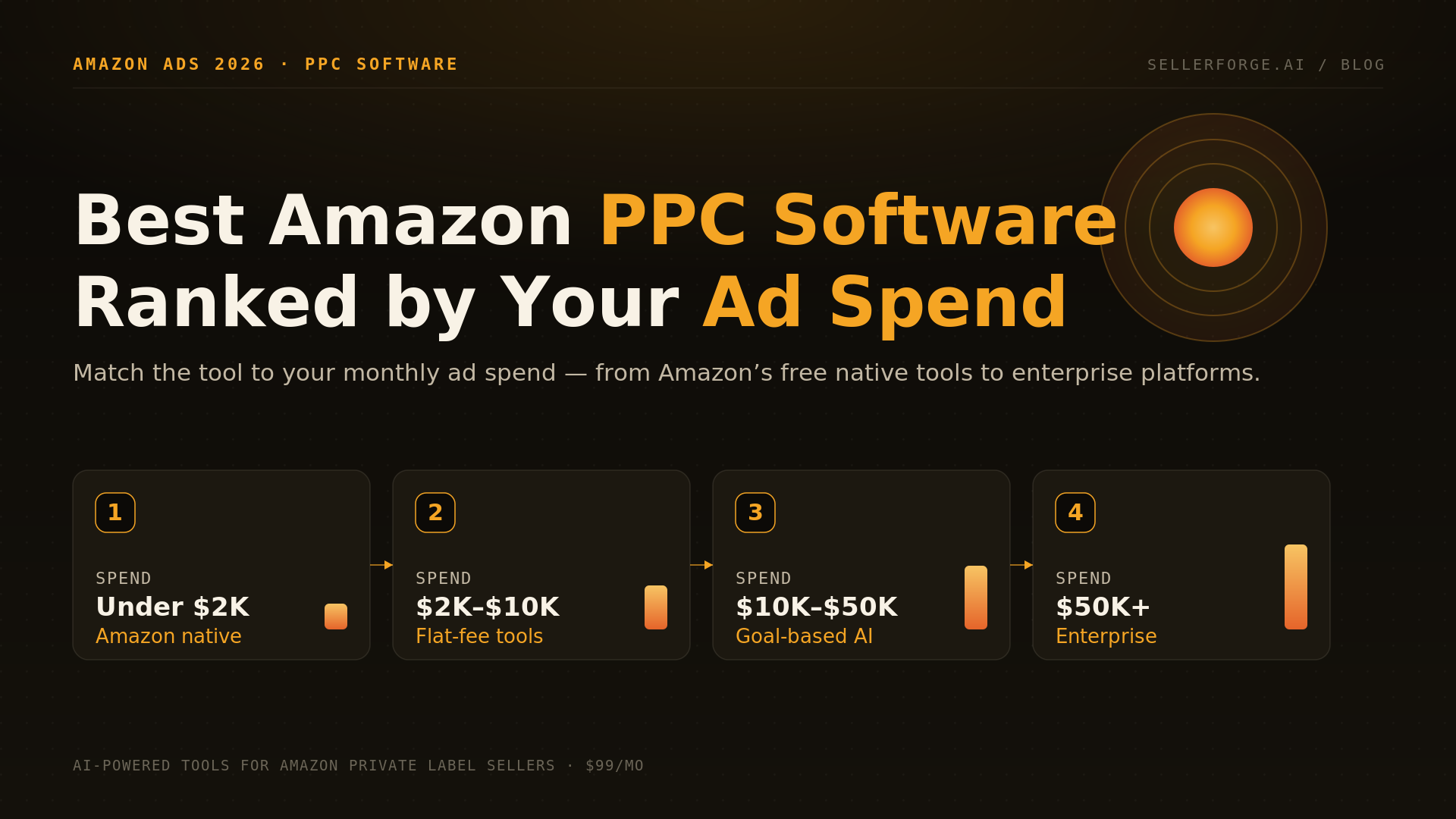
The Ad-Spend Bracket is the simplest honest way to choose PPC software: find your monthly ad spend, buy for that bracket, and re-check when you cross into the next one. It stops you paying enterprise prices at hobby spend — and from hand-managing $40,000 a month you no longer have time to touch. The brackets held through 2026; what changed is which tools live in them.
- 1Under ~$2,000/mo — Amazon native, plus your own hands. Free rule-based bidding, budget rules, the Ads Agent and Performance+ cover the basics. A paid tool rarely pays back here.
- 2~$2,000–$10,000/mo — flat-fee or ASIN-priced tools. Scale Insights (from $78/mo for five automated ASINs) or Helium 10 Ads, now included in the $129/mo Platinum plan rather than sold as a $199/mo add-on. Teikametrics Essentials ($179/mo) also caps here. Avoid percentage-of-spend contracts at this level.
- 3~$10,000–$50,000/mo — goal-based AI automation. Teikametrics (custom + 3% above $10K) and Perpetua (from $695/mo plus a percentage above $10K) bid portfolio-wide toward a target no human matches by hand. Do the percentage math first — the entry price roughly doubled in 2026.
- 4$50,000+/mo — enterprise retail-media platforms. Pacvue, Quartile or Perpetua's higher tiers bring DSP, AMC, multi-marketplace and managed services. At this spend, a fraction of a point of efficiency dwarfs the price.
The Ad-Spend Bracket has one rule the vendors hate: buy up a bracket only when your current tool is the bottleneck — not when a sales rep tells you you've 'outgrown' it. Most sellers overbuy by exactly one tier, and 2026's price increases made that mistake more expensive.
Before you judge any tool by the ACoS it promises, check what normal looks like in your category: our 2026 Amazon PPC benchmarks by category compare four datasets and show which category medians you can trust.
Amazon PPC Software Compared (2026)
Here's the honest comparison — every major platform by who it's for, how it prices, what it costs, and the catch nobody in the affiliate roundups mentions. Pricing is triangulated from public plans and multiple third-party sources as of September 2026; percentage-of-spend tools rarely publish exact numbers, so treat those as directional.
| Software | Best for (ad spend) | Pricing model | 2026 starting price | The catch |
|---|---|---|---|---|
| Amazon native (Ads Agent, Performance+, rules) | Under ~$2K/mo | Free | $0 | Optimizes for Amazon's revenue, not your margin |
| Scale Insights | $2K–$20K, hands-on | Per automated ASIN | $78/mo (5 ASINs) | Unlimited tier switches to 1% of ad spend |
| Helium 10 Ads (was Adtomic) | Existing Helium 10 users | Bundled (Platinum+) | $129/mo ($99 annual) | Diamond adds 2% on spend over $5K/mo |
| Teikametrics (ARI) | $10K–$50K, retail-aware | Flat, then % over $10K | $179/mo ($149 annual) | Free tier retired; 3% over $10K compounds |
| Perpetua | $10K–$500K, hands-off goals | Flat + % above $10K | $695/mo (to $10K spend) | Entry price ~2.5x higher than 2025 |
| Pacvue | $50K+, enterprise/agency | % of spend, custom | ~$500/mo min or 3–5% | No public pricing; enterprise onboarding |
| Quartile | $25K+, AI + managed | Tiered + % of spend | ~$895–$9,995/mo | ~$3K/mo spend minimum; DSP billed separately |
| SellerForge (ours) | Profit & inventory layer — any size | Flat tiers | $49–$499/mo | Not a pure autobidder — it proposes, you approve |
Perpetua — best hands-off goals, at a much higher entry price
Perpetua (which absorbed Sellics) is still the leading goal-based platform: set the objective — target ACoS, sales velocity, Buy Box share — and its engine adjusts bids and budgets across Sponsored Products, Brands, Display and DSP, plus Walmart and Instacart. The 2026 news is the price. Essentials is $695/month for up to $10K in monthly ad spend; Growth is that base plus an undisclosed percentage above $10K, adding hourly Amazon Marketing Stream optimization and share-of-voice data; Premium is custom above $500K. At $10K in spend that is a 7% effective rate — worth it at scale, hard to justify at the bottom of its own bracket.
Teikametrics ARI — best retail-aware bidding (but the free tier is gone)
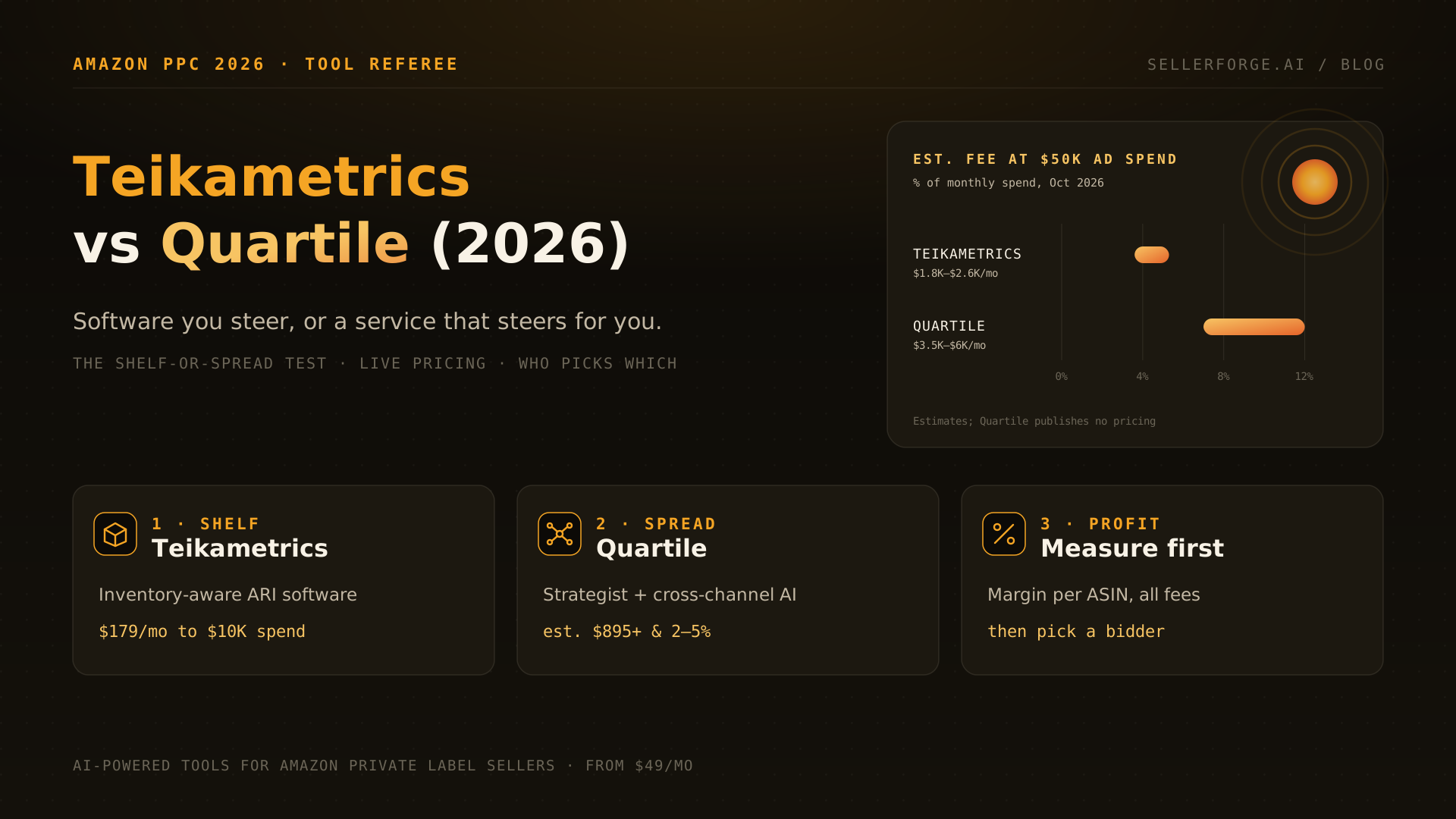
Teikametrics retired the Flywheel branding: at CES 2026 it launched ARI, or Artificial Retail Intelligence, a patent-pending engine it says unifies advertising, catalog optimization, inventory forecasting and analytics across Amazon, Walmart and TikTok. The inventory-aware bidding that always distinguished it — cutting bids when an ASIN's stock runs low — is now the centerpiece rather than a feature. What went away is the free plan for sellers under $10K in sales: Essentials is $179/month ($149 annual) capped at $10K in monthly ad spend, Advanced is custom plus 3% of spend above $10K, and the free entry point is now a 30-day trial.
Pacvue — best for enterprise and agencies
Pacvue is enterprise retail-media infrastructure: Amazon, Walmart, Instacart, Target and more, with deep AMC integration, dayparting, share-of-voice tracking and multi-account operations built for agencies. It prices as a percentage of ad spend — third-party sources triangulate 3–5% — with a roughly $500/month minimum and custom contracts, and publishes no pricing. Powerful and lever-rich; overkill below roughly $50K/month in spend. Worth knowing its engine also runs underneath Helium 10 Ads, so mid-market sellers can rent a slice of it for $129/month.
Scale Insights — best value for hands-on operators
Scale Insights was built by FBA sellers with $200M+ in combined revenue, and it shows: granular, rule-based control over every part of a campaign, priced per automated ASIN — $78/month for five, $98 for ten, $178 for twenty, $288 for thirty-five. Read the top of that ladder carefully: the unlimited-ASIN plan switches to 1% of monthly ad spend, so even the flat-fee tool has a percentage escape hatch. The other tradeoff is the learning curve — it rewards operators who want to encode their own logic, not those who want a black box.
Helium 10 Ads — best if you already own Helium 10
Adtomic no longer exists. Helium 10 replaced it with Helium 10 Ads, rebuilt on Pacvue's advertising engine and fed by Helium 10's own keyword database — and, unusually for 2026, the change made it cheaper. What was a $199/month add-on is now included with the $129/month Platinum plan ($99 billed annually) with no ad-spend threshold. Diamond ($359/month, $279 annual) adds rules-based controls and charges 2% on managed ad spend above $5,000/month. If you already pay for Helium 10, this is the least expensive competent bidder on the board.
Quartile — best AI plus managed service
Quartile pairs AI automation with managed services, using single-keyword, single-ASIN campaign structures that optimize on hourly Amazon Marketing Stream data. Published third-party tier schedules run from roughly $895/month to about $9,995/month, layered with a 2–5% share of ad spend, an onboarding minimum near $3,000/month in spend, roughly $500 per additional marketplace, and Amazon DSP typically billed separately at $1,000–$5,000/month. Sophisticated, and expensive in more line items than the headline suggests.
Down to Teikametrics or Quartile? We put both on the same ad-spend ladder, with live 2026 pricing and the exit terms, in our Teikametrics vs Quartile head-to-head.
The Pricing-Model Trap: When a Percentage of Spend Becomes Your Biggest Bill
The most expensive line in most PPC-software contracts isn't the sticker price — it's the percentage of ad spend. A tool advertised as "from $179/month" that also takes 3% of spend looks cheap at $5,000/month in ads and quietly becomes your biggest software cost at $50,000. I call the crossover the 3% Line: the point where a percentage fee overtakes a flat-fee tool plus a few hours of your time.
The math is worth doing before you sign, because it is rarely on the pricing page:
| Monthly ad spend | 3% fee | What that fee equals |
|---|---|---|
| $10,000 | $300/mo | More than a full Helium 10 Platinum plan |
| $30,000 | $900/mo | More than most mid-market tools charge outright |
| $60,000 | $1,800/mo | A part-time PPC contractor |
| $120,000 | $3,600/mo | A full enterprise platform plus managed service |
None of that makes percentage pricing wrong — at high spend the best AI bidders are worth far more than 3%. The trap is paying a scaling fee for a tool whose value doesn't scale the same way, and 2026 made it harder to spot: Perpetua's base rose to $695, Teikametrics layers 3% above $10K, Helium 10 Diamond charges 2% above $5K, Quartile takes 2–5%, and even Scale Insights' unlimited plan converts to 1%. Almost every tier now hides a percentage somewhere. Run your number against the 3% Line before signing a twelve-month contract.
Which PPC Tools Actually See Your Margin and Inventory?
In 2026 the biggest differentiator between PPC platforms is no longer the bidding algorithm — it is whether the software reacts to inventory, pricing and margin at all. Several vendors now market that capability, which is a real change from a year ago, but the claims cover very different amounts of ground. Here is who claims what, and what each one is actually reading.
| Platform | What it claims | What it actually reads | Acts or reports? |
|---|---|---|---|
| Teikametrics (ARI) | Unified ads, catalog and inventory forecasting | Amazon/Walmart sales and stock signals | Acts — cuts bids on low stock |
| Profasee (Marko) | Real-time pricing, inventory and listing coordination | Price elasticity plus ad and inventory data | Acts — from ~$399/mo |
| Trellis | Bidding tied to pricing and content | Listing, price and ad performance | Acts, priced on revenue plus spend |
| Perpetua / Pacvue | Profitability reporting | Ad metrics; margin only if you upload it | Reports |
| SellerForge (ours) | Ads read against per-ASIN net profit and stock cover | Landed cost, fees, returns, stock, account health | Proposes — you approve |
The word doing the work in every one of those claims is "margin," and margin is only as good as the landed cost behind it. So before you believe any profit-aware pitch, ask the vendor these four questions in order:
- 1Where does landed cost come from? If the answer is "Amazon's data," there is no landed cost — Amazon does not know what you paid your factory, your freight forwarder, or your 3PL.
- 2Who maintains it? A COGS field you upload once and never revisit produces confident, wrong profit numbers within a quarter. Ask how it gets updated when your unit cost changes.
- 3Does it act, or only report? A dashboard that shows negative-margin spend after the fact is a report. A system that changes or blocks the bid is a control. Both are useful; only one prevents the loss.
- 4What happens on a stockout? Ask for the specific behavior when stock cover drops below two weeks. "It surfaces an alert" and "it reduces bids automatically" are very different products at the same price.
What PPC Automation Actually Does (vs. What the Ads Claim)
PPC automation excels at the mechanical layer: bid adjustments, keyword harvesting, budget pacing, dayparting and negative-keyword mining across a portfolio too large to touch by hand. The bigger 2026 story is that the free floor keeps rising underneath it.
Amazon keeps absorbing what used to be paid features. Amazon's Ads Agent, a conversational AI that builds and optimizes campaigns, is native and free; Amazon Marketing Cloud became free and self-service for sponsored-ads advertisers; Performance+ — the conversion-optimizing campaign type that used to sit behind managed service — is now available self-service to all advertisers, with Brand+ covering the upper funnel. Sponsored Products and Sponsored Brands prompts, the AI mini-answers embedded in ad units, reached general availability in the US on March 25, 2026, Sponsored Brands collections added AI-curated product groupings, and from August 10, 2026 Sponsored Products began extending into creator content.
So the honest test for any PPC tool in 2026 isn't "does it automate bids?" — Amazon does that for free now. It's "does it automate bids meaningfully better than Amazon, and does anything connect that automation to my margin and inventory?" Rule-based-only tools mostly fail the first half; pure autobidders pass the first and fail the second.
Pacvue vs Perpetua: Which Should You Pick?
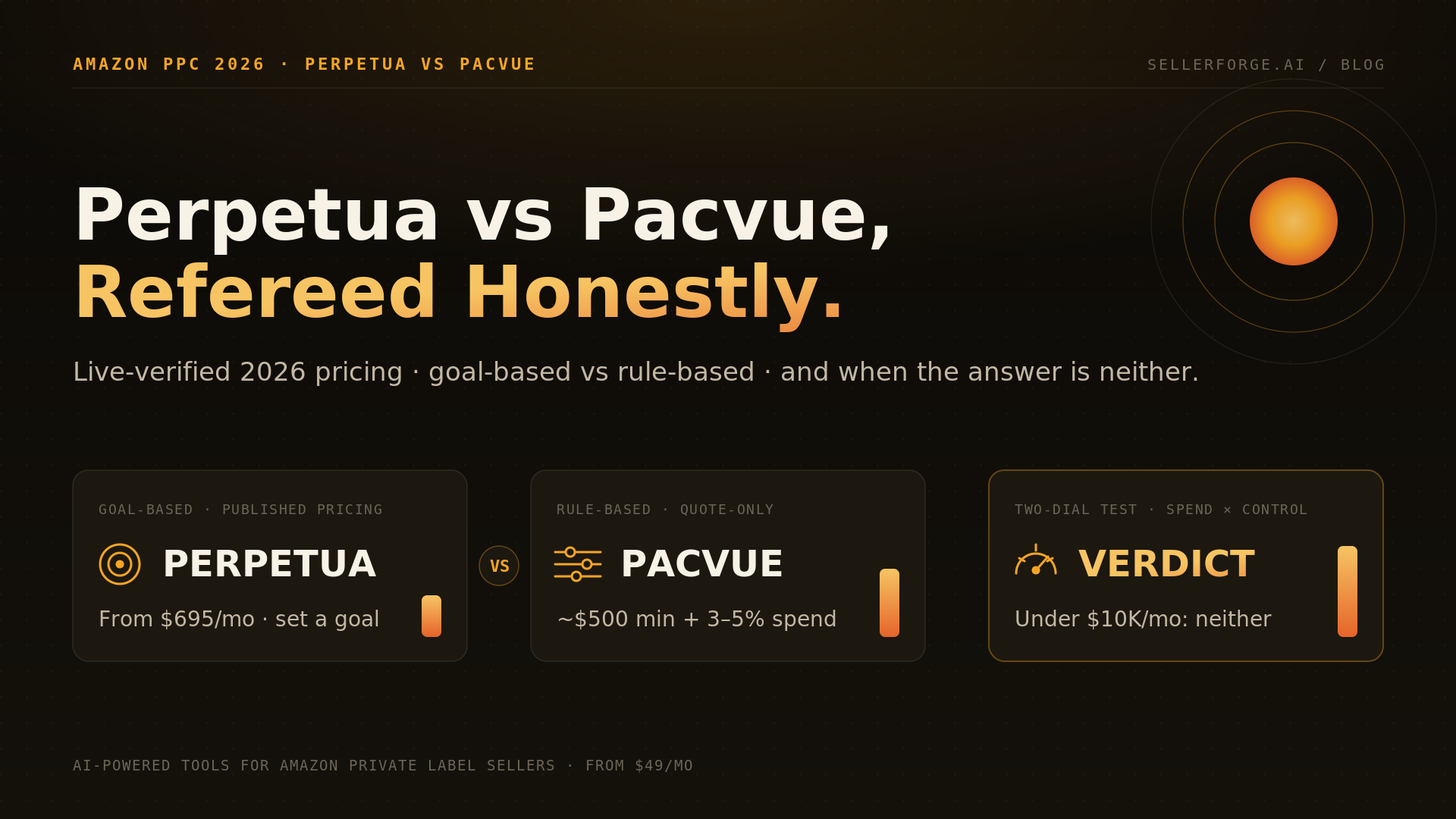
Pick Pacvue if you're an agency or enterprise brand that needs broad retail-media coverage, deep AMC analytics and multi-account operations; pick Perpetua if you're a single brand that wants hands-off, goal-based AI bidding and can clear its $695/month entry. Both are strong at high spend — they differ on control, coverage and how they price.
| Pacvue | Perpetua | |
|---|---|---|
| Best fit | Agencies, enterprise brands | Brands wanting hands-off goals |
| Automation style | Lever-rich, operator control | Goal-based, more black-box |
| Channel coverage | Amazon, Walmart, Instacart, Target+ | Amazon, Walmart, Instacart |
| Entry pricing | ~$500/mo min, 3–5% of spend | $695/mo to $10K spend, then % |
| Sweet spot | $50K+/mo spend | $10K–$500K/mo spend |
The tiebreaker is who's driving. Pacvue hands operators more levers and dashboards — great with a dedicated PPC manager, heavy without one. Perpetua asks for a goal and gets out of the way. Neither reads your landed cost unless you feed it.
2026 update: we now keep a dedicated referee page on this exact matchup — Perpetua vs Pacvue: which Amazon PPC platform fits — with live-verified pricing for both, the Two-Dial Test, and the honest case for each (including when the answer is neither).
What's the Best AI Software for Amazon Sellers?
The best AI software for Amazon sellers in 2026 depends on the job: for AI that writes listings, use a listing tool; for AI that bids, use Perpetua or Teikametrics; but for AI built around your entire account — advertising, true profit, inventory and account health in one shared context — the purpose-built option is SellerForge (ours, disclosed). That whole-account category is usually what people mean when they search the phrase, and it's where a general chatbot or a single-task bolt-on falls short.
Where SellerForge Fits: The AI Profit Layer (and Where It Doesn't)
Let's be direct, because this is our blog. What SellerForge is best at is that profit layer: reading your advertising against real per-ASIN margin, inventory cover and account health, then proposing changes you approve. What it is not is a pure bid-management engine — if you spend $80,000 a month and want a machine to run the auction while you sleep, buy Perpetua or Pacvue, because they're better at that one job than we are, and I'd tell a customer the same to their face.
The Bottom Line: How to Actually Choose
Start with your ad spend, not a listicle. Under ~$2K/month, use Amazon's free native tools and skip the subscription. From $2K–$10K, buy a flat-fee or ASIN-priced tool — Scale Insights, or Helium 10 Ads if you already own Helium 10, which is now the cheapest competent bidder available. From $10K–$50K, adopt goal-based AI (Teikametrics or Perpetua) and do the 3% Line math first, because both repriced upward this year. Above $50K, an enterprise retail-media platform earns its keep.
Then add the piece most autobidders still don't have, and interrogate it if they claim they do. Across the 57 accounts I managed at Worldfront, the most expensive PPC mistakes weren't bad bids — they were great bids pointed at the wrong ASINs: money spent efficiently driving traffic to products we couldn't restock or couldn't make money on. A bidder will do that flawlessly. Make sure something in your stack is watching the margin, and that it knows what your products actually cost.
David Gallo is the founder of SellerForge.ai. He previously managed 57 Amazon accounts representing over $350M in sales at Worldfront before building SellerForge to give sellers AI-powered tools at agency quality without the agency price.