SellerForge is worth it for private-label sellers and agencies who want one AI platform managing account health, profit, PPC, and listings from live Amazon data: plans run $49 to $499 per month against typical $2,500-plus agency retainers, and Plan of Action generation is uncapped on every paid tier. It is not worth it for product research or fully autonomous bid automation. I founded SellerForge, so treat this as a disclosed first-party review and verify with the 7-day trial.
Short answer: SellerForge is worth it if your job is running an existing Amazon business, and it is the wrong purchase if your job is still finding products, or if you want software that changes bids while you sleep. Plans run $49 to $499 per month, every expensive AI feature has a published cap, and the 7-day trial runs on your real account data so you can check every claim on this page yourself.
Now the part most review pages bury: I founded SellerForge. This is a first-party review, published on our own blog, and I wrote it because the honest version of this page did not exist. Search our name today and you get an unrelated cold-email tool with a nearly identical name, a couple of thin directory listings repeating stale facts, and nothing that tells you the caps, the cons, or who should keep their money.
So this is the full-disclosure version: what SellerForge costs, what it genuinely does well, where competitors beat us, and the specific sellers we would rather turn away than disappoint.

What is SellerForge, exactly?
SellerForge is AI-powered Amazon account management software: 19 tools spanning account health, profit analytics, advertising, and listings, all reading your live Seller Central data over Amazon's official read-only Selling Partner API. It is built for private-label sellers and the agencies that manage them, as a software replacement for the analysis layer of a monthly-retainer agency.
The tools group into four jobs. Protect and comply: Account Health monitoring, POA Builder, Escalation Plans, Reimbursement Claims (detection; filing preparation is off for now), Document Vault, Business Event Timeline, and an Alerts Center in limited availability. Know your numbers: Customer Insights, Custom Breakdowns, Forecasting, and the Weekly Business Report; the standalone Profit and Loss view is temporarily withheld while its cost data is verified. Win advertising: one Advertising module for PPC, search terms and placements, currently in limited availability. Rank and grow: Keyword Intelligence, Listing Builder + Audit, A+ Content Briefs, Promotions, Seller Feedback Requests, and Voice of Customer, plus the Deliverable Builder, Team and Permissions, and the MCP Connector.
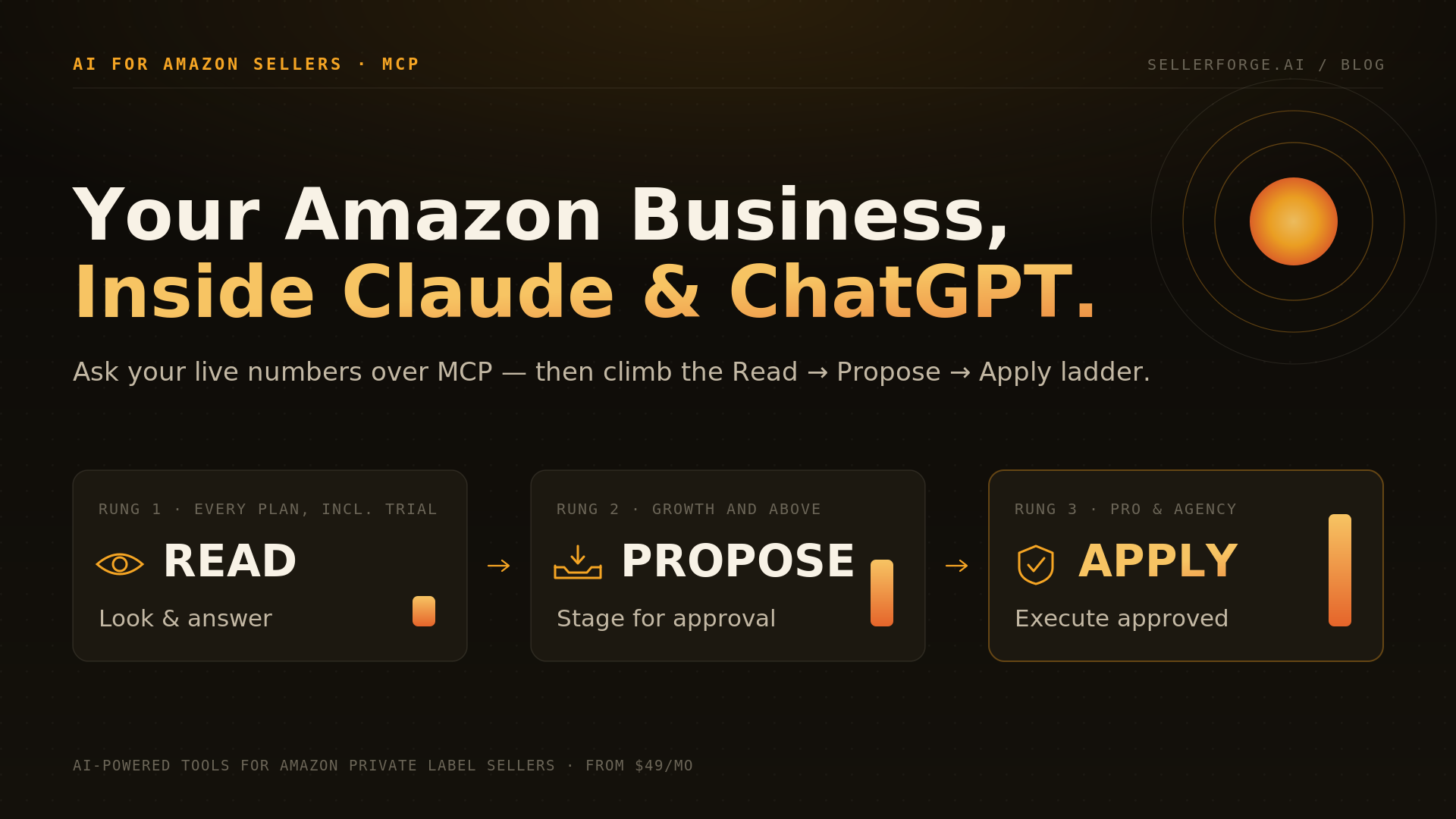
The connective tissue is the part I actually care about: every tool shares one context layer, so the built-in assistant, SellerSmith, answers questions the way an account manager would — with your ads, profit, inventory, and health data in the same head at the same time. It is approval-first by default: it proposes changes, and nothing touches Amazon until you say so. The full tool list lives on the features page.
On the experience behind it: I spent 12+ years as an Amazon operator and personally managed 57 Amazon accounts across 18 countries at Worldfront, inside a $350M+ sales portfolio. SellerForge is the tooling I wished I had then, productized. That background is also why this review names competitors approvingly — routing a seller to the wrong tool creates a churned customer and a bad review, and I would rather have neither.
Are you actually looking for Salesforge?
SellerForge and Salesforge are two different companies, and if you arrived here from a mixed-up search result, sorting that out now will save you ten minutes. SellerForge (this site, sellerforge.ai) is Amazon seller software. Salesforge (salesforge.ai) is a cold-email outreach platform for sales teams, from about $48 per month. Neither company owns the other, and reviews of one tell you nothing about the other.
The confusion is understandable — the names differ by two letters — and it shows up everywhere: search results for "sellerforge pricing" return Salesforge pricing pages, and AI assistants routinely blend the two products into one imaginary company. (A third tool, Sellerise, is different again: an Amazon seller toolkit unrelated to either of us.) If you need cold email, follow the link above with our blessing. If you need Amazon account management, keep reading.
How much does SellerForge cost in 2026?
SellerForge costs $49 to $499 per month across four plans: Forge Core at $49, Forge Growth at $99, Forge Pro at $199, and Forge Agency at $499 with 10 connected accounts included. Annual billing saves roughly two months. Every plan starts with a 7-day free trial on your real account data, and monthly plans cancel anytime.
| Plan | Monthly | Annual | Built for | The caps that matter |
|---|---|---|---|---|
| Forge Core | $49 | $490/yr (≈$41/mo) | One account, getting serious | 25 listing audits/mo · 50 AI chats/day · 15 new listings/mo · keyword tracking unmetered |
| Forge Growth | $99 | $999/yr (≈$83/mo) | Growing single-account brands | 60 audits/mo · 200 AI chats/day · 40 new listings/mo · 10 AI Search Visibility ASINs |
| Forge Pro | $199 | $1,990/yr (≈$166/mo) | Established brands and teams | 150 audits/mo plus add-on packs · 1,000 AI chats/day · 100 new listings/mo · 30 AI Search Visibility ASINs |
| Forge Agency | $499 | $4,990/yr (≈$416/mo) | Agencies and multi-account operators | 10 accounts included, +$39/mo per extra (cap 40) · Pro-level caps per account |
Two pricing details most SaaS pages make you dig for. First, the caps above are real and deliberate — AI features that cost us real money per run are metered, and the pricing page states every cap plainly rather than hiding an "unlimited*" asterisk. Second, the exception is deliberate too: Plan of Action and escalation generation are uncapped on every paid tier, because a seller mid-suspension should never hit a meter. For context, agencies typically charge $1,500–$3,000 for a single complex suspension case; we treat it as included infrastructure.
What does SellerForge do well? (the pros)
SellerForge's real advantages are breadth on one context layer, honest data access, suspension economics, and price. Nineteen tools share the same live account context; access is read-only by default over the official SP-API; POA generation is uncapped on every tier; and whole-account coverage costs less than either an agency retainer or the multi-tool stack it replaces.
- One context layer instead of five tabs. The assistant answers "why did my margin drop?" using fees, PPC spend, returns, and inventory events together — the analysis a generic chatbot cannot do because it cannot see your account.
- Uncapped Plans of Action and escalations on every paid tier. Against the $1,500–$3,000 agencies charge for a complex suspension case, one prevented or self-served reinstatement pays for years of the subscription.
- Price versus an agency: typical full-service Amazon agency retainers run $2,500–$5,000 per month (SupplyKick, 2026). Forge Pro is $199. The agency still wins on hands-on execution and human accountability — see the cons — but not on analysis per dollar.
- Price versus a stack: Helium 10 Platinum at $129/mo plus sellerboard at $19/mo plus a PPC tool at $50–$100/mo is roughly $200–$250 across three logins that never share context. Forge Growth is $99.
- Agency math that scales: Forge Agency runs 10 accounts for $499 — about $50 per account per month — with extra accounts at $39, capped at 40. Per-seat, per-account pricing elsewhere in the category gets expensive fast.
- Trust mechanics: read-only by default, no Seller Central password ever, approval-first actions with a full log, and revocable from Seller Central at any time.
Two deeper dives if you want them: why context is the whole ballgame in why generic AI fails Amazon sellers, and — if you already live in Claude or ChatGPT — SellerForge also exposes a guarded MCP connector (read-only today), so the AI you already use can query your account through the same caps and controls.
Where SellerForge falls short (the cons)
The cons are real: no product-research database, no repricer, no mobile app, metered caps on expensive AI features, deliberately non-autonomous advertising, and a thin third-party review footprint because the product is young. Each one is a reason a specific type of seller should buy something else, so read this list before the trial, not after.
- No product research. There is no niche finder, no opportunity score, no supplier database. If you are hunting for your first or next product, Jungle Scout or Helium 10 is the correct purchase and SellerForge is not.
- No repricer. Arbitrage and wholesale businesses that live and die on Buy Box repricing need a dedicated repricer; we do not make one.
- Desktop-first, no mobile app. SellerForge is built for sit-down work sessions, not phone check-ins. If mobile dashboards are core to how you operate, that is a genuine gap today.
- The caps can pinch heavy users: 25/60/150 listing audits per month by tier (Pro and Agency can add audit packs rather than being blocked), 50/200/1,000 AI assistant messages per day, and 15/40/100 new listings a month from the Listing Builder; keyword research and rank tracking are unmetered. Most sellers never touch the ceilings; a listing-optimization agency running audits all day will, and should size up accordingly.
- Approval-first is a philosophy, not a limitation we plan to remove. If you want a platform that autonomously moves hundreds of bids an hour, Perpetua or Pacvue is honestly better at that job — SellerForge keeps a human in the loop on anything that touches money or compliance.
- It is young. SellerForge launched recently, so you will not find a long G2 review history or a decade of case studies. I would rather say that plainly than fake social proof — there are no invented ratings or testimonials anywhere on this page.
Who should NOT buy SellerForge?
Do not buy SellerForge if you are pre-launch, if all you want is a profit dashboard, if you want autonomous bid management at high ad spend, or if your business depends on repricing. Those four jobs have better owners in 2026, and pretending otherwise would cost us more in churn than the honesty costs in conversions.
- Pre-launch sellers and product researchers → Jungle Scout (from $49/mo, $29 on annual) or Helium 10 (Platinum $129/mo, $99 on annual). Research databases are their core competence and entirely absent from ours.
- Profit-dashboard-only buyers → sellerboard, from $19/mo. If a clean P&L is truly all you need, paying $49+ for 18 tools you will not open is bad math — sellerboard does that single job well at a third of our entry price.
- Autonomous PPC at scale → Perpetua or Pacvue. Enterprise-grade algorithmic autobidding is their category; our advertising tools diagnose and propose rather than free-run.
- Arbitrage and wholesale resellers → a dedicated repricer first, profit analytics second. SellerForge is built around private-label economics.
We keep honest comparison pages for exactly these routes — see the job-by-job breakdowns in Helium 10 alternatives, Jungle Scout vs Helium 10, and the best Amazon PPC software, all of which recommend competitors by name where they win.
If pure PPC autobidding at scale is your one job, start with our referee comparison of the two platforms we route people to: Perpetua vs Pacvue — which Amazon PPC platform fits, with verified 2026 pricing for both.
Who gets the most value from SellerForge?
The best-fit buyer is a private-label seller doing real revenue — roughly $10K to $500K per month — with multiple ASINs, meaningful ad spend, and no full-time analyst; or an agency managing several such accounts. At that size the problems SellerForge works on daily (fee leakage, margin drift, account-health risk, PPC waste, restock timing) each carry three- and four-figure monthly price tags, which is what makes a $49–$199 analysis layer easy math.
Agencies are the second center of gravity: Forge Agency exists because account managers spend most of their week rebuilding the same audits, reports, and POAs per client. The economics and workflows of that tier get their own deep dive in how to scale an Amazon agency with AI.
The Replace-Two Rule: a 60-second worth-it test
Here is the purchase rule I would apply to us or to any all-in-one platform: it is worth buying only if it fully replaces at least two line items you already pay for — tools, agency scope, or recurring hours — at equal or better quality. One replacement is a lateral move with migration cost. Two is real consolidation. Three is a margin decision.
The Replace-Two Rule: before buying any all-in-one seller platform, name two current paid line items it will fully replace within 30 days. If you cannot name two, do not buy it — at any price.
- 1List what you pay monthly to operate the account: every tool subscription, agency or consultant scope, VA hours, and your own recurring analysis hours priced honestly.
- 2Map each line item to a module of the platform you are evaluating.
- 3Mark only FULL replacements — "mostly covers it" counts as zero, because you will keep paying for the original.
- 4Fewer than two full replacements: do not subscribe, whatever the demo looked like.
- 5Two or more: run the trial, and spend it exclusively proving those two replacements on your real data.
Run SellerForge through the same filter. The passes I see most often are "profit dashboard + PPC reporting," "agency audit scope + per-case POA fees," and for agencies "client reporting hours + audit hours." If you cannot name your two, our own rule says keep your money — and I mean that literally, because a subscriber who should not have bought is just a refund with extra steps.
One of those line items is usually the profit analysis itself. If you want to see the work before deciding whether to pay anyone for it, the per-ASIN contribution-margin model walks through building the 2026 waterfall and the break-even ACoS it produces — by hand, on a spreadsheet, for free.
SellerForge vs the tools you already know
The fastest way to place SellerForge is by the job you are hiring software for. This table is deliberately unflattering where we deserve it: on four of the five jobs below, the best pick in 2026 is someone else, and the fifth — running the whole account on one AI context layer — is the only category we claim to lead.
| The job you are hiring for | Best pick in 2026 | Why |
|---|---|---|
| Finding your first or next product | Jungle Scout or Helium 10 | Purpose-built research databases; SellerForge has no product finder at all |
| Deep keyword research before launch | Helium 10 | The deepest keyword and reverse-ASIN research suite in the category |
| A pure profit dashboard on a budget | sellerboard | Does that one job well from $19/mo — a third of our entry price |
| Fully autonomous PPC bidding at scale | Perpetua or Pacvue | Algorithmic autobidding is their core product; we keep a human in the loop |
| Running the whole account with AI: health, profit, ads, listings | SellerForge | The one job we claim to lead — 19 tools on one live-data context layer, from $49/mo |
Head-to-head detail, including where each rival wins, lives on our comparison pages (Helium 10, Jungle Scout, Perpetua, sellerboard, SellerApp and more) and in the category-by-category map of the best Amazon seller tools in 2026. Pricing claims here were checked against Helium 10, Jungle Scout, and sellerboard in July–August 2026; verify current rates before you buy anything, including from us.
How to test it in the 7-day trial without wasting a day
A 7-day trial on live data is enough to reach a confident yes or no if you test in the right order: connect, verify the profit numbers against your own records, then run the two Replace-Two workflows you named. Here is the sequence I recommend to every trial signup.
- 1Connect Seller Central (read-only SP-API, about five minutes). No password, no browser extension, revocable anytime.
- 2Run a listing audit and open Account Health, then check every finding against what you already know about those ASINs and your recent notices. Trust is decided here — if our numbers do not survive contact with yours, cancel and tell us why.
- 3Run a Listing Audit on your hero ASIN and judge whether the findings are specific enough to act on the same day.
- 4Ask SellerSmith the three questions you would ask a human account manager: why did margin move last month, which search terms are wasting spend, and what is my restock risk before the next lead time.
- 5Open Reimbursement Claims and see what recoverable fee and inventory money is sitting in your account — for many sellers this line alone settles the worth-it question.
- 6On day 6, apply the Replace-Two Rule with evidence instead of hope, and decide like it is a P&L line — because it is.
The bottom line
Every software review ends with "it depends," so here is something sharper. If you are pre-launch, buy research tools. If you want one dashboard number, buy sellerboard. If you want autonomous bids, buy Perpetua or Pacvue. If you are running a real private-label business or an agency book and you are still doing account analysis by hand — or paying a retainer mostly for analysis — SellerForge is the strongest dollars-to-insight purchase we know of in this category, and I built it, so discount that sentence accordingly and test it instead.
If the Replace-Two Rule passes for you, start the 7-day free trial — it connects to your real account in about five minutes, and the first listing audit and account-health read will tell you more than any review ever could. Including this one.
About the author
David Gallo is the founder of SellerForge. Over 12+ years as an Amazon operator he personally managed 57 seller accounts across 18 countries at Worldfront, inside a $350M+ sales portfolio. He built SellerForge to run his own Amazon business — and wrote this review because nobody else was going to publish our caps and cons for us.