
An Amazon seller MCP server connects your Seller Central data to an AI assistant like Claude or ChatGPT over the Model Context Protocol, so you can ask about profit, PPC, inventory, and account health and get answers from your live numbers. Amazon's only official MCP server (September 2026) covers advertising alone; whole-account access runs through third parties — DIY SP-API bridges, read-only data pipes, or a guarded connector like SellerForge's, where reads work on every plan and writes need approval.
Every week another Amazon seller asks some version of the same question: can I just connect my account to ChatGPT or Claude and ask it things? The answer in September 2026 is yes — and the interesting questions are the three hiding behind it. Through what? With what permissions? And what happens the first time the AI wants to change something instead of just reading it?
The 'through what' is MCP, the Model Context Protocol — the open standard that has quietly become the way AI assistants plug into outside systems, with more than 10,000 public servers by the time Anthropic handed its governance to the vendor-neutral Agentic AI Foundation in December 2025. Amazon itself has stepped only partway in: its official MCP server, in open beta since February 2, 2026, covers advertising and nothing else. Your orders, fees, inventory, and account health are reachable only through third-party servers.
I managed 57 Amazon accounts before building SellerForge (disclosed up front: SellerForge is our product, and it includes an MCP connector). This guide is the one I wish existed when I first wired an account into a chat window: what MCP actually is in seller terms, what Amazon officially supports, the four ways to connect, and the safety ladder that should decide which one you use.
What Is an MCP Server for Amazon Sellers?
An MCP server is a translator that sits between your AI assistant and your Amazon business: it holds an authorized connection to your seller data and exposes it as tools the AI can call. Ask Claude 'which SKUs run out inside 30 days?' and instead of guessing, the AI calls the server, gets your live numbers, and answers with them.
The protocol underneath is worth thirty seconds of history, because it explains why this suddenly works everywhere. Anthropic open-sourced the Model Context Protocol in November 2024 as a universal way for AI models to reach external tools — one standard instead of a custom integration per app. OpenAI adopted it across its products in March 2025, Google and Microsoft followed, and in December 2025 Anthropic donated the protocol's governance to the Agentic AI Foundation. By then MCP had over 97 million monthly SDK downloads and more than 10,000 active public servers. It is the de facto port that every serious AI client now speaks: Claude, ChatGPT, Cursor, Claude Code, Gemini, Copilot.
For a seller, the practical meaning is simple: the AI you already pay for can stop being a very confident intern with no access to your business and start being an analyst with your actual P&L open. The difference between generic chat advice and grounded answers is not the model — it is the connection. That is the same thesis we unpacked in how Amazon sellers are actually using AI; MCP is the plumbing that makes it real.
Does Amazon Have an Official MCP Server?
Amazon has exactly one official MCP server as of September 2026, and it covers advertising only. The Amazon Ads MCP Server entered open beta on February 2, 2026: roughly 50 tools spanning Sponsored Products, Sponsored Brands, Sponsored Display, DSP, and AMC, available to anyone holding Amazon Ads API credentials. There is no official MCP server for Seller Central or the Selling Partner API — none for orders, inventory, fees, returns, or account health.
That gap is not an accident of engineering priorities; it maps to how Amazon thinks about agents. Inside Seller Central, Amazon wants you using its own agent — Seller Assistant, rebuilt as an agentic AI in September 2025, with 230,000+ monthly users who accepted its recommendations about 90% of the time in 2025, per Amazon's own seller-impact reporting. Outside Seller Central, Amazon opened the ads lane first because advertising already had a mature third-party API ecosystem, as AdExchanger reported when the beta launched. Everything in between — the whole-account view — is where third parties live.
Two things follow from that. First, if your only goal is ads automation and you have developer credentials, the official Ads MCP is genuinely the right tool — it is free with API access, first-party, and will only deepen. Second, anyone promising you an 'official Amazon MCP' for your whole account is selling something that does not exist. Whole-account access runs through SP-API under a registered developer, or through a platform that already holds your authorized data.
Worth watching: Amazon Accelerate 2026 runs September 22–24 in Seattle, and agentic AI is the headline track. If Amazon ever ships a Seller Central MCP server, that is the stage it debuts on. Nothing announced as of this writing — I will update this page when that changes.
Is It Safe to Connect Your Amazon Account to an AI?
It is safe when the connection runs through Amazon's official APIs under OAuth, is scoped and revocable, and puts a human approval step in front of any write. It is dangerous when an agent holds your password or writes to your account with no gate. The entire safety question compresses into one distinction: authorized API access versus credential-holding agents.
The industry spent 2026 litigating exactly this line. Amazon sued Perplexity in November 2025 after its Comet browser agent shopped consumer accounts while, in Amazon's words, concealing itself — a federal judge blocked the agent in March 2026, and an appeals court later vacated that injunction, leaving the credential-agent question legally unsettled. You do not want your seller account anywhere near that gray zone. The API lane has none of this ambiguity: SP-API exists precisely so authorized tools can act on seller data, with Login with Amazon OAuth, scoped roles, and revocation — no password ever shared.
But 'uses the official API' is only half the safety story. The other half is what the AI is allowed to do once connected, and this is where I want to give you the frame I now use for every connector I evaluate — ours included.
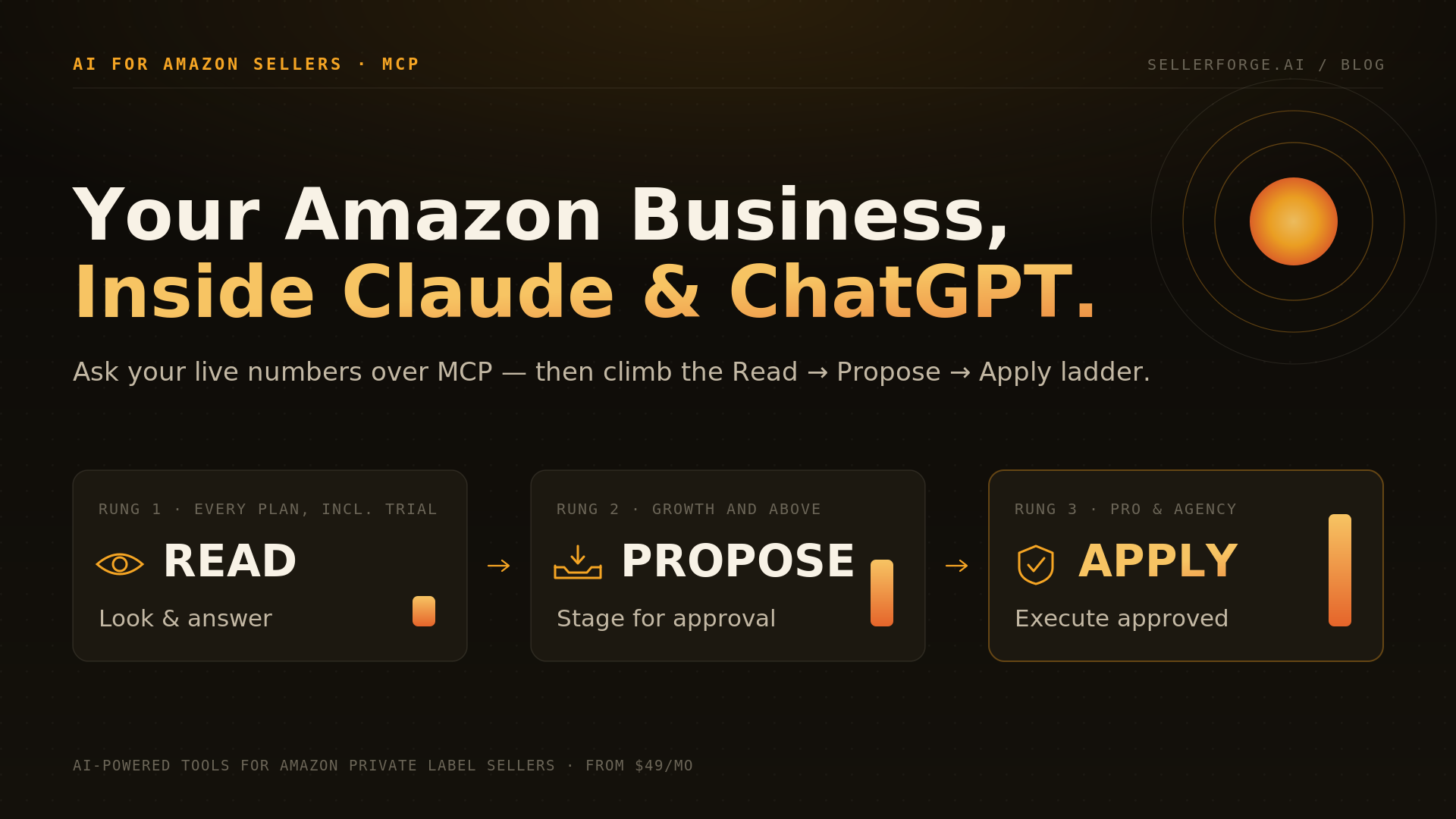
The Read→Propose→Apply Ladder: every AI-to-Amazon connection sits on exactly one rung. READ — the AI can look and answer, nothing more. PROPOSE — the AI can stage a change that a human reviews and approves. APPLY — the AI executes a change a human already approved, inside caps and an audit trail. Know the rung before you connect, and never hand an AI rung three through a connector that never built rung two.
Run every option you are considering up that ladder. A read-only reporting pipe is rung one by design — safe, and limited. A raw SP-API bridge that exposes write endpoints jumps straight to rung three with no rung two: the write goes through the moment the model decides to make it, which is exactly what you do not want an unsupervised language model doing to live listings or campaigns. Across the 57 accounts I managed, the expensive mistakes were rarely bad analysis — they were good analysis executed without a second pair of eyes. The approval step is not bureaucracy; it is the entire difference between an assistant and a liability.
- Insist on OAuth through official APIs — any tool that asks for your Seller Central password is disqualified, whatever else it does.
- Confirm you can revoke access in one place, and that revocation actually kills the token rather than just hiding a menu item.
- Ask where writes go: straight through (rung three with no gate), into an approval queue (rung two), or nowhere (rung one).
- Demand an audit trail — who proposed what, when, why, and who approved it. If the vendor cannot show you one, assume there is none.
The Four Ways to Connect Seller Central to an AI
Four routes exist in 2026, and honest routing matters more than brand loyalty: they solve different jobs, and two of them are not even competitors to the others. Here is the whole landscape in one table, including where each route genuinely wins.
| Route | What the AI can reach | Write safety (ladder rung) | Who it is really for |
|---|---|---|---|
| DIY SP-API bridge (open-source MCP servers on GitHub) | Whatever scopes you wire: orders, inventory, reports | Raw — writes pass straight through unless you build your own gates | Engineers who want full control and accept ~$200–$500/mo run costs plus maintenance |
| Read-only data connectors (Supermetrics, Windsor.ai, DataDoe, Adzviser) | Reporting fields piped into ChatGPT or Claude | Read rung by design — no writes possible | Analysts who want cross-channel reporting in chat, not account operations |
| Amazon Ads MCP Server (official, open beta Feb 2, 2026) | Advertising only: SP, SB, SD, DSP, AMC — 50+ tools | Real writes under your credentials, no staging layer — bring your own guardrails | Ads-focused builders and agencies holding Amazon Ads API credentials |
| SellerForge MCP Connector (ours — disclosed) | Whole account: profit, ads, keywords, inventory, account health, Voice of Customer | Full ladder: read everywhere, proposals staged to your approval inbox, approved actions applied under caps with an audit trail | Operators and agencies who want answers and guarded action from one connection |
To be plain about where we lose: if you only want ads automation and you have developer credentials, Amazon's own Ads MCP is first-party and free — use it. If you only want metrics from six platforms in one chat, a reporting pipe like Supermetrics or Windsor.ai does that job for less than an ops platform costs, and does it well. If you are an engineer who enjoys owning infrastructure, the DIY route teaches you more than any vendor will — we wrote up the real build honestly, including the parts that hurt, in our guide to building your own Amazon AI agent with Claude, and the $200–$500 monthly run cost still holds. SellerForge's case is specifically the whole-account operator who wants one connection that reads everything and can act on nothing without permission.
How to Connect Claude or ChatGPT to Seller Central
The connection takes about five minutes in any MCP-capable client, and the shape is identical everywhere: point the client at a server URL, authorize, ask. Here is the guarded route, using the SellerForge connector as the example — the same steps apply to any hosted MCP server, with its own URL.
- 1Pick your rung first. Decide whether this connection should read, propose, or apply before you authorize anything — not after the AI surprises you.
- 2In Claude (web or desktop): open Settings → Connectors, choose to add a custom connector, and paste the server URL: https://www.sellerforge.ai/api/mcp
- 3In ChatGPT: open Settings → Connectors, enable developer mode, create a new connector, and paste the same URL as the server endpoint.
- 4In Claude Code, it is one terminal command: claude mcp add --transport http sellerforge https://www.sellerforge.ai/api/mcp — Cursor takes the same URL in its mcp.json.
- 5Authorize your account when prompted. You sign in to SellerForge; the AI never sees a password, and Seller Central credentials are never involved.
- 6Ask a question you already know the answer to — last month's revenue, yesterday's ad spend — and confirm the numbers match before you trust anything else it says.
That last step is an old operator habit that transfers perfectly: calibrate the instrument before you fly it. Reading works on every SellerForge plan including the free trial, so the calibration run costs nothing. Staging proposals unlocks on Growth and above; executing an already-approved action is the Pro and Agency rung. Revoking a client takes one action in Settings → Connections, and a global switch in Settings → AI Actions pauses all execution — pending actions cannot run while it is off.
What Should You Actually Ask Once Connected?
The highest-value questions are the ones you currently answer with a 40-minute export-and-pivot ritual, because those are the ones you have quietly stopped asking. Connected over MCP, they cost one sentence each. These are the six I run weekly, and they map to the six data groups a whole-account connector should expose.
- Profit: "What was my true net profit last month after fees, ads, and COGS — and which three SKUs dragged it down?"
- Advertising: "Which campaigns have the worst ACoS this week, and where is spend being wasted?" — then sanity-check the answer against your ads dashboard.
- Keywords: "Which search terms are bleeding money, and which are worth harvesting to exact match?"
- Inventory: "Which SKUs run out inside 30 days at current sell-through, and what should I reorder this week?"
- Account health: "Is anything trending toward a threshold — ODR, late shipment, valid tracking — that I should fix before Amazon notices?"
- Voice of Customer: "What are customers actually complaining about in recent reviews and returns, by ASIN?"
Then there is the second tier, where MCP stops being a query interface and starts being leverage: turning answers into artifacts. Ask for a 90-day advertising review and a connected assistant can assemble the same board-ready document our Deliverable Builder produces — in the chat. Ask it to draft the appeal for a policy warning and it works from your account's actual data through the POA Builder rather than a generic template. Ask what to reorder and it reasons from the Forecasting module's lead times, not vibes. This is the pattern we keep returning to: generic AI fails sellers not because the models are weak but because they answer from nothing. Give the same model your real account and the quality jump is immediate.
One honest caution from someone who has done this daily for a year: a connected AI is confidently wrong less often, but it is not never wrong. Timezones, attribution windows, and half-loaded data will occasionally produce a plausible bad number. Keep the calibration habit — spot-check anything that would change a real decision. Rung two exists precisely so that an occasional bad number produces a rejected proposal instead of a paused campaign.
Where SellerForge Fits (and Where It Does Not)
SellerForge is our product, so weigh this section accordingly. The MCP Connector is included with every plan — no add-on fee — and plans run from $49/mo (Core $49, Growth $99, Pro $199, Agency $499, 7-day trial). Reading your whole account works everywhere, including the trial; proposing unlocks on Growth; applying approved actions is Pro and Agency. Every proposal lands in an approval inbox with the exact edit and the AI's reasoning; caps, roles, and an audit trail stay in force no matter what the AI asks for; MCP cannot change its own permissions or route around policy.
The honest boundary: we are not an ads-API automation layer — pure campaign automation at scale belongs to the advertising stack conversation and, for API builders, to Amazon's own Ads MCP. We are not a BI pipe either; if all you want is charts in chat, the reporting connectors are cheaper. What we are is the layer that already computes your profit truth, watches your weekly numbers, and holds your account context — the MCP Connector just puts all of that in reach of whichever AI you already talk to. If Amazon's own free agent covers your needs, use it; we mapped exactly where Seller Assistant stops and the complement stack that picks up from there.
The direction of travel is not subtle. Adobe measured AI-referred traffic to US retail sites up 393% year over year in Q1 2026, and by July those visitors were converting 60% better than non-AI traffic. Shopping is going agentic on the demand side; operations are going agentic on the supply side; and the sellers who wire their accounts into their assistants now — on the right rung of the ladder — are building the reflexes everyone else will be scrambling to learn in 2027.
Try the connected version of your own business: start a free SellerForge trial, point Claude or ChatGPT at https://www.sellerforge.ai/api/mcp, and ask it what your real net profit was last month. Details and setup walkthroughs live on the MCP Connector page.
About the author
David Gallo is the founder of SellerForge.ai. Before building SellerForge, he managed 57 Amazon seller accounts representing more than $350M in lifetime sales at Worldfront, where the export-and-pivot ritual described above consumed roughly a decade of his life. He now lets the AI do the pivoting and keeps the approval button for himself.


