Amazon Seller Assistant is the free agentic AI built into Seller Central that answers selling questions, monitors inventory, account health, and compliance, and takes permissioned actions like clearing listing flags and preparing shipment plans. Turn it on: it is the best free tool Amazon has shipped for sellers. But it stops at five walls (cross-tool context, profit truth, advocacy, multi-account work, off-Amazon data), and this guide maps both sides honestly, including where SellerForge (our product, disclosed) picks up.
Amazon built a free AI employee for every seller account, and it is better than most sellers think: 230,000+ monthly users, a roughly 90% recommendation-acceptance rate, and since March, a Canvas that turns questions into live dashboards. My advice is to turn it on today.
One framing rule before the map: none of what follows is a criticism of Amazon's engineering. The walls are structural. They come from what the assistant is allowed to see and who it works for, not from a weak model — under the hood it runs some of the best models available, including the ones my own product uses.

What Is Amazon Seller Assistant?
Amazon Seller Assistant is the free AI assistant built into Seller Central that answers selling questions, monitors your inventory, account health, and compliance, and — with your permission — takes actions on your behalf, from clearing a flagged listing to staging a shipment plan. It began as a Q&A chatbot (previewed as Project Amelia in September 2024) and became agentic on September 17, 2025, when Amazon announced it would 'reason, plan, and help take action' rather than just respond.
One disambiguation the search results will not give you cleanly: Amazon Seller Assistant is not the 'Seller Assistant App.' The latter is an unrelated third-party Chrome extension for online-arbitrage product research that happens to share the name. Half the reviews you find for 'Seller Assistant' are about that extension, not Amazon's AI. Everything in this guide is about Amazon's built-in assistant.
What Can Amazon Seller Assistant Actually Do in 2026?
In 2026, Seller Assistant proactively monitors inventory and flags slow-movers before long-term storage fees hit, watches account health and compliance continuously, analyzes demand to prepare shipment recommendations, guides compliance documentation, drafts growth plans ahead of seasonal peaks, and — through Canvas — builds interactive dashboards on request. With your approval it executes many of those plans itself.
The capability set, mapped to what Amazon has shipped and announced:
- Inventory and FBA optimization — real-time level monitoring, slow-mover flags before long-term storage fees, markdown/remove/leave recommendations, shipment plans split across FBA and AWD.
- Proactive account health — continuous scanning for policy and safety issues (its pesticide-wording example is Amazon's own), explanation of what triggered a flag, and one-click implementation of an approved fix.
- Compliance navigation — document analysis that catches missing certifications (like UL) at listing time and walks you through what each standard requires and why.
- Growth strategy — seasonal-peak plans that coordinate promotions, inventory, and marketing once approved; suggestions for new variations drawn from your catalog and sales data.
- Creative Studio — conversational ad-creative generation on the advertising side; Amazon cites a smart-bird-feeder seller whose AI-built Sponsored Video ad drove a 338% higher click-through rate.
- Canvas — the March 3, 2026 visual layer: ask a question, get an interactive dashboard that re-renders as you push follow-ups and what-if scenarios.
Is Amazon Seller Assistant Free — and Where Is It Available?
Seller Assistant is completely free with a Seller Central account — no premium tier, no published usage cap, no per-action pricing. It launched agentically for all US sellers in September 2025, Canvas reached all US and UK sellers on March 3, 2026, and international rollout has continued through 2026, including a June 14 launch for every Amazon.in seller. If you sell on Amazon, you either have it or will shortly.
Free changes the tools math. Every paid tool in your stack now has to beat a competent free baseline at something specific. That is healthy pressure — it killed the market for tools whose whole product was answering policy questions — and it is exactly why an honest map of the walls matters more than another feature list.
Where Does Seller Assistant Stop? The Landlord Test and the Five Walls
Seller Assistant stops where its scope and incentives stop: it works one account at a time, inside Amazon's data, as Amazon's employee. The decision rule I give sellers is the Landlord Test — before delegating a job, ask: would I be comfortable if my landlord's staff did this job for me? For rule-following jobs, nobody is better; for jobs that audit, argue with, or span beyond the landlord, you need your own tooling.
Amazon is the best landlord in retail — but it is still the landlord. Its assistant will tell you every rule of the building, fix your fixtures, and warn you before an inspection. It is not built to audit the service charges, argue your side in a dispute with the building, or manage your properties elsewhere. That is not cynicism; it is a job description. Here are the five walls, concretely:
| Wall | What lives behind it | What it means in practice |
|---|---|---|
| 1. The context wall | Whole-business memory across tools and time | Each conversation works from Amazon's view of one account. It does not carry your business-event history, supplier constraints, or the decisions you made last quarter into every answer. |
| 2. The profit wall | True net profit per ASIN | It reports Amazon's numbers — sales, traffic, fees. It does not hold your COGS, freight, off-Amazon costs, or recovered reimbursements, so it cannot tell you what you actually earned per unit. |
| 3. The advocacy wall | Cases where Amazon is the counterparty | Appeals, POAs, fee-overcharge claims, reimbursement recovery. The assistant works for the referee — it explains the rules well but is not built to build your case against its employer. |
| 4. The account wall | Multi-account and agency work | It operates inside one Seller Central login. Portfolio views, cross-client workflows, and client-ready deliverables are out of scope by design. |
| 5. The platform wall | Everything off Amazon | Your DTC store, TikTok Shop, supplier emails, bank balance, and freight quotes do not exist to it. Whole-business decisions need whole-business data. |
Can Seller Assistant Handle Account Health and Appeals?
Half of it, excellently. Seller Assistant is the best free early-warning system sellers have ever had: it continuously monitors account health, explains what triggered a flag, and can clear routine issues before they become enforcement. What it is not built for is the adversarial half — suspension appeals, Section 3 cases, and claims where you are asking Amazon to pay you back.
Amazon Seller Assistant vs Third-Party Tools: Which Jobs Go Where?
Give Seller Assistant every rule-following, single-account, on-Amazon job — it is free and competent. Keep product research with a research database, bid automation with a PPC platform, profit truth with a dedicated profit tracker, and whole-account intelligence (advocacy, multi-account, forecasting, business context) with a tool whose only client is you. Disclosure again: SellerForge, in the last row, is our product.
| Job | Best tool in 2026 | Why |
|---|---|---|
| Policy questions, listing flags, compliance docs, inventory nudges | Amazon Seller Assistant (free) | Nobody knows the rulebook like the landlord. This is now a solved, free problem — stop paying for it. |
| In-console dashboards and what-if exploration | Seller Assistant + Canvas (free) | Canvas visualizes Amazon's view of your business well. Use it before paying anyone for basic charts. |
| Product research and niche validation | Jungle Scout / Helium 10 | Pre-launch discovery needs marketplace-wide databases Seller Assistant does not expose. The research suites win this outright. |
| PPC bid automation at scale | Perpetua / Pacvue | High-spend algorithmic bidding is a specialized lane. Dedicated ad platforms beat both Amazon's assistant and us here. |
| True net profit per ASIN, with your COGS in | A dedicated profit tracker (Sellerboard-class) | Neither Seller Assistant nor SellerForge computes this today. A profit tracker that holds your product costs is the right tool for the profit wall. |
| Whole-account AI: POAs and appeals, reimbursements, forecasting, business-event context, multi-account work | SellerForge (ours — from $49/mo Core; Forecasting on Growth $99; multi-account on Agency $499) | Purpose-built for four of the five walls: your events and documents in context, advocacy drafting on your side, portfolio-wide workflows. |
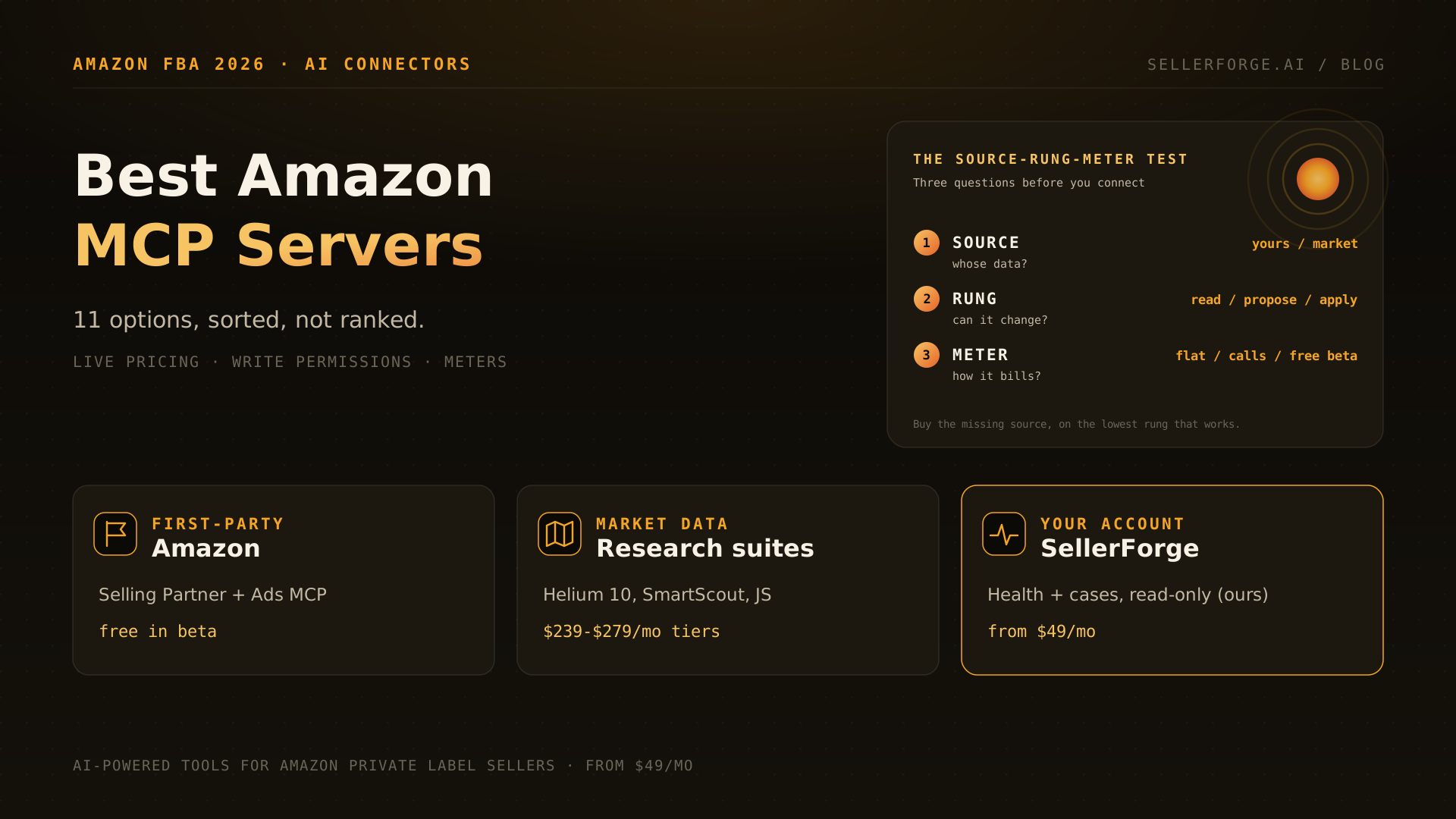
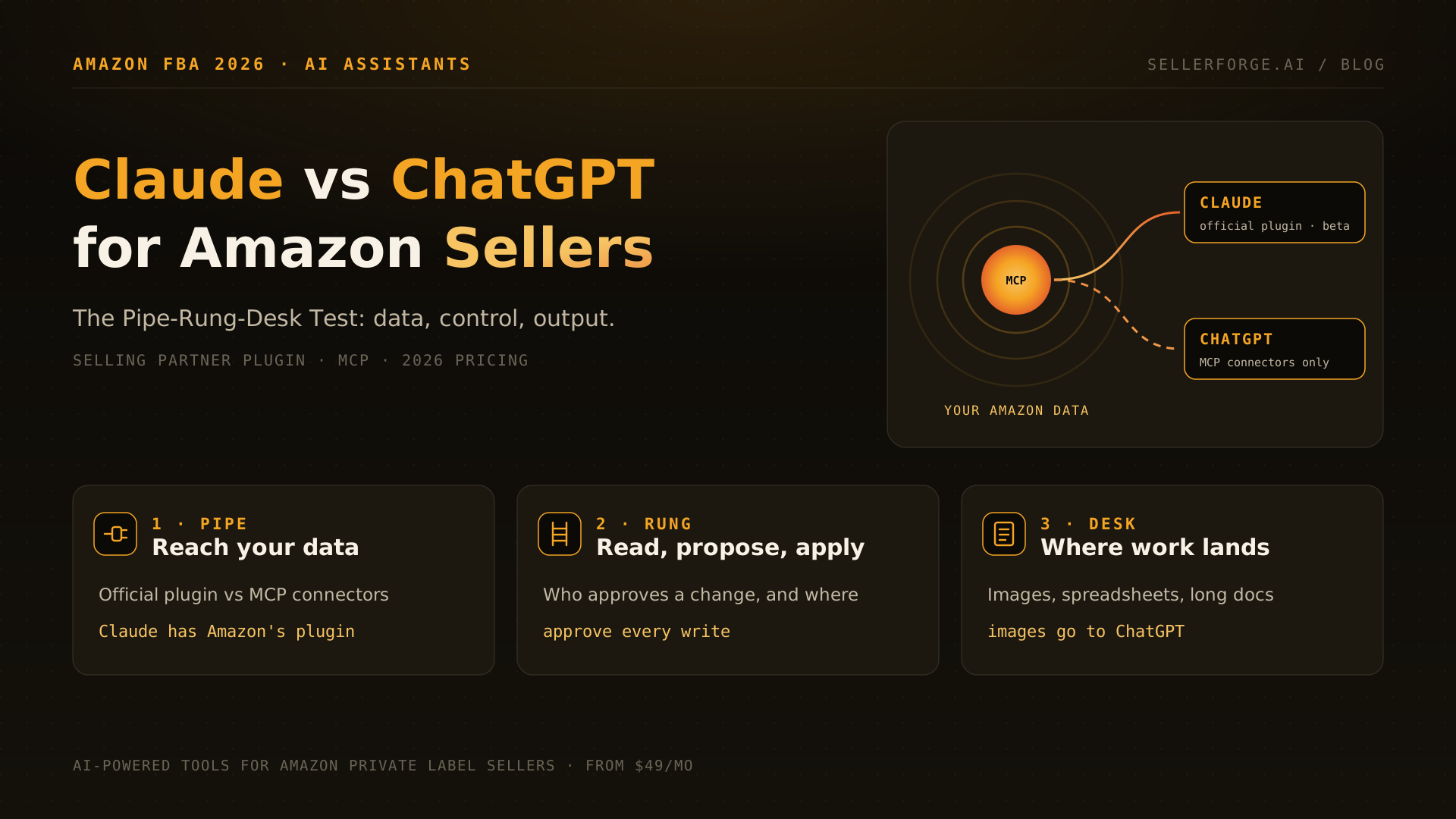
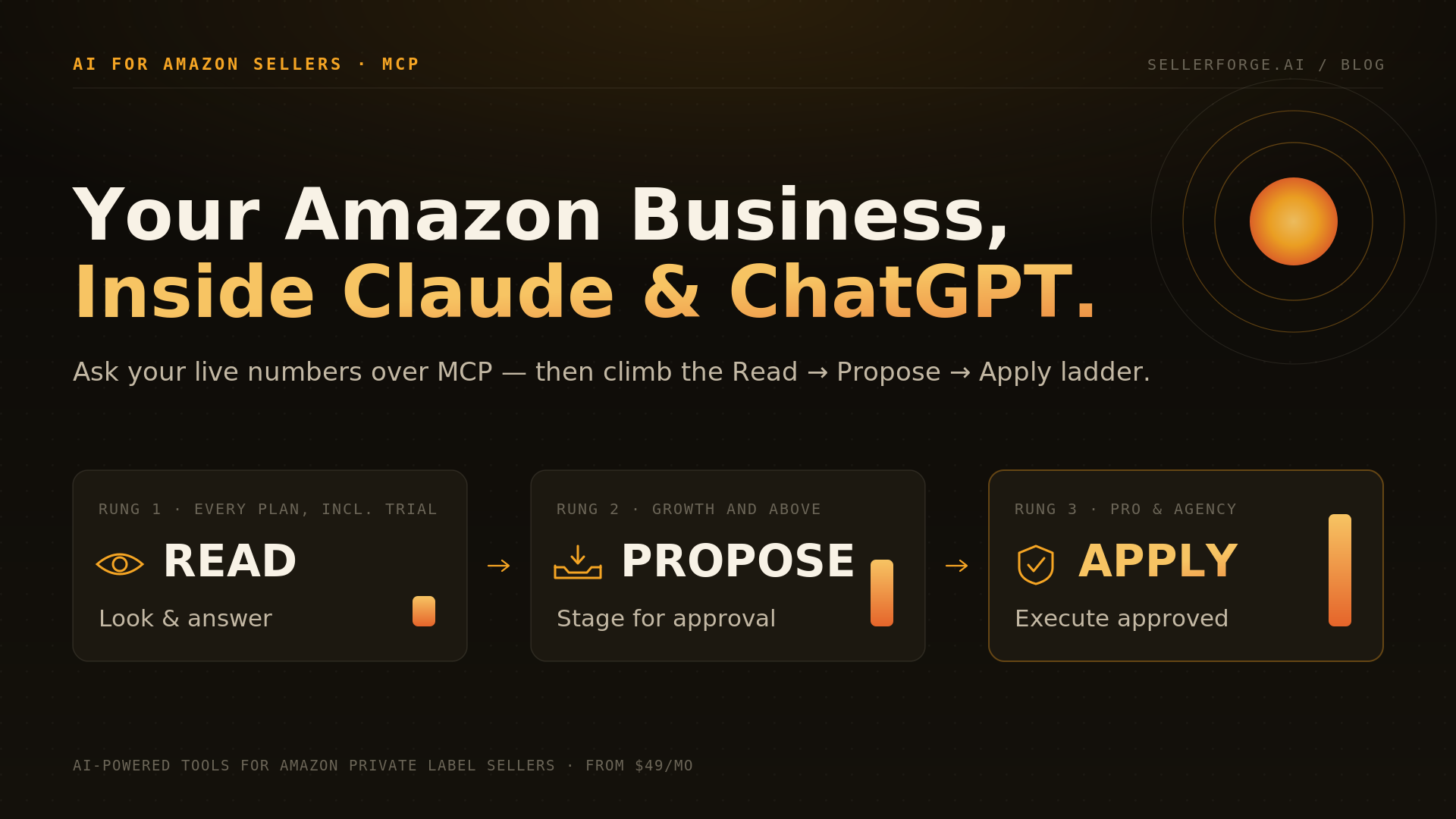
The complement stack gets much more concrete once your own tools speak to your assistant directly: see our Amazon seller MCP guide for how to connect Seller Central data to Claude or ChatGPT, what Amazon's official Ads MCP does and does not cover, and the approval ladder that keeps an AI from acting unsupervised.
For the bid-automation row, the head-to-head is refereed in full in Perpetua vs Pacvue: which Amazon PPC platform fits — verified 2026 pricing for both platforms, goal-based vs rule-based automation, and who genuinely fits each.
Where SellerForge Fits (and Where It Doesn't)
SellerForge is whole-account AI for Amazon sellers: it connects your real account data plus the things Amazon's assistant never sees — your business-event timeline, your documents, your other accounts — and puts an AI on your side of the table. Core starts at $49/month, Growth at $99/month adds Forecasting, advanced ads and Promotions, and agencies run the $499 Agency tier across client accounts. It is deliberately built at four of the five walls; the profit wall is the one it does not cover today.
And where we lose, honestly: if your whole need is pre-launch product research, buy Jungle Scout or Helium 10, not us. If you spend six figures a month on ads and want algorithmic bidding, Perpetua or Pacvue beat our advertising module at that one job. And if you are a small seller whose questions are all answered inside Seller Central — Seller Assistant is free, and free is the right price. We earn the subscription at the walls, or not at all.
How Should Agencies Treat Seller Assistant?
As a floor-raiser, not a threat — but a floor-raiser that resets what clients will pay for. Every client now has a free assistant answering the questions that used to justify a chunk of a retainer. Agencies that survive that reset sell what the assistant cannot do: cross-client operations, profit accountability, advocacy, and judgment.
The Operator's Bottom Line
Across the 57 accounts I managed at Worldfront, the expensive failures were almost never rule-following failures — Amazon's tooling, even pre-AI, kept those visible. The expensive failures were wall failures: profit nobody computed truthfully, appeals nobody drafted properly, money nobody clawed back, context nobody carried from one quarter to the next. Seller Assistant makes the rule-following cheaper than ever, and it does nothing about the walls. That is not a flaw. It is a boundary — and boundaries are where your stack, and your judgment, still earn their keep.
So: turn Seller Assistant on this week. Give it the inventory nudges, the compliance checks, the policy questions. Accept the 90% of recommendations that deserve accepting. Then look honestly at the five walls and decide, job by job, who works for you on the other side.
About the author
David Gallo is the founder of SellerForge.ai. He previously managed 57 Amazon accounts representing over $350M in sales at Worldfront before building SellerForge to give sellers AI-powered tools at agency quality without the agency price.