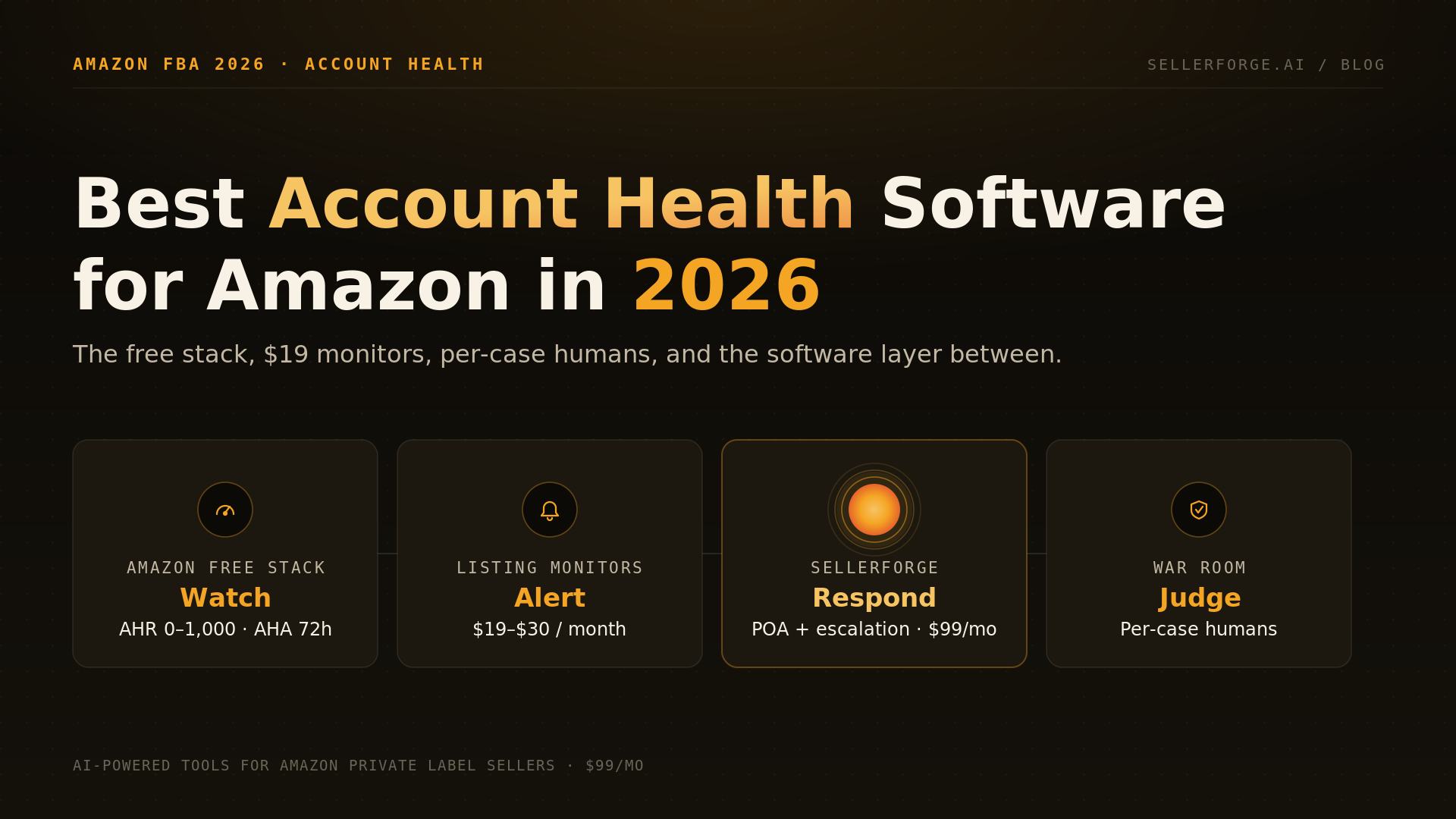
The best Amazon account health software in 2026 depends on the job: Amazon's free Account Health Dashboard covers metric tracking, $19–$30 listing monitors like SentryKit cover alerting, per-case human services cover complex reinstatements, and SellerForge (our product, disclosed) is the flat-rate AI platform that monitors health in whole-account context, drafts Plans of Action, and builds escalation plans at $99/month. Most pages ranking for this query sell monitoring retainers on data Amazon publishes free.
Type 'best Amazon account health software' into Google and almost nothing on page one is software. The results are offshore monitoring agencies, suspension-appeal services, and listicles that quietly mix the two. So here is the honest map. Amazon's free Account Health Dashboard already covers metric tracking. Listing monitors in the $19–$30 range cover alerting. Per-case consultants and attorneys cover complex reinstatements. And SellerForge, our product (disclosed here and throughout), is the AI software layer for the part in between: continuous monitoring, root-cause diagnosis, Plan of Action drafting, and escalation planning from $49 a month.
I managed 57 Amazon accounts representing more than $350M in sales at Worldfront, and I never once watched an account die from a lack of monitoring data. Amazon scores every account from 0 to 1,000, updates the score as violations occur, and emails you when it moves. The accounts that died responded slowly, or badly, to what the dashboard was already telling them. That distinction, watching versus responding, is the key to spending money well in this category.
This guide covers what Amazon gives every seller free, what the $19–$30 monitoring tools actually catch, what human services cost per case in 2026, a comparison across all four categories, and a simple rule for deciding which you need. Because we sell software in this category, treat every recommendation here as disclosed, and check the criteria yourself.
What is Amazon account health software?
Amazon account health software is any tool that monitors the performance metrics and policy signals feeding your Account Health Rating, alerts you when something moves, and helps you respond before Amazon escalates to a listing removal or account deactivation. The market splits into four categories: Amazon's free native stack, third-party listing monitors, human services, and operations platforms.
| Category | Examples | Typical 2026 price | The job it does |
|---|---|---|---|
| Amazon native stack | Account Health Dashboard, AHR, Account Health Assurance | Free | The official score, the violation list, and the 72-hour safety net |
| Listing monitors | SentryKit, AMZAlert, SellerSonar, Bindwise | $19–$30/month | Alerts when listings get suppressed, hijacked, or changed |
| Human services | Riverbend Consulting, appeal agencies, seller attorneys | $200–$300 assessments; $2,000+ reinstatements | Per-case judgment on complex suspensions and appeals |
| AI operations platform | SellerForge (ours) | From $49/month | Monitoring plus diagnosis, POA drafting, escalation plans, evidence vault |
What does Amazon give you for free?
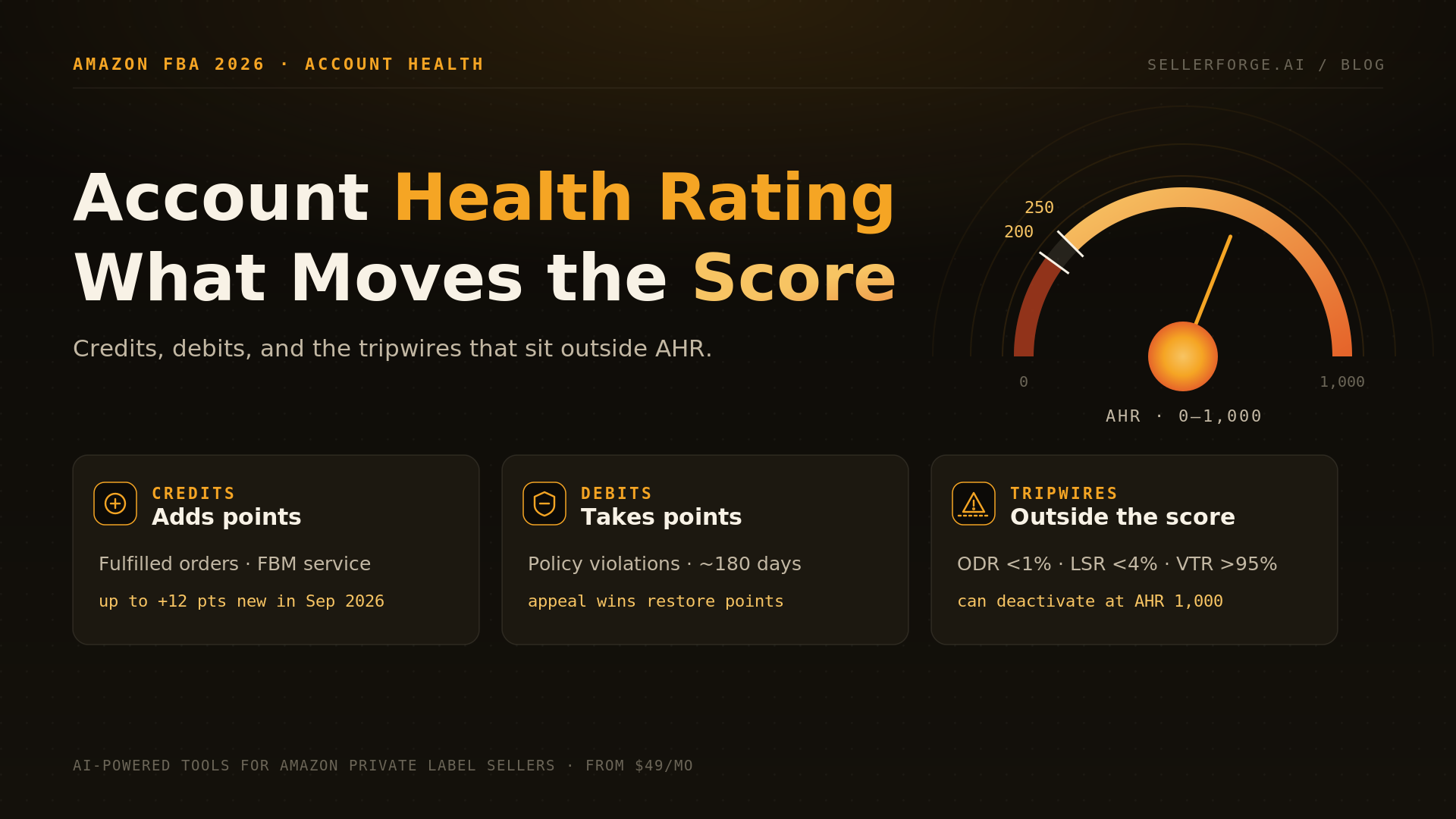
Amazon gives every seller the Account Health Dashboard, the Account Health Rating (a 0–1,000 score that moves as violations occur and resolve), Account Health Assurance for consistently healthy accounts, and phone support from Account Health specialists. Any paid tool has to beat this baseline, because the baseline already covers metric tracking and official warnings.
The dashboard tracks three areas: customer service performance, policy compliance, and shipping performance. The thresholds that matter are order defect rate under 1%, pre-fulfillment cancellation rate under 2.5%, late shipment rate under 4%, and valid tracking rate at 95% or higher. Policy compliance is where the score actually swings, because violations are weighted by severity, recency, and account size.
| AHR score | Status | What it means |
|---|---|---|
| 200–1,000 | Healthy (green) | Account in good standing; 250+ sustained is the Account Health Assurance bar |
| 100–199 | At risk (yellow) | Deactivation risk if open violations are not resolved |
| 0–99 | Unhealthy (red) | Eligible for deactivation, and often already deactivated |
Free covers watching. Nothing free covers responding: Amazon tells you a violation exists, but the 300–500 word Plan of Action, the evidence file behind it, and the escalation sequencing are entirely on you. Every paid option in this guide is really selling a response layer, whether the vendor says so or not.
Software or a service? The Watchtower–War Room Rule
The Watchtower–War Room Rule: buy software for the watchtower, hire humans per case for the war room, and never pay a monthly retainer for someone to watch a dashboard Amazon publishes free. Watching is a software job because it is continuous, cheap, and pattern-based. War-room cases are human jobs because they are rare, high-stakes, and judgment-heavy.
The watchtower is everything that should run without you: metric drift alerts, suppression and hijacker detection, violation triage, first-draft appeals, evidence retrieval. The war room is the short list of events where experience with Amazon's enforcement teams changes outcomes: Section 3 deactivations that hinge on identity or linked accounts, funds withheld after the 90-day settlement period, bad-faith IP attacks heading toward litigation, and failed identity verification loops.
Best Amazon account health software and services in 2026, compared
Here is the market as it actually exists in 2026, priced, with each option's honest ceiling. No affiliate links, and the last row is ours.
| Option | Type | 2026 price | Where it wins | Where it stops |
|---|---|---|---|---|
| Account Health Dashboard + AHA | Amazon native, free | $0 | The official score, every violation, and the 72-hour AHA safety net | No response help: no POA drafting, no escalation strategy |
| SentryKit | Listing and account monitor | From $19/month | Order-volume pricing, 22+ alert types, hijacker and suppression alerts on every plan | Alerts only: tells you something broke, not what to do about it |
| AMZAlert / SellerSonar / Bindwise | Listing monitors | Roughly $20–$30/month | Cheap, reliable pings for suppressions, hijacks, and content changes | Same ceiling: monitoring without diagnosis or response |
| SellerQI | Analytics suite with health alerts | Freemium, paid tiers | Listing-level policy alerts inside a broader listing-quality suite | Health is a feature, not the product; no POA or escalation layer |
| Riverbend-class consultants | Human, per case | $300–$700 simple; $1,500–$3,000 complex | Complex Section 3, verification, and funds-withheld cases | Priced per incident; their monitoring retainers re-sell the free dashboard |
| E-commerce attorneys | Human, legal | $2,000+ typical engagements | Bad-faith IP attacks, arbitration, cases with legal exposure | Overkill for routine violations and metric problems |
| SellerForge (ours) | AI operations platform | From $49/month | Monitors health in whole-account context, drafts POAs from your data, sequences escalations, keeps the evidence vault | Not a law firm; identity-hinged Section 3 cases still warrant a human specialist |
Read the middle column honestly and the routing writes itself. If alerts are all you want, SentryKit at $19 a month beats us on price and is excellent at exactly that job. If your case involves linked-account identity questions, withheld funds, or anything a court might eventually see, Riverbend-class consultants and seller attorneys beat any software, ours included. The software case is everything between those poles, which happens to be where most sellers live most of the time.
What should account health software actually do? The six-point checklist
A real account health platform does six jobs: watches all three dashboard categories, ties every violation to revenue at risk, drafts the response from your own account evidence, knows the current escalation ladder, keeps the evidence vault stocked before the complaint, and covers every account and marketplace you operate. Use the list below as a buying checklist regardless of whose product you evaluate, including ours.
- Watches all three categories, not just listings. Suppression pings are the easy third of the job; the score-killers are ODR drift, late-shipment creep, and policy-compliance clusters that listing monitors never see.
- Ties violations to money. A policy flag on an ASIN doing $40,000 a month and one on a dead SKU are not the same emergency, and a tool that cannot rank them is making you do the triage.
- Drafts the response from evidence, not vibes. The three-section structure Amazon's reviewers expect (root cause, corrective actions, preventive measures) is documented in our guide to writing a Plan of Action, and a serious tool pre-fills it from your orders, messages, and invoices in the 300–500 word range that gets read.
- Knows the 2026 escalation ladder. Since late 2025 the sequence is Submit Appeal, then the Seller Challenge lane for wrongful listing-level enforcement (three challenges per 180 days, decisions in roughly 48 hours), then Executive Seller Relations. Software should sequence these, because spraying appeals burns rungs.
- Keeps the evidence vault stocked before the complaint. IP complaints deduct 2–8 AHR points each and the fastest exits depend on producing invoices, authorization letters, and test reports the same day, not after a week of inbox archaeology.
- Covers every account and marketplace you run. AHR is scored per marketplace, and agencies and multi-brand operators need one view across all of them, not eight logins.
And when the score does drop, the response drill matters more than the tooling. This is the five-step sequence I trained every account manager to run:
- 1Open the Account Health Dashboard and identify which of the three categories moved before touching anything else.
- 2Sort the violation by family (metric drift, policy violation, IP complaint, or Section 3), because each family has a different playbook and a different clock.
- 3Pull the evidence file for the affected ASINs the same day: invoices, tracking, buyer messages, supplier records.
- 4Draft the three-section response and have it reviewed once before submitting, because a burned first appeal narrows every later path.
- 5Calendar the escalation ladder before you need it, and move one rung at a time instead of resubmitting the same text.
When should you hire a human service instead?
Hire a human for the war-room cases: Section 3 deactivations that hinge on identity or linked accounts, funds withheld after the 90-day settlement period, bad-faith IP attacks that may end up in court, and verification loops you have already failed once. These are rare, high-stakes, and judgment-heavy, which is exactly where per-case experts earn their fee.
The tell of a bad vendor in this category: a monthly monitoring retainer plus a separate per-case fee when trouble comes. That is paying twice, once at service rates for a software job, and again for the only part that was ever worth human rates.
Where SellerForge fits (and where it does not)
Who should pick what in 2026
- New seller under $10K/month: the free stack plus discipline. Check the dashboard twice a week, keep the four metrics inside thresholds, and target AHR 250+ from day one so Account Health Assurance is active before you ever need it.
- Growing private label, one account: add the software layer. A monitor if budget is tight; SellerForge if you want the response layer too, since one prevented deactivation or one clean IP exit pays for the year.
- Brand that attracts IP flak (competitive category, hijacker history): software watchtower plus an attorney relationship established before the next complaint, with the evidence vault stocked now.
- Agency or aggregator: multi-account software monitoring with client-ready POAs and reports (our Agency tier at $499/month), plus a per-case consultant relationship for the war-room files.
- Suspended right now: skip the software aisle entirely today. Run the first-48-hours playbook, hire per-case help if the trigger family warrants it, and come back to prevention tooling after reinstatement.
About the author
David Gallo is the founder of SellerForge.AI. Before building it, he managed 57 Amazon seller accounts representing more than $350M in sales at Worldfront, where account health reviews were a Monday-morning ritual and a deactivation notice meant a very bad week. He writes the SellerForge blog for operators, not affiliates.