
A used sold as new complaint means a buyer told Amazon an item listed as New arrived showing prior use. Amazon logs it as a Product Condition Customer Complaint — a violation that can remove the listing and, in a pattern, deactivate the account. Sort the complaint's origin first — your operation, Amazon's fulfillment layer, or the listing's promise — because origin decides evidence, fix, and whether the appeal survives. SellerForge's POA Builder drafts that appeal from your account's own data.
A used sold as new complaint is one of the quietest ways to lose a listing on Amazon — and one of the most misdiagnosed. The complaint itself is a symptom. The disease is a used unit reaching a customer who paid for New, and until you know where that unit picked up its history, every appeal you write is a guess.
The backdrop makes the math unforgiving. The National Retail Federation projects Americans will return nearly $850 billion in merchandise for 2025 — about 15.8% of retail sales, with online purchases returning at roughly 19.3%. Every one of those returns is a unit that might re-enter somebody's sellable inventory. Some of them re-enter yours.
Across the 57 accounts I managed at Worldfront, product condition complaints were the violation we saw most often land on sellers who had done nothing unusual — because the used unit frequently entered the supply chain after it left their hands. This playbook covers what the violation actually is, the Three-Origin Sort I use to find where the used unit came from, the 2026 appeal flow step by step, and the prevention system that ends repeat complaints. (Disclosure up front: I run SellerForge, whose account-health tooling appears near the end — the sort and the appeal work the same whether or not you ever use it.)
What Does Used Sold as New Actually Mean on Amazon?
A used sold as new complaint means a customer reported that an item you listed in New condition arrived showing signs of prior use — opened or resealed packaging, missing protective film, scuffs, hair or fingerprints, a previous owner's data on a device, or a return label inside the box. Amazon records it under Product Condition Customer Complaints on your Account Health page.
Amazon's condition guidelines define New as a brand-new, unused, unopened item in its original packaging, with all original packaging materials and any applicable manufacturer warranty intact. Notice what that standard is measured against: not your intent, and not your inspection — the customer's unboxing. A factory-sealed unit whose seal cracked in transit and a deliberately re-shelved return read identically to the buyer opening the box.
It helps to be precise about what this violation is not. It is not an authenticity complaint — the buyer is not claiming the product is fake, only that it is not new. Authenticity asks whether the item is genuine; condition asks whether it arrived as promised. The two violations sit in different rows of your Account Health page, demand different evidence, and carry different severity. Mixing them up in an appeal is a fast route to a rejection.
The complaint reaches Amazon through more channels than most sellers watch. Return reasons like item not as described or used item, buyer-seller messages, product reviews that mention condition, chargebacks, and A-to-z claims all feed Amazon's negative customer experience signals. One high-visibility report can be enough to trigger a violation; so can a quiet pattern of return comments nobody read.
What Happens to Your Account When a Complaint Lands?
One complaint typically produces a policy violation on your Account Health page and a one-time deduction from your Account Health Rating, and — depending on severity and repetition — anything from a warning, to the listing losing its offer, to a Section 3 deactivation of the whole account. The violation posts under Performance → Account Health → Policy Compliance.
| Stage | What Amazon does | Your clock |
|---|---|---|
| Warning / violation posted | Violation appears in Account Health with an AHR deduction; listing usually still live | Appeal any time; unresolved violations fall off after ~180 days |
| Listing deactivated | The ASIN loses its offer until the violation is resolved | Condition-complaint appeals are typically reviewed in ~3 days |
| Account at risk | AHR trends toward the deactivation threshold; critical warnings appear | AHA members (AHR 250+ for 6 months) get 72 hours to engage before most deactivations |
| Account deactivated | Section 3 notice; funds may be held under a 90-day settlement process | Generally a 90-day window to appeal the deactivation |
Two mechanics soften the blow if you act. First, the AHR hit is a one-time deduction, and Amazon reinstates the points once the violation is successfully removed — so a clean appeal repairs the score, not just the listing. Second, the escalation path on rejection got real structure in 2026; the ladder is mapped in our Section 3 deactivation guide, and the first-48-hours triage in the suspension playbook applies here unchanged.
Do not delete the listing to make the violation disappear. The violation record persists until it is appealed or ages out, the complaint still counts toward your pattern, and you have thrown away the sales history for nothing.
The Three-Origin Sort: Find Where the Used Unit Came From
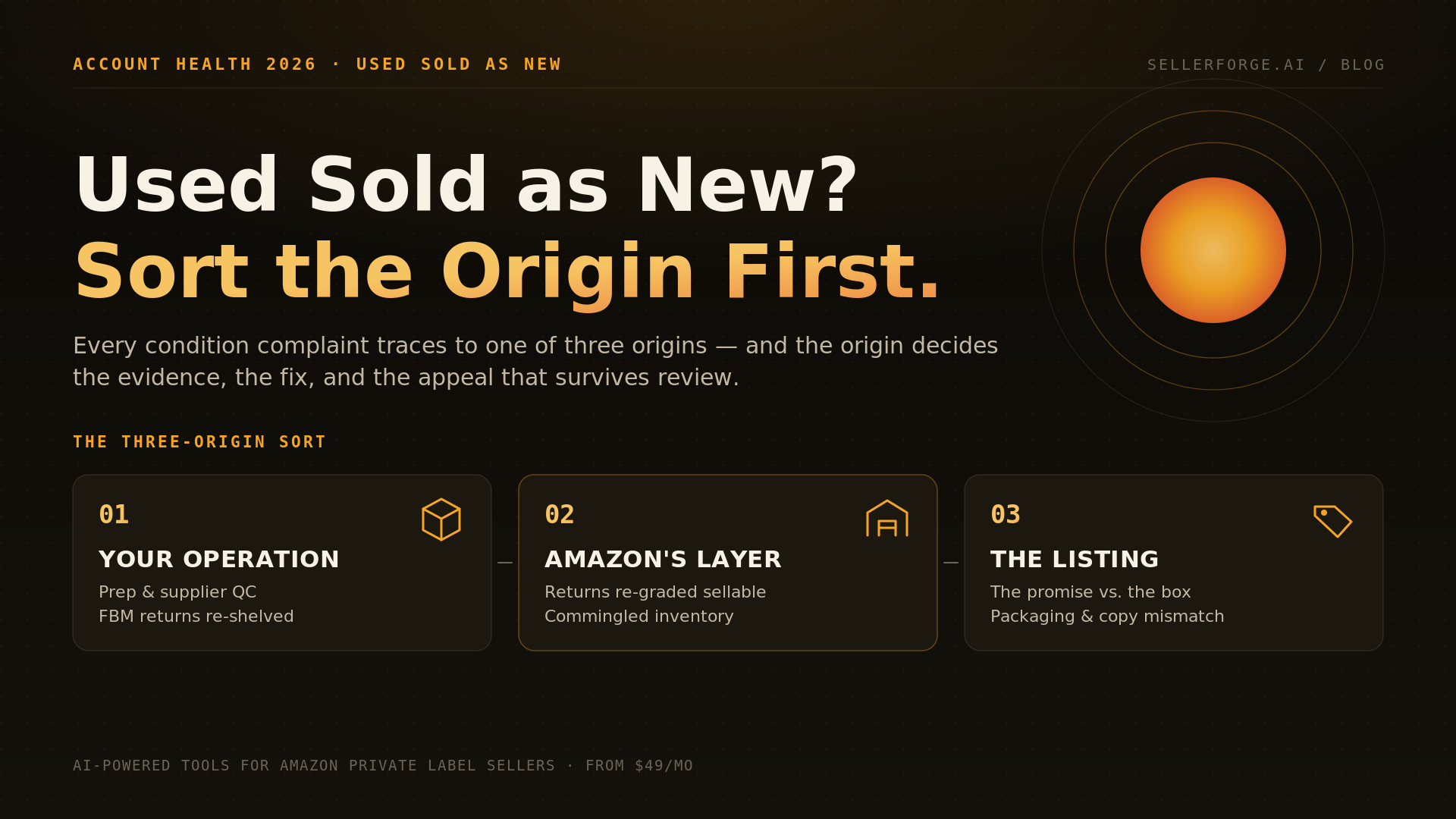
Every used sold as new complaint traces to exactly one of three origins: your operation, Amazon's fulfillment layer, or your listing's promise. Sort the complaint into its origin before you write a word of appeal — the origin decides what evidence exists, what fix is real, and what a credible root cause statement even sounds like.
Origin one: your operation. A supplier shipped shelf-worn or open-box stock, your prep step skipped inspection, an FBM return went back on the shelf ungraded, or your packaging fails in transit so units arrive looking opened. This is the origin appeal reviewers see claimed least and believe most — owning it, with the process change attached, is persuasive.
Origin two: Amazon's fulfillment layer. Amazon evaluates every FBA return at the fulfillment center and routes units it judges sellable straight back into inventory, and with stickerless commingled inventory the unit shipped for your order may have been pooled from another seller entirely. You never touched the used unit — but the complaint is still yours to resolve, and blaming Amazon in an appeal without evidence reads as deflection.
Origin three: the listing's promise. Nothing about the unit is used — the detail page just promised something the box does not deliver. Retail-boxed photos over frustration-free packaging, a repackaged multipack, missing packaging-may-vary language, or bulk-sourced goods with handling marks the listing never mentioned. Customers report what they perceive, and perception is set by the page.
| Origin | Telltale signs | The fix | Appeal evidence |
|---|---|---|---|
| Your operation | Complaints cluster on one batch or PO; FBM orders affected; supplier changed recently | Incoming QC sampling; 100% inspection of FBM returns before re-shelving; packaging upgrade | Inspection SOP, QC records, supplier invoices, corrective PO or supplier change |
| Amazon fulfillment layer | FBA-only complaints; order IDs trace to previously returned units; commingled (manufacturer barcode) setting on | Switch to FNSKU labeling; removal-order cadence for returned stock; enroll FBA Grade and Resell | Return and reimbursement reports, barcode-setting change confirmation, removal order IDs |
| Listing promise | Complaints mention packaging, not the product; returns say not as described; product itself pristine | Fix photos and copy to match what ships; add packaging-may-vary where honest | Before/after listing content, updated images, return-reason trend after the change |
The sort takes an hour with the right reports open: pull the complaint's order IDs, check whether each unit had been returned before it shipped again, check your barcode setting, read the exact words of the return reasons. That hour is the appeal. Reviewers reject vague root causes daily; they approve specific ones with matching evidence.
Why FBA Returns Are the Top Source of Condition Complaints
FBA returns generate more used sold as new complaints than any other mechanism because Amazon — not you — decides whether a returned unit goes back on the shelf as New, and that evaluation happens at warehouse intake speed. Industry analyses of FBA returns processing put roughly 60–70% of returned units back into sellable inventory after Amazon's check.
Most of those re-shelved units are genuinely fine. But the failure mode is structural: a buyer opens a device, sets it up, repacks it neatly, and returns it as unopened — and a fast visual check at intake sends it back into New stock with the last owner's fingerprints on the screen. Analyses like ReturnPro's guide to FBA returns processing describe exactly this pipeline. Category pressure varies with return rates — apparel runs 20–40% and electronics 8–15% per 2026 benchmark roundups, against a typical FBA range of 5–15% — so the more returnable your category, the more second-life units are circulating in it.
Run the math on a healthy account: 1,000 units a month at a 10% return rate is 100 returns; if even 5% of the re-shelved ones carry visible history, five customers a month are unboxing someone else's purchase. At scale, a complaint pattern is not bad luck — it is a probability you have not managed yet.
Two levers change the odds. FBA Grade and Resell lets Amazon grade eligible returns into Used conditions — Like New, Very Good, Good, Acceptable — and relist them honestly under your account, recovering value from units that should never again ship as New. And a standing removal-order cadence pulls returned stock out for your own inspection instead of trusting intake grading with your Account Health. Neither is free of cost or effort; both are cheaper than a deactivation.
Commingling deserves its own sentence: if your inventory setting uses the manufacturer barcode, Amazon may fulfill your order with an identical unit pooled from another seller — including one that seller sourced or handled badly. Switching to the Amazon barcode (FNSKU) on every new shipment ends the pooling, and makes every future complaint traceable to stock you actually own.
How Do You Appeal a Product Condition Complaint in 2026?
The appeal runs through the Account Health page, not email: Performance → Account Health → Product Condition Customer Complaints → Submit appeal. The guided flow tells you what this specific violation requires — a Plan of Action, supporting documents, or both. Condition-complaint appeals are typically reviewed in about 3 days; account deactivations carry a longer, 90-day appeal window.
- 1Open the violation from Account Health itself — not the email summary — and read exactly which ASIN, which orders, and what Amazon is asking for.
- 2Pull the evidence trail before forming a theory: order IDs, return reasons, buyer messages, and the Voice of the Customer comments for the ASIN.
- 3Run the Three-Origin Sort honestly. If the trail shows a previously returned unit re-shipped, say so; if your prep skipped inspection, say that.
- 4Gather documents that match the origin: supplier invoices from the last 365 days (supplier name, address, contact; ASIN identifiable; quantities plausible), inspection SOPs, removal order IDs, or listing change records.
- 5If a Plan of Action is requested, write the standard three sections — root cause (specific, no excuses), corrective actions (past tense, already done), preventive measures (systemic) — in 300–500 words.
- 6Attach clean, unaltered documents. Redacting prices is fine; editing anything else is how legitimate sellers get treated as forgers.
- 7Submit through the guided flow and track the case — expect movement in about 3 days for listing-level condition violations.
- 8If rejected, fix the root cause statement first (shallow root cause is the top rejection reason), then work the 2026 escalation ladder rather than re-spamming the same appeal.
The three-section structure and the phrasing that passes review are covered in depth in how to write an Amazon Plan of Action, with worked examples in the POA template library. The short version: reviewers pattern-match for specificity. A root cause that names the batch, the process gap, and the date reads as true; a root cause that promises to provide better customer experience going forward reads as a template.
The Prevention System That Ends Repeat Complaints
Prevention means putting a control on each of the three origins and running those controls on a calendar, because a one-time cleanup decays. The sellers who stop seeing this violation are not lucky — they made each origin boring: inspected stock in, graded returns out, and a listing that promises exactly what ships.
- Returns: run a monthly removal-order cadence for customer-returned units you want eyes on, inspect 100% of FBM returns before anything re-shelves, and enroll eligible ASINs in FBA Grade and Resell so borderline units sell honestly as Used instead of gambling your Account Health as New.
- Inventory identity: switch to Amazon barcode (FNSKU) labeling on every new shipment so no pooled stranger-unit can become your complaint.
- Supplier: sample incoming cartons against a written QC checklist, photograph what master cartons and units look like on arrival, and file it — evidence collected before a complaint is worth ten times evidence reconstructed after.
- Listing: audit the promise quarterly — do the photos show the packaging that actually ships, is packaging-may-vary stated where honest, does a multipack say it is seller-assembled?
- Monitoring: read Voice of the Customer and return reasons weekly; a bad batch announces itself in return comments two to three weeks before it becomes a violation.
The returns half of this system pays for itself twice — the same triage that catches condition risks is the one that defends your margins from the 2026 returns-fee changes, which we built out in the returns fee margin defense playbook. One process, two problems retired.
Where SellerForge Fits (and Where It Does Not)
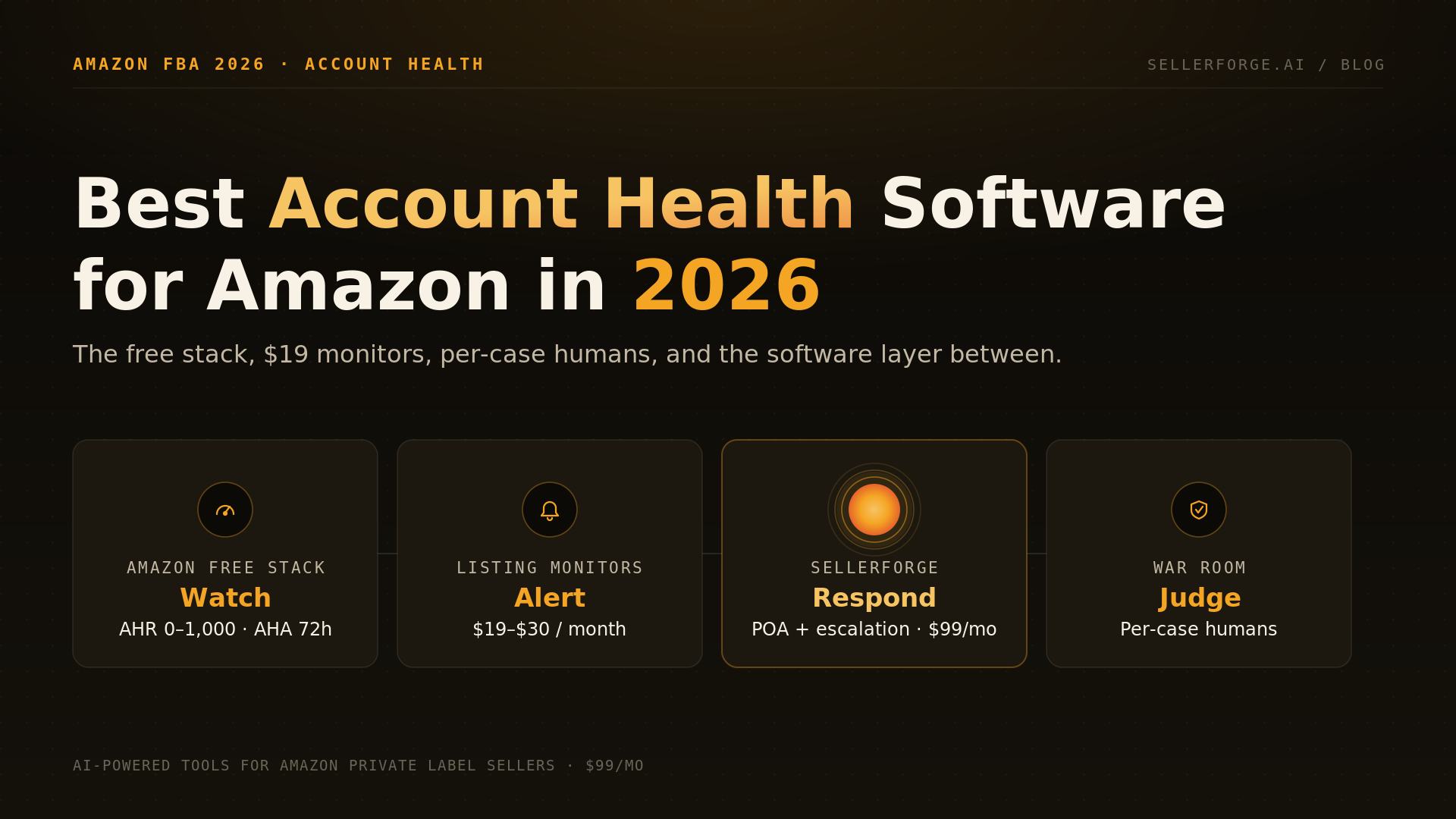
Disclosure: SellerForge is our product. The fit here is the system around the appeal, not magic words in it. The account health layer watches your AHR, violations, and Voice of the Customer signals so a condition pattern surfaces while it is still a returns anomaly; the POA Builder drafts the three-section appeal from your account's actual data — the order IDs, the return reasons, the dates — instead of a generic template; the Document Vault keeps invoices and QC records filed before trouble, which is what makes a 365-day-invoice request a ten-minute task; and Escalation Plans map the path when a first appeal fails. Plans run from $49/mo (Core $49, Growth $99, Pro $199, Agency $499).
The honest boundary: software is the watchtower, not the war room. A catastrophic deactivation with six figures of funds held, suspected related-account entanglement, or anything smelling of legal exposure is a moment for an experienced human — a reinstatement service or an e-commerce attorney — and we said exactly that, with the decision rule, in the account health software guide. Use software to make sure you rarely need the war room.
The Bottom Line
Used sold as new is rarely a moral failing and never just bad luck — it is a traceable unit with a history, and your job is to trace it. Sort the origin, fix that origin, and write the appeal the evidence supports. Across 57 accounts, I never saw a specific, evidence-matched condition appeal fail twice; I saw template appeals fail five times in a row on the same ASIN.
The deeper habit is running the prevention calendar when nothing is wrong. Every seller has a used unit somewhere in their pipeline right now. The ones who never meet this violation are the ones who find it first.
Want the watchtower running before the next complaint? Start a free SellerForge trial — connect your account, and the account health layer, POA Builder, and Document Vault are watching your violations, returns signals, and evidence file from day one. From $49/mo.
About the author
David Gallo is the founder of SellerForge.ai. Before building SellerForge, he managed 57 Amazon seller accounts representing more than $350M in lifetime sales at Worldfront — where the fastest condition-complaint fix he ever shipped was a $0 settings change: turning off commingled inventory.


&category=Account%20Health&type=hero)