For running an Amazon business in October 2026, Claude is the stronger base for most U.S. sellers, because Amazon's official Selling Partner plugin works in Claude (beta) and not ChatGPT, and Claude allows data connectors on every plan, including Free. ChatGPT still wins for listing image concepts, voice, and teams already on ChatGPT Business. Both speak MCP, so connectors like SellerForge (ours, from $49/mo) work in either.
Here is the short answer I give every seller who asks me this in October 2026: Claude is the better base for running an Amazon business today, and ChatGPT is the better tool for making things that people look at. The reason is not writing quality. It is plumbing. On September 23, 2026, Amazon launched its official Selling Partner plugin, and it works in Amazon Quick and Claude, not ChatGPT.
Across the 57 accounts I managed at Worldfront, the expensive AI mistakes were never bad prose. They were confident answers built on numbers the model never saw. So this guide grades both assistants on three things: the pipe into your data, the rung of control it gets, and the desk where the work lands.
Is Claude or ChatGPT Better for Amazon Sellers in 2026?
Claude is better for Amazon account operations in 2026, because it is the only general-purpose assistant with Amazon's official Seller Central plugin and it allows custom data connectors on every plan. ChatGPT is better for image-heavy creative work and for teams that already run on ChatGPT Business. For plain writing, the gap is too small to decide anything.
The comparison most blogs run, pasting the same listing prompt into both and judging the output, measures the least important variable. Both models write a compliant bullet. Neither knows that your hero ASIN has nine days of cover, that your order defect rate ticked up last Tuesday, or that the keyword you want to add is already indexed. A grounded mediocre answer beats an eloquent guess every time money is on the line.
| Amazon job | Claude | ChatGPT | Referee call |
|---|---|---|---|
| Read Seller Central data with Amazon's official plugin | Yes, beta for U.S. stores since Sep 23, 2026 | Not supported at launch | Claude |
| Connect third-party MCP connectors | Connectors on every plan, including Free | Custom MCP servers; writes only on Business, Enterprise, Edu | Claude for individuals, tie for teams on Business |
| Amazon Ads data via the official Ads MCP Server | Yes, any MCP client with Ads API credentials | Yes, same requirement | Tie |
| Listing image concepts, lifestyle mockups, A+ drafts | No native image generation | Native image generation on every tier | ChatGPT |
| Long inputs: settlement reports, 500-review dumps, SOPs | Context window up to 1M tokens, varies by model | Input limits vary by plan and model; check OpenAI's plan page | Lean Claude; test with your own files |
| Short, character-limited copy and brainstorming | Strong | Strong and fast | Tie, slight edge ChatGPT |
| Spreadsheet work on your own exports | Claude in Excel on Pro and up | Excel extensions expanded on Pro | Tie, check your plan |
Read that table as a routing map, not a scoreboard. Four of seven rows are ties or near-ties. The two that are not ties, the official Seller Central pipe and native image generation, are the ones that should decide which subscription you pay for.
Can ChatGPT Connect to Amazon Seller Central?
Two caveats keep this honest. First, the plugin is a beta that rolls out in waves, so having Claude does not guarantee access this week. Second, it has hard edges: independent write-ups of the launch scope note it does not reach Amazon Ads, financial settlements, Vendor Central, or multiple seller accounts. And context matters: Amazon has invested $8 billion in Anthropic, so Claude going first is a business relationship as much as a technical choice. That is not a reason to avoid it. It is a reason not to assume the gap is permanent.
Which Is Safer to Let Touch Your Amazon Account?
Both are safe at the read level when they connect through OAuth and official APIs. They differ on writes. Amazon's plugin in Claude requires your approval on every action and logs an audit trail. In ChatGPT, OpenAI limits full MCP write actions to Business, Enterprise, and Edu workspaces, where admins and owners add and publish the connection, and keeps Pro to read and fetch.
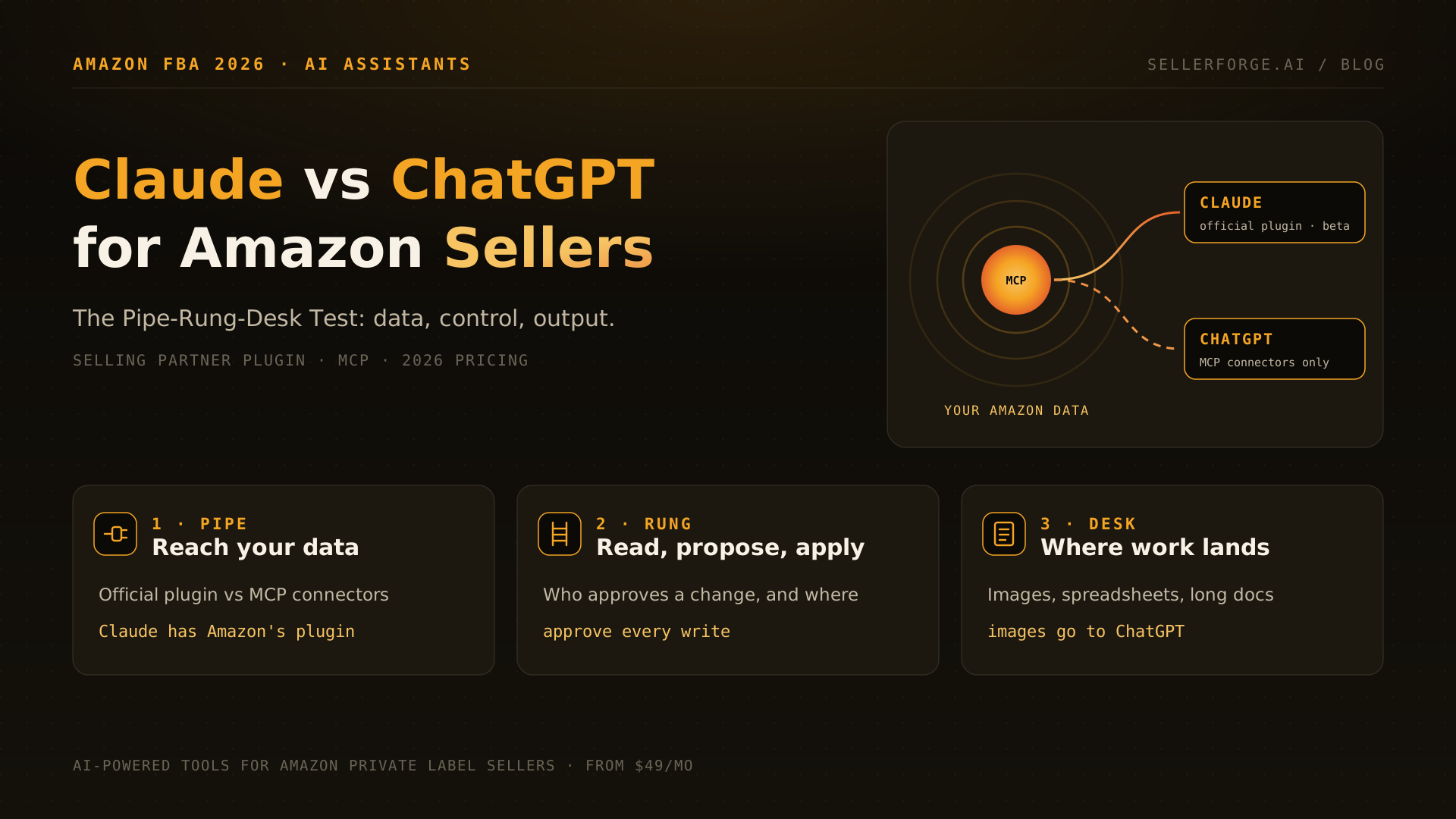
The Pipe-Rung-Desk Test: before you pick an AI for your Amazon business, answer three questions. PIPE: which connectors can reach my Amazon data from this client? RUNG: on my plan, can it only read, can it propose changes I approve, or can it apply them? DESK: where does the finished work land, an image, a spreadsheet, a long document, or a teammate's queue? Pick the client that wins two of three for the job you do most.
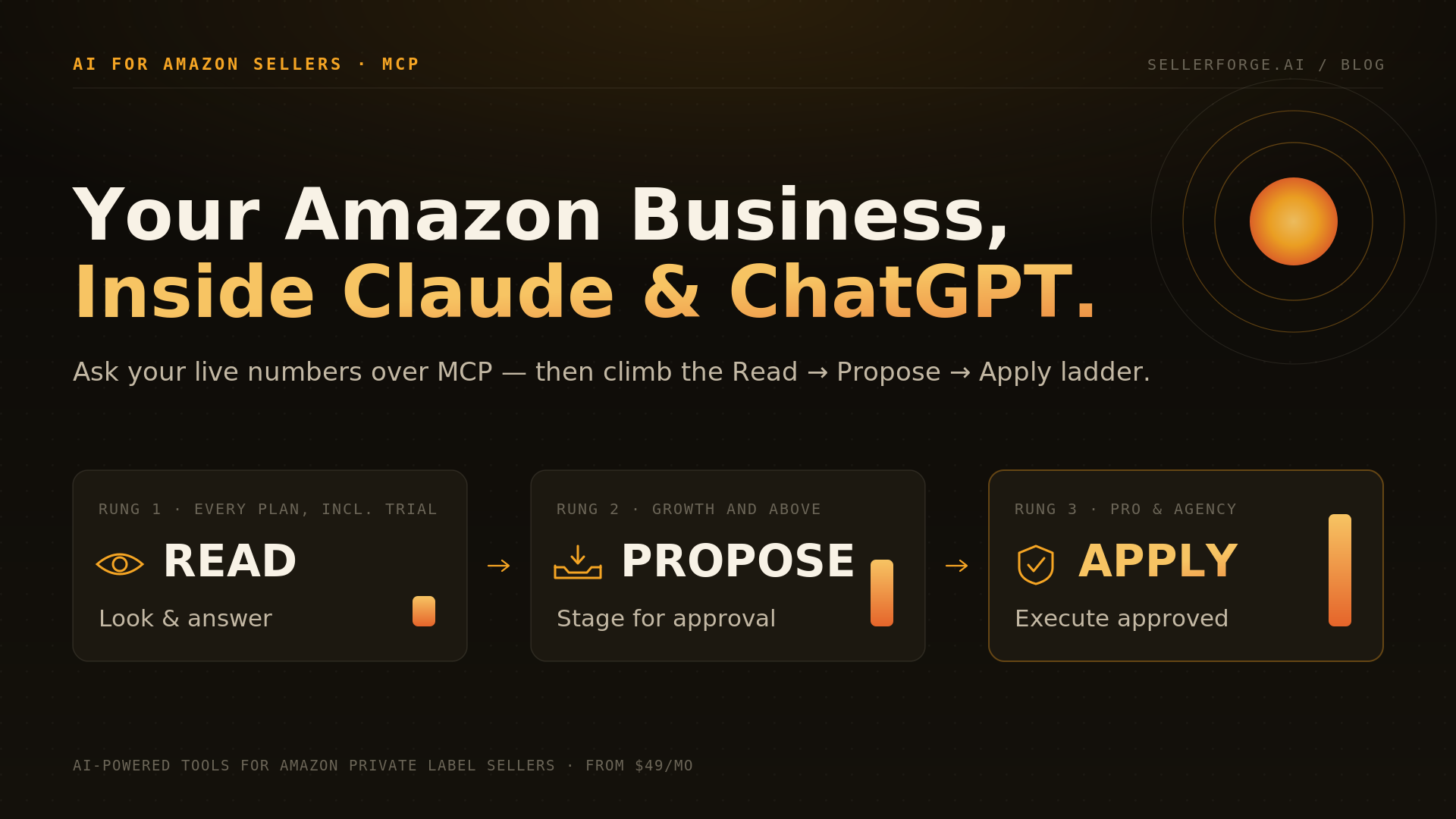
The rung question comes from the Read, Propose, Apply ladder we use for every connector. Reading is safe by design. Proposing puts a human approval between the model and your listing. Applying executes approved changes inside caps. The dangerous configuration is the one that skips the middle rung: a raw API bridge where a write goes through the moment the model decides to make it. Whichever assistant you choose, never grant a rung the connector never built.
Which Is Better for Amazon Listings and Images?
ChatGPT is better for listing visuals because it generates images natively and Claude does not. For listing copy the two are close: ChatGPT is quicker at punchy, character-limited lines, and Claude handles more source material at once, such as a full review export plus a brand style guide. Neither one knows Amazon's current listing rules unless you supply them.
Use ChatGPT's images for concepts, not final assets. Lifestyle scenes, infographic layouts, and A+ module mockups are fast to iterate there, and a photographer or designer then shoots or builds the real thing. Your main image still needs to show the actual product on pure white, and an AI render of a product that does not exactly match what ships is a returns and complaints problem waiting to happen.
Where Claude pulls ahead on listings is volume of evidence. Paste 500 reviews, three competitor listings, your return-reason report, and your brand voice document into one conversation, and Claude keeps all of it in view. That is the job I used to give a junior analyst for a day. It now takes ten minutes, and the bullets that come out answer the objections buyers actually raise.
How Much Do Claude and ChatGPT Cost for an Amazon Business?
The entry paid tiers cost the same: Claude Pro and ChatGPT Plus are both $20 a month. Claude Pro drops to $17 a month on annual billing and Max starts at $100. ChatGPT adds a cheaper Go tier at $8 in the U.S. and, since September 29, 2026, three Pro tiers at $100, $200, and $500. Team seats on both run $20 to $25 per user.
| Option | Price (Oct 2026) | How it reaches your Amazon data | Highest rung on that plan | Best for |
|---|---|---|---|---|
| Claude Pro / Max | $20/mo ($17 annual); Max from $100/mo | Amazon Selling Partner plugin (beta, U.S.) plus any custom MCP connector | Propose, with per-action approval in Amazon's plugin | Owner-operators running the account from one assistant |
| ChatGPT Plus / Pro | $20/mo; Pro $100, $200, or $500/mo | Third-party MCP connectors added as custom MCP servers; no official Amazon plugin | Read at most (Pro is read and fetch only per OpenAI) | Creative-heavy sellers: images, A+, ad concepts |
| ChatGPT Business | $25/user/mo ($20 annual), 2-seat minimum | Admin-enabled MCP apps, including write actions | Apply, with admin controls and confirmations | Teams already standardized on ChatGPT |
| Amazon Selling Partner plugin | No separate plugin fee announced; Amazon also offers a free year of Quick Plus | First-party Seller Central data inside Claude or Amazon Quick | Propose, every action approved and logged | U.S. single-account sellers who want Amazon's own view |
| SellerForge MCP Connector (ours) | Included on every plan, from $49/mo (Agency $499 for 10 accounts) | Works in Claude and ChatGPT; your account plus the records SellerForge keeps | Read today; it cannot stage or apply changes | Operators and agencies who want one whole-account context in either AI |
The honest cost math for a seller doing $1M to $5M a year: the AI subscription is a rounding error. The cost that matters is the hour a week you spend exporting reports so the model has something to read. Pay for whichever assistant removes that hour.
How Do You Choose? The Pipe-Rung-Desk Test in 10 Minutes
Run the Pipe-Rung-Desk Test against the one job you do most each week. Score Claude and ChatGPT on the data pipe they can reach, the rung of control your plan allows, and the desk where the output lands. The assistant that wins two of three gets your paid seat; the other stays on its free tier for what it does best.
- 1Name your highest-frequency AI job honestly. For most private-label sellers it is weekly account review; for brand builders it is creative; for agencies it is client reporting.
- 2Check the pipe. If you sell in Amazon's U.S. stores and want first-party Seller Central data, join the Selling Partner plugin beta in Claude. If you need data the plugin does not cover, such as ads performance, multiple accounts, or reimbursement history, list the MCP connectors that do and confirm they support your client.
- 3Check the rung on your actual plan, not the marketing page. Write down whether each connector can read, propose, or apply, and where approvals happen.
- 4Check the desk. If the output is an image, ChatGPT wins this leg. If it is a 40-tab spreadsheet or a 5,000-word evidence pack, Claude usually does.
- 5Calibrate before you trust. Ask the connected assistant a question you already know the answer to, such as your current order defect rate, and confirm it matches Seller Central.
- 6Re-run the test every quarter. Amazon has said more AI tools will get the plugin, and OpenAI keeps widening MCP access, so today's referee call has a shelf life.
Which AI Should an Amazon Agency Use?
Agencies should choose by multi-account reach, not by model. Amazon's Selling Partner plugin is built around one seller account and does not manage multiple accounts, so it cannot be an agency's backbone. Agencies need a connector that spans client accounts with roles and audit trails, and then whichever client their team already lives in.
Where Does SellerForge Fit With Claude and ChatGPT?
SellerForge is our product, so weigh this accordingly. It is the whole-account context layer that plugs into Claude or ChatGPT over MCP, from $49 a month with the connector included on every plan. It is not a chatbot and not an image tool, and for some jobs Amazon's plugin or another vendor is the better answer.
David Gallo, founder of SellerForge
The model is a choice you can change in an afternoon. The connection to your account is the asset. Build the connection once, on a protocol both assistants speak, and let the models compete for your $20.
The Bottom Line
If you run an Amazon account in the U.S. and want one AI to watch it with you, start with Claude and join the Selling Partner plugin beta. If your AI work is mostly creative, ChatGPT Plus earns its $20. If you run a team or an agency, decide on multi-account context and access controls first, and the assistant second. Whatever you choose, connect it to your real numbers before you let it near a decision.
About the author
David Gallo is the founder of SellerForge.ai. Before building SellerForge, he managed 57 Amazon seller accounts representing more than $350M in sales at Worldfront. He uses Claude and ChatGPT daily, and keeps the approval button for himself.