The best Amazon MCP server depends on whose data you need: Amazon's free Selling Partner plugin (beta, U.S., Claude) for your own Seller Central basics, the Amazon Ads MCP Server for campaign work, and a research server such as SmartScout or Helium 10 for market data. SellerForge, our product, is the read-only account-health and case-history layer from $49/mo.
The best Amazon MCP server is not one server. It is the right pair: one that reads your own account and one that reads the market, each sitting on the safety rung you chose on purpose. In October 2026 Amazon itself offers two free first-party options, research suites have bolted MCP onto their top tiers, and a dozen hosted connectors sell everything in between.
Disclosure before anything else: SellerForge is our product and it includes an MCP connector. Every other roundup on page one for this query is also written by a vendor, and every one of them ranks its own server first. So this page does not rank. It sorts eleven options by whose data they read, what they are allowed to change, and how they bill, using prices checked on vendor pages on October 21, 2026.
I managed 57 Amazon accounts at Worldfront before building SellerForge. The lesson that transfers to MCP is old: the expensive mistakes were never bad analysis, they were changes made to live accounts without a second pair of eyes. Read the permissions column first.
What Is the Best Amazon MCP Server for Sellers?
For most U.S. sellers the best starting point is free: Amazon's Selling Partner plugin in Claude for listings, inventory and sales, plus the Amazon Ads MCP Server if you hold Ads API credentials. Add a paid server only for a gap those two leave: market research, profit per SKU, multiple accounts, or case history.
That answer sounds anticlimactic, and it is the one vendor roundups skip, because Amazon's options are not anyone's affiliate product. The first-party pair covers more than most sellers realize. What it does not cover is where the paid market splits into four very different products that happen to share the word MCP.
- Account-data servers read your own Seller Central or Ads numbers: Seller Labs, DataDoe, Helium 10 for connected accounts, and SellerForge for health and cases.
- Market-data servers read data about everyone else: SmartScout, Jungle Scout, and Helium 10's research tools.
- Platform servers expose an enterprise ad platform you already pay for, such as Pacvue's Report MCP.
- Do-it-yourself servers wrap the raw SP-API or Ads API for engineers who want full control.
If you are new to the protocol itself, our Amazon seller MCP guide explains what MCP is and walks through connecting Claude or ChatGPT step by step. This page is the buyer's map that guide deliberately left out.
The Source-Rung-Meter Test: Three Questions Before You Connect Anything
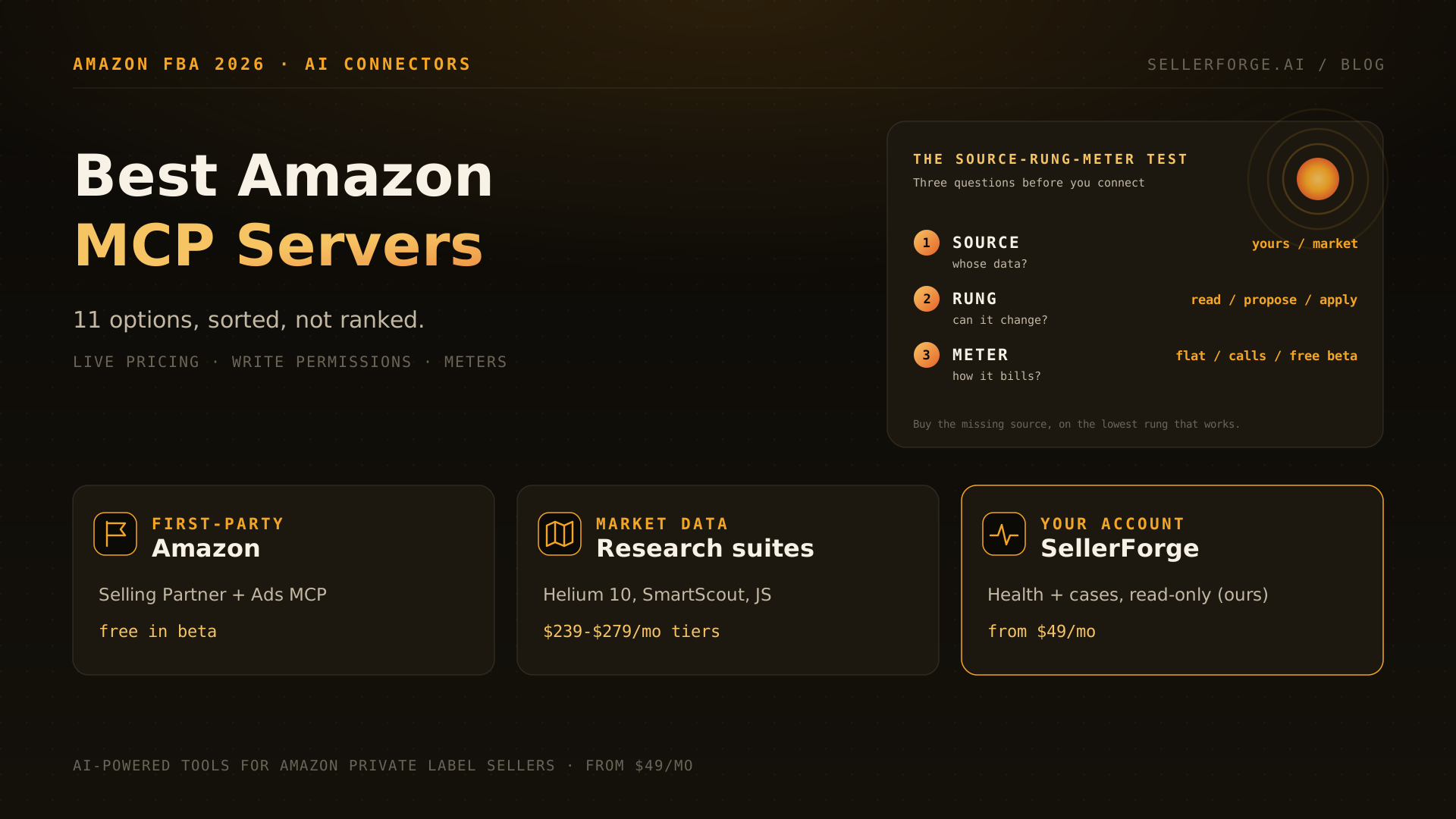
The Source-Rung-Meter Test scores any Amazon MCP server on three questions: whose data it reads (source), what it may do with that data (rung), and how it charges you as usage grows (meter). Two servers that look identical on a features page usually differ sharply on at least one of the three, and that difference decides the purchase.
The Source-Rung-Meter Test. SOURCE: does it read your account, the market, or a platform you already use? RUNG: can it only read, can it propose a change for your approval, or can it apply changes itself? METER: is it flat, capped by calls or tokens, bundled into a plan you already pay for, or free during a beta that will end? Buy for the source you are missing, on the lowest rung that does the job, with a meter you will not hit by Wednesday.
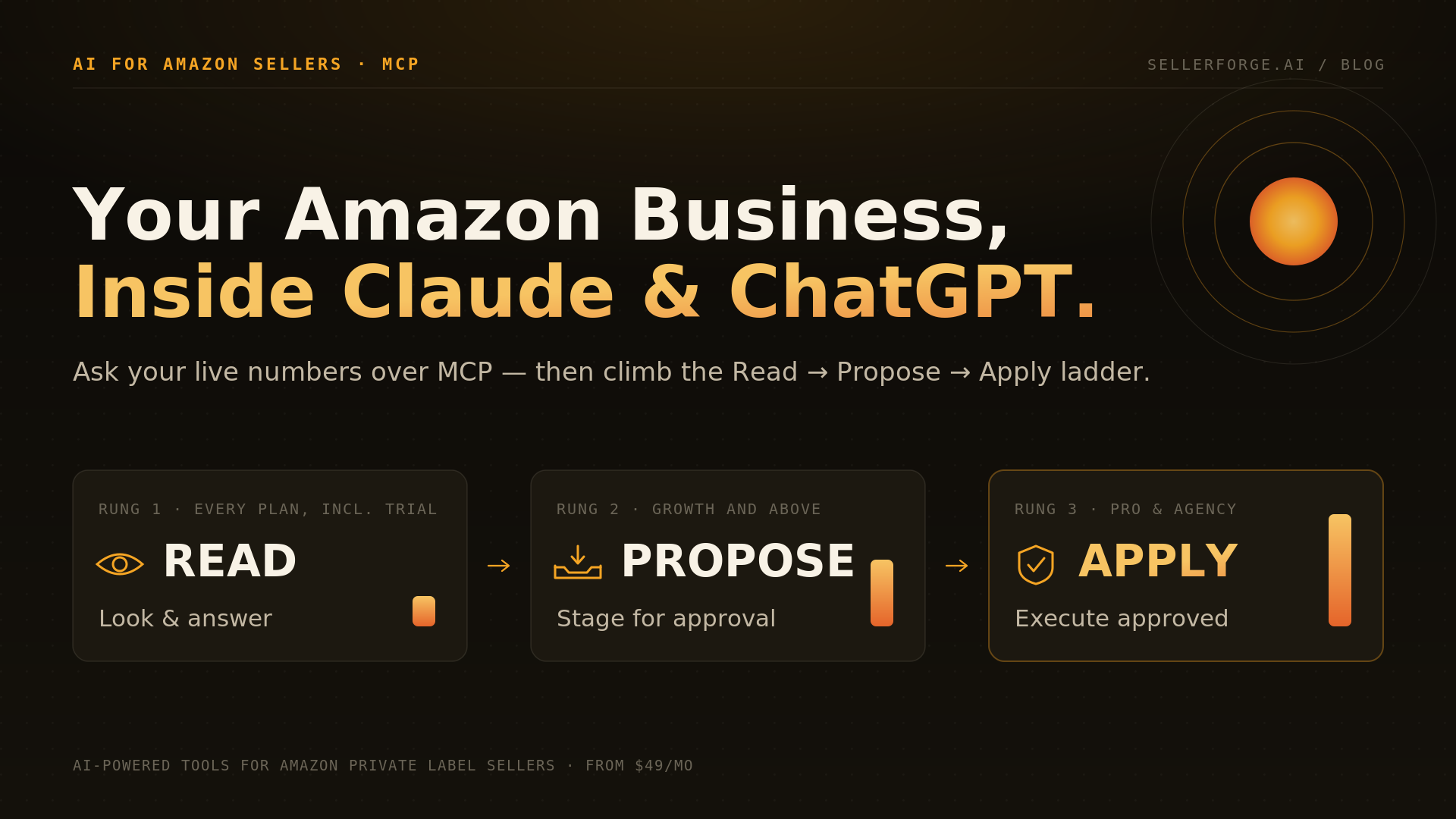
The rung question extends the Read-Propose-Apply Ladder we use for every connector. READ answers questions. PROPOSE stages a change you approve. APPLY executes changes. A server that applies without a propose step is fine for a developer testing on a sandbox and dangerous for a busy operator at 11pm.
The meter question is the one nobody tabulates, and it is where the surprise bills live. Helium 10 includes up to 1,000 MCP calls a month on Diamond; reviewers estimate a simple question uses one or two calls and a detailed analysis five to ten, which works out to roughly 100 to 500 questions a month. Seller Labs prices by calls outright. DataDoe meters AI tokens. Amazon's plugin is free in beta, and Amazon has not said what happens after.
Every Amazon MCP Server Compared (October 2026)
Eleven options cover the market as of October 21, 2026. The table sorts them by source rather than by rank, lists the rung each one actually reaches, and shows the price you pay to unlock MCP access specifically, which is often higher than the vendor's entry price. Prices are from each vendor's live page on that date unless marked as reported.
| Server | Source: whose data | Rung | Meter: price to get MCP access | Best for |
|---|---|---|---|---|
| Amazon Selling Partner plugin | Your Seller Central: listings, inventory, sales, performance (U.S. stores) | Propose and apply, each action approved by you, with an audit trail | Free in beta in Claude; Amazon Quick Plus free for 12 months if claimed by Dec 31, 2026 | U.S. sellers who want first-party account data in Claude |
| Amazon Ads MCP Server | Your Amazon Ads: campaigns, reporting, account settings, billing | Apply: creates, updates and deletes campaigns under your credentials | No published fee; requires Amazon Ads API credentials; open beta since Feb 2, 2026 | API builders and agencies automating campaign work |
| Amazon SP-API developer MCP | SP-API docs and live calls for coding tools | Whatever you build | Free, open source | Engineers building their own integrations |
| Helium 10 MCP | Helium 10 research plus your connected keyword, rank, ads, profit, inventory | Read-focused; confirm write behavior before relying on it | Diamond: $279/mo yearly or $359 monthly, up to 1,000 calls/mo | Brands already paying for Diamond |
| SmartScout MCP | Market: brands, sellers, 40,000+ subcategories | Read | Snapshot MCP on Business: $239/mo yearly or $299 monthly; Full Access MCP on Enterprise (custom) | Wholesale buyers, agencies, category analysts |
| Jungle Scout MCP | Market data from Cobalt, plus connected sales and ads where available | Read | Cobalt subscription, demo only, no public price | Enterprise brands already on Cobalt |
| Seller Labs MCP | Your sales, ads, profit by SKU, inventory, reviews; 10 marketplaces | Apply for Sponsored Products: campaigns, bids, budgets, negatives, with guardrails | Free: 100 calls/mo (500 lifetime cap); $39/mo for 101-400 calls; custom above 8,000 | Sellers who want PPC edits from chat |
| DataDoe MCP | Your Seller, Vendor and Ads data, up to 2 years backfilled, unlimited accounts | Read-only or read-write per account, optional dry run | $97/mo single plan, 2,000 AI tokens/mo, 14-day trial | Multi-account sellers and vendors who want a data warehouse |
| Pacvue Report MCP | Pacvue reports across 13 retail media platforms | Read: returns reports as CSV or Excel | Bundled with Pacvue (enterprise, demo) | Enterprise retail media teams |
| Reporting pipes (Porter, Windsor.ai, Supermetrics, Adzviser) | Reporting fields across many channels | Read | Free tiers to usage-based; varies by vendor | Cross-channel reporting in chat |
| SellerForge MCP Connector (ours) | Your account health, reimbursements, POA and escalation cases, inventory, keywords and rank, listing audits, campaigns, document vault | Read only: cannot change anything in Seller Central or Amazon Ads | Included on every plan from $49/mo; reading works on the trial | Operators and agencies who want account-health and case context in any AI |
Sources: Amazon's Selling Partner plugin announcement, Amazon Ads' open beta announcement, Helium 10 pricing, SmartScout pricing, Seller Labs' MCP pricing guide (updated October 13, 2026) and DataDoe pricing, all checked October 21, 2026. Seller Labs' paid tier is from its pricing page; its FAQ notes you also need Claude Pro or ChatGPT Business, or higher, to connect it.
Does Amazon Have an Official MCP Server?
Yes, Amazon has two official MCP routes for sellers plus a developer tool. The Amazon Ads MCP Server covers advertising and has been in open beta since February 2, 2026. The Selling Partner plugin, launched September 23, 2026, covers Seller Central basics in Amazon Quick and, in beta, Claude. Both are free to use today.
The Ads server is the more powerful of the two and the more dangerous. Per Amazon Ads' announcement, it can create, update or delete campaigns, run reporting queries, manage account settings and access billing data, and one tool builds an end-to-end Sponsored Products campaign from a single prompt. It executes what you ask; it does not judge whether the campaign structure or bid makes sense for your margin. That judgment is still yours.
The Selling Partner plugin is the more careful of the two. Amazon's announcement says sellers can connect Claude in roughly 60 seconds, choose whether the AI only recommends or also acts, and must review and approve every action, with each one logged. It is in beta for Amazon's U.S. stores, with international expansion planned but undated. Amazon also says 90% of selling partners already use third-party AI tools, which is why it opened the door at all.
The limits matter as much as the launch. The plugin's announced scope is listings, inventory, sales and performance metrics; ad campaigns, reimbursement cases, appeals history and multi-account views are not in it, and early reports describe one account and marketplace at a time. If those are your weekly questions, a free first-party server is the floor, not the ceiling.
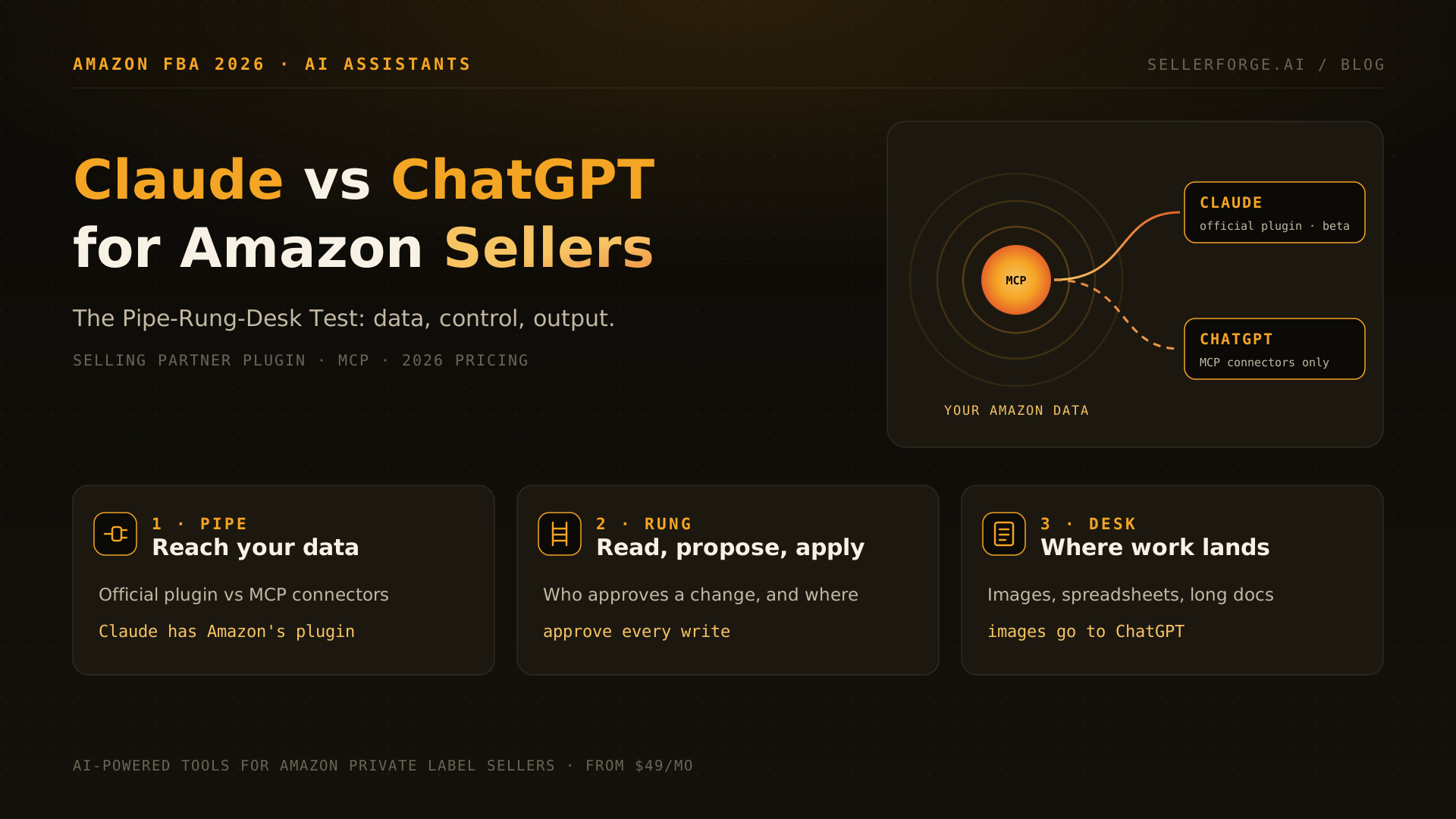
We covered the plugin's launch and what else Amazon announced in our Accelerate 2026 recap for sellers, and which assistant to run it in, job by job, in Claude vs ChatGPT for Amazon sellers.
Which MCP Servers Read Market Data Instead of Your Account?
Helium 10, SmartScout and Jungle Scout sell MCP servers that read market data: other brands, sellers, keywords and categories. None of them sees why your own margin moved unless you also connect your account to them. All three gate MCP at a premium tier, so the real price is the tier, not the entry plan.
This is the most common overpayment I see in MCP buying. A seller connects a research suite, asks why profit fell last month, and gets a confident answer built from estimates about other people's listings. Research data answers who is winning and what to sell. It cannot answer what happened to your account.
- Helium 10 MCP: the broadest of the three because it reaches both Helium 10 research and your connected rank, ads, profit and inventory data. The catch is the tier: Diamond only, $279 a month yearly, and a 1,000-call monthly cap that heavy agency use will feel.
- SmartScout MCP: the best market map per dollar if your questions are about brands and sellers. Snapshot MCP starts on Business at $239 a month yearly; Basic and Essentials have no MCP at all.
- Jungle Scout MCP: enterprise only through Cobalt, sold by demo. Strong if you are already a Cobalt customer, not a reason to become one.
We refereed the two research suites head to head, including which tier unlocks brand, seller and MCP data, in SmartScout vs Jungle Scout, and when a seller needs no research suite at all in Jungle Scout vs Helium 10.
Which Amazon MCP Servers Can Change Your Account?
Four options in the table can write to a live Amazon account: Amazon's Ads MCP Server, Amazon's Selling Partner plugin, Seller Labs MCP and DataDoe in read-write mode. They differ on the gate in front of the write. Only the plugin requires your approval on every single action by design.
| Server | What it can change | The gate in front of the change |
|---|---|---|
| Amazon Ads MCP Server | Campaigns, budgets, keywords, account settings | No general staging layer published (its end-to-end campaign tool returns a campaign for your review and approval); other changes execute as instructed, so rely on your AI client's confirmations and your own limits |
| Amazon Selling Partner plugin | Account actions such as price changes | Seller reviews and approves each action; every action logged |
| Seller Labs MCP | Sponsored Products campaigns, bids, budgets, negatives; COGS and lead time | Changes only on request; blocks budgets above 2x the 30-day average and campaigns on ASINs under 14 days of FBA supply unless you confirm |
| DataDoe MCP | Write-back to Amazon on read-write accounts | Read-only or read-write chosen per account; optional dry run |
| SellerForge MCP Connector (ours) | Nothing; it reads SellerForge data only | Not applicable: actions are set and approved inside the SellerForge app, never through MCP |
Seller Labs deserves credit here: its guardrails are the most specific published in this market, and a 2x-budget block is exactly the kind of rule that saves a holiday weekend. If PPC edits from a chat window are the job, it is the strongest hosted option at its price. Our own connector cannot do that job at all, and that is a deliberate choice, not a roadmap gap we are hiding.
Across the 57 accounts I ran, the incidents that cost real money were a bulk bid change applied to the wrong match type and a budget that tripled on a Friday. Both were correct ideas executed without a review step. An AI makes that class of error faster, not rarer, which is why the rung matters more than the model.
How Much Does an Amazon MCP Server Cost?
Amazon MCP servers cost from nothing to enterprise contracts. Amazon's two first-party options are free today, hosted account connectors run about $39 to $97 a month, research-suite MCP sits on tiers from $239 to $279 a month billed yearly, and enterprise platforms like Pacvue and Jungle Scout Cobalt sell by demo.
The cheapest way to compare is cost per answered question, because the meters differ. A rough worked example at October 21, 2026 prices:
- Seller Labs: $39 a month for up to 400 calls is about $0.10 per call before the next tier.
- Helium 10: $279 a month on yearly Diamond with 1,000 calls is about $0.28 per call, though most Diamond buyers are paying for the research suite and treat MCP as included.
- DataDoe: $97 a month flat for unlimited accounts, metered on 2,000 AI tokens, so multi-account sellers spread the cost.
- SellerForge: no separate MCP charge; the connector is included from Core at $49 a month, and the Agency plan at $499 covers 10 client accounts.
- Amazon plugin and Ads MCP: $0 today, plus the Claude or other AI plan you already pay for.
Do not forget the AI client. Several hosted servers require a paid assistant plan to connect custom MCP servers, so add your Claude or ChatGPT subscription to the real monthly cost before comparing.
Who Should Use Which Amazon MCP Server?
Match the server to your most frequent weekly question, not to the longest feature list. Start with the free Amazon pair, then add exactly one paid server for the gap that remains. The combinations below cover nearly every seller and agency profile I have worked with.
- 1U.S. owner-operator, one account: Amazon's Selling Partner plugin in Claude, plus the Ads MCP Server if you have Ads API access. Pay for nothing else until a question goes unanswered twice.
- 2Seller who wants PPC changes from chat: Seller Labs MCP for guarded Sponsored Products edits, kept on its approval prompts.
- 3Multi-account seller or vendor who wants a data warehouse: DataDoe at $97 a month for unlimited accounts.
- 4Brand already on Helium 10 Diamond: use the included Helium 10 MCP before buying another research server.
- 5Wholesale buyer or agency prospecting brands: SmartScout Business for Snapshot MCP market maps.
- 6Enterprise retail media team: Pacvue Report MCP or Jungle Scout MCP inside contracts you already hold.
- 7Operator or agency whose week is account health, appeals, reimbursements and listing audits: SellerForge's connector, read-only, alongside any of the above.
Agencies should run the test per client, not per agency: the right pair for a $50,000-a-month brand rarely matches a $5 million one. Our guide to white-label Amazon agency software covers how to keep the client-facing layer under 3% of the retainer while you do.
Where SellerForge Fits (and Where It Does Not)
SellerForge is our product, so weigh this section accordingly. Its MCP connector is the read-only account layer for the records no other Amazon MCP server holds: account health history, Plan of Action and escalation cases, reimbursement claims, listing audits and your document vault, in Claude, ChatGPT, Claude Code or Cursor, included on every plan from $49 a month.
Plainly, where we lose: we are not a research server, so market maps belong to SmartScout or Helium 10. We cannot change campaigns, so guarded PPC edits belong to Seller Labs or Amazon's Ads MCP. For U.S. sellers who only want listings, inventory and sales in Claude, Amazon's free plugin does that first. What SellerForge adds is the case file around the account: the Plan of Action Builder and Escalation Plans history, reimbursement claims, listing audits, the Document Vault and the weekly business report, so an AI can answer the account-health question with your evidence attached.
The safety posture is the point of the product, not a limitation we are apologizing for. The connector cannot change anything in Seller Central or Amazon Ads, cannot select an execution mode, and cannot bypass caps, role checks or approvals. Any actions run inside the SellerForge app under settings you control, and revoking a client takes one click in Settings, Connections.
The broader numbers say most sellers are still early. Marketplace Pulse's 2026 Seller Index found 83.4% of surveyed sellers use AI somewhere, yet 25.4% said no area had produced measurable results, the single largest answer. Connecting the AI to real data is the step that closes that gap. Setup for our connector lives on the MCP Connector page, and the wider tool map is in our best Amazon seller tools guide.
Want your account health and case history inside the AI you already use? Start a SellerForge trial, point Claude or ChatGPT at https://www.sellerforge.ai/api/mcp, and ask which account-health items need attention this week. Plans start at $49/mo.
About the author
David Gallo is the founder of SellerForge.ai. Before building SellerForge, he managed 57 Amazon seller accounts representing more than $350M in sales at Worldfront, where he learned that the costly mistakes were rarely bad analysis and almost always good analysis applied to a live account without review.