The best white label Amazon agency software depends on which client surface you need to brand: AgencyAnalytics (from $20 per client per month) or DashThis for a branded ad-data portal, Looker Studio plus a connector to build your own, DataHawk or MerchantSpring for quoted enterprise portals, and SellerForge Agency ($499/mo for 10 accounts, ours) for the profit, inventory and health work clients actually judge. Keep the client layer under 3% of the retainer.
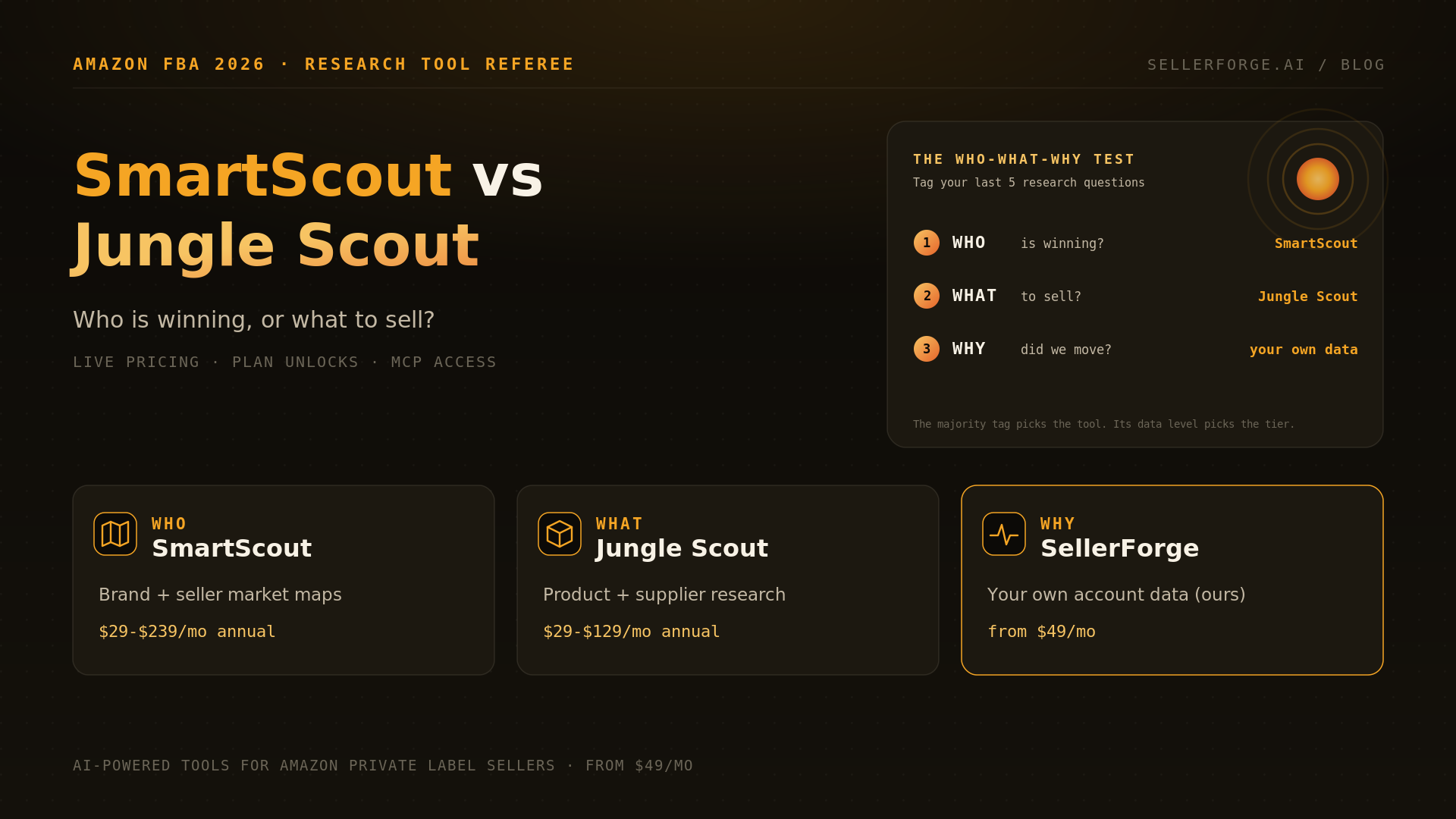
White label Amazon agency software is any reporting, dashboard or analysis tool that presents your agency's brand instead of the vendor's. The honest 2026 answer to which one to buy: AgencyAnalytics or DashThis if you need a cheap branded ad-data portal, Looker Studio plus a connector if you want to build, DataHawk or MerchantSpring if you need a quoted enterprise portal, and SellerForge Agency (our product, $499 a month for 10 client accounts) if the job is the profit, inventory and account-health work behind the report.
The catch most comparison pages skip is that the cheapest white-label portals reach Amazon Ads, not Seller Central. Your logo ends up on the half of the account that clients can now query for free, while the half they fire agencies over, margin, stockouts and account health, still lives in spreadsheets.
Across the 57 accounts I managed at Worldfront, I never once lost a client over the logo on a report. I lost them over finding out about a stockout or a suppressed listing before we told them. This guide is built around that distinction.
What Does White Label Mean for an Amazon Agency?
For an Amazon agency, white label means clients see your brand on every surface they touch, not the software vendor's. That covers four surfaces: the scheduled report, the live portal, the alert that flags a problem, and deliverables like audits or quarterly review decks. Most white-label tools brand only the first two, which is where clients look least.
Two very different things get sold under the same phrase. White-label software is a tool you rent and present as yours. White-label services are fulfillment agencies that do PPC or listing work under your name. Half of page one for this query is the second kind. This guide covers only the software, though the same rule applies to both: clients judge the output, not the masthead.
The branding itself is now a commodity. AgencyAnalytics includes logo, colors, custom domain and custom email on its base plan; DashThis includes white-labeled dashboards and a custom domain on all four of its plans. If a vendor still charges a premium for removing its logo, that is a negotiating point, not a feature.
The Four-Surface Test: What Clients Actually Touch
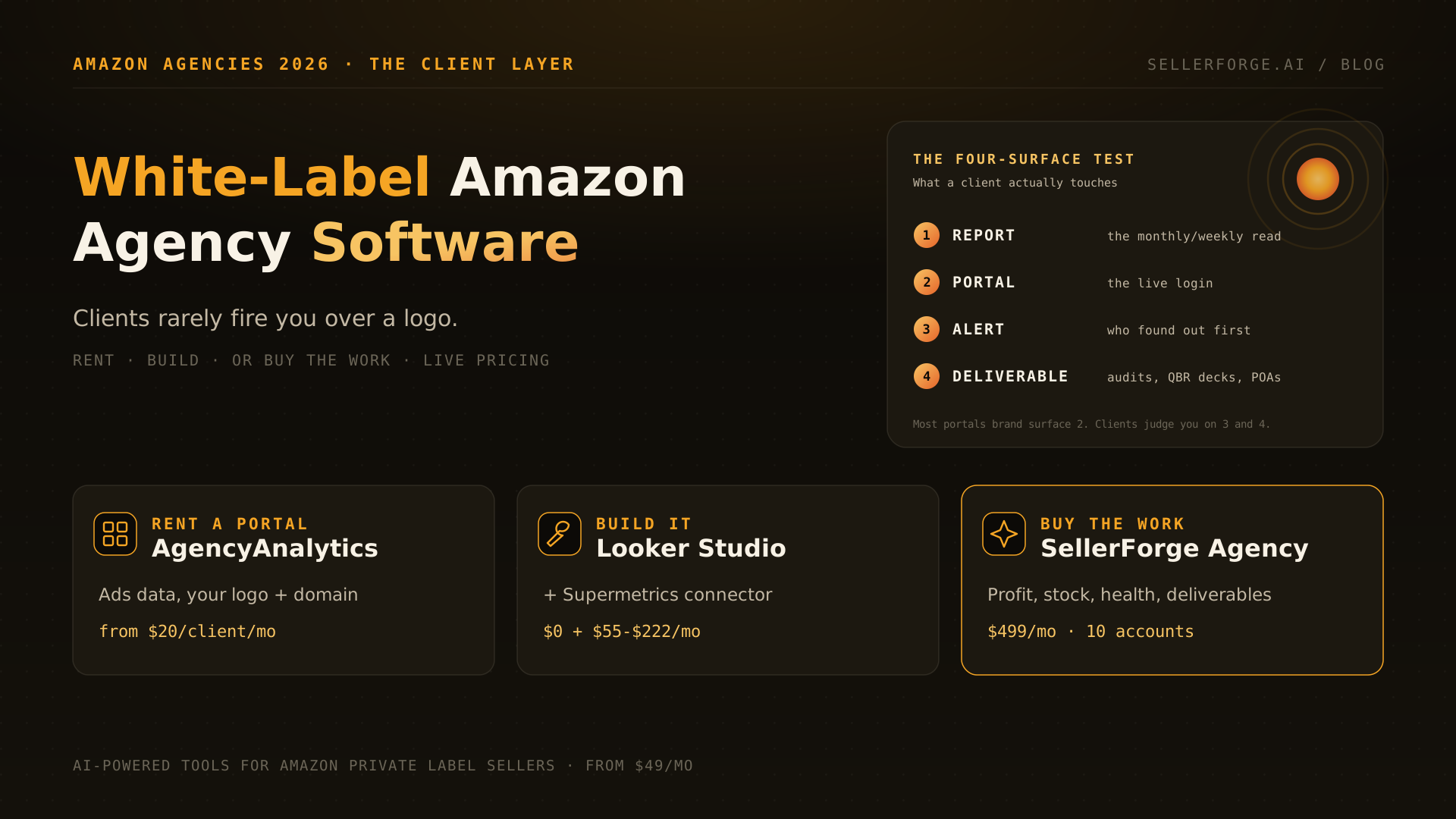
The Four-Surface Test scores any white-label option on the four places a client meets your agency: report, portal, alert and deliverable. Score each surface on two questions, does it carry your brand and does it show the whole account, then buy for the surfaces your clients use. Most agencies overpay for the portal and underinvest in alerts.
- 1Report: the weekly or monthly read. Does it arrive branded, on schedule, and does it include contribution margin and inventory, or only ACoS and ROAS?
- 2Portal: the live login. Will this client actually log in between calls? If they have no in-house team, the answer is usually no, and a portal is decoration.
- 3Alert: who found out first. Does anything tell you, before the client, that a listing was suppressed, a top ASIN is 14 days from stockout, or the Account Health Rating moved?
- 4Deliverable: audits, POAs, QBR decks and forecasts. Can the tool produce a client-ready document from live data, or does an account manager rebuild it in slides every quarter?
The Four-Surface Test: brand what clients read, alert on what they fear, and only buy a portal for clients who will log in. A beautiful login on ad-only data scores one surface out of four.
Our Amazon agency client reporting playbook covers the report surface in depth, including the Three-Layer Report format and the Silence Ledger for tracking who found each problem first. This guide is about the software that carries those surfaces.
White Label Amazon Agency Software Compared (Live Prices)
At live October 2026 prices, AgencyAnalytics is the cheapest fully branded portal at $20 per client per month billed annually, DashThis runs $44 to $429 a month by dashboard count, a Looker Studio build costs $55 to $222 a month in connectors, DataHawk and MerchantSpring are quote-only, and SellerForge Agency is $499 a month for 10 accounts.
| Option | What you brand | Amazon data it reaches | Published price (Oct 19, 2026) | Where it wins |
|---|---|---|---|---|
| AgencyAnalytics | Portal, reports, login, custom domain | Amazon Ads (60 days of history); no Seller Central on its Amazon page | $20/client/mo billed annually; volume pricing from 25 clients | Cheapest full white-label portal across Google, Meta and Amazon Ads |
| DashThis | Dashboards, custom domain on all plans | Amazon not named on the pricing page; confirm the connector or feed via Sheets | $44 (3 dashboards), $139 (10), $279 (25), $429 (50+) per month | Simple per-dashboard pricing for multichannel agencies |
| Looker Studio + Supermetrics | Anything you design; your domain via embed | Seller Central and Amazon Ads as standard connectors | Looker free; Starter $55/mo (3 sources x 3 accounts), Growth $222/mo (6 x 7) | Full control for agencies with a data person |
| DataHawk | Dashboards, PDF exports, share links, branded portal | Amazon and Walmart sales, ads (60-day backfill), keywords, market data | Custom quote; white-label in agency quotes | Deep Amazon analytics plus a managed warehouse for BI |
| MerchantSpring | Dashboards, PDFs and live links with your logo, colors and domain | Amazon, Walmart, eBay, Shopify, TikTok Shop; 120+ channels | Quote via demo | Cross-marketplace portfolio dashboards |
| SellerForge Agency (ours) | Client-ready PDF, Excel, PowerPoint and Word deliverables plus weekly reports | Whole account: sales, fees, ads, inventory, account health | $499/mo for 10 client accounts, +$39/mo per extra account | Does the analysis and alert work behind the report; not a portal on your domain |
Prices were read from each vendor's live page on October 19, 2026: AgencyAnalytics pricing, Supermetrics for Looker Studio pricing and DashThis pricing. DataHawk and MerchantSpring publish no agency price list. Vendor prices move often, so re-check before you sign anything annual.
Read the third column before the fourth. A $20 portal that reaches only Amazon Ads is not cheaper than a $50 option that reaches fees and inventory; it is a different product. Amazon's own Ads Agent, Amazon Marketing Cloud and the Ads MCP Server already let a client ask a chatbot what ACoS did last week, so a portal that only charts ad metrics is selling formatting.
Why Do Most White-Label Portals Show Only Ad Data?
Most white-label portals show only Amazon ad data because the Amazon Ads API is easy to connect and looks like every other ad platform they already support. Seller Central data, settlements, fees, inventory and account health, comes through the Selling Partner API, which is messier, Amazon-specific and rarely worth building for a generalist reporting vendor.
That creates three blind spots that matter to an Amazon client and to nobody else:
- Margin: ROAS looks healthy while FBA fees, returns processing and storage quietly eat the contribution margin. Without settlement data, the report cannot show it.
- Inventory: the most expensive Amazon mistake, a stockout on a ranking ASIN, never appears in an ads dashboard until sales have already collapsed.
- Account health: suppressed listings, policy warnings and Account Health Rating changes live in Seller Central only. Clients who hear about these from Amazon before they hear from you start shopping for a new agency.
History is the quieter problem. AgencyAnalytics and DataHawk both state roughly 60 days of Amazon Ads history on connection. If you want year-over-year ad reporting, you need to start storing data on day one of the engagement, not when the client asks for a Q4 comparison in October.
The pillar playbook makes the same point from the reporting side: our breakdown of what Amazon agency client reports should include ends with a one-line test for any paid tool, does it read something the free Amazon ad stack cannot. Run every vendor in the table above through it.
Should You Build or Buy Your Agency's Client Dashboards?
Buy your client dashboards unless reporting is the product you sell. A Looker Studio build costs little in licenses but roughly 30 to 40 hours to design and 3 to 5 hours a month to maintain, and it breaks when connectors or Amazon reports change. Building pays off with a data person, 25-plus clients and a reporting design that wins deals.
Here is the math I use, at an assumed $50 per hour of account-manager or analyst time. These are planning estimates from my own builds, not vendor figures:
| Cost line (10 clients, year one) | Build: Looker Studio + Supermetrics | Rent: AgencyAnalytics | Buy the work: SellerForge Agency |
|---|---|---|---|
| License or connector | $2,124 (Growth, annual) but capped at 7 accounts per source, so 10 clients needs Enterprise pricing | $2,400 ($20 x 10 x 12) | $4,990 (annual) or $5,988 monthly |
| Setup hours | 30-40 hours ($1,500-$2,000) | 4-6 hours ($200-$300) | 2-4 hours ($100-$200) |
| Monthly maintenance | 3-5 hours ($1,800-$3,000/yr) | About 1 hour ($600/yr) | About 1 hour ($600/yr) |
| Seller Central coverage | Yes, through the connector | No; Amazon Ads only | Yes, whole account |
| Analysis still done by an AM | All of it | All of it | Drafted; an AM reviews and decides |
The license line is the smallest number on every column. What moves the total is who does the analysis. A branded portal saves the 1.5 to 2 hours of assembly per report; vendors' own case studies put manual report builds near two hours each. It does not save the hour an account manager spends working out why margin fell on the top ASIN.
If you are tempted to go further and build straight on Amazon's Selling Partner API, one 2026 risk belongs in the spreadsheet. Amazon announced a $1,400 annual SP-API subscription plus GET-call usage fees on November 3, 2025, then told developers on May 14, 2026 that it would not move forward with them "at this time," as PPC Land reported. Today the API is free to call. Plan as if that could change.
How Do You Price the Client Layer Into a Retainer?
Price the client layer as a fixed cost inside the retainer and keep it under 3% of the fee. On a $3,500 monthly retainer that is about $105 per client per month for portal, connectors and analysis software combined. Never itemize the portal; clients will compare it to free Amazon tools.
At 10 clients, every option here clears that 3% ceiling comfortably: AgencyAnalytics at $20 per client, DashThis Professional at about $14 per dashboard, SellerForge Agency at $49.90 per account. So the decision is never really about license cost. It is about which tool removes the most account-manager hours, because payroll, not software, is what eats an agency's margin.
- Bundle it: "weekly performance report and real-time alerts" belongs in the scope of work, not on the invoice as a software pass-through.
- Tier it: offer a portal login only on the top retainer tier, where clients have in-house teams who will use it.
- Charge for deliverables, not dashboards: a quarterly audit or a reinstatement POA is a billable output; a dashboard refresh is not.
For the retainer structures themselves, flat, percentage of spend, percentage of revenue and hybrid, see our guide to Amazon agency pricing models, which includes the workload-backwards method for checking whether a quote covers the account-manager hours it implies.
What Do Amazon Clients Actually Want to See?
Amazon clients want three things from the client layer: an early warning before they discover a problem themselves, a plain-English explanation of what changed and why, and proof that the agency is acting on profit, not just ad efficiency. Branding matters only to the extent it makes those three feel like your work.
When I audited why clients left at Worldfront, the pattern was consistent: the departures followed a surprise, not a bad month. A client who sees a 20% drop on the report you sent, with the cause and the fix already written, usually stays. A client who finds a stranded-inventory email from Amazon that you never mentioned usually does not.
That is why the alert surface outranks the portal. In 2026 it is also why clients are less impressed by charts than they were two years ago: Amazon's Seller Assistant gained persistent memory and always-on automations at Accelerate in September, and any client can connect Amazon Ads data to a chatbot. What clients cannot get free is someone watching the whole account and telling them first.
Our map of what Amazon Seller Assistant can and cannot do is worth sending to clients who ask why they need an agency now that Amazon has a free AI. It is also the clearest list of which surfaces an agency still owns.
Where SellerForge Fits (Disclosure: It Is Ours)
SellerForge Agency is our product, and it is not a white-label portal. It is AI-native account intelligence across client accounts, $499 a month for 10 accounts plus $39 for each extra, that does the report, alert and deliverable work behind your brand: margin, inventory, account health, listings and ads read together, then turned into client-ready documents.
On the Four-Surface Test it covers three surfaces well. The report surface is the Weekly Business Report, an AI-written narrative of what changed in each account every Monday. The deliverable surface is the Deliverable Builder, which turns live account data into PDF, Excel, PowerPoint or Word documents you send under your own cover, alongside the Listing Audit, POA Builder and Forecasting outputs agencies bill for. The alert surface comes from reading health, inventory and margin in one place, with custom breakdowns for contribution margin per ASIN.
What it does not do, stated plainly: it does not host a client login on your domain with your logo, and it is not a bid-automation engine. If a client insists on a branded portal, put AgencyAnalytics or a Looker Studio build in front for that surface. If the bottleneck is pure PPC autobidding at scale, a dedicated platform like Perpetua or Pacvue is the right purchase, not us.
Agencies that want the cross-client view inside their own AI assistant can also query every connected account from Claude or ChatGPT through SellerForge MCP. Our guide to scaling an Amazon agency with AI without hiring shows how the freed hours turn into more accounts per account manager.
Who Should Pick What
Pick by the surface your clients use most. Agencies whose clients want a branded login across Google, Meta and Amazon Ads should rent AgencyAnalytics. Agencies with a data person and 25-plus clients can build in Looker Studio. Enterprise portfolios should get DataHawk and MerchantSpring quotes. Agencies whose clients judge them on margin, stock and health should start with SellerForge Agency.
- Full-funnel marketing agency adding Amazon Ads to Google and Meta clients: AgencyAnalytics. Cheapest real white-label portal, and Amazon Ads sits next to everything else.
- Small multichannel agency that wants flat, predictable pricing: DashThis Professional at $139 for 10 dashboards, once you confirm how Amazon data gets in.
- Agency with an in-house analyst and a reporting style that wins pitches: Looker Studio plus Supermetrics, with a warehouse from day one for year-over-year history.
- Agency managing large brands across Amazon, Walmart and others that needs a managed data warehouse: DataHawk or MerchantSpring, and budget for an annual quote.
- Amazon-specialist agency of 3 to 30 accounts whose account managers are the bottleneck: SellerForge Agency for the work, with a portal in front only for the clients who ask.
If you are the seller reading this and wondering whether your agency's reporting is worth the retainer, our piece on why Amazon sellers are leaving their agencies has the Three-Door Test for deciding. The broader tool landscape is in our best Amazon seller tools guide.
The bottom line: white-label branding is cheap and nearly universal in 2026, so it should never be the reason you pick a tool. Score options on the Four-Surface Test, check whether each one reaches Seller Central or only Amazon Ads, keep the whole client layer under 3% of the retainer, and spend the saved hours on the alerts and deliverables clients actually remember.
Running Amazon clients on spreadsheets and screenshots? Start a SellerForge trial, connect a client account, and see margin, inventory risk and account health in one place, with client-ready deliverables in minutes. Plans start at $49/mo, and the Agency plan covers 10 client accounts for $499/mo.
About the author
David Gallo is the founder of SellerForge.ai. Before building SellerForge, he managed 57 Amazon seller accounts representing more than $350M in sales at Worldfront, where he learned that clients rarely leave over a report's design and almost always leave over a surprise.