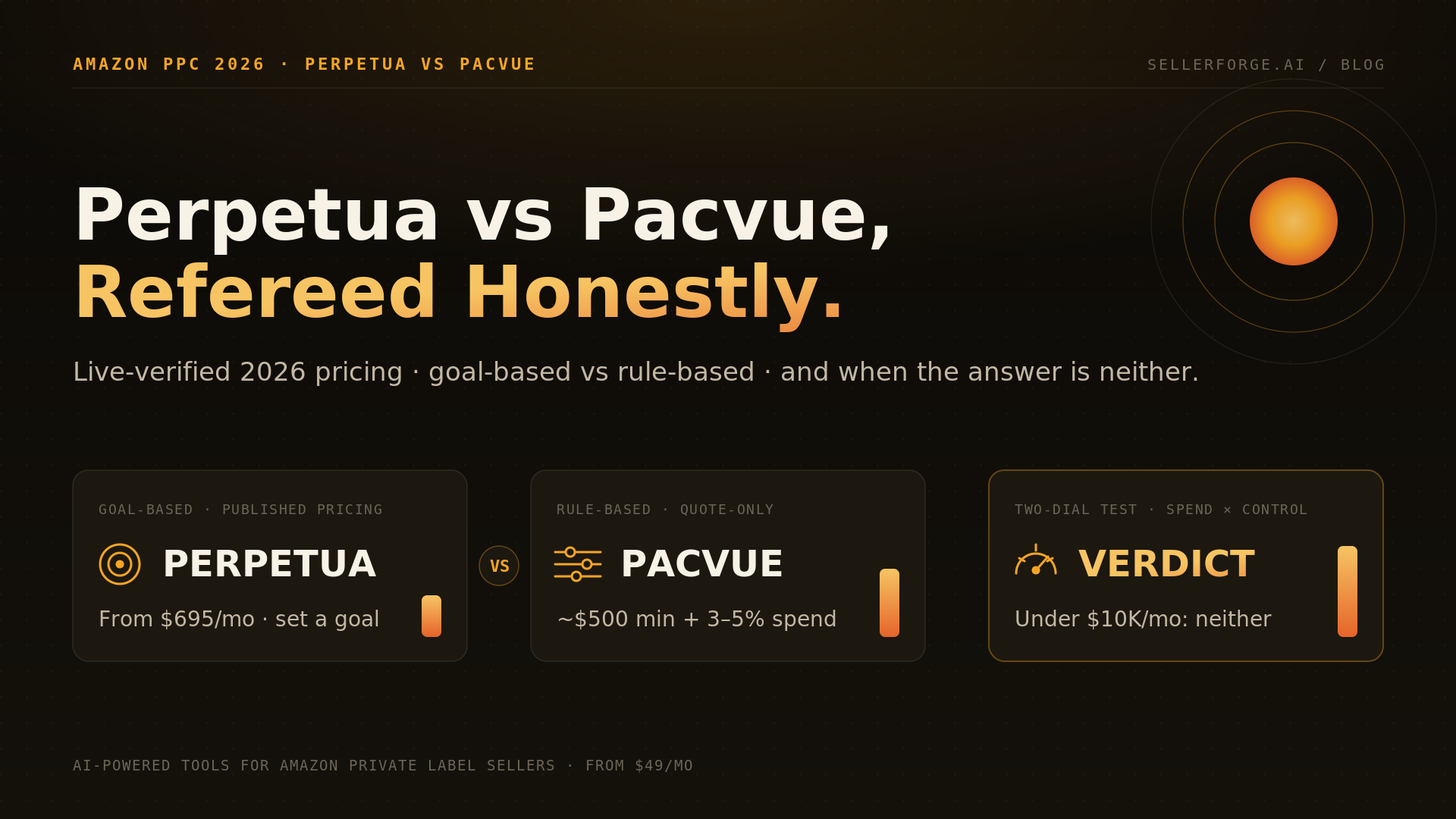
Pick Perpetua for goal-based, hands-off automation at $10K–$200K in monthly Amazon ad spend — pricing is published, from $695/mo. Pick Pacvue for rule-based control, agency workflows, and multi-retailer scale — quote-based, triangulated at roughly a $500/mo minimum plus 3–5% of ad spend. Under ~$10K/mo, neither is priced for you. And neither sees your margins, inventory, or account health — the whole-account jobs where SellerForge (our product, disclosed) takes over.
Perpetua versus Pacvue is the wrong first question, and I say that as someone with a horse in the adjacent race. The right first question is: how much do you spend, and how much control do you want? Answer those two and this comparison mostly resolves itself — Perpetua for goal-based automation from $10K a month in ad spend, Pacvue for rule-based control and multi-retailer scale above $50K, and honestly, neither if you are under $10K.
Disclosure before anything else: I run SellerForge, which competes with neither platform at its core job — high-spend algorithmic bidding — and gets recommended in this post only for the whole-account work bid platforms do not touch. Both of these tools beat our advertising module at pure autobidding, and this page says so plainly. That independence is exactly why this referee page can exist: neither vendor can write it, and the comparisons ranking today are mostly written by companies selling a third ad tool without telling you.
Everything here is priced against live sources as of September 16, 2026 — stale pricing is the single biggest failure of the pages currently ranking for this query, and prices in this category moved a lot this year.
Perpetua vs Pacvue: The Short Answer
Perpetua is the goal-based platform: you hand it a target — ACoS, ROAS, TACoS — and its algorithms run bids, harvesting, and budget pacing toward it, from a published $695/mo. Pacvue is the rule-based enterprise platform: you define the logic across 90+ retail networks, on quotes that typically total a minimum plus 3–5% of spend.
That single design difference — goals you delegate versus rules you author — explains almost every downstream contrast: pricing structure, learning curve, who each vendor hires salespeople to call, and which one your agency already uses. It is also why the 'which is better' framing fails. They are optimized for different operators. A brand founder doing four jobs at once experiences Pacvue as overwhelming; a dedicated PPC manager experiences Perpetua as a black box with too few knobs. Neither reaction is wrong — they are the two dials this guide keeps coming back to.
How Much Does Perpetua Cost in 2026?
Perpetua costs $695/mo on the Essentials plan, which covers accounts up to $10K in monthly ad spend. Above $10K you move to Growth — the same $695 base plus an unpublished percentage of ad spend — and above $500K/mo you are on custom Premium pricing. That structure is confirmed on Perpetua's own pricing page, checked the day this post published.
Three things the pricing page will not volunteer. First, the Growth percentage is the number that actually determines your bill, and you will only get it on a sales call — ask for it in writing, and ask what happens in a spike month. Second, the entry price roughly 2.5x'd in recent years: sellers still cite the old ~$250 entry tiers, which no longer exist, and plenty of ranking comparison posts still print them. Third, what $695 buys is real: AI bid optimization, keyword harvesting, and profitability reporting, with hourly Amazon Marketing Stream data and competitor search-term insights arriving on the Growth tier. Sellics users ended up here too — Perpetua absorbed Sellics in 2022, and its old plans are gone.
The fairest read: Perpetua is priced like a junior employee, not like software. At $20K/mo spend with a modest percentage, you are plausibly paying $900–$1,200/mo. The question is never whether that is expensive — it is whether it replaces hours you currently pay more for, which is precisely the calculation the goal-based design is built to win.
How Much Does Pacvue Cost in 2026?
Pacvue publishes no pricing at all. Triangulating independent 2026 sources: a platform minimum around $500/mo, a typical rate of 3–5% of monthly ad spend, DSP management billed separately at a reported $1,000–$5,000/mo, and procurement data putting the average annual contract near $26,455. At $100K/mo in ad spend, expect a $3,000–$5,000 monthly platform bill before add-ons.
Quote-based pricing is not a scam — it is a signal about who the product is for. Pacvue sells to enterprises and agencies where every deal is negotiated, multi-retailer scope varies, and the buyer has a procurement team. If reading that sentence made you tired, you are probably not the customer, and that is useful information that no demo call will give you as directly.
When I evaluated platforms at Worldfront, managing ad budgets across 57 accounts, the line item that scared me was never the platform minimum — it was the percentage of spend. A percentage looks small at signature and compounds every time your spend grows; at scale, a point of difference is tens of thousands a year, and it quietly taxes your best months hardest. Whatever you negotiate with Pacvue, get the percentage, the floor, the DSP add-on, and each extra retail network priced in writing. The same discipline applies to Perpetua's Growth tier.
Goal-Based vs Rule-Based: What Actually Separates Them
The automation models are genuinely different, not marketing shades of the same thing. Perpetua asks for an outcome and hides the machinery: set a TACoS target, and the system decides bids, placements, and harvesting on its own. Pacvue asks for your logic and executes it precisely: if ACoS exceeds X for Y days between these hours, do Z — across any of its 90+ supported retailers.
Each model fails in its own characteristic way, and the failure modes matter more than the feature lists. Goal-based systems fail opaquely: when performance dips, your options are to adjust the goal and wait, because the why is inside the black box. Rule-based systems fail verbosely: they do exactly what you wrote, including the dumb thing you wrote at 11pm, and the maintenance burden of a large rule library is a real ongoing cost that never appears on the invoice. You are not choosing which platform is smarter — you are choosing which failure mode your team is better equipped to live with.
One more structural difference the vendor pages soft-pedal: breadth. Pacvue's rule engine, reporting, and (separately billed) DSP tooling span Amazon, Walmart, Instacart, Target and dozens more retail media networks in one interface — if you are running serious money on three networks, consolidation is its own justification. Perpetua covers the majors but is Amazon-centric in practice, and its deepest features — Amazon Marketing Stream hourly optimization, AMC reporting — are Amazon features.
Perpetua vs Pacvue: Feature by Feature (2026)
The head-to-head, with every number sourced in this post rather than recycled from 2023 listicles:
| Criteria | Perpetua | Pacvue |
|---|---|---|
| Published pricing | Yes — $695/mo Essentials (to $10K spend); Growth $695 + % of spend; Premium custom ($500K+) | No — quote-based; ~$500/mo minimum + 3–5% of spend, triangulated |
| Automation model | Goal-based: set ACoS/ROAS/TACoS, algorithm runs it | Rule-based + AI: author the logic, dayparting, granular bid control |
| Best-fit monthly ad spend | ~$10K–$200K | ~$50K+ (or agency portfolios) |
| Retail media coverage | Amazon-centric; covers major other networks | 90+ retailers and marketplaces in one interface |
| Learning curve | Low — built for delegation | High — built for PPC professionals |
| DSP + AMC | Growth/Premium tiers; custom AMC reporting on Premium | Full suite; DSP billed separately ($1,000–$5,000/mo reported) |
| 2026 AI headline | No standalone agent launch as of Sep 2026 | Pacvue Agent (Apr 14, 2026): governed agentic execution |
| Ownership | Flywheel → Omnicom ($835M, closed Jan 2024); folded into Omnicom Media Group May 2026 | Heads its own family, incl. Helium 10 (Helium 10 Ads runs on Pacvue tech) |
| Free trial | No — sales-led | No — demo-only |
Context for the spend brackets: Amazon advertising is not a place to guess anymore — ad revenue hit $19.8 billion in Q2 2026 alone, up 26% year over year and past $70B trailing-twelve-months, per Amazon's earnings, and roughly three-quarters of third-party sellers run Sponsored Products. Meanwhile the 2026 benchmark datasets disagree with each other — SellerPlex's managed-account median CPC of $1.07 versus the Trellis/Autron healthy band of $1.18–$1.22 — which is exactly why we argued in the ACoS vs TACoS guide that your own margin math, not industry averages, should set your targets on either platform.
What Changed in 2026: Agents and Owners
Two 2026 stories should shape a buying decision this year, and neither appears in the comparison posts currently ranking. The first is agentic AI: Pacvue shipped its headline agent in April, and the free floor beneath both platforms keeps rising. The second is ownership: Perpetua's parent got reorganized, twice.
On agents: Pacvue Agent launched April 14, 2026 — AI that recommends and executes campaign changes under governance rather than just charting them, starting with Amazon Ads. In August, its sibling Helium 10 shipped a commerce agent of its own. And Amazon itself keeps giving more away: Performance+ is self-service for every advertiser, the console's AI prompts went GA in March, and the official Amazon Ads MCP server has been in open beta since February — meaning a capable AI assistant can now read and work your ads account through official rails. The bar both paid platforms must clear is rising beneath them every quarter.
On owners: Perpetua sits inside Flywheel, which Omnicom acquired for $835 million in January 2024 — and in May 2026 Omnicom, fresh off closing the largest merger in agency history, quietly moved Flywheel into its media group. None of that makes Perpetua worse software this morning. But if you have ever been a small customer of a product inside a giant holding company mid-reorg, you know why it belongs in the decision: roadmaps, support quality, and pricing all answer to strategy set several floors above the product team. Pacvue's family consolidation runs the other direction — Helium 10 Ads has run on Pacvue's engine since February 2025, giving Pacvue a genuine downmarket on-ramp at $129/mo that Perpetua lacks entirely.
The Two-Dial Test: Who Should Pick Which
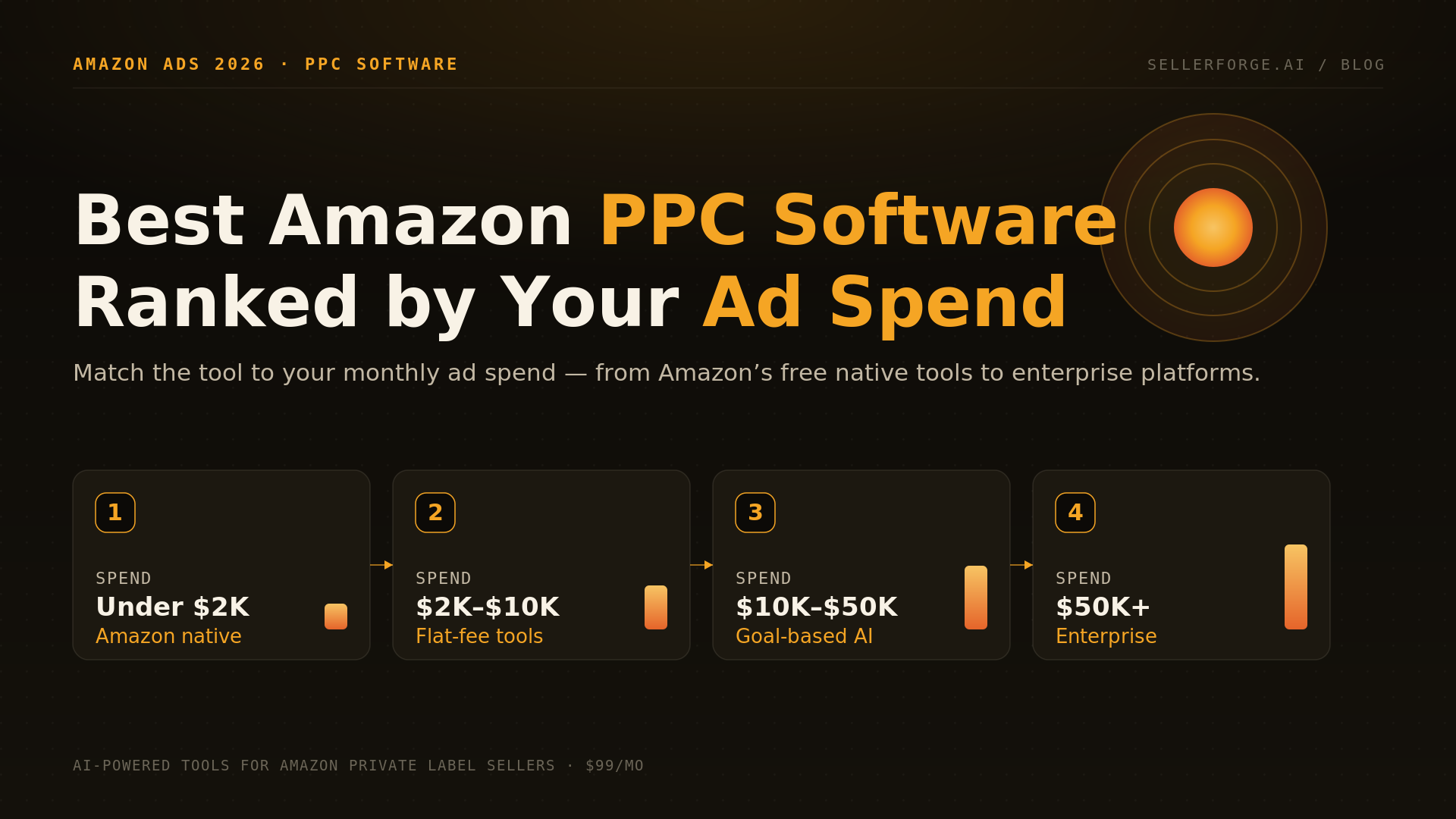
The Two-Dial Test: read two dials before any demo call. Dial one — monthly ad spend: under $10K, neither platform is priced for you; $10K–$50K, Perpetua territory; $50K+ or multi-retailer, Pacvue territory. Dial two — control appetite: want to delegate to an algorithm, that is Perpetua; want to author the rules, that is Pacvue. When the dials disagree, spend wins — control preferences adapt faster than budgets grow.
- 1Read dial one honestly: take your average monthly Amazon ad spend over the last 90 days, not your peak month or your plan for next year.
- 2Read dial two honestly: count the hours per week someone on your team actually spends in campaign managers today. Under two hours, you are a delegator — goal-based. Over ten, you have a practitioner who will want Pacvue's control.
- 3Cross the dials against the table above, then price the winner properly: Perpetua Growth’s percentage in writing, or Pacvue’s full quote with minimum, percentage, DSP, and per-retailer add-ons itemized.
- 4Before signing either, subtract the free floor: run Amazon's own Performance+ and console AI on part of the account for two weeks and measure what the paid platform must beat. In 2026 that floor is high enough to change some verdicts.
And the routing table, including the rows the vendors would leave out:
| If your situation is… | Buy | Why |
|---|---|---|
| $10K–$200K/mo spend, small team, want it handled | Perpetua | Published entry price, goal-based delegation, low ops burden |
| $50K+/mo, dedicated PPC talent or agency, multiple retail networks | Pacvue | Rule-based depth, 90+ retailers, Pacvue Agent, agency workflows |
| Under ~$10K/mo spend | Helium 10 Ads ($129/mo) or Amazon’s free layer | Pacvue’s engine at seller pricing; Performance+ costs nothing |
| Profit-aware, inventory-aware, whole-account decisions around the ads | SellerForge (ours — from $49/mo) | Bid platforms optimize the ad account; this optimizes the business the ads sit inside |
When Neither Fits: The Jobs a Bid Platform Cannot See
Both platforms optimize inside the advertising console, and that is the honest boundary of the category: neither holds your landed costs, your supplier lead times, your reimbursement queue, or your account health file, so neither can tell you whether a winning campaign is actually making you money — or about to sell out the SKU it is scaling.
This is where SellerForge sits, disclosed and specific. We do not out-bid Perpetua or Pacvue and do not claim to: our advertising module proposes changes with your margin and inventory in view rather than autobidding at their scale. What we own is the layer around the ads — per-ASIN, ad-inclusive contribution margin, forecasts that know a scaling campaign drains inventory, and a weekly owner's report that says what the week actually earned after fees and ad spend — from $49/mo, with most sellers on the $99 Growth tier. Plenty of Pacvue and Perpetua customers run us alongside, and the pairing is coherent: their platform works the auction, ours works the P&L. The wider tool landscape, category by category, is mapped in the 2026 seller tools guide and the full PPC software buyer's guide, which brackets every ad tool by spend.
For agencies the calculus is sharper: your clients are on both platforms, your retainer is justified by judgment rather than clicks, and the reporting layer — not the bidding layer — is where clients decide you are worth it. That is the argument of our agency reporting playbook, and it holds whichever bid platform sits underneath.
The Operator's Bottom Line
If I were running $30K a month with a two-person team, I would buy Perpetua, set honest TACoS targets, and spend the reclaimed hours on product. If I were running $150K across Amazon, Walmart, and Instacart with a PPC lead on staff, I would buy Pacvue and let that lead build. Under $10K, I would run Helium 10 Ads or Amazon's free layer and bank the difference. And in every one of those cases I would keep the profit truth outside the bidding tool — because across the 57 accounts I managed, the expensive advertising mistakes were never bad bids. They were good bids on bad unit economics, made by systems that had no way to know better.
Want the layer that knows better? Start a free SellerForge trial — connect your account in about two minutes, and the first weekly report will tell you what your ads actually earned after every fee. From $49/mo, and it works just fine next to either platform on this page.
About the author
David Gallo is the founder of SellerForge.ai. He previously managed 57 Amazon accounts representing over $350M in sales at Worldfront before building SellerForge to give sellers AI-powered tools at agency quality without the agency price.