Jungle Scout is worth it in 2026 for sellers still choosing products and suppliers, and Growth Accelerator ($49 a month billed yearly, $79 monthly) is the plan to buy, because Starter has no Supplier Database or rank tracking. It is usually not worth renewing once you mostly reorder. Then Amazon's free tools, Helium 10 for keywords, or SellerForge (ours, from $49/mo) for account operations fit better.
Jungle Scout is worth it in 2026 if you are still deciding what to sell and who will make it. For that job, Growth Accelerator at $49 a month billed yearly ($79 month to month) is the plan to buy. If you are past launch and mostly reorder the same products, it is usually not worth renewing, and the money does more work elsewhere.
Most reviews of this tool are out of date. Jungle Scout's own article on whether it is worth it, last modified in November 2024, still lists Brand Owner at $399 a month; the live price is $149, or $129 billed yearly. Several affiliate reviews quote accuracy figures from tests of three products. This page uses live prices and says where the evidence is thin.
Is Jungle Scout Worth It in 2026? The Short Answer
Jungle Scout is worth it for pre-launch and early-stage private-label sellers who need product, keyword and supplier data in one place, and Growth Accelerator is the plan that delivers all three. It is weak value for sellers past their first year who mostly reorder, and for $1M+ brands that need Cobalt, which is sold only after a demo.
| Your situation | Worth it? | Plan to buy | Why |
|---|---|---|---|
| Validating a first product | Yes | Growth Accelerator, $49/mo billed yearly | Supplier Database, 250 Keyword Scout searches a month; Starter has no supplier data |
| Curious, not ready to buy inventory | Not yet | Amazon's Product Opportunity Explorer first | Niche demand data inside Seller Central; buy Jungle Scout when you are ready to source |
| Launched, 1 to 10 products, still adding | Often | Growth Accelerator | Rank Tracker (500 keywords), Listing Builder, Review Automation, Sales Analytics |
| Established brand, mostly reordering | Usually no | Cancel, or Starter if you research a few times a year | You open it a few times a quarter, so the cost per decision climbs |
| Several brands, watching competitors | Sometimes | Brand Owner, $129/mo billed yearly | Competitive Intelligence (5 segments), 2,000 tracked products, 5,000 tracked keywords |
| $1M+ brand or agency wanting MCP and category data | Depends | Cobalt (demo, custom price) | The MCP connector and enterprise market data are Cobalt features |
The mistake I see most often is buying Starter to save $20 a month. At $29 billed yearly it looks like the sensible first step, but it has no Supplier Database, no Rank Tracker, no Listing Builder and only 50 Keyword Scout searches a month. A first-time seller doing serious research hits those caps inside a week and upgrades anyway, having paid for a plan they outgrew.
How Much Does Jungle Scout Cost in 2026?
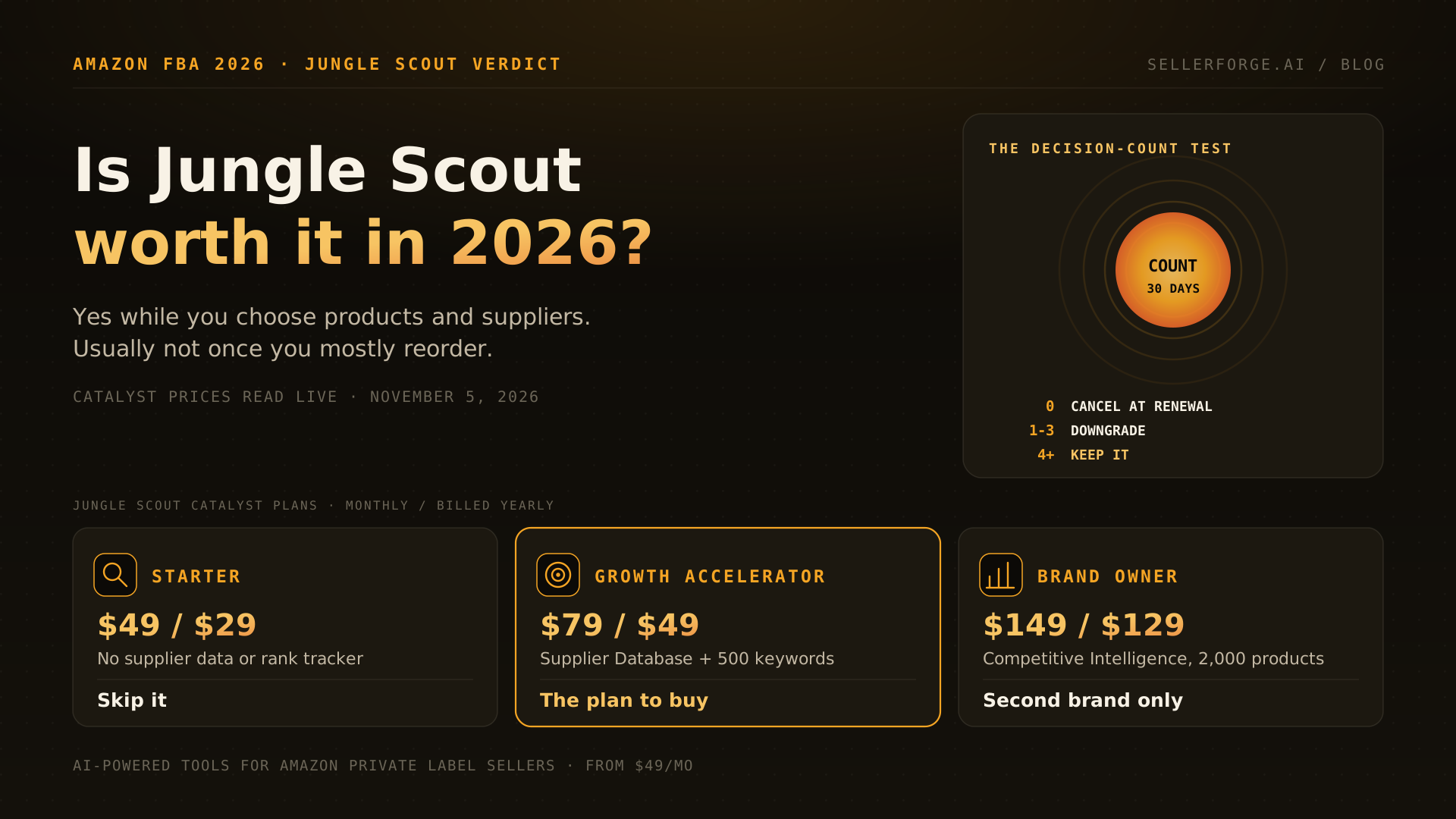
Jungle Scout Catalyst costs $49, $79 or $149 a month on monthly billing, or $29, $49 or $129 a month billed yearly ($348, $588 or $1,548 paid up front). There is no free trial, only a 7-day money-back guarantee on standard plans. Cobalt, the enterprise platform for brands above $1M a year, has no public price and requires a demo.
| Plan | Monthly billing | Billed yearly (per month) | Paid up front per year | Users |
|---|---|---|---|---|
| Starter | $49 | $29 | $348 | 1 |
| Growth Accelerator | $79 | $49 | $588 | 1 (extra seats $49/mo or $459/yr) |
| Brand Owner | $149 | $129 | $1,548 | 3 in the comparison table; the FAQ says 10, so confirm |
| Cobalt (enterprise) | Custom, per user | Custom | Demo required | Team seats |
My rule for any research tool: pay monthly for the first 60 days and switch to yearly only after you have used it every week for two straight months. On Growth Accelerator that insurance costs $60 ($79 minus $49, twice), which is cheap next to a full year you might not use.
What Does Each Jungle Scout Plan Actually Include?
Starter covers basic product and keyword research with hard monthly caps. Growth Accelerator adds the Supplier Database, Rank Tracker, Listing Builder, Review Automation, Sales and Advertising Analytics, Inventory Manager and FBA Reimbursements. Brand Owner raises every limit and adds Competitive Intelligence. The jump from Starter to Growth Accelerator is the one that changes what you can do.
| Feature | Starter | Growth Accelerator | Brand Owner |
|---|---|---|---|
| Product Database and Opportunity Finder | 100 searches/mo each | Included | Included |
| Keyword Scout | 50 searches/mo | 250 searches/mo | Included |
| Historical keyword data | 1 month | 1 year | 2 years |
| Product Tracker | 50 products, 30 days of history | 150 products, 6 months | 2,000 products, 2 years |
| Sales Estimator | 500/mo | 1,000/mo | 5,000/mo |
| Supplier Database and Supplier Tracker | No | Yes | Yes |
| Rank Tracker | No | 500 keywords | 5,000 keywords |
| AI Assist | Chat only | 100/mo | 500/mo |
| Listing Builder / Listing Analyzer | No / No | Yes / 50 per month | Yes / 300 per month |
| Review Automation, Sales and Advertising Analytics, Inventory Manager, FBA Reimbursements | No | Yes | Yes |
| Competitive Intelligence | No | No | 5 segments (+$99/mo per 5 more) |
Brand Owner is the plan people overbuy. Unless you track more than 150 products or need Competitive Intelligence segments to watch rival brands, Growth Accelerator covers the same research for $80 a month less on yearly billing.
Are Jungle Scout's Sales Estimates Accurate?
Jungle Scout's sales estimates are accurate enough to rank opportunities, not to plan exact inventory. Its own case study claims 84.1% accuracy. An independent DemandSage test against five real seller accounts, published September 7, 2026, found monthly errors of 10 to 15%, daily errors of 15 to 20% and revenue errors around 10%. Treat every estimate as a range.
Across the 57 accounts I managed, we checked estimator output against our own Seller Central numbers whenever we launched into a niche we already sold in. Every tool missed in the same places, so I learned to read estimates as a ranking, not a forecast:
- New listings under about 90 days old, where the tool has little sales-rank history to model.
- Variation families, where sales pool across child ASINs and get misassigned.
- Deal and Prime Day spikes, which inflate the 30-day average for weeks afterwards.
- Small niches, where a handful of sales a day moves the estimate by a large percentage.
The rule that saved us money: never size a first purchase order above the low end of any tool's estimate. If the product only works at the high end, it does not work.
Jungle Scout Catalyst vs Cobalt: Which One Do You Need?
Catalyst is the self-serve plan family for sellers under $1M a year in revenue; Cobalt is the enterprise platform for $1M+ brands and agencies, priced per user after a demo. Most private-label sellers need Catalyst. Cobalt matters only if you need category-wide market share data, Jungle Scout's MCP connector for AI assistants, or enterprise team seats.
Compare that with the other suites. Helium 10's MCP connector is included on Diamond ($359 a month, $279 billed yearly) and sold as an add-on from $50 a month on Platinum, and SmartScout includes a Snapshot MCP on its Business plan. If you want a research tool inside Claude or ChatGPT without an enterprise contract, Jungle Scout is currently the hardest of the three to get there with.
The Decision-Count Test: Is Jungle Scout Worth It for You?
The Decision-Count Test measures whether Jungle Scout pays for itself: count the money decisions its data changed in the last 30 days, then divide the plan cost by that number. A launch, a kill, a supplier pick, a reorder size or a keyword target each counts once. Zero means cancel, one to three means downgrade, four or more means keep it.
- 1List every decision from the last 30 days that moved real money: products launched or dropped, suppliers chosen, purchase order sizes, price changes and keyword targets.
- 2Mark only the decisions where Jungle Scout data changed what you did. Checking the tool and then doing what you had already planned does not count.
- 3Divide your monthly cost (the per-month equivalent if you prepaid a year) by the marked count. Growth Accelerator at $49 with four marked decisions is about $12 per decision.
- 4Score it: zero marked decisions means cancel at renewal, one to three means Starter or monthly Growth Accelerator, four or more means keep Growth Accelerator. Keep Brand Owner only if Competitive Intelligence drove at least one decision.
- 5Repeat the count 14 days before every renewal date, because yearly plans renew and charge in full.
Rule of thumb from the accounts I ran: a research tool should cost less than 1% of the revenue it informs, and while you are launching it should change at least one decision a week. When both fail two months in a row, the tool has become a habit, not a lever.
A worked example. A seller doing $40,000 a month across eight products, all in reorder mode, used Jungle Scout last month to check two keyword ideas and changed nothing. The decision count is zero, so the $49 to $79 a month goes back into the business. The same seller, three months earlier while choosing a ninth product and its supplier, would have counted six decisions in a month and been right to keep the tool.
When Should You Skip Jungle Scout, and What Should You Use Instead?
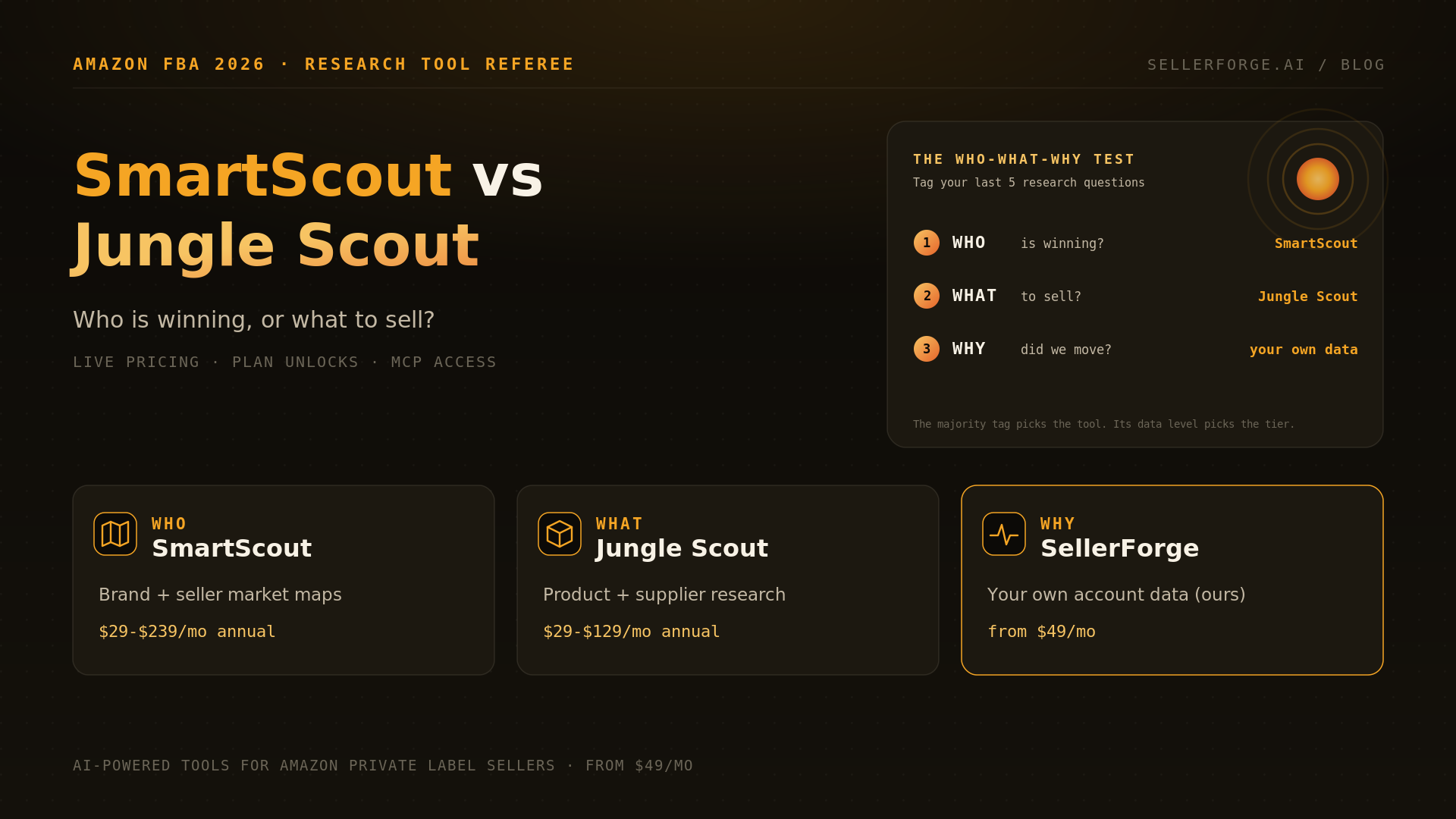
Skip Jungle Scout if your main job is keyword depth (Helium 10), brand and seller intelligence (SmartScout), price history (Keepa), or running the account after launch, which no research suite handles well. If you only want a first look at niche demand, Amazon's Product Opportunity Explorer sits inside Seller Central at no extra cost.
| If your main job is | Better fit | Price (checked November 2026) | What you give up vs Jungle Scout |
|---|---|---|---|
| A first look at niche demand | Amazon Product Opportunity Explorer | Included in Seller Central | Supplier Database, product tracking, keyword history |
| Deep keyword and reverse-ASIN research | Helium 10 Platinum or Diamond | $129/mo ($99 yearly); Diamond $359 ($279 yearly) | The guided idea-to-supplier path and supplier data |
| Who is winning a category: brands and sellers | SmartScout Basic and up | From $49/mo ($29 at the lower rate) | Supplier Database and Listing Builder |
| Price and sales-rank history for sourcing | Keepa | €29/mo | Everything except history and alerts |
| Keyword-led listing rewrites | Data Dive Starter | $39/mo ($32 yearly) | Product and supplier research |
| Account health, listings, ads and inventory after launch | SellerForge (ours) | From $49/mo | Product research and supplier data entirely |
Where SellerForge Fits (and Where It Doesn't)
SellerForge does not replace Jungle Scout for product research or supplier sourcing; it has neither. It fits after launch, when the work shifts to account health, listings, advertising and inventory: an AI workspace for the whole account, built on Claude, from $49 a month. Plenty of sellers run Jungle Scout while launching and SellerForge for operations.
| SellerForge plan | Price | What the live /subscribe page lists |
|---|---|---|
| Core | $49/mo | POA, Escalation and Reimbursements; Listing Audit 25/mo, Builder 15/mo; keyword research, rank tracking and core advertising; AI Assistant 50 msgs/day |
| Growth | $99/mo ($999/yr) | Everything in Core; Listing Audit 60/mo, Builder 40/mo; advanced ads, Forecasting, Promotions, Customer Insights; Weekly Report; 3 team members |
| Pro | $199/mo | Everything in Growth; Premium AI (Opus) on ads, forecasting and listings; AI Assistant 1,000 msgs/day; up to 10 team members |
| Agency | $499/mo | Everything in Pro on every account; 10 accounts included ($39 each additional, up to 40); account switcher; 15 seats |
- Pick SellerForge if: your products are launched and the hard part of the week is account health, listing quality, ad diagnosis and stock, or you run several client accounts.
- Keep Jungle Scout (and skip SellerForge for now) if: you are still choosing your first or next product and supplier. Research comes first; operations tools help once something is selling.
Who Should Buy Which Jungle Scout Plan?
Most sellers who should buy Jungle Scout should buy Growth Accelerator, starting monthly at $79 and moving to $49 billed yearly once it proves weekly use. Starter suits occasional research without suppliers, Brand Owner suits multi-brand competitive tracking, Cobalt suits $1M+ brands that want MCP, and sellers in pure reorder mode should buy none.
- Starter ($49 monthly, $29 billed yearly): you research a few times a year and do not need supplier data or rank tracking.
- Growth Accelerator ($79 monthly, $49 billed yearly): first-time and early private-label sellers. This is the default answer.
- Brand Owner ($149 monthly, $129 billed yearly): more than 150 tracked products or Competitive Intelligence on rival brands.
- Cobalt (custom, demo): $1M+ brands and agencies that want category data and the MCP connector inside Claude or ChatGPT.
- None: established sellers who mostly reorder. Use Amazon's free tools and spend the money on the account itself.
If I were launching my first product today, I would buy Growth Accelerator monthly, use it hard for 60 days, run the Decision-Count Test, and only then decide between yearly billing and cancelling. I would not buy Brand Owner until I had a second brand.
About the author
David Gallo is the founder of SellerForge.ai. Before building SellerForge, he managed 57 Amazon seller accounts representing more than $350M in sales at Worldfront, where his teams used Jungle Scout, Helium 10 and most of the research tools in this article on live launches. He writes about Amazon operations, advertising and AI from the operator's side.