The best Amazon feedback software is the cheapest tool that automates Amazon's own Request a Review and alerts you to new negative feedback, because every compliant tool sends the same Amazon email. FeedbackFive (from $34/mo) is the best standalone pick, SageMailer has a free tier, and Helium 10 or Jungle Scout users already own one. SellerForge (ours, from $49/mo) ties requests to account health.
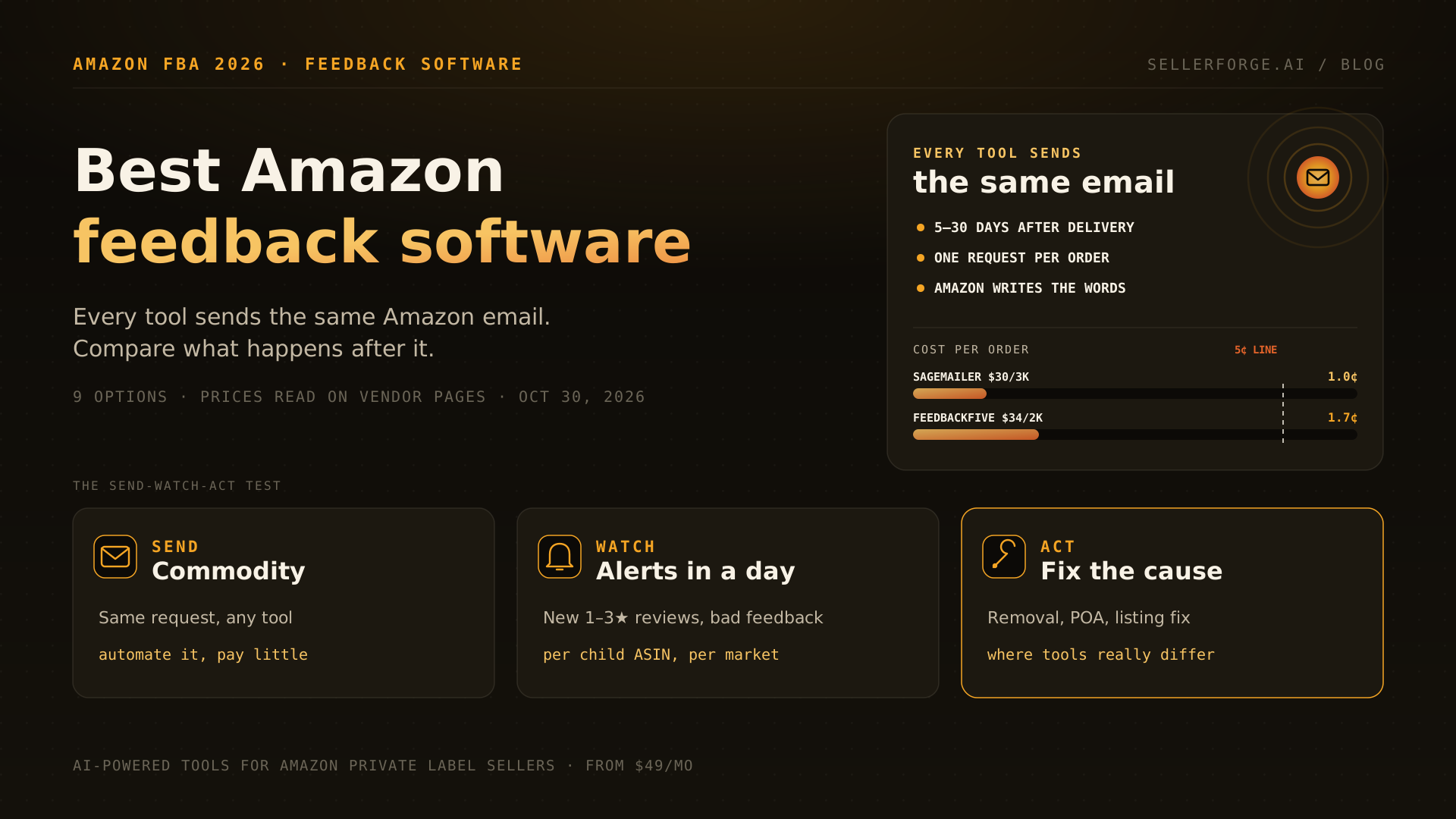
The best Amazon feedback software is the cheapest tool that automates Amazon's own Request a Review and tells you fast when a negative review or feedback lands. That is the whole decision, because every compliant tool sends the same Amazon-written email, in the same 5-to-30-day window, once per order. No vendor can send a better request than another. They can only differ in what they watch and what they help you do next.
Page one for this query is vendor listicles that rank themselves first and directory pages with prices from last year. This one has prices read on the vendors' own pages on October 30, 2026, and a test you can apply in ten minutes.
What Is the Best Amazon Feedback Software in 2026?
The best Amazon feedback software in 2026 is FeedbackFive for a standalone tool (from $34 a month), SageMailer for a free tier, Helium 10 Follow-Up or Jungle Scout Review Automation if you already pay for those suites, and Amazon's own free button under about 300 orders a month. FeedbackWhiz now ships only inside Threecolts Seller 365 bundles.
| Option | Best for | Starting price (Oct 30, 2026) | Where it wins | Where it loses |
|---|---|---|---|---|
| Amazon Request a Review (Seller Central) | Under ~300 orders a month | Free | Zero cost, zero risk, it is the official action | Manual, one order page at a time; no alerts |
| FeedbackFive (eComEngine) | Most private-label brands | $34/mo up to 2,000 orders | Requests plus review and feedback alerts, 17 marketplaces, agency plans | Price climbs with order volume; no other tools included |
| SageMailer | Small sellers on a budget | Free (200 messages); Premium $30/mo for 3,000 | Free tier, 30-day trial, unlimited stores | Smaller company; lighter analytics |
| Helium 10 Follow-Up | Existing Helium 10 users | Inside Platinum $129/mo ($99 yearly), 5,000 emails | Already paid for; 15,000 emails on Diamond | Not worth buying Helium 10 for this alone |
| Jungle Scout Review Automation | Existing Jungle Scout users | Growth Accelerator $79/mo ($49 yearly) | Exclusions included; part of a research suite | Not on Starter; Delayed Send only on Brand Owner ($149/mo) |
| FeedbackWhiz (Threecolts Seller 365) | Resellers who will use the bundle | Seller 365 Standard $69/mo; Brands 1K $179/mo | Emails, alerts, profits, repricer in one bill | No standalone FeedbackWhiz price shown; bundle cost if you only need requests |
| Seller Labs Feedback Genius | Sellers already on Seller Labs | Revenue-based; free under $2K/mo revenue | Custom message flows plus Request a Review | Price depends on revenue; check the live pricing page |
| SmartScout Rating Booster | SmartScout subscribers | No price listed on the Rating Booster page | Set-and-forget requests inside a market-intel tool | Confirm which SmartScout tier includes it |
| SellerForge Seller Feedback Requests (ours) | Brands and agencies that want requests tied to account health | Plans from $49/mo (Core) to $499/mo (Agency) | Requests, per-ASIN exclusions and feedback score tracking next to POAs, audits and Voice of Customer | Not the cheapest sender; no custom buyer-seller message sequences |
Why Does Every Compliant Tool Send the Same Request?
Every compliant tool sends the same request because Amazon writes it. The Request a Review action, and the Solicitations API that automates it, send one Amazon-templated email asking for a product review and seller feedback together, between 5 and 30 days after delivery, once per order. Sellers cannot edit the wording, so tools compete on timing and everything around the request.
This matters for buying because a lot of marketing in this category still sells the request itself: higher response rates, smarter messaging, more reviews. When the message is identical across tools, a claim like that is really about timing or volume, both of which you can check yourself. SmartScout's Rating Booster page, for example, says consistent requests can lift a review rate from about 1% to 2% or more. That is a claim about sending to every eligible order instead of a few, which any tool on this page will do.
If a feedback tool's sales page promises a better review request than its competitors, read it as a promise about timing and coverage. Amazon writes the email for everyone.
The Send-Watch-Act Test: How to Choose Amazon Feedback Software
The Send-Watch-Act Test scores any feedback tool on three jobs. SEND is commoditized, so it only needs to be automatic and cheap. WATCH is where tools differ: alerts on new negative reviews and feedback. ACT is what the tool helps you do next. Pay for the first job only if you also get the other two.
- 1SEND: confirm the tool uses Amazon's Request a Review or the Solicitations API, lets you set the delay per ASIN inside the 5-to-30-day window, and excludes refunded and returned orders. If all three are yes, stop comparing send features. They are the same request.
- 2WATCH: check what gets alerted and how fast. You want new 1-to-3-star reviews and new negative seller feedback flagged within a day, per marketplace, with the order attached, and a feedback score trend you can glance at weekly.
- 3ACT: ask what happens after an alert. Can the tool help you request removal of feedback that breaks Amazon's rules, route a defect into an account health response, or turn complaint themes into listing fixes? A tool that only sends and watches leaves this job to you.
- 4COST: divide the monthly price by your monthly orders. FeedbackFive at $34 for 2,000 orders is about 1.7 cents an order; SageMailer Premium at $30 for 3,000 messages is about 1 cent. If your number is above 5 cents an order, you are paying for features beyond requests, so make sure you use them.
Across the accounts I managed, the expensive feedback problems were never a missed request. They were a run of one-star seller feedback about late FBM deliveries that nobody saw for two weeks, while the Order Defect Rate crept toward 1%. Send was automated on every account. Watch and act were where the damage happened.
FeedbackFive vs FeedbackWhiz: Which Is Better in 2026?
FeedbackFive is better for most private-label brands in 2026 because it does one job at a low price: from $34 a month for up to 2,000 orders, with requests, review monitoring, feedback alerts and listing change alerts across 17 Amazon marketplaces. FeedbackWhiz is now sold inside Threecolts Seller 365 bundles, starting at $69 a month for resellers and $179 for brands.
| FeedbackFive | FeedbackWhiz (Seller 365) | |
|---|---|---|
| Entry price | $34/mo up to 2,000 orders | $69/mo Standard (resellers); $179/mo Brands 1K ($149 yearly) |
| What else is in the bill | Nothing; Operational Analytics tier from $89/mo adds Buy Box, returns and fee reports | Repricer, profits, listing alerts, AI listings on Brands plans |
| Marketplaces | 17 Amazon marketplaces | Amazon plus Walmart and other channels on Brands plans |
| Trial | Free trial (length not stated on pricing page) | 14 days (7 up front, 7 more after connecting an account) |
| Agency use | Agency plans combine FeedbackFive and SellerPulse | Teams and Pro seats; extra users $15/mo |
| Pick it if | You want requests and monitoring, nothing else | You will actually use the repricer and profits tools in the bundle |
The honest read: if you are a brand that does not reprice and already tracks profit elsewhere, Seller 365 Brands at $179 a month is over five times FeedbackFive's entry price for the same Amazon email. If you are a reseller who needs a repricer anyway, the Standard bundle at $69 can be cheaper than buying a repricer and a feedback tool separately. Note that the Seller 365 page lists FeedbackWhiz email limits two different ways for Standard and Teams, so confirm the limit before you commit.
Do You Need Feedback Software If You Already Pay for Helium 10 or Jungle Scout?
You usually do not need separate feedback software if you already pay for Helium 10 Platinum or Jungle Scout's Growth Accelerator. Helium 10 Platinum ($129 a month, $99 billed yearly) includes Follow-Up with 5,000 emails a month, and Jungle Scout's Growth Accelerator ($79 a month, $49 billed yearly) includes Review Automation and exclusions.
- Helium 10: Follow-Up allowances are 5,000 emails on Platinum and 15,000 on Diamond ($359 a month, $279 yearly). If you ship more than 5,000 orders a month on Platinum, check whether the cap or a dedicated tool is cheaper.
- Jungle Scout: the $49-a-month Starter plan ($29 yearly) includes neither review automation nor the extension's manual review requests. Delayed Send, which lets you pick the day inside the window, is only on Brand Owner at $149 a month ($129 yearly).
- Both: neither suite is worth buying for review requests alone. A $34 standalone tool or a free tier does the same send job.
Is It Against Amazon Policy to Automate Review Requests?
Automating review requests is not against Amazon policy when the tool uses Amazon's Request a Review action or the Solicitations API, because Amazon writes and sends the message. Policy risk comes from custom messages, incentives, asking only satisfied buyers, or anything that steers sentiment. The FTC's rule on consumer reviews adds legal exposure on top of Amazon's rules.
- Allowed: one Amazon-templated request per order, 5 to 30 days after delivery, sent by a tool through the Solicitations API.
- Risky: custom buyer-seller emails that ask for a review. Amazon's communication guidelines allow them only without incentives or marketing language, and one bad template can cost you messaging permissions.
- Banned: discounts, refunds or free products for reviews (Vine is the only sanctioned exception), asking only happy customers, inserts asking for five stars, and review swaps.
- Legal: the FTC's Consumer Reviews and Testimonials Rule took effect in October 2024, bans suppressing negative reviews and sentiment-conditioned incentives, and carries civil penalties of up to $53,088 per violation.
Seller Feedback vs Product Reviews: Why Monitoring Is the Real Product
Seller feedback and product reviews need separate monitoring because they hurt you in different places. Product reviews shape conversion and the AI review summaries shoppers read. Negative seller feedback counts toward your Order Defect Rate, which Amazon wants under 1%, and a high ODR puts your account health and selling privileges at risk.
| Signal | Where it shows | What a bad run costs you | What to watch weekly |
|---|---|---|---|
| Product reviews | Detail page, AI review highlights, search | Conversion and ranking on that ASIN | New 1-to-3-star reviews by ASIN; recurring complaint themes |
| Seller feedback | Seller profile, Account Health | Order Defect Rate, Featured Offer eligibility, account risk | New negative feedback; feedback score trend; FBA vs FBM split |
| Review sharing (2026) | Each child ASIN since the Feb 12 rollout | A new variation can start with zero reviews | Review count per child, not per parent |
One 2026 change sharpens this. Since Amazon split review sharing for functionally different variations (announced January 7, rolled out from February 12), each child ASIN carries its own review count. Feedback tools that report by parent ASIN can hide a new variation sitting at zero reviews. Ask any vendor whether alerts and counts work per child.
Where SellerForge Fits (and Where It Does Not)
SellerForge fits sellers and agencies who want review requests handled inside the same tool that watches account health, writes POAs and audits listings. It is not the cheapest request sender. If requests and alerts are all you need, FeedbackFive at $34 or SageMailer's free tier does that job for less, and I would tell a friend to start there.
- Pick SellerForge if: you want send, watch and act in one place, or you run several accounts and want one view of feedback and account health.
- Pick something else if: you only need requests (FeedbackFive, SageMailer), you need custom buyer-seller message sequences (Seller 365, Feedback Genius, SageMailer), or you already pay for Helium 10 or Jungle Scout.
Who Should Pick What
Choose by order volume and by what you already pay for. Most sellers should not add a new subscription just to send review requests, because the request is free inside Seller Central and bundled in the big suites. Buy a dedicated tool only when monitoring, multiple marketplaces or client accounts make it worth the fee.
- Under 300 orders a month: Amazon's Request a Review button by hand, or SageMailer's free tier for 200 messages.
- 300 to 2,000 orders a month, no suite: FeedbackFive at $34 a month, roughly 2 cents an order or less.
- Already on Helium 10 Platinum or Jungle Scout Growth Accelerator: turn on Follow-Up or Review Automation and set per-ASIN delays. Spend nothing more.
- Reseller who needs a repricer: Threecolts Seller 365 Standard at $69 a month covers both.
- Multi-marketplace brand: FeedbackFive (17 marketplaces) or a suite that covers your regions.
- Agency: FeedbackFive agency plans for requests only, or SellerForge's Agency plan ($499 a month) if you want feedback, account health and client deliverables across accounts.
If I were setting up a new account today, I would turn on automated requests on day one with whatever I already owned, set delays by product type, and put a weekly ten-minute check on negative feedback into the calendar. The software choice matters less than the habit of looking.
About the author
David Gallo is the founder of SellerForge.ai. Before building SellerForge, he managed 57 Amazon seller accounts representing more than $350M in sales at Worldfront, where a weekly look at negative seller feedback caught more account health problems than any dashboard. He writes about Amazon operations, account health and tools from the operator's side.