CPSC eFiling requires the importer of record to file certificate data (CPC or GCC) electronically in CBP's ACE system at entry for regulated consumer products, mandatory since July 8, 2026, with no low-value exemption. For most FBA sellers that importer is you, not Amazon or your factory. File through your broker or the CPSC Product Registry, keep one importer name across certificate, registry and entry, and keep the same documents ready for Amazon; SellerForge, our product, stores them.
CPSC eFiling is the rule that, since July 8, 2026, requires the importer of a regulated consumer product to file its certificate data electronically with US Customs at entry. For most FBA private-label sellers, that importer is you. Not Amazon, not your factory, and not your freight forwarder, unless one of them is formally the importer of record.
This guide covers who must file, the seven data elements, broker versus Product Registry filing, what has changed since July, and how Amazon's own checks line up with the federal rule.
What Is CPSC eFiling?
CPSC eFiling is the electronic submission of certificate of compliance data to US Customs and Border Protection at the time of entry, for imported consumer products subject to a Consumer Product Safety Commission rule, ban or standard. The data comes from your Children's Product Certificate (CPC) or General Certificate of Conformity (GCC). It became mandatory on July 8, 2026.
Why the CPSC cares: its own 2017 to 2018 certificate study found an entry was five times more likely to have a violation when no certificate was ever provided, and about three times more likely when the certificate arrived more than 24 hours late. eFiling moves the certificate from an afterthought to a screening input.
Who Is Responsible for CPSC eFiling on Amazon?
The importer is responsible for CPSC eFiling, and for most Amazon FBA private-label sellers the importer of record is the seller. Amazon does not act as importer of record for your inbound inventory, and your factory's test report does not file itself. A customs broker usually transmits the data, but the broker files what the importer supplies.
Three common setups decide who that is in practice:
- You are the importer of record on your own bond. This is the cleanest setup. You own the certificates, you control the Product Registry account, and your broker files on your behalf.
- Your forwarder ships DDP on its own bond. The forwarder or its client entity is the importer of record, so the certificate data must name and match that entity. Ask in writing whose name appears on the entry, and get a copy of what was filed.
- Your supplier ships direct to an FBA warehouse. Someone is still the importer of record on that entry. If neither you nor the supplier can name them, you have found the problem before customs does.
What Data Does CPSC eFiling Require?
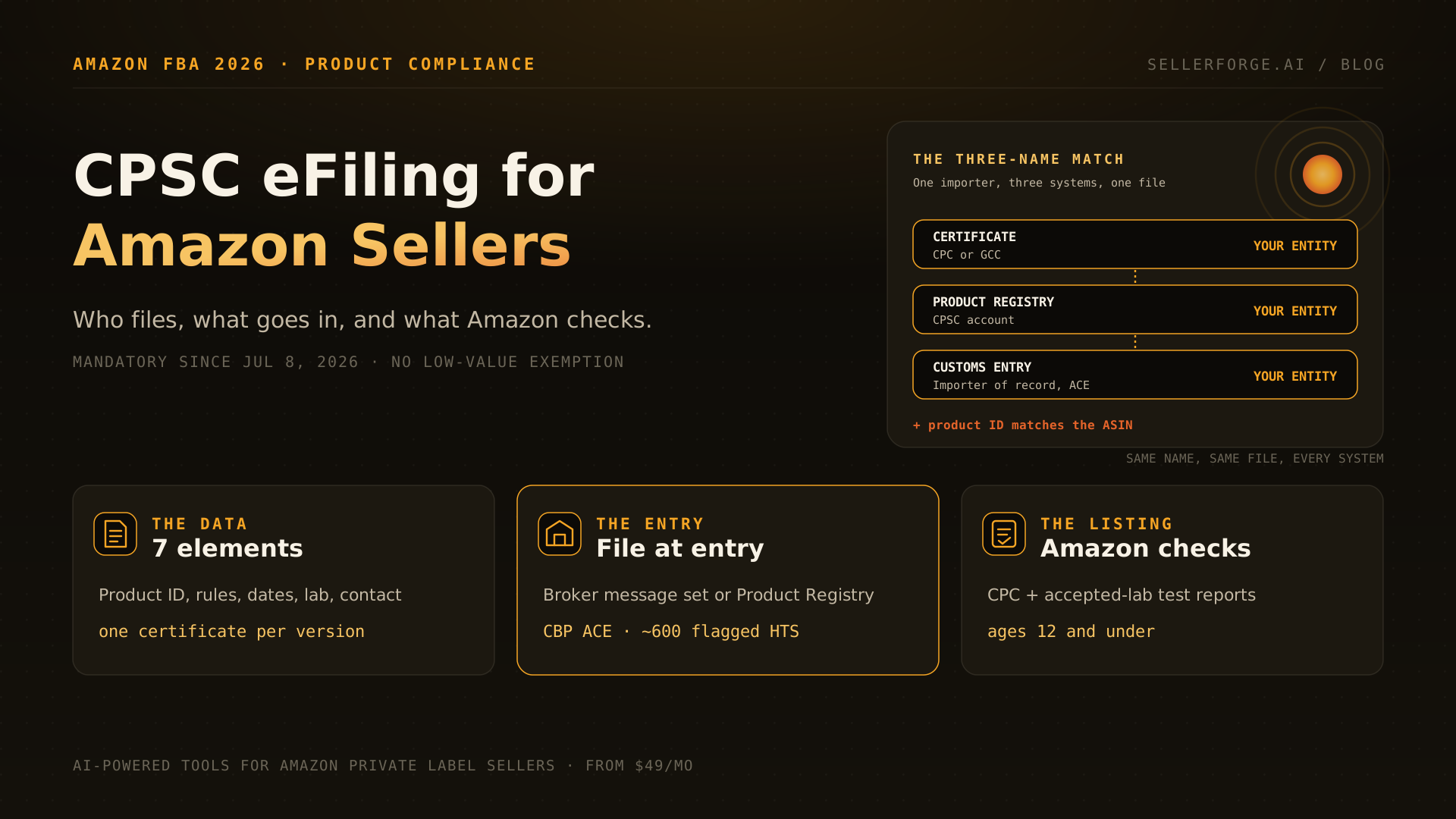
CPSC eFiling requires seven certificate data elements for each regulated product: a product identifier, every cited safety rule, the date of manufacture, the place of manufacture, the date of the most recent compliance test, the testing laboratory, and the point of contact who keeps the test records. Each certificate covers exactly one product version.
| Data element | What to enter | Where sellers trip up |
|---|---|---|
| Product identifier | GTIN, UPC, model number, SKU, serial or registered number (at least one) | Using an internal SKU on the certificate and a different identifier on the listing |
| Cited safety rules | Every CPSC rule the product is certified to (for example the toy standard, lead and phthalate limits) | Citing only the headline standard and missing lead-in-paint or phthalate rules |
| Date of manufacture | At least month and year of the production run | Reusing one certificate across production runs months apart |
| Place of manufacture | Factory name, full address and contact | Naming the trading company instead of the factory |
| Date of last test | When the product was most recently tested | Test dates older than the materials or factory now in use |
| Testing laboratory | Lab name, address and contact; CPSC-accepted labs use a four-digit ID | Children's products tested at a lab that is not CPSC-accepted |
| Records contact | Name, address and contact of whoever keeps the test records | A contact who no longer works there or does not respond |
Product Registry or Broker Filing: Which Should You Use?
Sellers who import the same products repeatedly should use the CPSC Product Registry: enter each certificate once, then your broker cites it by reference on every entry. Sellers with a handful of SKUs or one-off shipments can have the broker send the full data set with each entry. Both routes end in CBP's ACE system.
| Full message set (broker sends everything) | Reference message set (Product Registry) | |
|---|---|---|
| How it works | All seven data elements sent with every entry | Certificate stored once; entry cites certifier ID, product ID and version |
| Best for | A few SKUs, irregular shipments | Repeat imports, larger catalogs, multiple brokers |
| Who controls the data | Mostly your broker's templates | You, in your own registry account |
| Error risk | Retyped every time; drift between entries | One source of truth; versioned when the product changes |
| Setup effort | Low upfront, ongoing per entry | Account, permissions and upload (web form, CSV or API) |
Two practical notes. First, permissions must be set in both the Product Registry and ACE, or your broker cannot see what you uploaded. Second, the registry versions certificates, so a new production run or material change should become a new version, not an edit that silently overwrites last quarter's data.
What Has Changed Since July 8, 2026?
Three things changed after July 8. Customs confirmed it will accept entries with missing CPSC data rather than reject them, the CPSC refreshed its list of roughly 600 flagged tariff codes with required and may-be-needed flags, and international mail shipments began folding into the same eFiling process from October 22, 2026.
- Disclaim A covers products outside CPSC certificate requirements, such as items under another agency's jurisdiction or component parts.
- Disclaim B covers products under formal enforcement discretion, such as certain plain-surface adult apparel fabrics and consumer-to-consumer gifts.
- Neither disclaim covers a regulated product whose certificate you simply do not have.
Penalties stay serious even while entry rejection is off the table. Civil penalties for Consumer Product Safety Act violations reach $120,000 per violation and $17.15 million for a related series after inflation adjustment, figures cited in an August 2026 Senate bill summary that proposes removing the cap altogether.
What Does Amazon Check, and How Does It Connect to eFiling?
Amazon checks the same certificates from the listing side. For products designed for children 12 and under, it requires a Children's Product Certificate plus test reports from a CPSC-accepted laboratory, and it can request them for any ASIN at any time. Missing documents usually surface as a listing removal and a request under Account Health, not as a customs problem.
Amazon's checks run on separate rails from customs, which is exactly why one clean document chain matters:
- Document requests. Amazon asks for the CPC and test reports through Account Health (Product Compliance Requests), and compliance consultants report it rejects certificates with any required section missing. Their guidance is to put the ASIN on the CPC as the product identifier.
- Direct verification for some categories. Toys (since September 2025), clothing storage units (since March 2026) and children's jewelry (from September 2026) go through Amazon-approved testing providers who send results to Amazon directly.
- Lab standards. Amazon accepts compliance reports only from labs that meet its requirements and keeps a list of suspended labs, so a cheap test from the wrong lab fails twice: at Amazon and as a CPC citation.
The cheapest compliance work is done once, before the shipment leaves the factory. Every fix after that happens under a deadline, either at the port or in Seller Central.
The Three-Name Match: How to Keep One Clean Chain
The Three-Name Match is a simple rule: the importer named on the certificate, the account that holds it in the CPSC Product Registry, and the importer of record on the customs entry must be the same legal entity, and the product identifier must match the ASIN listing. When all three names agree, eFiling, broker filing and Amazon document requests all draw from one file.
Most of the early friction traces to a mismatch in one of those three places. Run this before every first shipment of a new product, and again whenever a factory, material or forwarder changes:
- 1Map every SKU to its tariff code and check it against the CPSC's CP1 and CP2 list; decide for each one whether a CPC, a GCC or a disclaim applies.
- 2Confirm who is importer of record for each shipping lane, in writing from your forwarder, and fix any lane where the answer is not you or your own entity.
- 3Issue one certificate per product version, naming that importer, the real factory, the production month, every cited rule and a CPSC-accepted lab for children's products.
- 4Put the ASIN and the barcode on the certificate so the same file serves customs and Amazon.
- 5Load the certificate into your Product Registry account and grant your broker access, or send the broker the full data set if you file per entry.
- 6Ask the broker for the filing confirmation on the first entry and compare it field by field with the certificate.
- 7File the certificate, test reports and filing confirmation together where you can find them in minutes, because Amazon's request will not wait for you to email the factory.
Across the 57 accounts I managed at Worldfront, the compliance cases that cost the most were never the ones with failed tests. They were the ones where the test was fine and nobody could produce the right version of the document in time. A children's product that sat suppressed for three weeks over a certificate showing the wrong factory lost more money than a retest would have cost.
Where SellerForge Fits (and Where It Doesn't)
Where it does not fit, plainly: your customs broker and the CPSC Product Registry are where eFiling happens, and an accredited lab is where testing happens. For complex classification questions or a CPSC enforcement letter, a trade-compliance attorney or consultant is the right call, not software. SellerForge keeps the Amazon side ready; it does not make an untested product compliant.
CPSC eFiling Checklist for Amazon Sellers
Use this short checklist to get compliant for the next shipment. It assumes you sell at least one product covered by a CPSC rule; if every product you sell falls outside CPSC jurisdiction, your broker still needs the right disclaim on flagged codes.
- Every regulated SKU has a current CPC or GCC naming your importer entity and the real factory.
- Children's products cite a CPSC-accepted lab and every applicable rule, not just the headline standard.
- Your forwarder has confirmed in writing who is importer of record on each lane.
- Your Product Registry account exists, holds current certificate versions and grants your broker access.
- The ASIN and barcode on each certificate match the live listing.
- Certificates, test reports and filing confirmations are stored together and reachable in minutes.
- Anyone shipping samples or small replenishments by international mail knows those parcels are in scope from October 22, 2026.
About the author
David Gallo is the founder of SellerForge.ai. Before building SellerForge, he managed 57 Amazon seller accounts representing more than $350M in sales at Worldfront, where the compliance cases that hurt most were not failed tests but missing or mismatched documents.