A2X vs Link My Books comes down to your accountant and your tax footprint: pick A2X for accountant-led U.S. books, NetSuite or long settlement history, and Link My Books for UK and EU VAT or several sales channels on Xero or QuickBooks Online. At 5,000 Amazon orders a month, A2X is $85 and Link My Books $68, or $88 with its deferral add-on. SellerForge (ours, from $49/mo) is not a connector.
A2X vs Link My Books is a choice between two good Amazon settlement connectors, and the right answer depends less on features than on two facts about your business: who closes your books, and where you owe sales tax or VAT. A2X wins for accountant-led U.S. books, NetSuite and long history. Link My Books wins for UK and EU VAT, for sellers with several sales channels, and on price at most volumes.
A2X vs Link My Books: What Is the Difference?
A2X and Link My Books do the same core job: they read each Amazon settlement and post one summarized journal into Xero or QuickBooks Online that matches the bank deposit, with sales, refunds, each fee type, advertising and marketplace tax on separate lines. The differences are which ledgers they reach, how much history and tax help each plan includes, and how they price extra channels.
Both are mature and well reviewed by the people who use them most. On the Xero App Store's U.S. listings on November 17, 2026, A2X showed 5.0 stars from 951 reviews and Link My Books 4.99 stars from 613. A2X says more than 13,000 ecommerce businesses and accounting professionals use it and cites Xero's Small Business App of the Year award for 2026 in the U.S. and Canada. Neither tool is a risky choice; they are different choices.
| Factor | A2X | Link My Books |
|---|---|---|
| Ledgers | QuickBooks Online, Xero, NetSuite (Sage listed on A2X's comparison page) | Xero and QuickBooks Online only |
| Native sales channels | Amazon, Shopify, eBay, Etsy, Walmart, PayPal; TikTok Shop via Shopify | Amazon, eBay, Etsy, Shopify, Walmart (U.S.), TikTok Shop (UK and U.S.), WooCommerce, Square |
| How it prices | Per channel by order volume; separate Multi-channel plans from $95 | One plan by total orders plus number of sales channels |
| Settlement history (1 Amazon account) | 3 months on Mini, 12 on Starter, 24 on Standard, maximum available on Premium | 3 months on one channel; 12 at two channels, 18 at three, 24 at ten; extra history sold as a one-off fee |
| COGS | Starter and above (not on Mini) | Included |
| Amazon deferred transactions (DD+7) | Automated accruals; A2X says included on Amazon plans | Add-on: $20, £15 or A$30 a month per Amazon channel |
| VAT | Splits VAT by transaction type; daily posting for MTD | Guided Tax Wizard, mixed-rate product groups, VAT audit |
| Marketplaces per Amazon account | One Merchant ID per plan up to Premium 10k; 5 to 20 on higher Premium tiers | Unlimited marketplaces per Merchant ID |
| Trial | Free, no card, post three settlements | 14 days, no card, 90 days of data |
Read that table twice and a pattern appears. A2X charges more and includes more per Amazon account: deferred accruals, long history on its mid tiers, NetSuite. Link My Books charges less per account and less again per extra channel, but sells history and deferrals separately. Which pattern is cheaper depends on your shape, which is why the next section prices the shapes.
How Much Do A2X and Link My Books Cost in 2026?
For one Amazon account on November 17, 2026, A2X costs $29, $65, $85, $169 and $309 a month at 200, 1,000, 5,000, 10,000 and 20,000 orders. Link My Books costs $24, $47, $68, $112 and $198 at the same volumes. Link My Books is cheaper at every volume on list price, but its single-channel plans include three months of history and no deferral handling.
| Orders per month (1 Amazon account) | A2X (since Nov 14, 2026) | Link My Books (1 channel) | Link My Books + deferral add-on | History included (A2X / LMB) |
|---|---|---|---|---|
| Up to 200 | $29 (Mini, no COGS) | $24 | $44 | 3 months / 3 months |
| Up to 1,000 | $65 (Starter) | $47 | $67 | 12 months / 3 months |
| Up to 5,000 | $85 (Standard) | $68 | $88 | 24 months / 3 months |
| Up to 10,000 | $169 (Premium 10k) | $112 | $132 | Max available / 3 months |
| Up to 20,000 | $309 (Premium 20k, 5 Merchant IDs) | $198 | $218 | Max available / 3 months |
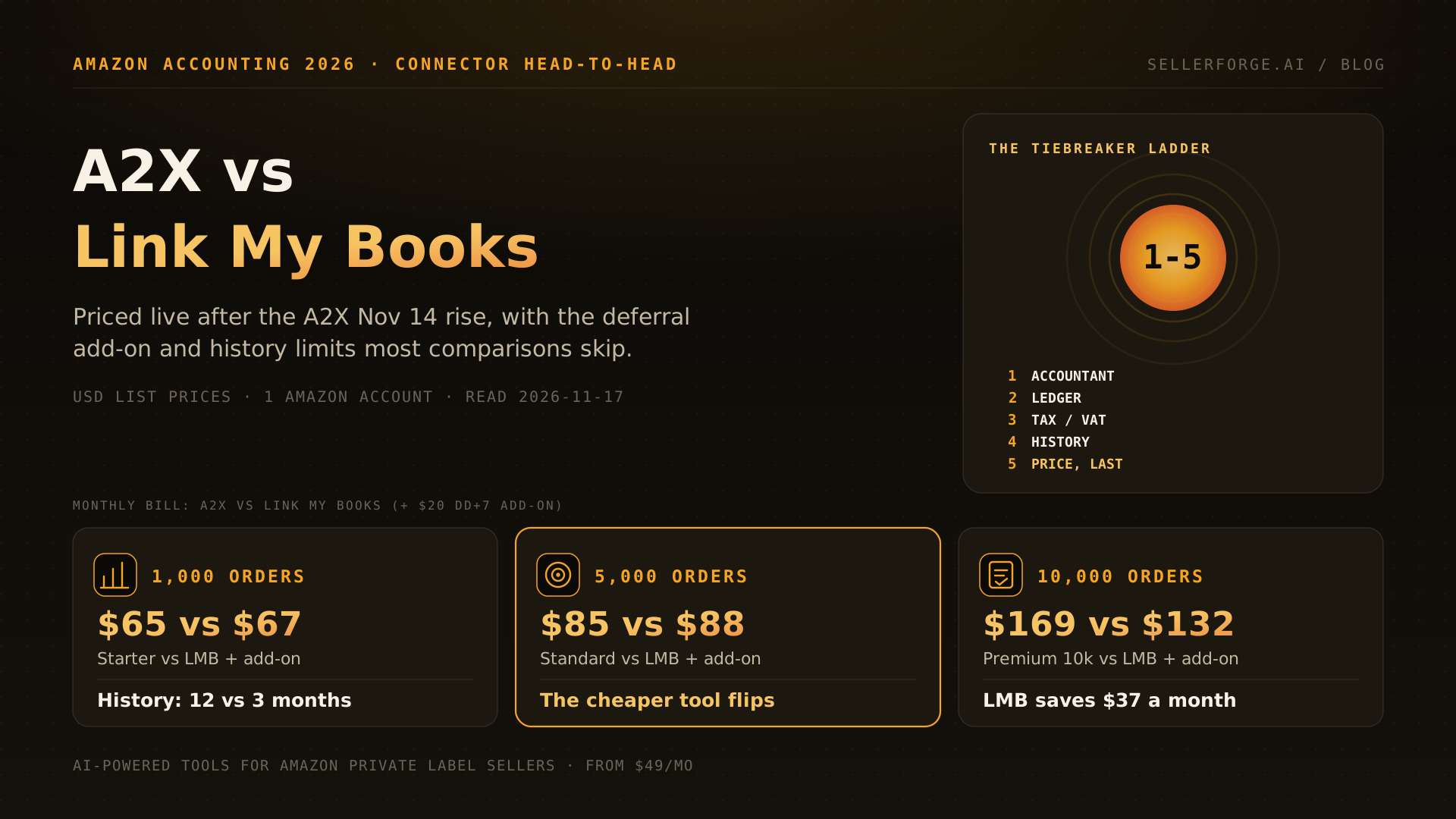
The add-on column is the number most comparisons skip. At 1,000 and 5,000 orders, a U.S. seller who wants DD+7 deferrals handled automatically pays about the same on either tool: $67 versus $65, and $88 versus $85. The real Link My Books saving starts at 10,000 orders, where it is $37 a month even with the add-on, and grows to $91 at 20,000.
History is the other hidden line. If you are catching up on a year of unbooked settlements, A2X Standard reaches back 24 months on one account. Link My Books' single-channel plan reaches back three, and more history is a one-off purchase whose price the calculator does not show. For a seller starting clean this month, three months is plenty; for a catch-up year, ask Link My Books for the history quote before you compare.
Which Is Cheaper for Multi-Channel and Multi-Account Sellers?
Link My Books is much cheaper for sellers with more than one sales channel. At 5,000 orders a month across two channels, such as Amazon plus Shopify or Amazon North America plus Amazon Europe, Link My Books is $77 with 12 months of history. A2X's Multi Premium 5K plan, which covers four channels and lists COGS, is $179.
The gap comes from how each tool counts. Link My Books counts sales channels, where one Amazon Merchant ID is one channel no matter how many marketplaces it covers, and adds a small step per extra channel: $68 for one channel at 5,000 orders, $77 for two, $90 for three. A2X prices Multi-channel plans separately: $95 for up to 1,000 combined orders on two channels, $125 for 2,000 on three, $179 for 5,000 on four and $249 for 10,000 on five.
- Amazon only, one Merchant ID, under 10,000 orders: the gap is small once you price deferrals, so decide on the ladder below, not on price.
- Amazon plus Shopify, eBay or Etsy: Link My Books is roughly half the price at 5,000 combined orders, and adds history as you add channels.
- Amazon North America plus Amazon Europe: two channels on Link My Books ($77 at 5,000 orders) against A2X Multi ($179) or two Standard subscriptions ($170). Add $40 for two deferral add-ons on Link My Books if both accounts need them.
- TikTok Shop sold directly, WooCommerce or Square: Link My Books lists direct integrations; A2X handles TikTok Shop orders that flow through Shopify.
Across the 57 accounts I managed, the multi-channel brands were where connector bills drifted. Nobody re-priced the stack when a brand added Shopify or opened Europe, so the bill grew one subscription at a time. If your channel count changed this year, re-run this table before your next renewal.
Which Is Better for UK VAT Sellers and for U.S. Sellers With an Accountant?
Link My Books is better for most UK and EU sellers, because VAT is where it was built: a Guided Tax Wizard, product groups for mixed rates and a VAT audit view. A2X is usually better for U.S. sellers whose bookkeeper closes the month, because it is the connector many ecommerce accounting firms already run, with an adviser certification program and NetSuite support.
UK and EU sellers: VAT decides it
The practical test is your product mix. A UK seller on Pan-European FBA with children's clothing at zero rate and supplements at standard rate needs tax rules applied per product, every settlement, in several countries. That is Link My Books' home turf, and a misconfigured connector is costliest here, because VAT errors surface in a return, not on a dashboard. A2X splits VAT by transaction type too, and still makes sense when your accountant runs a book of A2X clients.
U.S. sellers: your accountant decides it
Accountant time is the most expensive line in this decision. A $17-a-month saving disappears the first time your bookkeeper spends an extra hour on an unfamiliar mapping screen. Three U.S. situations point to Link My Books anyway: you do your own books, you sell on Walmart, eBay, Etsy and Shopify alongside Amazon, or you run 10,000 orders or more on one channel. If your accountant has no preference, run both trials on the same messy settlement.
The Tiebreaker Ladder: How to Choose in Five Questions
The Tiebreaker Ladder is a five-rung order for choosing between A2X and Link My Books. Ask the questions from the top and stop at the first rung where the two tools differ for your business: accountant, ledger, tax, history, then price. Price sits at the bottom on purpose, because the monthly gap is usually smaller than the cost of getting any rung above it wrong.
The Tiebreaker Ladder: 1. Accountant: which tool does the person closing your books already run? 2. Ledger: NetSuite or Sage means A2X. 3. Tax: UK or EU VAT with mixed rates leans Link My Books. 4. History: catching up a year or more on one account leans A2X. 5. Price: only now compare the bill, deferral add-on included.
- 1Accountant. Ask your bookkeeper which connector they run for other Amazon clients. A firm standard beats a cheaper tool, and the answer settles most U.S. decisions on this rung.
- 2Ledger. If you are on NetSuite, or will be within a year, choose A2X; Link My Books connects only to Xero and QuickBooks Online.
- 3Tax. If you file UK or EU VAT with more than one rate in your catalog, lean Link My Books for its Tax Wizard and product groups.
- 4History. If you need to book 12 months or more of past settlements on one Amazon account, A2X Starter or Standard includes it; price Link My Books' extra history before comparing.
- 5Price. Compare the bill you would actually pay: deferral add-on, channel count and history included. Use the tables above, then confirm on both vendors' live pages.
How Do A2X and Link My Books Handle Amazon DD+7 Deferrals?
Both now automate Amazon's deferred transactions. Since Amazon moved to delivery-date-based payouts, sales from late in a month can settle in the next one. A2X accrues those deferred sales, fees and COGS into the month they were earned and reverses the accrual when Amazon releases the funds; Link My Books does the same through a paid add-on.
Whether you need it depends on who reads your monthly numbers. If you close quarterly for tax, settlement journals may be enough. If a lender, investor or buyer reads monthly results, revenue in the wrong month raises questions, and the accrual is worth paying for.
How Do You Switch From A2X to Link My Books, or Back?
You switch connectors safely by choosing one settlement as the boundary: the old tool posts everything before it, the new tool posts that settlement and everything after, and no settlement is ever posted twice. Most switching damage comes from duplicate journals and a changed chart of accounts, not from the new tool itself.
- 1Pick the boundary. Choose the first settlement of a new month or quarter, so your accountant can compare periods cleanly.
- 2Export the old tool's history for every settlement it posted, and save its account mappings as a reference.
- 3Map the new tool to the same chart of accounts. Changing accounts mid-year makes year-over-year reports useless.
- 4Post the boundary settlement to a test file in the new tool and run the Penny-Match checks before touching live books.
- 5Switch off posting in the old tool, then let the new tool post the boundary settlement live. Check the bank reconciliation for that deposit the same day.
- 6If you rely on deferral accruals, set the new tool's deferral start date to the boundary and reverse any open accruals the old tool left behind.
- 7Cancel the old subscription only after one full month has closed cleanly in the new tool.
The one thing I would not do is switch in the last month of a fiscal year or during a Q4 peak. Pick a quiet month, and give your bookkeeper the boundary date in writing. For agencies that run books for many clients, the larger win is standardizing on one connector across the book, so every close follows the same steps.
Where SellerForge Fits (Disclosure: It Is Ours)
SellerForge is not accounting software and replaces neither A2X nor Link My Books. It is AI-native account intelligence for Amazon sellers and agencies, from $49 a month, that works above the books: your connector records what happened in a form your accountant can file, and SellerForge helps you act on the account before the next settlement lands.
| Job | A2X | Link My Books | SellerForge (ours, from $49/mo) |
|---|---|---|---|
| Post settlement journals to Xero or QuickBooks | Yes | Yes | No; pair it with either connector |
| UK and EU VAT handling | Yes | Yes, with guided Tax Wizard | No |
| Amazon deferred-transaction accruals | Included | $20 add-on per Amazon channel | No |
| Flag reimbursement gaps and assemble the evidence | No | No | Yes, on Core |
| Weekly business report and inventory forecasting | No | No | Yes, on Growth ($99) |
| Document Vault for invoices and compliance files | No | No | Yes, from 1 GB on Core |
What SellerForge will not do, plainly: post journals, file VAT or sales tax, accrue deferred revenue or produce a general ledger, and it does not compute net profit by product today. For the books, choose A2X or Link My Books from the tables above.
Who Should Pick What
Pick by the Tiebreaker Ladder, in order. A2X fits accountant-led U.S. books, NetSuite and catch-up history on one account. Link My Books fits UK and EU VAT, multi-channel sellers and do-it-yourself books on Xero or QuickBooks Online. At 5,000 orders on one account the bills are within a few dollars once deferrals are priced, so price should rarely decide.
- U.S. seller whose accountant runs A2X: A2X, on Starter or above so COGS posts.
- UK or EU seller with Pan-European FBA or mixed VAT rates: Link My Books on Xero, with the deferral add-on only if you report monthly.
- Amazon plus Shopify, eBay, Etsy, Walmart or TikTok Shop: Link My Books; its channel pricing is roughly half of A2X Multi at 5,000 orders.
- On NetSuite, or moving there within a year: A2X.
- Catching up 12 to 24 months of unbooked settlements on one account: A2X Standard, unless Link My Books' history quote changes the math.
- Doing your own books at 10,000 orders or more on one channel: Link My Books, which stays $37 a month cheaper even with the deferral add-on.
- Whatever connector you choose: add an operating layer such as SellerForge (ours) for reimbursements, forecasting and the weekly view.
About the author
David Gallo is the founder of SellerForge.ai. Before building SellerForge, he managed 57 Amazon seller accounts representing more than $350M in sales at Worldfront, where his teams ran both A2X and Link My Books into client books and learned that the right connector is the one your accountant closes fastest in.