Sellerboard is worth it in 2026 for most Amazon sellers who want a daily per-ASIN profit dashboard and will act on it weekly: Standard costs $19 a month for up to 3,000 orders, with a free month and no card. Most growing sellers really pay $29, because Standard allows only 150 review requests and one user. For accounting-grade books add A2X; for AI account operations, SellerForge (ours, from $49/mo).
Sellerboard is worth it in 2026 for most Amazon sellers who want an accurate daily profit number per product and will act on it every week. Standard costs $19 a month for up to 3,000 orders, and the one-month free trial needs no credit card. It stops being worth it when Amazon's free Profit Analytics dashboard already answers your questions, or when the job you need is accounting-grade books or someone acting on the numbers.
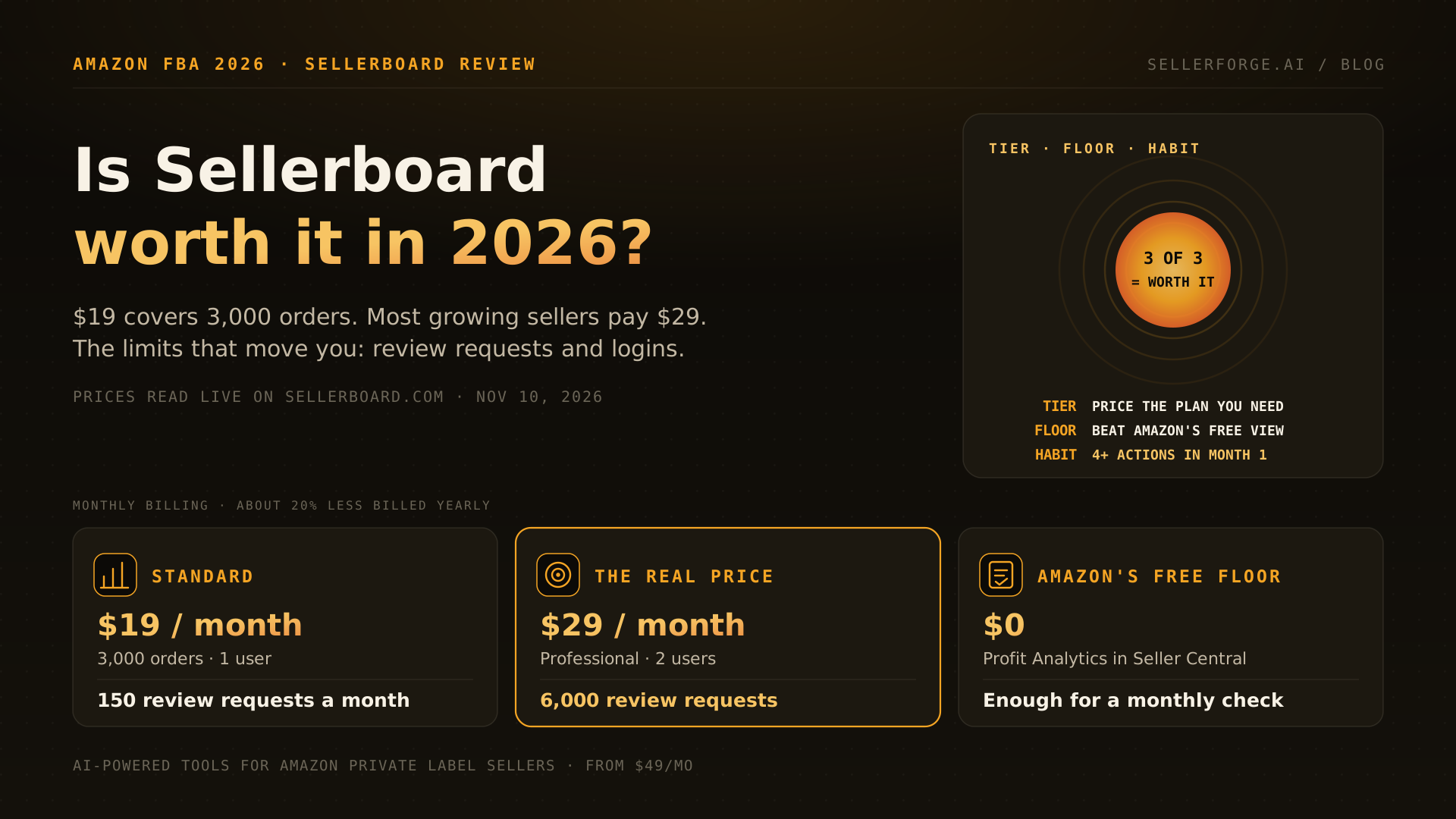
The short version most reviews miss: the $19 headline is real, but the Standard plan includes only 150 automated review requests a month and one user. Those two limits, not order volume, are what move most growing sellers to the $29 plan.
Is Sellerboard Worth It in 2026? The Short Answer
Yes for most sellers with more than a handful of orders a day who want per-ASIN profit daily; no for single-account sellers who check profit once a month. The plan to buy depends less on order volume than on review requests, logins and accounts, which is why the right answer for a growing brand is usually Professional at $29, not Standard at $19.
| Your situation | Worth it? | Plan to buy | Why |
|---|---|---|---|
| One account, low volume, profit checked monthly | Maybe not | Amazon Profit Analytics (free) first | Amazon's free dashboard covers fees, ads and returns once you enter COGS |
| One account, you want per-ASIN profit every day | Yes | Standard ($19, or $15 billed yearly) | The cheapest accurate per-ASIN profit view with ads, refunds and FIFO COGS |
| More than 150 orders a month and you want automated review requests on all of them | Yes | Professional ($29) | Standard caps follow-up emails and review requests at 150 a month |
| Owner plus a VA or bookkeeper | Yes | Professional (2 users) or Business (4 users) | Standard includes one user |
| Agency or multi-brand operator needing per-client access control | Yes | Enterprise ($79) | Only Enterprise manages user rights by account, marketplace and product |
| You need books your accountant can file from | Not on its own | Add A2X or Link My Books | A profit dashboard is not a general ledger |
How Much Does Sellerboard Cost in 2026?
Sellerboard costs $19, $29, $39 or $79 a month on monthly billing for Standard, Professional, Business and Enterprise, read live on November 10, 2026. Billed yearly, the same plans work out to $15, $23, $31 and $63 a month, charged as $179, $279, $369 or $759 up front. Plans are tiered by monthly orders, from 3,000 to 50,000, with a one-month free trial and no card.
| Plan | Monthly billing | Billed yearly (per month) | Paid per year | Orders per month | Review requests or follow-up emails per month | Users | Automated reports |
|---|---|---|---|---|---|---|---|
| Standard | $19 | $15 | $179 | 3,000 | 150 | 1 | 3 |
| Professional | $29 | $23 | $279 | 6,000 | 6,000 | 2 | 6 |
| Business | $39 | $31 | $369 | 15,000 | 15,000 | 4 | 8 |
| Enterprise | $79 | $63 | $759 | 50,000 | 30,000 | 4 | 16 |
The same table lists 4, 6, 8 and 16 under additional seller accounts, so even Standard can hold more than one Amazon account, and Sellerboard supports up to 30,000 products per account. Every plan includes the real-time profit dashboard, listing change alerts, PPC optimization, the repricer, inventory management, refunds for lost inventory and the LTV dashboard. Only Enterprise adds user access rights by account, marketplace and product. EU prices are shown net of VAT.
Annual billing saves $49 a year on Standard and $189 on Enterprise, roughly 20%. My advice is the same as for any tool with a free trial: use the full month on real data, pay monthly for one or two more, and only then commit a year up front.
What does the $19 Sellerboard plan actually cover?
The $19 Standard plan covers the full profit dashboard and every core tool for up to 3,000 orders a month, which is more volume than most single-brand sellers reach. Its real limits sit elsewhere: 150 automated review requests or follow-up emails a month, one user login and three automated reports.
- Review requests: at 150 a month, a seller with 600 orders automates requests on a quarter of them. Amazon allows one Request a Review per order, between 5 and 30 days after delivery, so on Standard the cap, not Amazon, decides your coverage.
- Users: one login means a VA or bookkeeper either works from yours or waits for Professional, which adds a second seat.
- Automated reports: three scheduled reports cover a weekly profit summary and a monthly review, not per-brand or per-client reporting.
- Orders: 3,000 a month is roughly $90,000 to $150,000 in monthly sales at a $30 to $50 average order, so order volume is rarely the first ceiling.
So the honest version of the pricing is $19 if you are a solo operator who does not need automated review requests on every order, and $29 for almost everyone else. That is still cheap. It is just not the number on the homepage.
Is Sellerboard Accurate?
Sellerboard is accurate when your cost of goods is complete, and wrong in predictable ways when it is not. It pulls Amazon fees, refunds and ad spend automatically, but COGS, freight to Amazon, prep and duties come from you, so most complaints that Sellerboard is wrong trace back to a missing or stale cost input rather than the software.
A profit tool is only as accurate as the landed cost you typed in last. Put a reminder on every purchase order: the day a batch is received, update its COGS.
Sellerboard vs Amazon's Free Profit Analytics Dashboard
Amazon's free Profit Analytics dashboard, released September 18, 2025 in Seller Central, now covers much of what sellers used to pay Sellerboard for: selling, fulfillment, storage and inbound fees, returns and Amazon ad costs, plus your own COGS through an optional inputs section. Sellerboard still wins on freshness, multi-account views and the tools built around the numbers.
| Job | Amazon Profit Analytics (free) | Sellerboard (from $19/mo) |
|---|---|---|
| Amazon fees, returns and Amazon ad costs | Included automatically | Included automatically |
| Cost of goods | Optional Additional Financial Inputs, including spreadsheet upload | Per batch with FIFO, plus cost-accuracy alerts |
| Freshness | Typically 1 to 2 days behind; some fees up to 7 days | Marketed as a real-time dashboard; estimated fees reconcile at settlement |
| Off-Amazon ad spend (Meta, TikTok, Google) | Can be entered manually | Can be added as expenses |
| Several seller accounts in one place | One account at a time | Multiple accounts on every plan |
| Review requests, repricer, reorder alerts, lost-inventory reports | Not part of the dashboard | Included on every plan |
| Price | Free | $19 to $79 a month |
The Tier-Floor-Habit Test: Is Sellerboard Worth It for You?
The Tier-Floor-Habit Test is a five-minute check before you pay: find the tier you actually need, name the gap Amazon's free dashboard leaves, and confirm the habit of acting on the number. Sellerboard is worth it when all three pass. If any one fails, stay on the free dashboard or the cheaper plan until it does.
- 1TIER: price the plan your real needs land on, not the $19 headline. Count monthly orders, review requests you want automated, people who need a login and accounts you run. Whichever of the four needs the highest plan decides the price.
- 2FLOOR: write down one decision Amazon's free Profit Analytics dashboard cannot support for you this month, such as a per-batch FIFO margin, a daily ad-profit check or a combined view across two accounts. No decision, no purchase.
- 3HABIT: during the free month, log every time a Sellerboard number changed what you did: a price change, a paused campaign, a reorder, a reimbursement case. Fewer than four in the month means you bought a dashboard you will not open.
- 4Repeat the test 14 days before any annual renewal, so the renewal is a decision rather than a default.
Worked example: a two-person brand doing 1,100 orders a month on one account wants review requests on every order and a login for its VA. Orders point to Standard, but review requests and users both point to Professional, so the real price is $29 a month, or $279 a year. If the free month logs six actions, it is worth it at that price. If it logs one, the free dashboard and a spreadsheet will do.
Across the accounts I managed, profit dashboards rarely failed because the math was wrong. They failed because nobody opened them after the first month, and the subscription renewed anyway. The habit check is the one sellers skip, and it is the one that decides the answer.
When Do Sellers Outgrow Sellerboard?
Sellers outgrow Sellerboard when the job changes, not when the price climbs, because even Enterprise is $79 a month. The three common exits are needing accounting-grade books, selling heavily off Amazon, and wanting software or a team that acts on the numbers instead of displaying them. Interface fatigue is a fourth, softer reason.
- Books: Sellerboard is a management dashboard, not a ledger. When your accountant needs settlements posted to QuickBooks or Xero, add a connector. A2X starts at $29 a month for 200 orders and $59 for 1,000, read live today, and its pricing page says plans above Mini rise from November 14, 2026.
- Multichannel: Sellerboard's site now lists Shopify and Walmart products, and its March 2026 update added Walmart expense import and eBay order-level cost uploads, but reviewers still name limited off-Amazon integration as a drawback. Test your second channel inside the trial.
- Action: Sellerboard shows a margin drop; it does not investigate it. If the follow-up is the work you want off your plate, you need an operations layer or a person.
- Interface: reviewers praise accuracy and value but call the interface dated and the setup, especially entering costs, slow. Budget an afternoon for COGS on your top 20 products.
Sellerboard vs Helium 10 Profits and Other Options
Against suites, Sellerboard is the cheaper way to buy profit tracking on its own. Helium 10 includes its Profits tool in Platinum at $129 a month, or $99 billed yearly, which only makes sense if you also use its keyword research. For books, add A2X. For account operations, SellerForge sits beside Sellerboard rather than replacing it.
| Option | Price (date checked) | Best at | Where it loses to Sellerboard |
|---|---|---|---|
| Amazon Profit Analytics | Free (Seller Central) | A monthly profit check on one account | Freshness, multi-account views and the tools around the numbers |
| Sellerboard | $19 to $79/mo (Nov 10, 2026) | Daily per-ASIN profit with FIFO COGS | Baseline |
| Helium 10 Platinum (includes Profits) | $129/mo, $99 billed yearly (Oct 28, 2026) | Keyword research and profit on one bill | About 5x the price of Standard if profit is all you use |
| A2X | From $29/mo for 200 orders (Nov 10, 2026) | Accounting-grade settlement journals for QuickBooks or Xero | It is not a daily profit dashboard |
| SellerForge (ours) | From $49/mo | AI account operations: health, listings, ads, forecasting and a weekly narrative | It does not compute net profit per ASIN; keep Sellerboard for that |
Where SellerForge Fits (and Where It Doesn't)
SellerForge is our product, and it is not a Sellerboard replacement. It does not compute net profit or contribution margin per ASIN, so if per-ASIN profit is the job, Sellerboard is the better buy and we say so to customers. SellerForge fits beside it: an AI workspace, built on Claude, that works on the account itself, from $49 a month.
| SellerForge plan | Price | What the live /subscribe page lists |
|---|---|---|
| Core | $49/mo | POA, Escalation and Reimbursements; Listing Audit 25/mo, Builder 15/mo; keyword research, rank tracking and core advertising; AI Assistant 50 msgs/day |
| Growth | $99/mo ($999/yr) | Everything in Core; Listing Audit 60/mo, Builder 40/mo; advanced ads, Forecasting, Promotions, Customer Insights; Weekly Report; 3 team members |
| Pro | $199/mo | Everything in Growth; Premium AI (Opus) on ads, forecasting and listings; AI Assistant 1,000 msgs/day; up to 10 team members |
| Agency | $499/mo | Everything in Pro on every account; 10 accounts included ($39 each additional, up to 40); account switcher; 15 seats |
- Add SellerForge if: you already know your margins and the hard part of the week is account health, listing quality, ad diagnosis and stock, or you run several client accounts.
- Keep Sellerboard alone if: your main question is what each ASIN made yesterday and you are happy to act on it yourself. At $19 to $29 a month that is the rational buy.
Who Should Buy Which Sellerboard Plan?
Most sellers who should buy Sellerboard should start the free month, then pick Professional at $29 if they want review requests on every order or a second login, and Standard at $19 if they do not. Business suits teams of three or four, Enterprise suits agencies that need per-client access rights, and low-volume single-account sellers can stay on Amazon's free dashboard.
- Standard ($19 monthly, $15 billed yearly): solo sellers under 3,000 orders who do not need more than 150 automated review requests a month.
- Professional ($29 monthly, $23 billed yearly): the default for growing brands; 6,000 orders, 6,000 review requests and two users.
- Business ($39 monthly, $31 billed yearly): teams of up to four users or brands past 6,000 orders a month.
- Enterprise ($79 monthly, $63 billed yearly): agencies and multi-brand operators who need user rights by account, marketplace and product.
- None yet: one account, low volume, profit checked monthly. Use Amazon's Profit Analytics dashboard and revisit when the Tier-Floor-Habit Test passes.
If I were setting up a new private-label brand today, I would enter COGS for the top 20 products on day one of the free month, run the payout check at the first settlement, and buy Professional monthly if the habit count clears four. I would not prepay a year until the second renewal looked like a decision rather than a default.
About the author
David Gallo is the founder of SellerForge.ai. Before building SellerForge, he managed 57 Amazon seller accounts representing more than $350M in sales at Worldfront, where his teams ran Sellerboard, Helium 10 and most of the profit and accounting tools in this article on live accounts. He writes about Amazon operations, advertising and AI from the operator's side.