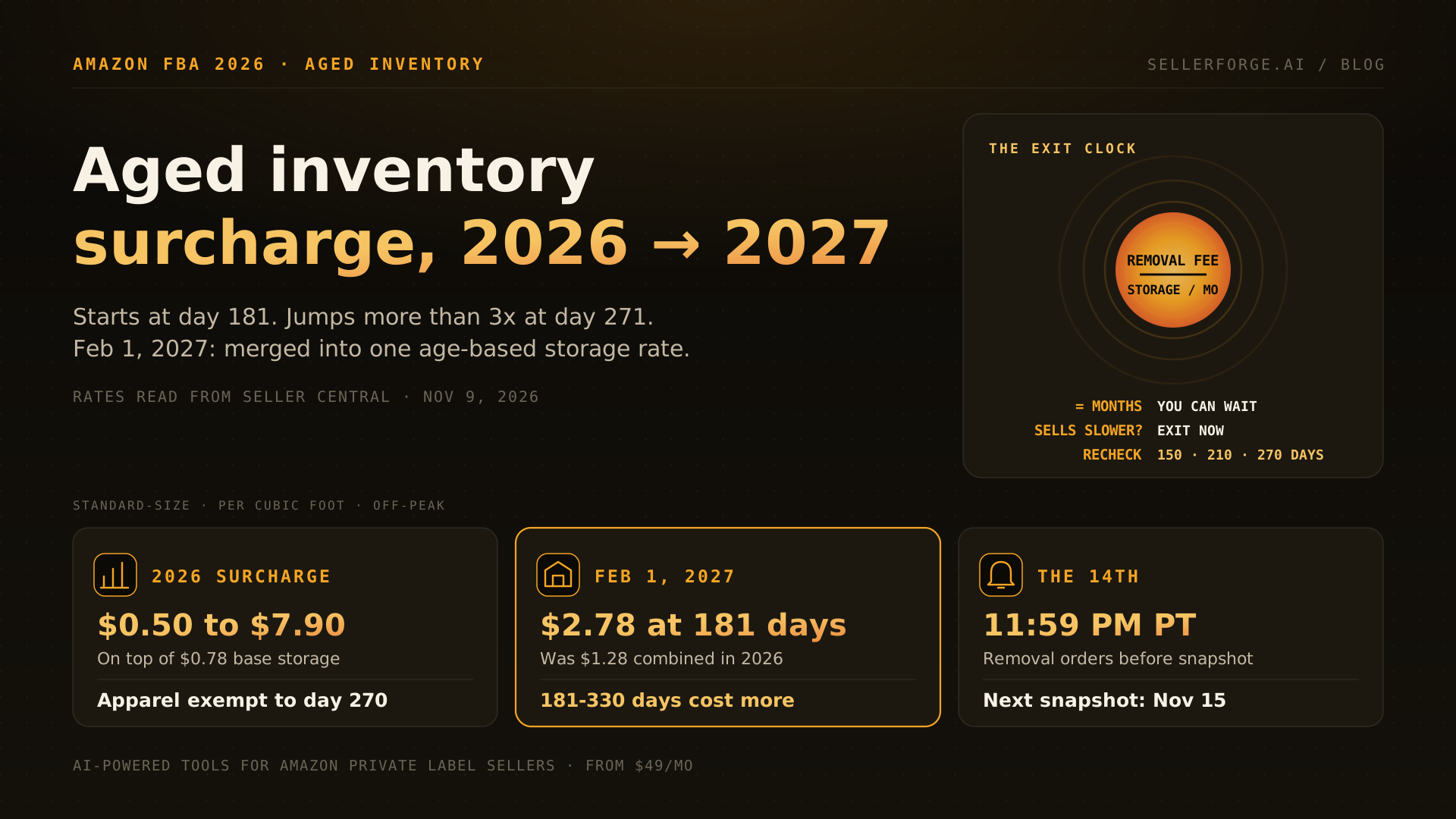
Amazon's aged inventory surcharge is a monthly fee on FBA units older than 180 days, charged on top of storage: $0.50 per cubic foot at 181 to 210 days, rising to the greater of $7.90 per cubic foot or $0.35 per unit at 456+ days. From February 1, 2027 it merges into one age-based storage rate that costs more for 181 to 330 day stock. Plan reorders so units sell before day 180; SellerForge (ours, from $49/mo) forecasts that.
Amazon's aged inventory surcharge is a monthly fee on FBA units older than 180 days, added on top of normal storage. In 2026 it starts at $0.50 per cubic foot and climbs to the greater of $7.90 per cubic foot or $0.35 per unit once a unit passes 455 days. The next snapshot is December 15, so removal orders are due by 11:59 p.m. Pacific on December 14; the last snapshot under the current rules is January 15, 2027.
The bigger news landed on November 5. Amazon announced that on February 1, 2027 the surcharge disappears as a separate fee and merges into a single age-based storage rate. Some early coverage of the announcement said the new rates were not published. They are on Seller Central, and for stock between 181 and 330 days old they are higher than today's combined bill.
What Is the Amazon Aged Inventory Surcharge?
The aged inventory surcharge is an FBA fee Amazon charges every month on units that have been in its fulfillment centers for more than 180 days. It is billed per cubic foot on top of the monthly storage fee, rises in steps as the unit ages, and after 365 days becomes the greater of a cubic-foot charge or a per-unit minimum.
It is the successor to the old long-term storage fee, which is why most sellers still call it that. Three mechanics decide what you actually pay:
- Snapshot on the 15th. Amazon looks at the age of every unit on the 15th of each month and bills the surcharge roughly between the 18th and the 22nd.
- First in, first out. Age is counted across the whole network, oldest units first. A fresh inbound shipment does not reset the age of the units already sitting there.
- The 14th deadline. Removal or disposal orders submitted by 11:59 p.m. Pacific on the 14th avoid that month's surcharge on those units, even if the units leave later.
Aged Inventory Surcharge Rates for 2026, by Age Band
In 2026 the surcharge runs in eight bands from 181 days to 456+ days. It stays mild through day 270, then jumps more than threefold at day 271, from $1.50 to $5.45 per cubic foot. After a year a per-unit minimum applies, which is what catches small, light products. Clothing, shoes, bags, jewelry and watches skip the first three bands.
| Unit age | Surcharge (2026) | Base + surcharge, standard-size, Jan to Sep | Note |
|---|---|---|---|
| 0 to 180 days | None | $0.78 per cu ft | Base storage only |
| 181 to 210 days | $0.50 per cu ft | $1.28 | Apparel, shoes, bags, jewelry, watches exempt |
| 211 to 240 days | $1.00 per cu ft | $1.78 | Same exemption |
| 241 to 270 days | $1.50 per cu ft | $2.28 | Same exemption |
| 271 to 300 days | $5.45 per cu ft | $6.23 | All categories |
| 301 to 330 days | $5.70 per cu ft | $6.48 | All categories |
| 331 to 365 days | $5.90 per cu ft | $6.68 | All categories |
| 366 to 455 days | Greater of $6.90 per cu ft or $0.30 per unit | $7.68 per cu ft, or $0.78 per cu ft + $0.30 per unit | Per-unit floor rose from $0.15 in Jan 2026 |
| 456+ days | Greater of $7.90 per cu ft or $0.35 per unit | $8.68 per cu ft, or $0.78 per cu ft + $0.35 per unit | Tier added Jan 2026 |
Two things the table does not show. First, October through December the base storage rate for standard-size units is $2.40 per cubic foot instead of $0.78, so an aged unit held through Q4 pays the peak base plus the surcharge. Second, the storage utilization surcharge, up to $1.88 per cubic foot for Professional sellers above 22 weeks of cover, stacks on top for inventory older than 30 days. Oversize units use a $0.56 off-peak base.
Across the 57 accounts I managed, the day-271 step is where aged inventory turned from an annoyance into a real line on the monthly statement. A unit at day 265 and the same unit at day 275 can differ by $3.95 per cubic foot in a single month ($1.50 against $5.45).
What Changes on February 1, 2027?
Amazon's own framing is "flat or lower fees for inventory that turns in under six months, higher fees for aged inventory". Here is the standard-size, off-peak comparison, using the 2026 base plus surcharge so the two years line up. Peak months in 2027 add $1.62 per cubic foot for standard-size and $0.84 for bulky and oversize.
| Unit age | 2026 combined (base + aged) | 2027 unified rate | Change |
|---|---|---|---|
| 0 to 180 days | $0.78 | $0.78 | None (and no utilization surcharge) |
| 181 to 210 days | $1.28 | $2.78 | +$1.50 per cu ft |
| 211 to 240 days | $1.78 | $2.78 | +$1.00 |
| 241 to 270 days | $2.28 | $2.78 | +$0.50 |
| 271 to 300 days | $6.23 | $6.68 | +$0.45 |
| 301 to 330 days | $6.48 | $6.68 | +$0.20 |
| 331 to 365 days | $6.68 | $6.68 | None |
| 366 to 455 days | $7.68, or $0.78 + $0.30 per unit | $7.68, or $0.78 + $0.30 per unit | None |
| 456+ days | $8.68, or $0.78 + $0.35 per unit | $8.68, or $0.78 + $0.35 per unit | None |
Four details matter more than the headline:
- The 181 to 270 day band is where the increase lives. A unit that ages into month seven pays more than double what it pays today.
- The apparel exemption ends. Clothing, shoes, bags, jewelry and watches pay $1.78 per cubic foot for standard-size units aged 181 to 270 days, against today's $0.78 base with no surcharge.
- The timing changes. The unified fee is assessed per FNSKU at the end of each month from daily average inventory in each age tier, and billed between the 7th and the 15th of the next month. The page describes no mid-month snapshot, so the 14th-of-the-month removal deadline should stop mattering; units that leave earlier in the month lower the average.
- Overstocked inventory gets cheaper while it is young. With the utilization surcharge gone, units older than 30 days stop paying it: $0.76 per cubic foot extra for a seller at 28 to 36 weeks of cover, up to $1.88 at 52 weeks or more.
How Is the Aged Inventory Surcharge Calculated?
The surcharge equals the unit's cubic feet times the rate for its age band, summed across every aged unit on the snapshot date. For bands after 365 days Amazon compares the cubic-foot charge with the per-unit minimum and bills the larger. Monthly storage is charged separately on the same units.
- 1Measure the packaged unit: length times width times height in inches, divided by 1,728, rounded to three decimals the way Amazon's examples do.
- 2Find the unit's age band on the 15th, counting first in, first out.
- 3Multiply cubic feet by the band rate. After 365 days, also compute units times $0.30 (366 to 455 days) or $0.35 (456+ days), and keep the larger number.
- 4Add the monthly storage fee for the same units: $0.78 per cubic foot January through September, $2.40 October through December, standard-size.
The per-unit minimum changes which products hurt. Ten T-shirts at 0.014 cubic feet each, aged 400 days, cost $0.97 on the cubic-foot rate but $3.00 on the per-unit minimum, so Amazon bills $3.00. For small, light products, the minimum, not the volume, is the real cost after a year.
The Exit Clock: When Should an Aged Unit Leave?
The Exit Clock is the number of months of storage that would cost the same as removing the unit today: removal fee divided by next month's storage cost per unit. If you do not expect to sell the unit within that many months, exiting now is cheaper than waiting. It turns the fee table into a per-SKU decision.
I started using this after watching teams argue about aged stock in feelings rather than numbers. The rule is deliberately simple: compare two costs per unit, not a spreadsheet of scenarios. Here it is for three common product sizes, off-peak, using Amazon's 2026 removal fees and storage rates.
| Product | Removal fee per unit | Monthly storage at 181 to 210 days, 2026 / 2027 | Exit Clock, 2026 / 2027 | Monthly storage at 271 to 300 days | Exit Clock |
|---|---|---|---|---|---|
| Small accessory, 0.014 cu ft, under 0.5 lb | $0.84 | $0.02 / $0.04 | 47 / 22 months | $0.09 / $0.09 | 9.6 / 9.0 months |
| Toy, 0.102 cu ft, 0.5 to 1 lb | $1.53 | $0.13 / $0.28 | 12 / 5 months | $0.64 / $0.68 | 2.4 / 2.2 months |
| Kitchen item, 0.25 cu ft, 1 to 2 lb | $2.27 | $0.32 / $0.69 | 7 / 3 months | $1.56 / $1.67 | 1.5 / 1.4 months |
Read the toy row. At 290 days old, if that SKU is not going to sell its remaining units within about two months, removal is already cheaper than keeping them, before counting the capital tied up in the units. Under the 2027 card, the same decision arrives at month seven for bulkier products, three months earlier than today.
The Exit Clock: removal fee per unit ÷ next month's storage per unit = months you can afford to wait. If months-to-sell is longer than the Exit Clock, exit now. Months-to-sell = units on hand ÷ average monthly units sold. Recheck at 150, 210 and 270 days.
Two honest limits. The clock ignores what the unit is worth to you elsewhere, so pair it with the exit options below. And it uses removal as the benchmark because removal and disposal cost the same per unit; liquidation can beat both when the goods still have resale value.
Should You Sell, Liquidate, Remove or Dispose of Aged Inventory?
Sell through first if the SKU can clear within its Exit Clock with a price cut that keeps contribution margin positive. Liquidate when the goods have resale value but not at your price. Remove when you can resell elsewhere at full price. Dispose only when the units are worth less than the fees to move them.
| Option | Cost per standard-size unit (2026) | What you get back | Best when |
|---|---|---|---|
| Sell through (coupon, price cut, Outlet deal) | The discount plus any deal fee | Full sale minus the markdown | Months-to-sell after the cut is shorter than the Exit Clock |
| Liquidate (FBA Liquidations) | 15% of recovery value + $0.25 to $0.40 processing (more over 2 lb) | Recovery value minus fees, paid to you | Goods have resale value but will not sell at your price |
| Remove (return to you) | $0.84 under 0.5 lb; $1.53 to 1 lb; $2.27 to 2 lb; $2.89 + $1.06 per lb over 2 lb | The units, to sell FBM or on another channel | You can resell elsewhere at near full price |
| Dispose | Same as removal | Nothing | Damaged, expired or near-worthless stock |
One trap I saw repeatedly: removing everything at once. Pull the excess, not the whole SKU. Leave enough cover to stay above 28 days of supply, or the low-inventory-level fee replaces the storage problem you just fixed.
How to Avoid the Aged Inventory Surcharge, Step by Step
You avoid the surcharge by making sure units sell before day 181, and by acting on the stragglers before the snapshot on the 15th. The work is mostly ordering discipline, plus a short monthly routine that catches slow SKUs at day 150 instead of day 290.
- 1Pull the FBA Inventory page's age columns, or the inventory age report, and sort FNSKUs by units aged 151 days or more.
- 2Calculate months-to-sell for each: units on hand divided by average monthly units sold over the last 90 days.
- 3Calculate each SKU's Exit Clock at its next age band, and mark any SKU where months-to-sell is longer.
- 4For SKUs close to the line, run a coupon, a price cut or an Outlet deal at day 150, and model the margin before you launch it.
- 5For SKUs past the line, submit liquidation or removal orders by 11:59 p.m. Pacific on the 14th.
- 6Fix the cause: cut the next purchase order for every SKU that aged, and shorten the reorder cycle so no shipment carries more than about four months of cover.
- 7Before February 1, 2027, clear anything that will sit in the 181 to 270 day band in February, especially apparel, which loses its exemption.
Does AWD Help You Avoid Aged Inventory Fees?
Yes, today and in 2027, with a catch from March 2027. Inventory in Amazon Warehousing and Distribution does not pay the FBA aged inventory surcharge. Amazon also waives the FBA aged surcharge for units aged 181 to 365 days, the storage utilization surcharge and the low-inventory-level fee on a SKU when at least 70% of it reached FBA through AWD automatic replenishment in the previous 90 days; limits you set on automatic replenishment can bring those fees back. From February 1, 2027, an FNSKU with 70% or more of its units auto-replenished from AWD pays the lowest unified FBA storage rate regardless of age.
The catch arrives a month later. From March 1, 2027 AWD storage itself becomes age-based, and AWD inventory held more than 12 months pays 2.5 times the standard rate. AWD works as a flow-through buffer for bulk orders, not as long-term storage for stock that is not selling.
Where SellerForge Fits (and Where Amazon's Free Tools Are Enough)
SellerForge does not remove or liquidate inventory for you, and Amazon's free FBA Inventory page, inventory age data and Revenue Calculator are enough to run the Exit Clock by hand. Where SellerForge helps is upstream: forecasting reorders so units sell before day 180, and modeling markdowns before you run them.
| Plan | Price | Relevant to aged inventory |
|---|---|---|
| Core | $49/mo | Listing Audit and Listing Builder, keyword research, rank tracking and core advertising; Forecasting is not included |
| Growth | $99/mo ($999/yr) | Forecasting, Promotions, Weekly Business Report, advanced ads |
| Pro | $199/mo | Everything in Growth with premium AI on ads, forecasting and listings |
| Agency | $499/mo | Everything in Pro across 10 client accounts |
- Use SellerForge if: aged units keep showing up because reorders are sized by gut feel, and you want reorder quantities tied to real velocity and lead time.
- Skip it for now if: you have a handful of SKUs and one supplier. The Exit Clock and Amazon's own reports will do.
The Bottom Line on Amazon's Aged Inventory Surcharge
In 2026 the aged inventory surcharge starts at 181 days and jumps hard at 271. From February 1, 2027 it merges into a unified storage fee that is the same for fast-turning stock, higher for 181 to 330 day stock, and no longer exempts apparel in months seven to nine. The cheapest fix in both years is the same: units that sell before day 180.
If I were cleaning up an account this week, I would pull every FNSKU with units older than 150 days, run the Exit Clock on each, get liquidation and removal orders in before the December 14 deadline, and then cut the January purchase orders for the SKUs that aged. Then I would do it again in January, before the new card starts.
About the author
David Gallo is the founder of SellerForge.ai. Before building SellerForge, he managed 57 Amazon seller accounts representing more than $350M in sales at Worldfront, where monthly aged-inventory cleanup was part of every account's routine. He writes about Amazon operations, inventory and AI from the operator's side.