The best Amazon inventory management software depends on catalog size: Amazon's free Restock Inventory tool plus AWD auto-replenishment covers simple single-channel catalogs, SoStocked or Inventory Hero fit brands that need purchase orders and 12-month forecasts, and Inventory Planner fits Shopify-first brands. SellerForge, our product, adds forecasting inside whole-account intelligence from $49/mo.
The best Amazon inventory management software is the one that keeps every FBA SKU inside the band Amazon now charges you to stay in: above 28 days of supply, where the low-inventory-level fee starts, and below a 22-week storage ratio, where the utilization surcharge starts. For a simple catalog, Amazon's own free tools do that. For a brand with purchase orders, multiple suppliers and seasonality, a dedicated tool earns its fee quickly.
This comparison covers nine options, from Amazon's free Restock Inventory tool to SoStocked, RestockPro, Inventory Hero, Helium 10, Sellerboard, Inventory Planner and Prediko, with prices checked against vendor pages on October 22, 2026. SellerForge is our product, disclosed here and everywhere it appears below; its Forecasting module is one of the nine, and it is not the right pick for every seller. I will say where it loses.
Across the 57 accounts I managed at Worldfront, the stockouts that hurt most were rarely forecasting failures in the math. They were lead-time failures: a supplier slipped two weeks, nobody re-ran the reorder date, and a hero ASIN went dark in the middle of its best month. Software that does not hold your real lead times is a calculator, not a system.
What Is the Best Amazon Inventory Management Software in 2026?
The best Amazon inventory management software in 2026 is Amazon's free Restock Inventory tool plus AWD auto-replenishment for simple single-channel catalogs, SoStocked or Inventory Hero for brands that need purchase orders and 12-month forecasts, RestockPro for order-volume pricing, and Inventory Planner for Shopify-first brands. SellerForge, ours, fits sellers who want forecasting inside whole-account intelligence.
Prices in the table come from each vendor's own pricing or help page, read on October 22, 2026, except where a third-party source is named because the vendor only quotes on request. Tiers that scale by order volume or revenue are shown at the entry point.
| Tool | Starting price (Oct 22, 2026) | Forecasting | AWD and capacity | POs and locations | Best for |
|---|---|---|---|---|---|
| Amazon Restock Inventory + AWD auto-replenishment | Free (AWD storage and transfer fees apply) | Amazon's own demand forecast once you enter lead times | Native: Capacity Monitor, auto-replenishment from AWD | No purchase orders; FBA and AWD only | Single-channel catalogs under about 50 SKUs |
| Sellerboard | $19/mo (3,000 orders); $15/mo billed yearly | Days-of-stock and reorder signals from velocity | Not an AWD planner | Supplier purchase orders (added 2023) | Profit-first sellers who want restock alerts next to their numbers |
| Helium 10 Inventory Management | Platinum $129/mo ($99 yearly), 40 SKUs; Diamond $359/mo ($279 yearly), 500 SKUs | Forecast and reorder inside the suite | Sends inventory to Amazon from the tool | Supplier orders | Helium 10 users with small catalogs |
| RestockPro (eComEngine) | $49/mo up to 1,000 FBA orders; up to $249/mo at 35,000+ | Velocity and lead-time restock suggestions | FBA-focused | Purchase orders and supplier tracking | FBA sellers who want order-based pricing |
| SoStocked (SPS Commerce) | ProfitFlow + Inventory from $250/mo; ProfitFlow alone $97/mo | Up to 12 months, seasonality and promotions | Restock-limit aware, syncs with AWD | Purchase orders, multiple suppliers and warehouses | Multi-SKU brands with complex supply chains |
| Inventory Hero | Starter $79/mo (1,000 orders); Expert $399; Enterprise $799 | Seasonality-informed forecast with order-by dates from days of supply, lead time and safety stock | Tracks FBA, AWD and 3PL stock | Drafts POs for your approval | Growing FBA brands that want AWD and 3PL in one view |
| Inventory Planner by Sage | Essentials $119.99/mo (Shopify only); higher tiers quote-based | Multi-channel demand planning | Not Amazon-native | Multi-warehouse on Standard and up | Shopify-first brands that also sell on Amazon |
| Prediko | $49 to $199/mo by revenue band | AI demand forecasting | Amazon listed as an integration; confirm FBA depth | Not verified for FBA; ask the vendor | Shopify-first DTC brands |
| SellerForge Forecasting (ours) | Growth plan $99/mo; plans from $49/mo | 90-day rolling forecast, seasonality-adjusted, lead-time aware | Out-of-stock risk indicators; no AWD transfer planning | Reorder point and quantity; no PO system | Private-label sellers who want forecasting next to ads, listings and account health |
Sources for the table: Helium 10's pricing page, the eComEngine help center's RestockPro price range, SPS Commerce's SoStocked page, Inventory Hero's and Prediko's published pricing, Sellerboard's plans as tracked by RevenueGeeks (September 24, 2026), and EightX's June 2026 breakdown of Inventory Planner, which confirms only the Essentials price.
Does Amazon Have Its Own Inventory Management Tool?
Yes. Amazon gives every FBA seller free inventory tools: Restock Inventory recommends reorder quantities and ship dates from your sales history once you enter supplier and prep lead times, the Capacity Monitor shows next month's FBA limit, and AWD auto-replenishment refills FBA from Amazon's upstream warehouses. What Amazon does not provide is purchase orders, landed-cost tracking, or a multi-channel view.
Restock Inventory lives under Inventory Planning in Seller Central. Its recommendations are only as good as the settings behind them: supplier lead time, your own processing time, replenishment frequency and case pack. Leave the defaults and the tool assumes a supply chain you do not have. Fill them in honestly and it is a serious baseline that costs nothing.
AWD auto-replenishment is the bigger lever. Inventory stored in Amazon Warehousing and Distribution does not count against your FBA capacity limit, and with auto-replenishment on, Amazon tops up FBA as you sell. Amazon reports that sellers enrolled in AWD during Q4 2025 shipped more than 13% more units with more than 30% fewer out-of-stock days. Those are Amazon's own program figures, not independent ones, but the mechanism is real.
There is also a newer route: Amazon's Selling Partner plugin, in beta for U.S. sellers since September 23, 2026, lets Claude or Amazon Quick read your inventory alongside listings and sales. It is useful for asking questions, not for running a reorder process.
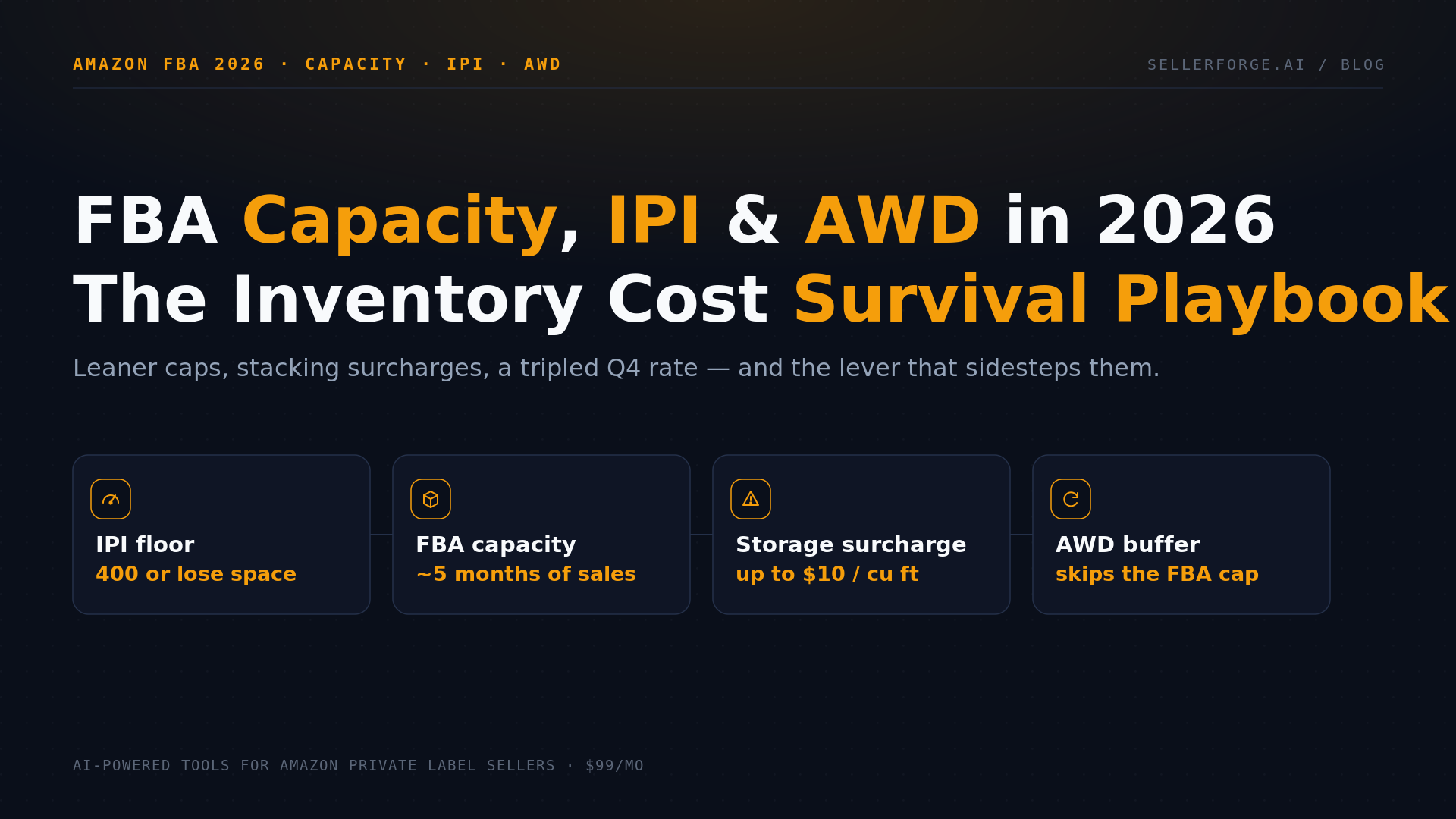
If you run one channel, fewer than about 50 SKUs, one or two suppliers and a stable season, start here and only pay for software when a specific gap appears. The storage-side mechanics behind these tools, including the five-month capacity calculation and the IPI floor, are in our 2026 FBA capacity, IPI and AWD playbook.
What Is the 28/154 Corridor?
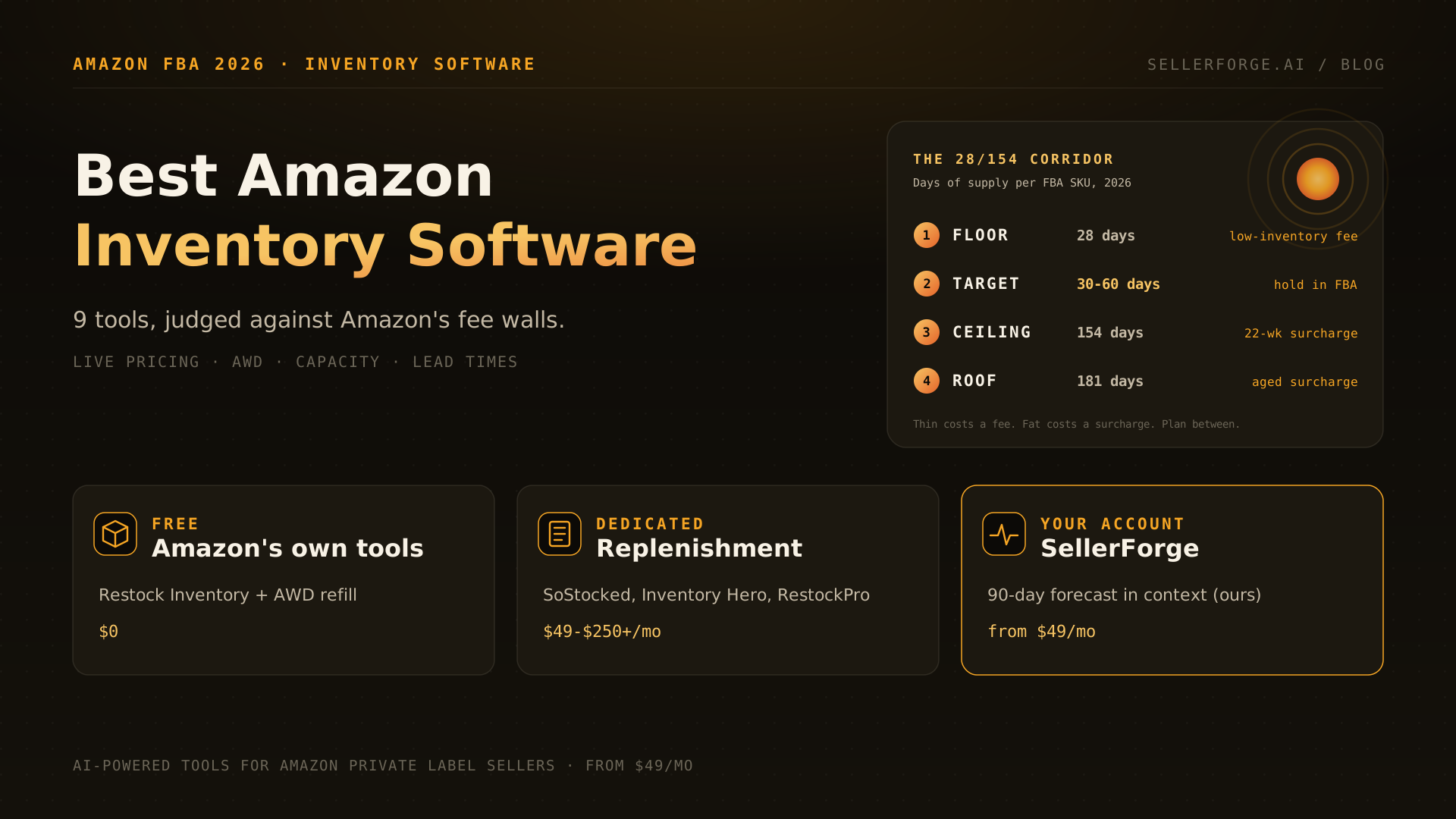
The 28/154 Corridor is the band every FBA SKU should live in during 2026: at least 28 days of historical supply, so the low-inventory-level fee never triggers, and under 154 days, the 22-week storage utilization ratio where Amazon's surcharge starts. Above 181 days the aged inventory surcharge begins. Good inventory software plans inside that band automatically.
I coined the name because sellers treat these as three unrelated fees, and most inventory tools model at most one of them. They are one system. Amazon is charging you for being too thin and for being too fat, and the safe zone between the two walls is narrower than most reorder spreadsheets assume.
| Wall | Trigger (US, 2026) | What it costs | Measured |
|---|---|---|---|
| Floor: low-inventory-level fee | Historical days of supply below 28 on BOTH the 30-day and 90-day windows | $0.32 to $0.89 per small-standard unit; up to $1.11 large standard; up to $2.09 Large Bulky | Per FNSKU since Jan 15, 2026, per unit shipped |
| Ceiling: storage utilization surcharge | Size-tier storage ratio above 22 weeks (154 days), measured over 13 weeks | +$0.44 per cubic foot at 22 to 28 weeks, rising to +$1.88 at 52+ weeks (standard size) | Account level per size tier; needs 25+ cu ft average daily volume |
| Roof: aged inventory surcharge | Units older than 181 days | $0.50 per cubic foot at 181 to 210 days; at 456+ days, the greater of $7.90 per cubic foot or $0.35 per unit | Monthly snapshot on the 15th, FIFO aging |
| Cap: FBA capacity limit | Roughly five months of projected sales, in cubic feet | Blocks new shipments rather than billing you | Monthly, published in the Capacity Monitor |
The floor numbers come straight from Amazon's low-inventory-level fee help page and the ceiling and roof from Amazon's monthly storage fee page, both read through Seller Central's public help system and re-checked in September 2026. Three exemptions matter for planning: products selling fewer than 20 units in the past 7 days are exempt from the floor fee, new Professional sellers get 365 days from their first FBA receipt, and any SKU with 70% or more of its FBA units auto-replenished from AWD over the prior 90 days is exempt as well.
The 28/154 Corridor: keep every FBA SKU at 28 or more days of supply and under 22 weeks of cover, and park the rest upstream. In practice, 30 to 60 days in FBA with the surplus in AWD or a 3PL keeps most private-label SKUs off every fee wall at once.
Peak season makes the corridor more expensive to miss. Standard-size FBA storage runs $0.78 per cubic foot a month from January to September and $2.40 from October to December, so a January safety stock sitting in a fulfillment center in November pays triple. AWD inventory sent with auto-replenishment keeps the off-peak storage rate through October 31, 2026, which is why the corridor and the AWD decision are the same decision.
How Should You Evaluate Amazon Inventory Software?
Evaluate Amazon inventory software with five questions, which I call the Corridor Test: does it read Amazon's own days of supply per FNSKU, does it model the ceiling as well as the floor, does it plan AWD as a stage, does it hold your real lead times, and does it handle purchase orders and every location your stock sits in.
- 1Floor: does it read days of supply the way Amazon calculates it, per FNSKU on 30-day and 90-day windows, and warn you before both drop under 28? A tool that only shows units on hand will walk you into the fee.
- 2Ceiling: does it know your capacity limit and flag SKUs drifting past 22 weeks of cover or toward 181 days of age? Overstock is the expensive half of the corridor, and most reorder tools only watch the bottom.
- 3AWD: does it treat AWD as a planning stage, with transfer timing and the 70% auto-replenishment exemption in view, or does it ignore inventory Amazon holds upstream?
- 4Lead time: does it hold supplier production time, ocean or air transit, customs, and Amazon receiving time per SKU, and re-date the reorder when one of them slips? This is where stockouts actually come from.
- 5Purchase orders and locations: can it raise a PO, track partial deliveries and multiple suppliers, and see a 3PL or a Shopify warehouse? If you only sell FBA from one supplier, you may not need this check at all.
Score each tool a simple yes, partial or no on the five. Amazon's free stack passes the floor, AWD and capacity checks and fails purchase orders. Sellerboard and Helium 10 pass partially on most. SoStocked and Inventory Hero come closest to five full passes for FBA-heavy brands, and Inventory Planner wins the multi-channel half while being weaker on Amazon-specific walls.
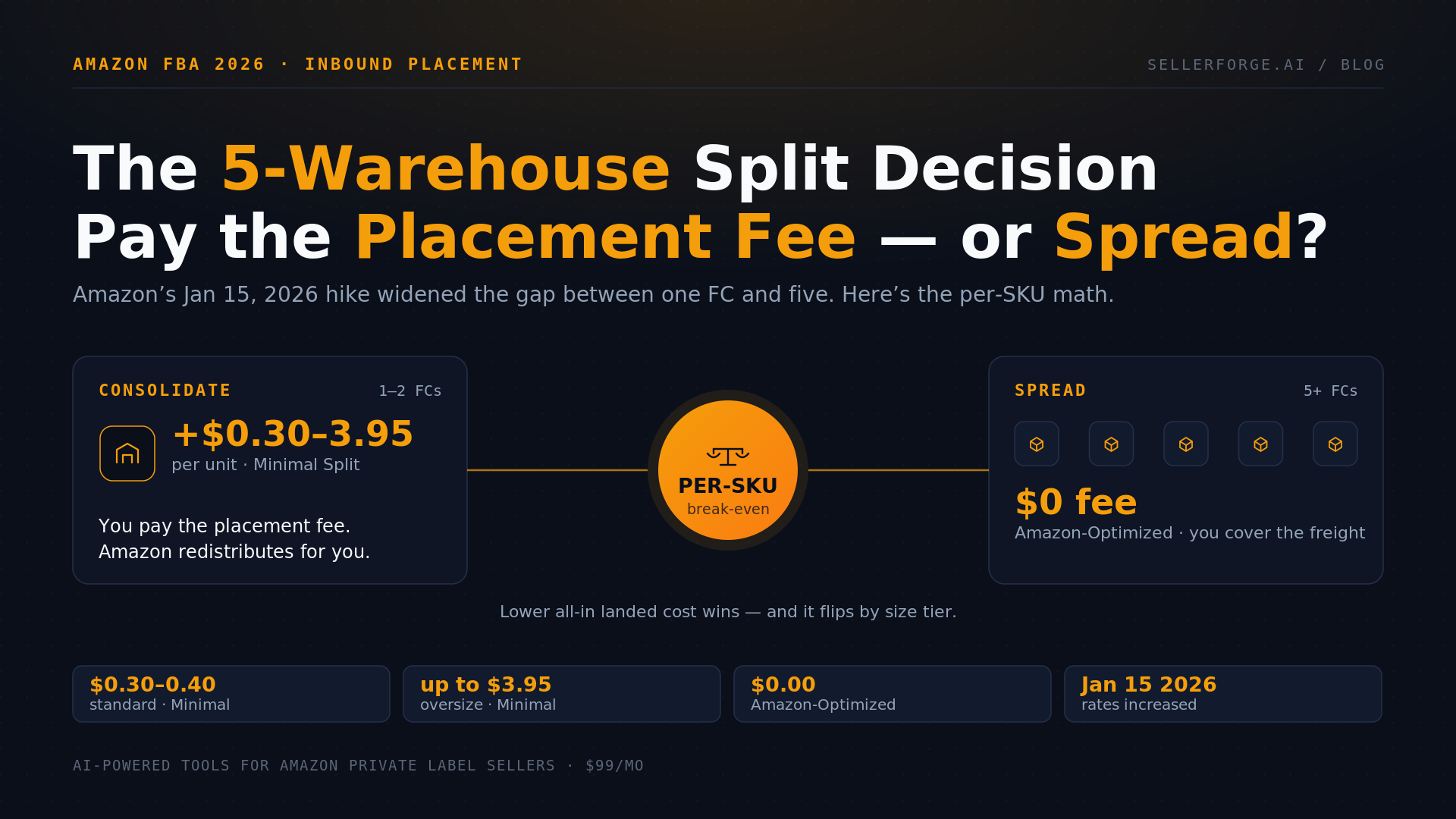
Inbound timing deserves its own line in any lead-time model, because Amazon's placement choices change both the fee and the days it takes stock to become sellable. Our guide to Amazon inbound placement and shipment splits covers that tradeoff.
How Much Does Amazon Inventory Management Software Cost?
Dedicated Amazon inventory software costs roughly $49 to $400 a month for a typical private-label brand in 2026, and the pricing model matters as much as the sticker. Vendors charge by order volume, by revenue band, by SKU count, or by quote, so the cheapest tool at 500 orders a month can be the most expensive at 20,000.
- By FBA orders: RestockPro runs $49 a month up to 1,000 FBA orders and $249 at 35,000 or more; Inventory Hero starts at $79 for 1,000 orders and reaches $799 for unlimited; Sellerboard starts at $19 for 3,000 orders.
- By revenue band: Prediko charges $49 under $100K a year, $119 from $100K to $500K and $199 from $500K to $2M; Inventory Planner's Essentials tier is $119.99, with quotes above it.
- By SKU cap: Helium 10 includes Inventory Management for 40 SKUs on Platinum and 500 on Diamond, so a growing catalog forces a plan change.
- By bundle: SoStocked's inventory planning is sold as ProfitFlow plus Inventory from $250 a month, a step above ProfitFlow's $97 profit-only plan.
- Free: Amazon's Restock Inventory and Capacity Monitor cost nothing; AWD charges its own storage and transfer fees.
Set the price against the cost of being wrong. IHL Group estimated in September 2025 that inventory distortion from out-of-stocks and overstocks costs retailers $1.73 trillion a year, about 6.5% of global retail sales. On Amazon the stockout half is worse than lost units: a dark hero ASIN loses organic rank and ad momentum that take weeks to rebuild after it comes back. One avoided stockout on a top SKU usually pays for a year of any tool in the table.
How Do You Forecast Amazon Inventory Without Software?
To forecast Amazon inventory without software, calculate each SKU's average daily units sold, multiply by total lead time plus a safety buffer, and reorder when sellable units plus inbound fall below that reorder point. It works well for under about 20 SKUs on one channel and breaks once AWD, seasonality or several suppliers enter the picture.
- 1Pull daily velocity per SKU from the last 30 and 90 days, and use the lower of the two unless a trend is clearly real.
- 2Add up total lead time in days: supplier production, freight, customs and Amazon receiving. Use your worst recent shipment, not the quote.
- 3Set safety stock at 14 to 21 days of velocity for steady SKUs and more for seasonal ones, so a slip never pushes you under the 28-day floor.
- 4Reorder point equals daily velocity times (lead time plus safety days). Reorder quantity equals the days you want to buy, typically 60 to 90, times velocity, capped by your capacity limit and your cash.
- 5Re-run the sheet weekly, and re-date every open order the day a supplier slips.
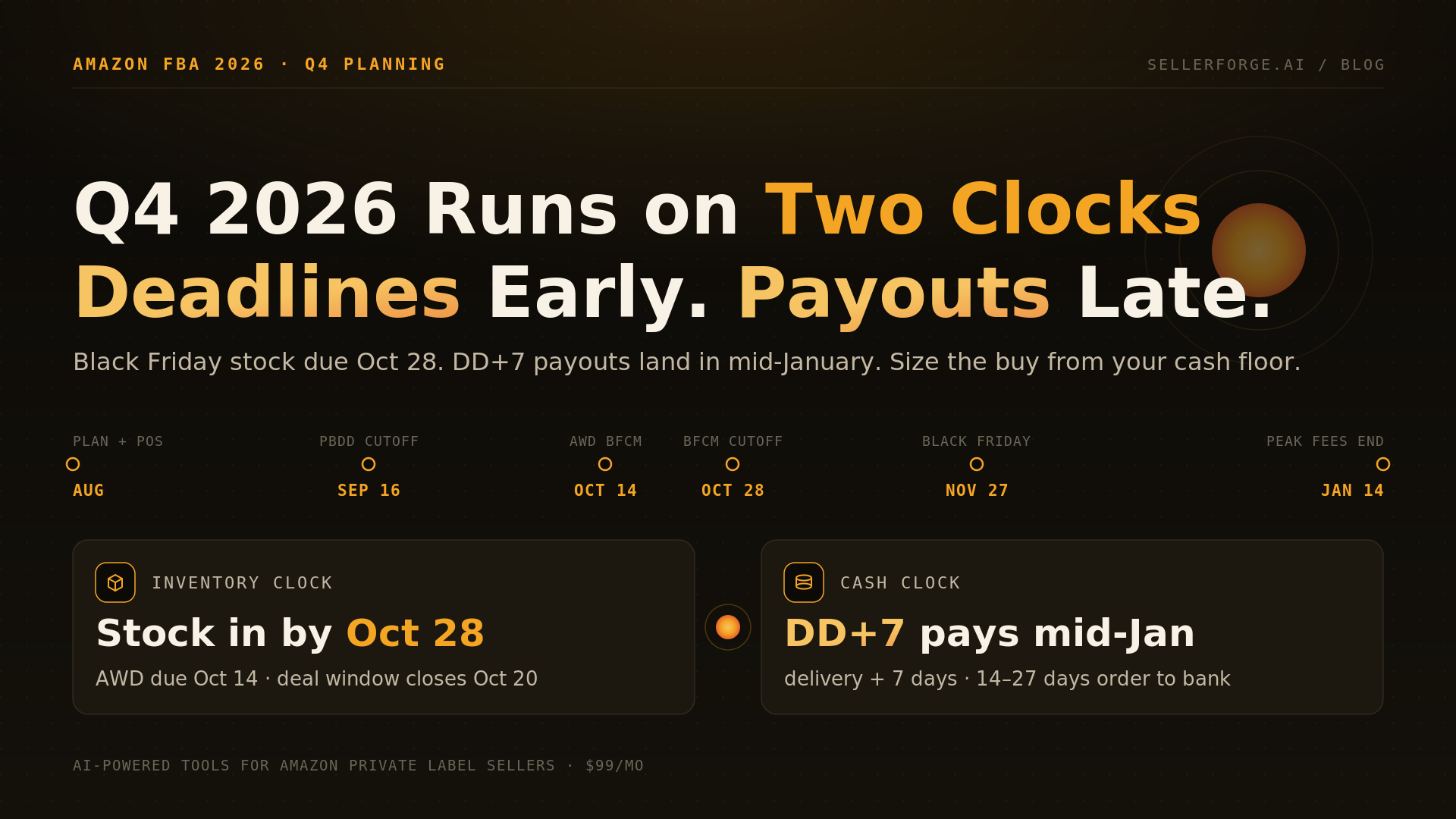
The cash side is where spreadsheets usually lie, because DD+7 payout timing delays the money you planned to reorder with. Our Q4 inventory and cash-flow plan shows how to size a buy against both clocks.
Which Amazon Inventory Software Should You Choose?
Choose Amazon inventory software by your constraint, not by feature count. Small single-channel sellers should stay on Amazon's free tools, profit-focused sellers can use Sellerboard's restock signals, FBA brands with purchase orders and seasonality should test SoStocked or Inventory Hero, and Shopify-first brands should start with Inventory Planner or Prediko.
- Under 20 SKUs, one supplier, one channel: Amazon Restock Inventory plus AWD auto-replenishment and a weekly spreadsheet. Paying for software here is usually premature.
- Profit-first, light replenishment needs: Sellerboard, from $19 a month, puts days of stock beside your numbers. It is a profit tool first, so expect restock signals, not AWD or 12-month planning.
- Already on Helium 10 with a small catalog: use the included Inventory Management before buying another tool, and watch the 40-SKU cap on Platinum.
- FBA-heavy brand, 50+ SKUs, multiple suppliers, seasonality: SoStocked (12-month horizon, AWD sync) or Inventory Hero (FBA, AWD and 3PL in one view, AI-drafted POs you approve). Trial both on your own history.
- Shopify-first brand with Amazon as a second channel: Inventory Planner by Sage or Prediko, then check how each handles FBA inventory before committing.
- Agencies running replenishment for clients: a dedicated tool per client account, with the forecast reviewed in the weekly client meeting rather than left to alerts.
For the profit side of that decision, see our Sellerboard alternatives comparison, and for the full tool map across research, ads and operations, our best Amazon seller tools guide.
Where SellerForge Fits (and Where It Does Not)
SellerForge is our product, so weigh this section accordingly. Its Forecasting module gives a 90-day rolling forecast by ASIN, reorder point and quantity recommendations, seasonality adjustment, lead-time awareness and out-of-stock risk indicators, on the Growth plan at $99 a month; plans start at $49. It is forecasting inside whole-account intelligence, not a purchase-order system.
Plainly, where we lose: SellerForge does not raise purchase orders, track partial supplier deliveries, plan AWD transfers, or see a 3PL or Shopify warehouse. Its forecast horizon is 90 days, not SoStocked's 12 months. If those are your gaps, SoStocked or Inventory Hero is the better buy, and for a small single-channel catalog Amazon's free tools are enough. What SellerForge adds is context: the forecast sits in the same account as the Weekly Business Report, the Business Event Timeline, Promotions and account-health monitoring, so a velocity drop shows up next to the suppression, price change or deal that caused it, before it becomes a bad reorder.
That matters more than it sounds. The worst reorder I ever approved at Worldfront was built on a velocity spike from a Lightning Deal nobody had tagged in the forecast. The math was right and the input was wrong. A forecast that knows what else happened in the account catches that; a standalone reorder tool usually does not.
Want reorder points next to the rest of your account? Start a SellerForge trial, open Forecasting, and check which of your top ASINs sit outside the 28/154 Corridor this week. Plans start at $49/mo.
About the author
David Gallo is the founder of SellerForge.ai. Before building SellerForge, he managed 57 Amazon seller accounts representing more than $350M in sales at Worldfront, where the stockouts that cost the most were lead-time slips nobody re-dated, not bad forecasting math.