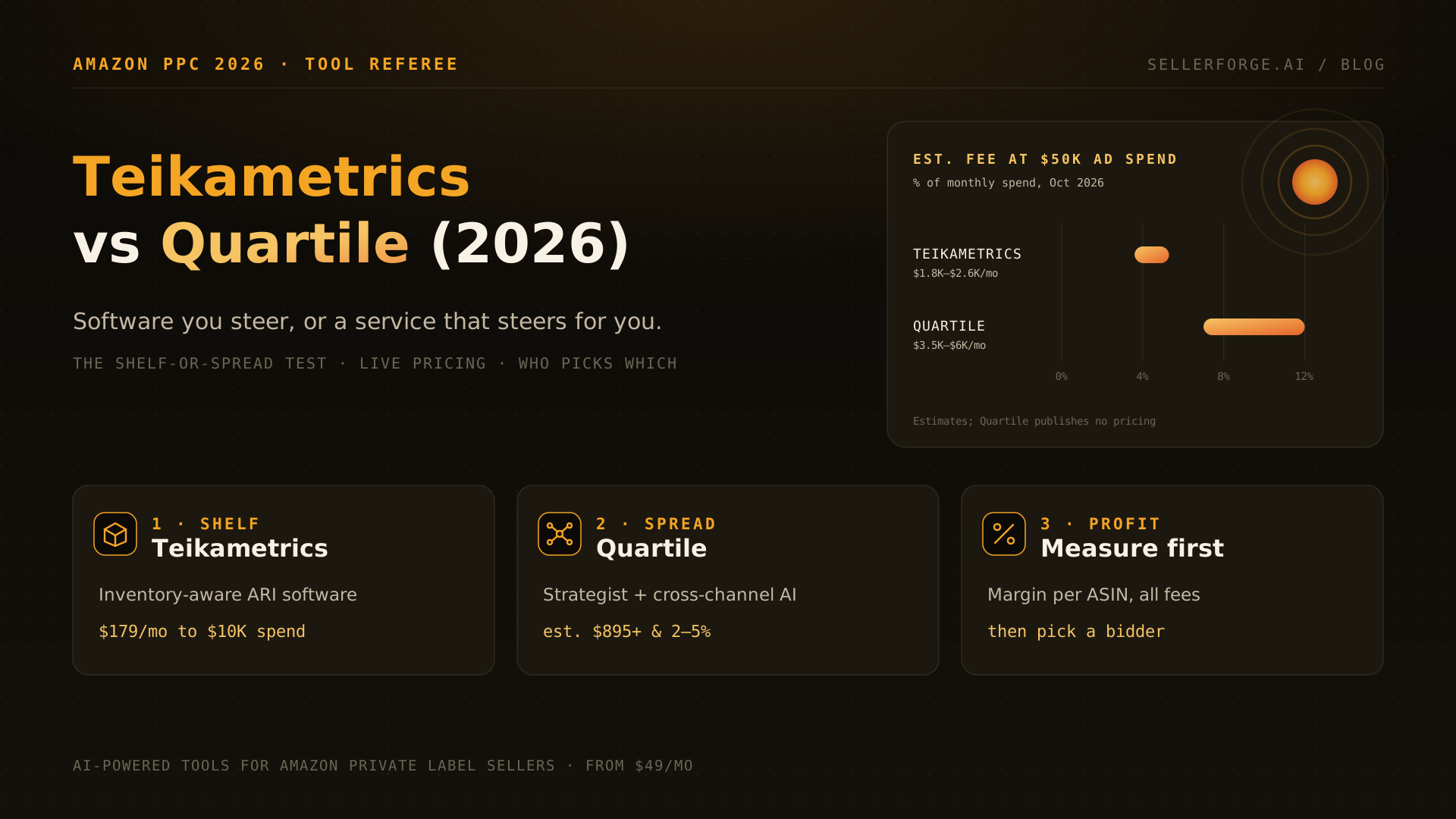
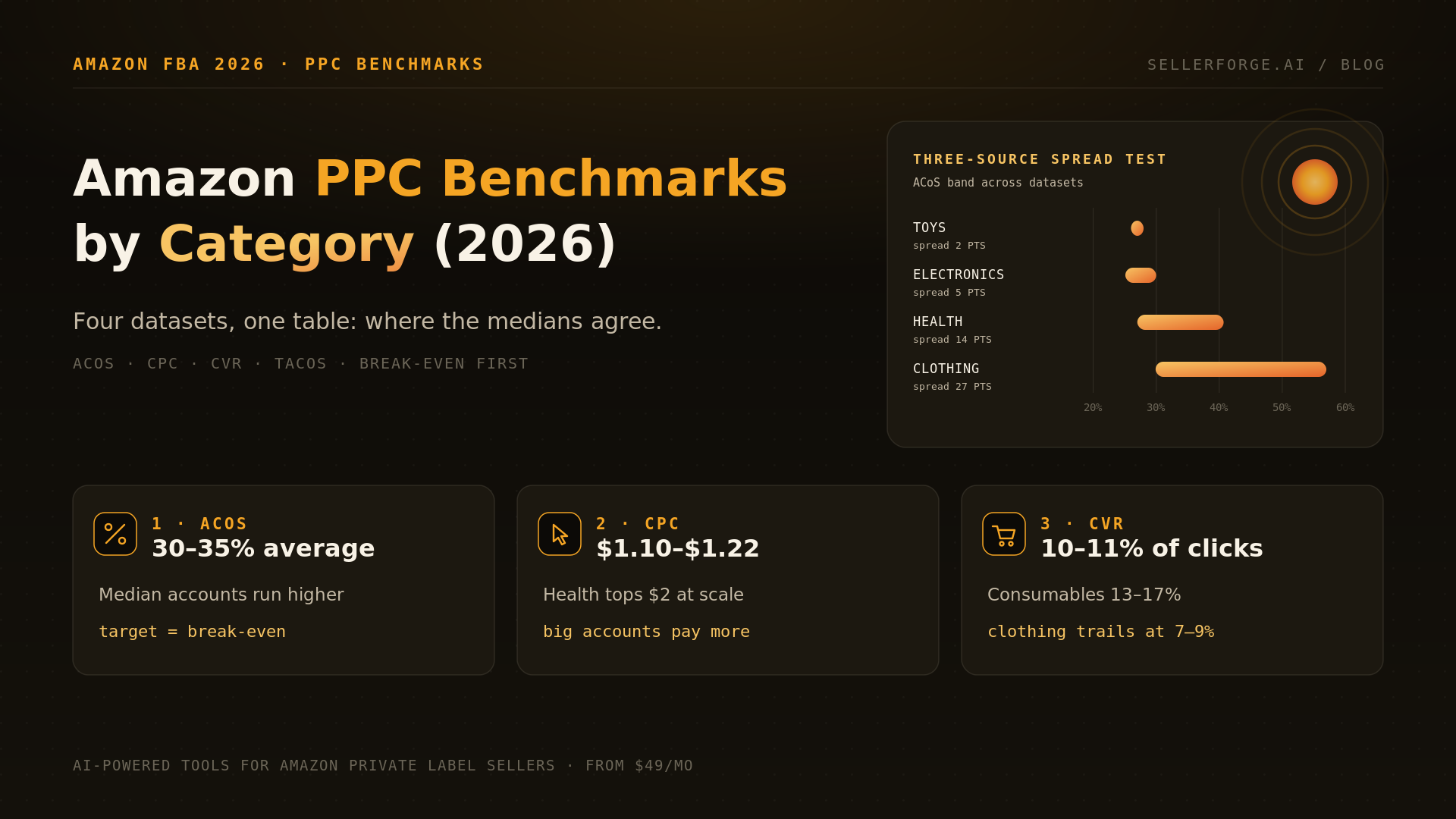
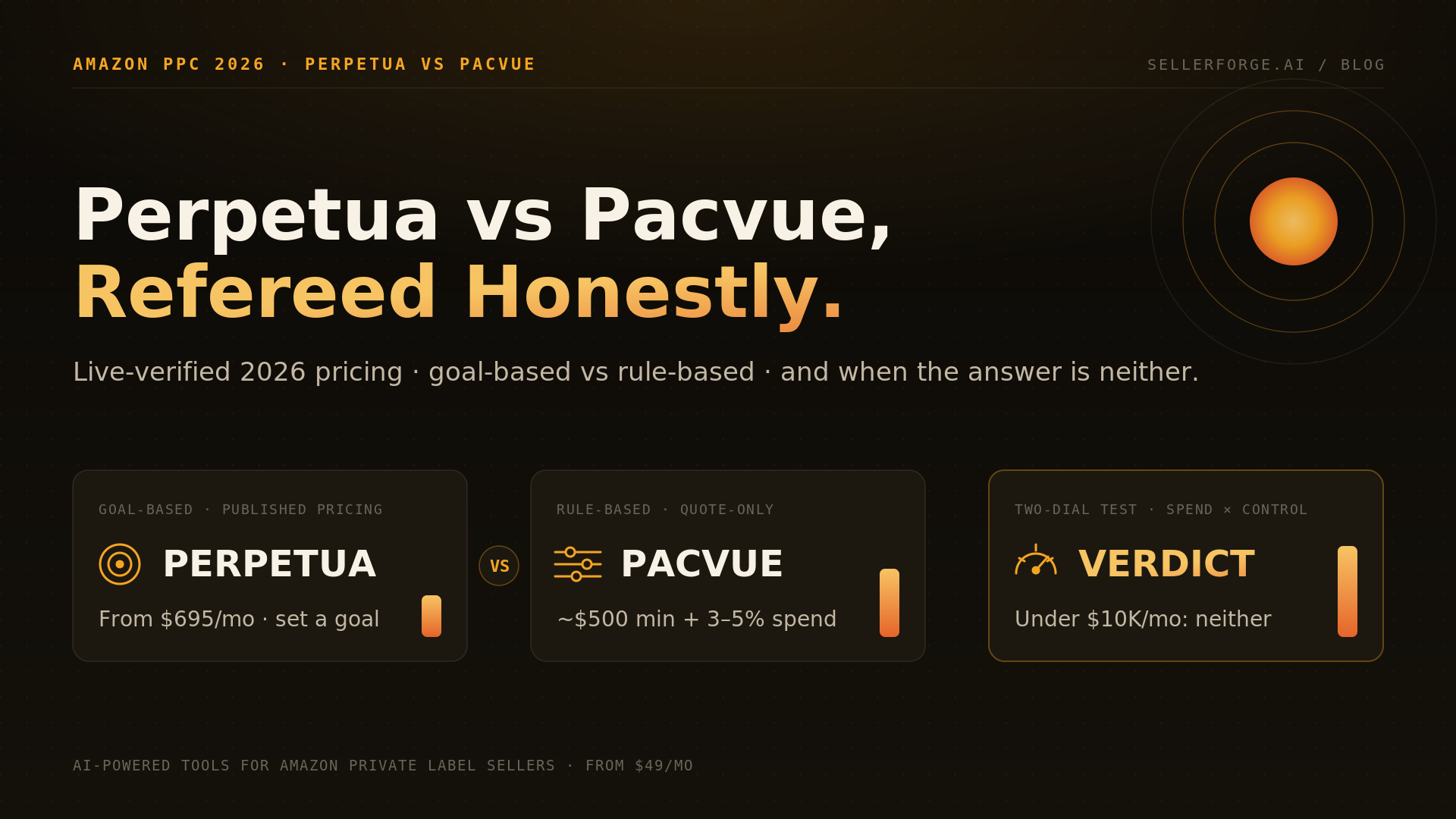
The best Perpetua alternative depends on why you are leaving. For cost, Ad Badger ($275 to $1,830/mo flat by spend band) or Scale Insights (from $78/mo). For hands-on control, Scale Insights or Pacvue. For retail-aware AI, Teikametrics ($149/mo yearly). Under $5K a month in ad spend, Amazon's free Ads Agent tools first. SellerForge (ours, from $49/mo) is not an autobidder; it covers the account around the ads.
The best Perpetua alternative is the one that fixes the reason you are leaving. Most sellers leave over cost: Perpetua starts at $695 a month and adds a percentage of spend above $10,000. Some leave because goal-based automation hides too much. A few leave because their real problems were never inside the ad console.
The pages ranking for this query today are software directories and vendor listicles, most of them selling one of the tools they rank. This one gives you the prices, the cost at your spend level, and a test for choosing.
What Are the Best Perpetua Alternatives in 2026?
The best Perpetua alternatives in 2026 are Ad Badger and Scale Insights for lower cost, Teikametrics for retail-aware AI, Pacvue for enterprise control, Quartile and Intentwise for managed or data-heavy programs, Helium 10 Ads for Helium 10 Diamond users, and Amazon's free Ads Agent tools for small budgets. Each wins a different reason for leaving.
| Alternative | Best for | Pricing model | Starting price (Oct 29, 2026) | Where it beats Perpetua | Where Perpetua still wins |
|---|---|---|---|---|---|
| Amazon Ads Agent (native) | Under ~$5K/mo spend | Free | $0 | No fee at all; Full-Funnel Campaigns live for all US advertisers | Your goals, not Amazon's; deeper keyword harvesting |
| Scale Insights | Hands-on sellers, $2K to $50K | Per automated ASIN, or 1% of spend | $78/mo (5 ASINs) | Price and rule control; preview every change before it runs | Setup time; you build the strategy |
| Ad Badger | Small teams, $3K to $250K | Flat by spend band | $275/mo (to $5K spend) | Flat fee that never becomes a percentage | Hourly Marketing Stream optimization on Growth |
| Teikametrics | Sellers who want AI that sees stock | Flat to $10K, then custom + 3% | $149/mo billed yearly | Price under $10K; inventory-aware ARI bidding | Goal-based delegation at mid spend |
| Helium 10 Ads | Brands already on Helium 10 Diamond | Inside Diamond + 2% of managed spend | $279/mo yearly + 2% | Bundled with research; runs on Pacvue's engine | Not a fit if you do not want the suite |
| Intentwise | Data-heavy brands and agencies | Quote-based | Reported from ~$500/mo | Data warehouse, analytics and MCP gateway | Published price, faster start |
| Pacvue | $50K+ spend, agencies, multi-retailer | Quote: minimum + % of spend | Est. ~$500/mo min, 3 to 5% | Rule depth, 90+ retailers, Pacvue Agent | Simplicity and price at mid spend |
| Quartile | $20K+ spend, wants it done for them | Quote: tiers + % of spend | Est. $895 to $9,995/mo + 2 to 5% | A strategist plus AI, across retail and off-Amazon channels | Cost and transparency |
| SellerForge (ours) | The account around the ads, any size | Flat tiers | From $49/mo; advanced ads on Growth ($99) | Account health, reimbursements, listings, forecasting in one place | Pure autobidding; we do not compete there |
Why Do Sellers Leave Perpetua?
Sellers leave Perpetua for three reasons: cost, control and scope. Cost means the $695 floor plus a percentage of spend is too big a share of the ad budget. Control means goal-based automation gives too few levers. Scope means the problems hurting the business, such as stockouts or account health, sit outside any ad tool.
Cost is the most common exit, and the math explains it. Perpetua's Essentials tier is $695 a month for accounts up to $10,000 in monthly ad spend. At $10,000 that is 7% of spend; at $5,000 it is 14%; at $3,000 it is 23%. No bid algorithm reliably earns back a fee that large. Above $10,000, the Growth tier keeps the $695 base and adds a percentage of spend that Perpetua does not publish, so the bill rises in your best months.
Control is the second exit. Perpetua is goal-based: you set an ACoS, ROAS or TACoS target and the algorithm decides bids, harvesting and pacing. When results dip, your main lever is to change the goal and wait. Operators who like to see why a bid moved tend to outgrow that and want rules they author themselves.
Scope is the quiet third exit. Across the 57 accounts I managed, the most expensive ad months were rarely caused by bad bids. They were caused by good bids on a SKU about to stock out, or by spend that kept running into a listing Amazon had suppressed. A better ad tool does not fix either, which is worth knowing before you migrate anything.
How Much Does Perpetua Cost in 2026?
Perpetua costs $695 a month on Essentials, for accounts spending up to $10,000 a month on ads. Growth, for accounts over $10,000, costs $695 a month plus an unpublished percentage of ad spend. Premium, for accounts over $500,000 a month, is custom. Those three tiers are listed on Perpetua's own pricing page as of October 29, 2026.
What each tier buys is real. Essentials includes AI bid optimization, automated keyword harvesting, performance and profitability reporting, and chat support. Growth adds hourly reporting and intraday optimization through Amazon Marketing Stream, hourly share-of-voice and organic rank insights, competitor search-term data and a client success team. Premium adds custom Amazon Marketing Cloud reporting and a dedicated account team.
Two facts the old listicles miss. First, the entry price used to be far lower; sellers still quote tiers near $250 that no longer exist. Second, ownership changed twice. Perpetua merged with Sellics in 2022, and its parent Flywheel was bought by Omnicom for $835 million, closing in January 2024. Our Perpetua vs Pacvue page covers what that means for buyers.
What Is the Cheapest Alternative to Perpetua?
The cheapest paid alternative to Perpetua is Scale Insights, from $78 a month for five automated ASINs with a 30-day free trial. Ad Badger is the cheapest flat-fee option by spend band, at $275 a month up to $5,000 in ad spend. The cheapest option overall is Amazon's own Ads Agent tooling, which costs nothing beyond your ad spend.
Price per month is the wrong comparison, though. The useful number is the fee as a share of your ad spend, at your spend. This table prices every alternative with a public rate at three spend levels:
| Tool | At $5K/mo ad spend | At $20K/mo | At $60K/mo |
|---|---|---|---|
| Perpetua | $695 (13.9%) | $695 + undisclosed % | $695 + undisclosed % |
| Ad Badger (monthly billing) | $275 (5.5%) | $440 (2.2%) | $660 (1.1%) |
| Scale Insights 1% plan | $50 (1.0%) | $200 (1.0%) | $600 (1.0%) |
| Teikametrics (monthly billing) | $179 (3.6%) | Custom base + $300 | Custom base + $1,500 |
| Helium 10 Diamond + Ads (monthly) | $459 (9.2%, includes the full suite) | $759 (3.8%) | $1,559 (2.6%) |
| Pacvue (estimate) | Not priced for this size | ~$600 to $1,000 | ~$1,800 to $3,000 |
| Amazon Ads Agent | $0 | $0 | $0 |
Notes on the math: Scale Insights' 1% plan is for unlimited automated ASINs and is arranged through its sales team; its per-ASIN plans run $78 to $688 a month for 5 to 100 automated ASINs. Ad Badger's annual plans cost less, for example $2,550 a year on Starter. Teikametrics' Advanced base is custom, so only the 3% over $10K is computable. Pacvue figures are triangulated estimates.
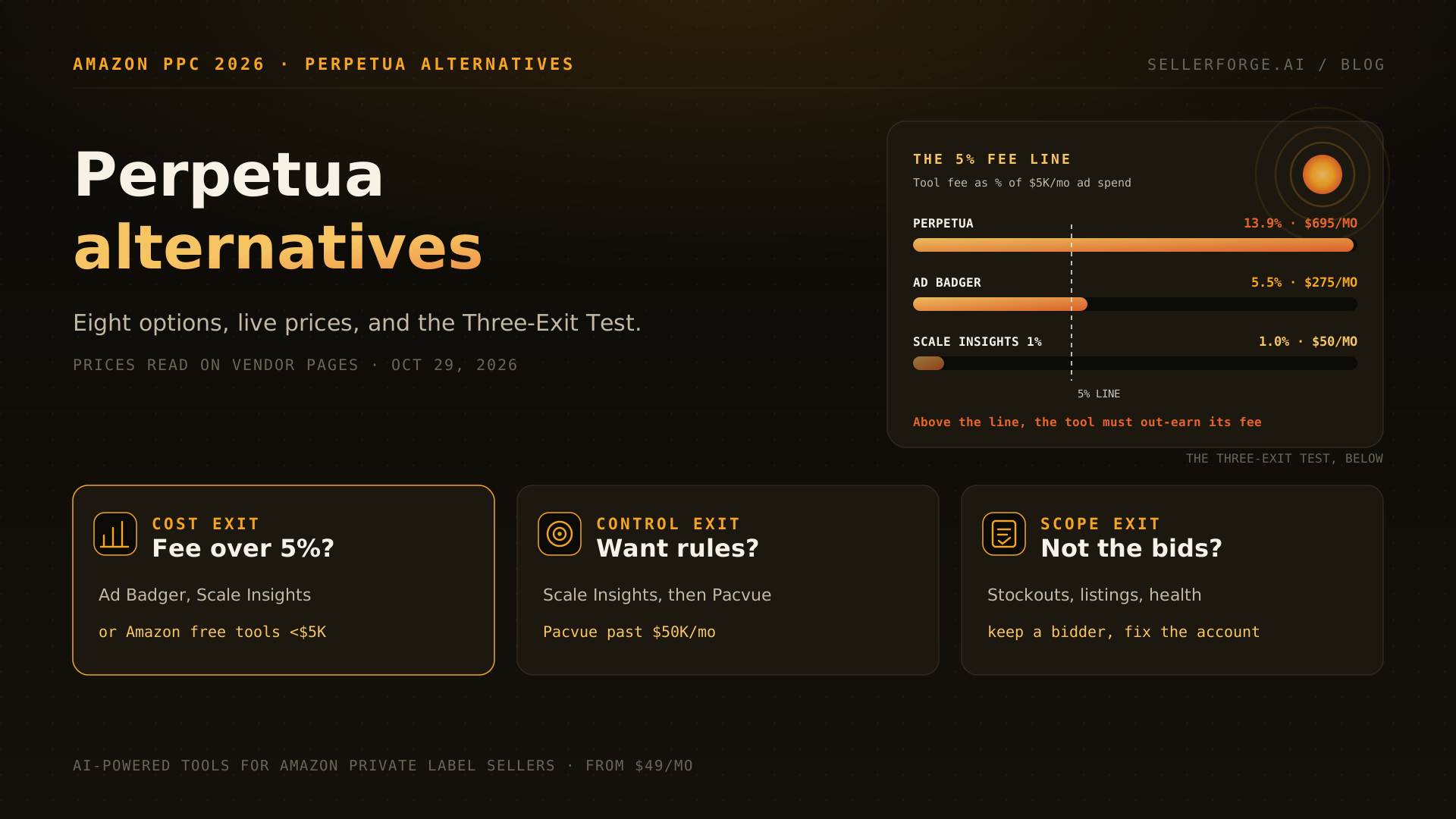
The 5% Fee Line: if your ad tool's fee is more than 5% of your monthly ad spend, the tool has to beat your current results by more than 5% just to break even. Below $10,000 a month in spend, that is a high bar for any algorithm, and it is why Perpetua's $695 floor drives most exits.
The Three-Exit Test: Which Alternative Fits Your Reason for Leaving
The Three-Exit Test matches your reason for leaving Perpetua to the alternative built to fix it. Answer three questions in order: is the fee above 5% of your ad spend, do you want to author rules instead of goals, and are your costly problems outside the ad console. The first yes decides the shortlist.
- 1Cost exit: divide your monthly Perpetua bill by your average monthly ad spend over the last 90 days. If the result is above 5%, shortlist Ad Badger (flat by band), Scale Insights (per ASIN or 1%) or, under $10K in spend, Teikametrics Essentials. Under $5K, run Amazon's free tools for a month first.
- 2Control exit: count the hours a week someone on your team spends inside campaign managers. Over five, you have an operator who wants rules. Shortlist Scale Insights for rule stacking with change previews, or Pacvue above $50K a month and across multiple retailers.
- 3Scope exit: list your three most expensive ad months of the last year and write down why each was expensive. If the causes were stockouts, suppressed listings, account health holds or returns, an ad tool will not fix them. Keep a bidder you like and add whole-account software around it.
- 4Before you cancel: run the replacement in parallel on one product line for 30 days. Scale Insights and Ad Badger both offer 30-day trials, which covers it.
When two exits apply, take the cost exit first. It is the one with a number attached, and the savings fund whatever else you add.
Perpetua Alternatives Reviewed One by One
Each alternative below is judged on what it does better than Perpetua, what it does worse, and who should pick it. Prices are from the vendor's pricing page on October 29, 2026, unless marked as an estimate.
Amazon Ads Agent: the free floor
Scale Insights: the cheapest control
Scale Insights is a rules engine priced per automated ASIN: $78 a month for 5, $178 for 20, $388 for 50, $688 for 100, or 1% of ad spend for unlimited ASINs. Yearly billing saves 20%. It lists 11 algorithm types and 200+ parameters, and it previews upcoming changes and shows each algorithm's calculation. It beats Perpetua on price and transparency. It loses on effort: you design the strategy.
Ad Badger: flat pricing by spend
Ad Badger charges a flat monthly fee by ad-spend band: $275 up to $5,000, $440 up to $25,000, $660 up to $75,000, $920 up to $250,000, $1,375 up to $750,000 and $1,830 up to $1.5 million, each with a 30-day free trial. Its Bids by Badger algorithm updates bids daily toward a target ACoS. The fee never turns into a percentage, which is the cleanest fix for a cost exit. It lacks Perpetua's hourly Marketing Stream optimization.
Teikametrics: AI that sees inventory
Teikametrics Essentials is $149 a month billed annually for up to $10,000 in monthly ad spend, with a free trial; its ARI system covers ads, catalog, inventory and insights. Advanced, over $10,000, is custom-priced plus 3% of ad spend over $10K and adds DSP, Walmart Onsite Display and Amazon Marketing Cloud. It beats Perpetua on price under $10K and on stock awareness.
Helium 10 Ads: for Diamond users only
Helium 10 Ads runs on Pacvue's engine and, since April 2026, is available only on Helium 10's Diamond plan, $279 a month billed yearly or $359 monthly, plus a 2% management fee on spend managed through it. If you already pay for Diamond for research, it is a strong value. If you do not want the suite, it is an expensive way to buy a bidder.
Intentwise: data first
Intentwise leads with a unified marketplace data layer, an analytics cloud and an AI gateway over MCP, with ad automation on top. It publishes no pricing; a RevenueGeeks review updated August 2026 reports tiers starting near $500 a month and a 14-day trial. It fits brands and agencies whose bottleneck is reporting across channels, not bidding alone.
Pacvue and Quartile: the enterprise exits
Pacvue is the rule-based enterprise platform across 90+ retailers, with Pacvue Agent for governed AI execution since April 14, 2026, on quotes estimated at a ~$500 minimum plus 3 to 5% of spend. Quartile is software plus a strategist across Amazon, Walmart, Google, Meta and more, estimated at $895 to $9,995 a month plus 2 to 5% of spend. Both make sense above roughly $50,000 and $20,000 a month respectively, and rarely below.
Where SellerForge Fits (and Where It Doesn't)
SellerForge, our product, is not a Perpetua replacement for bidding, and I would not move a high-spend account's bids to it. It is AI-native account intelligence from $49 a month that watches the parts of the business ads depend on: account health, listings, reimbursements and inventory. It pairs with any bidder on this page.
Where it does not fit: if your exit is cost or control, the answer is a bidder from the table above, not us. If your exit is scope, SellerForge is the honest answer, usually next to Scale Insights, Ad Badger or Teikametrics. The bidder works the auction; SellerForge watches the account the auction depends on.
How Do You Switch From Perpetua Without Losing Performance?
Switch from Perpetua in parallel, not in one cut. Export your harvested keywords and negatives first, start the replacement on one product line for 30 days, compare TACoS and spend on matched weeks, then move the rest. The main risk is losing the keyword and negative lists Perpetua built, not the bids themselves.
- 1Export before you cancel: download search-term reports for the last 60 to 90 days from the Amazon Ads console, plus every negative keyword and negative ASIN Perpetua added, since your campaigns keep them but your notes will not.
- 2Freeze the goals: write down each Perpetua goal and its current target so the new tool starts from the same intent.
- 3Run one product line in parallel for 30 days on the replacement's trial, leaving Perpetua on the rest.
- 4Compare on matched weeks: total sales, ad spend, TACoS and new-to-brand orders, not ACoS alone. Our guide to Amazon advertising metrics beyond ACoS explains why.
- 5Cancel Perpetua at the end of a billing period, after the replacement has run every product line for at least two weeks.
The Operator's Bottom Line
If I were spending $4,000 a month with Perpetua today, I would move to Scale Insights or Ad Badger, or try Amazon's free tools for a month, and save over $5,000 a year. At $25,000 with a small team that wants it handled, I would keep Perpetua if its Growth percentage came in low, and otherwise price Ad Badger and Teikametrics against it. Above $75,000 across several retailers, I would be talking to Pacvue. In every case I would keep an eye on the account around the ads, because that is where the expensive surprises came from.
About the author
David Gallo is the founder of SellerForge.ai. Before building SellerForge, he managed 57 Amazon seller accounts representing more than $350M in sales at Worldfront, where ad platform contracts were reviewed against what they actually earned each quarter. He writes about Amazon operations, advertising and account health from the operator's side.